

Next-Gen Satellites: The Critical Backup for National Security

Mitsubishi’s Next-Gen SUV Spotted Testing—Is the Pajero Making a Bold Comeback?

New Tariffs Set to Shake Up Car Prices This August

Tesla Adds Controversial Grok AI Chatbot to Cars Amid Backlash and Leadership Shakeup
Racing Through History: Valentino Balboni Pushes the Countach to Its Limits on Italian Roads

Lexus Tops List of Most Stolen Cars as Range Rover Thefts Drop Sharply
 Brand has five of the top eight cars most likely to be stolen
Five Lexus models were among the top 10 cars most likely to be stolen in 2024, according to government data – and the Range Rover, previously a high-profile target for car thieves, is now among the most protected.
Last year, more than 61,000 cars were stolen across the UK. The Ford Fiesta – the country’s most popular second-hand car, with 306,207 sales in 2024 – topped the table for overall number of thefts, at 4719.
However, new analysis of the latest DVLA data, which ranks stolen cars as a proportion of the total number registered, paints an alternative picture.
It reveals the Lexus ES 300 as the model most likely to be stolen in 2024, with one in 30 taken. It is followed by the Lexus RX 450 and Mercedes GLS, both one in 39.
The other Lexus models in a top 10 dominated by slightly older and relatively low-volume, higher-value cars are the LC 500 (fifth place, one in 55), the UX 250 (sixth, one in 62) and the NX 300 (eighth, one in 75).
Applying the same analysis to the Fiesta ranks the model in 312th place.
According to the analysis by PR agency Loop, Lexus is the second-most-likely brand to be stolen (one in 120) after Abarth (one in 116).
The Abarth most likely to be stolen is the 595, with a one-in-87 chance, ranking it ninth in the model table.
A spokesman for Toyota premium brand Lexus said: “Toyota GB has invested millions of pounds in a variety of security solutions. Our anti-theft measures form part of a nationwide customer care offering.
“For example, at a cost of more than £10 million to Lexus, selected customers were provided with a free Tracker vehicle location service. As a result, a 96% recovery rate has been achieved. We have subsequently rolled out Tracker installation as an option for buyers of certain models.”
Following similar incidents of theft, JLR updated security software for its new and existing vehicles last year. As a result, having previously been among the most stolen models, the Range Rover now ranks 52nd in the table of cars most likely to be stolen, behind other premium SUVs such as the Bentley Bentayga (36th) and Mercedes GLS (third).
“Lexus is making considerable efforts to protect its customers’ cars but JLR suffered a rise in thefts sooner than it and so has had more time to react and develop solutions,” said Clive Wain, head of police liaison at Tracker. “However, its cars are still being stolen. There is a thriving market overseas for Lexus, JLR and other premium vehicles and we recover many at docksides. Until this export market ends, recovering these vehicles will remain an ongoing programme for us.”
Commenting on Abarth and Fiesta thefts, Mark Silvester, a crime prevention specialist at West Midlands Police, said: “These cars are usually stolen to be broken for parts. Fortunately, we’re identifying more stolen cars and locating and closing down chop shops where they are dismantled.
“Among other countermeasures, we advise people to have their cars serviced at a garage or main dealer with access to the latest security software updates.”
Volkswagen Shuts Down Major Chinese Plant as Demand for Gas Cars Plummets
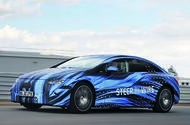
How Steer By Wire Is Revolutionizing Car Control and Design
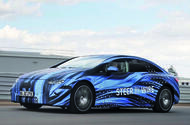 New steering technology is becoming increasingly prominent and is already in showrooms of various brands
Steer by wire is coming of age quickly and on its way to the showrooms of various brands.
Mercedes will be the first German manufacturer to introduce the technology with a ZF-developed system that does away with mechanical connections between the driver and road wheels, relying instead on sensors and electric actuators.
Nio is also fitting the ET9 with a ZF system, Lexus is launching steer-by-wire with the RZ next year and Bosch has three Chinese customers for its steerby-wire through its joint venture, Bosch Huaya Steering Systems, with production starting soon.
Steer-by wire was once an automotive forbidden fruit: legislation dictated that the connection between driver and wheels was mechanical.
UNECE Regulation 79 changed that in 2003, making steer-by-wire legal in Europe. Safety is taken care of in Mercedes’ system mainly by duplicated controls, so if one electronic link between driver and steering fails, the other will remain in place.
Redundancy applies to every step, including dual electronic signal paths, duplicated power supplies and hardware actuators.
Even if the whole lot fails, there are other ways of maintaining control. In the unlikely event of complete failure, some automated steering is still possible using rear-axle steering and by braking individual wheels using ESP.
The Mercedes’ steering feedback unit (SFU) sends an electronic signal representing the driver’s inputs to the steering rack unit (SRU), which does the steering.
There’s no mechanical connection, so there’s no steering torque, or feel. To create some, the tyre-to-road contact is calculated and fed back through the system. Steer-by-wire systems are not simple bolt-on pieces of kit, and each manufacturer will do a considerable amount of work calibrating it on a model-by-model basis.
Mercedes has already done more than 621,000 miles (one million kilometres) bench testing and the same again on proving grounds and in real-world traffic.
Nio says there are packaging and design benefits with freedom to set the steering wheel angle and the amount of feedback, and control is more precise.
A rectangular steering wheel is possible, for a better view of the instruments, and full lock can be achieved with only a 240deg movement of the wheel.
The ET9 system fi lters more than 80% of road vibrations back through the wheel from the road, and the steering column can telescope in and out by 153mm. Nio also says it opens up opportunities for a Game Mode – which is important in the Chinese market, particularly.
It also enables other technologies in the future, such as steering using a joystick rather than a wheel.
How to Choose a Motorcycle Helmet That Truly Protects You
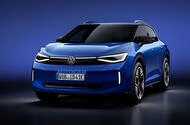
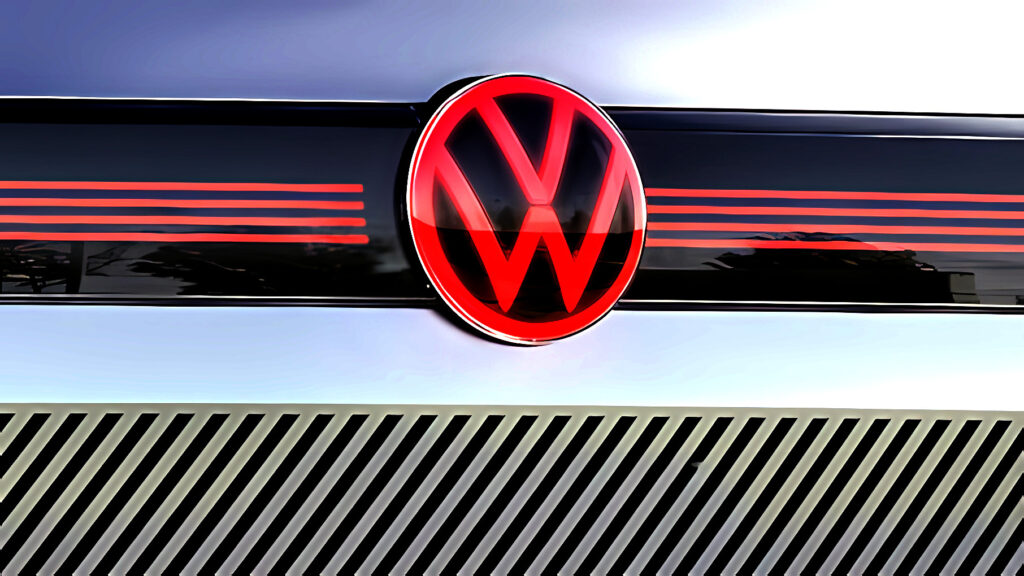
Volkswagen ID 4 Reinvented Inside and Out for 2026 With Bold New Design and...
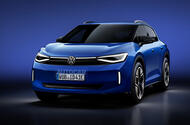
Autocar artist's impression shows what the reinvented ID 4 could look likeID 4 facelift, known internally as 'electric Tiguan', will bring reinvention inside and out
Volkswagen will overhaul the ID 4 SUV so comprehensively next year that it will be more like a new generation than a facelift, as part of a drive to sustain its strong sales figures and make it a more obvious electric equivalent to the Tiguan.
The ID 4, Volkswagen's second bespoke electric car after the closely related ID 3 hatchback, is approaching its fifth birthday, having launched in 2020 as a crucial component of the firm's drive to become a global leader in EV sales.
It quickly became one of the world's most popular EVs, and remains an important part of Volkswagen's electric portfolio: currently it is Europe's fourth best-selling electric car, between the ID 7 and ID 3, according to figures from Jato Dynamics.
And now, at five years old, the Toyota bZ4X and Tesla Model Y rival is due an extensive round of design and technical updates to bring it into line with its newer stablemates.
Volkswagen CEO Thomas Schäfer said the new 2026 ID 4 is "really beautiful" and hinted at just how extensively it has been overhauled: "We'll re-do the ID 4 completely inside and out. It will be a completely different car - a huge step up."
A major priority for the design overhaul is to ensure the ID 4 is visually related to the upcoming ID 1 city car and ID 2 superminis. "We felt it needed to fit in with the new design language going forward, since it is still our most important electric vehicle in numbers," said Schäfer.
“It's also to stay competitive for a while: let's [bring] a completely new one.”
Autocar understands the new ID 4 is known internally as the 'electric Tiguan', hinting at a push to present the two similarly sized SUV models more overtly as siblings.
The company has not confirmed plans to go as far as changing the ID 4’s name, but Schäfer previously suggested to Autocar that the Tiguan moniker would always have a place in Volkswagen’s portfolio - even as the line-up goes all-electric: “We've decided we're not going to throw away the traditional, successful names that have carried us for so long, that we've invested in for so long, like Golf and Tiguan. Why would you let them go?”
An electric Tiguan equivalent has long been understood to be part of Volkswagen's product roadmap, the combustion-powered car being Volkswagen's most popular car globally, and was earmarked for a launch in 2025 or 2026 - which would coincide with the planned rollout for the upgraded ID 4.
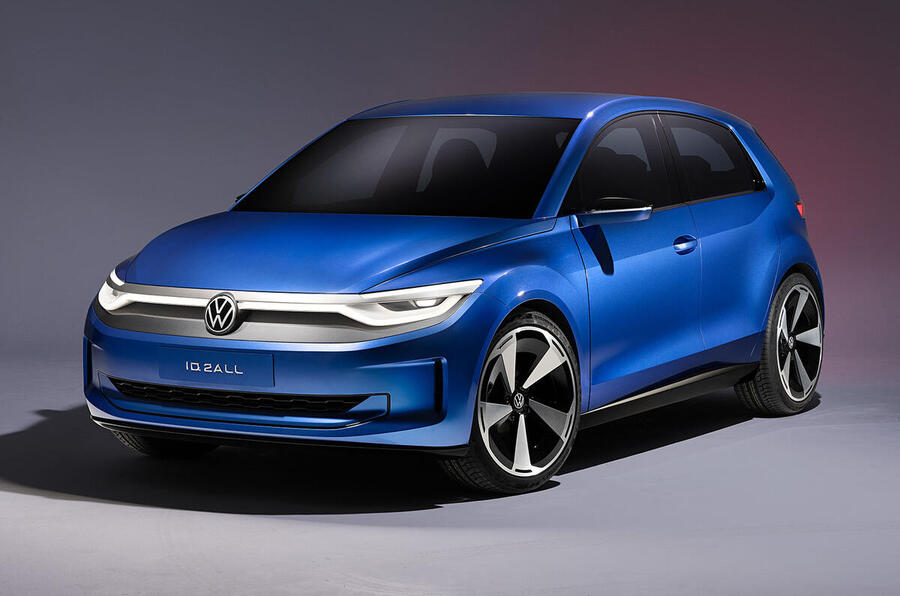
Speaking to Autocar, Volkswagen technical development boss Kai Grünitz recently confirmed that the ID 4 will follow the ID 3 hatchback in adopting the new design language first introduced on the 2023 ID 2all concept, giving them “a family resemblance to the ID 2” as well as a “lower and squatter stance”.
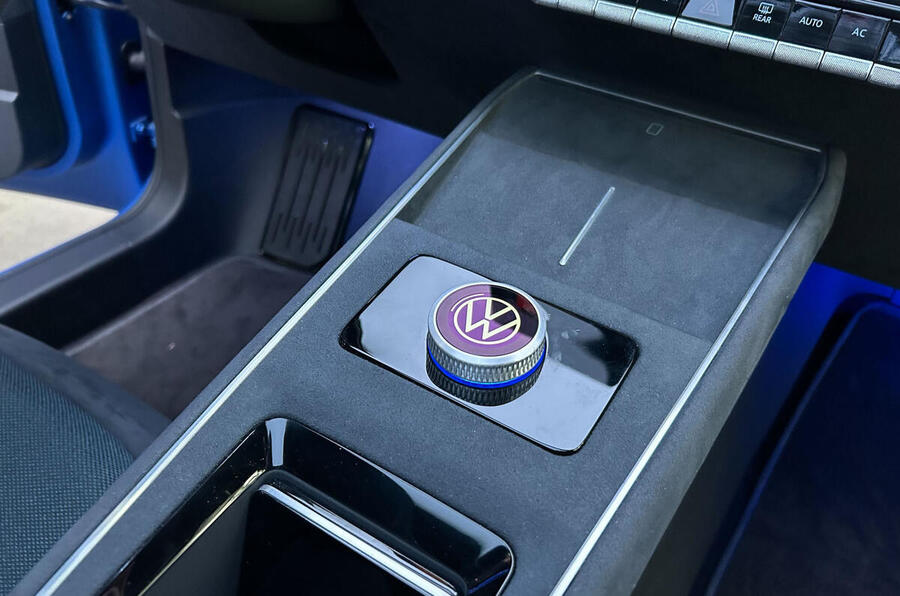
Inside, Grünitz confirmed that the facelifted ID 3 and ID 4 will receive fully revised interiors featuring a new dashboard and user interface. Among the changes is a return of physical buttons and knobs in place of digital display-based functions and the controversial slider element, a move first hinted at by the ID 2All.
“We’re going to bring back a round knob for the volume control,” an insider said, adding: “If you develop something that works, and it has worked for years, there’s no reason to replace it.”
Technical details of the facelifted ID 3 and ID 4 have yet to be revealed, though Autocar has been told Volkswagen’s best-selling electric models will benefit from the efficiency and performance gains brought to other more recently launched models, including the ID 7, through newer and more technically advanced electric motors and more contemporary battery and inverter technology.
The facelifted ID 3 is scheduled to be revealed during the second quarter of next year, with the ID 4 arriving later in 2026.
The ID 4's rakish-roofed ID 5 sibling is understood to be earmarked for retirement, rather than undergoing the same round of updates. Volkswagen does not break out individual model performance in its annual reports, but the ID 5 is not currently in Europe's top 25 EVs, and has sold around a third the number of ID 4s in the UK since the duo launched.
The updates are part of a broader effort to reset Volkswagen’s image as a maker of EVs after early criticism of quality, software and user experience in its first-generation MEB-based models.
Alongside the arrival of three new MEB Entry-based EVs next year – the VW ID 2, Cupra Raval and Skoda Epiq – the goal is to extend the lifespan of the current 400V models to keep VW at the top of Europe’s EV sales charts, insiders say, while the firm readies its next-generation 800V SSP platform, which is due to underpin VW EVs from 2028.
Volkswagen also intends to differentiate its EV designs by region, with European and US models sharing a common design theme while Chinese-market cars receive their own styling direction. This strategy was hinted at by the unveiling of the ID Aura, Era and Evo at the Shanghai motor show in April.
Before the arrival of the heavily updated ID 3 and ID 4, Volkswagen will use the Munich motor show in September to preview its next electric model: the ID 2X. A crossover sibling of the ID 2, it is due to arrive in 2027 as a rival to the Jeep Avenger and Peugeot e-2008.