BMW M3 Identity Reimagined: How a 10-Foot-Wide VW Lamando Became China’s Most Audacious Automotive...

Mercedes C-Class Electric Challenges BMW i3 With Refined Comfort and Design Ambition
 The BMW i3 edges the C-Class on the spec sheet, but an early ride shows there's more to consider
When the Mercedes C-Class and BMW i3 EVs were unveiled earlier this year, it felt a little like Stuttgart had been beaten to the electric executive punch – and not just because the 3 Series came first.
The i3 has the C-Class Electric licked when it came to the key statistics: official range, charging speeds and pricing (£53k versus £58k).
BMW's saloon rides on the same Gen6 architecture that has won its iX3 SUV sibling such widespread dynamic acclaim. The C-Class’s MLA platform has already proven softer and slightly less exciting – but still excellent in its own right – in the technically identical GLC Electric.
But after a brief ride in the C-Class ahead of our first drive in the coming weeks, there’s plenty here to get excited about. After a faltering start with the competent but unremarkable EQE and then redemption with the CLA, currently our favourite saloon, it seems Mercedes has finally cracked the mainstream electric exec.
The first thing of note is that this feels a larger car than previous C-Classes. It's longer, wider and taller – the last of which owing to it being based on a skateboard platform, with the body effectively sitting as a hat atop the battery and chassis.
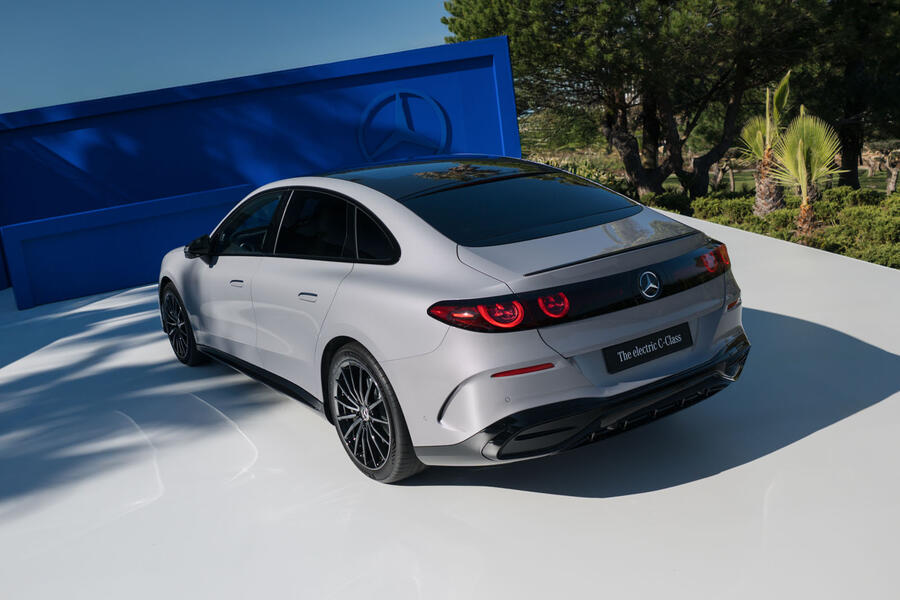
While the glass roof and black detailing around the rear end help to take away a bit of the visual heft, it’s a little slab-sided. And there’s still a hint of the EQE’s egginess about the front end, I reckon, despite the brand's push to make its EVs less amorphous.
Some of the details are questionable, too: the overwhelming number of three-pointed stars – particularly those lights – feel like peacocking and slightly too glitzy in an era where other brands are favouring a more restrained approach to exterior decoration.
Still, it’s identifiable as a C-Class and looks vastly more futuristic than the ubiquitous petrol or diesel-fired car.
Inside the electric C-Class
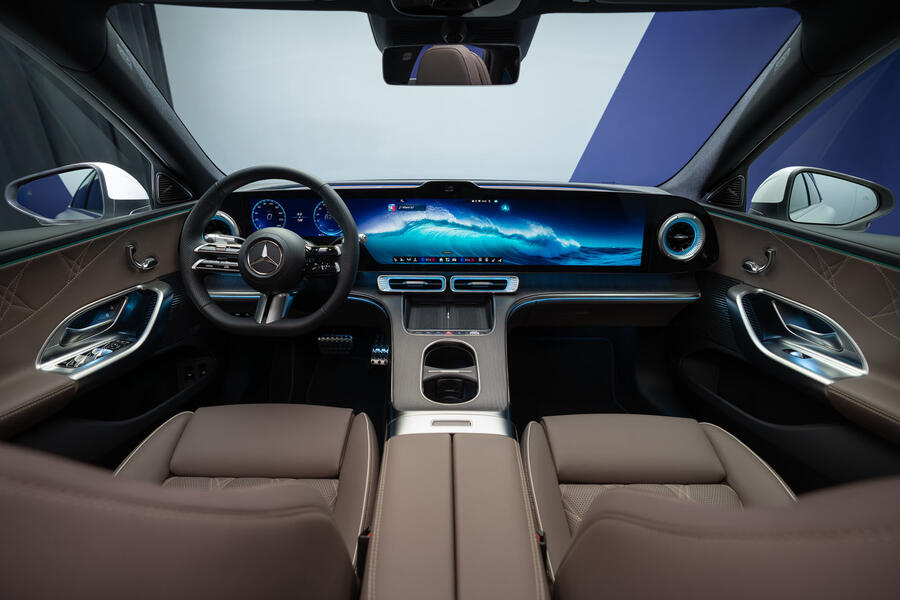
In a practical sense, there’s much to enjoy: a good amount of interior space; a wide and deep boot that still has a small saloon opening, despite the sloped roofline; and a compartment under the bonnet big enough for a carry-on suitcase or a couple of overnight bags.
Slide in and it’s easy to find a comfortable position in both rows, with nicely squishy bolsters and quality-feeling leather upholstery solidifying the C-Class’s long-distance credentials.
There’s an overarching sense of quality that feels reassuringly Mercedes. I’m a particular fan of the grained tan leather, and it wins bonus points for the cushioning along the doorcards and windowsills – a nice touch.
There’s a lounge-like feel here, and homely elements such as optional wood around the centre console are a welcome departure from the cold, minimalist arrangements of some rivals.
Fit and finish too seem an improvement compared with the cheaper CLA, as I suppose they should, but it might even outdo the vastly more expensive EQS.
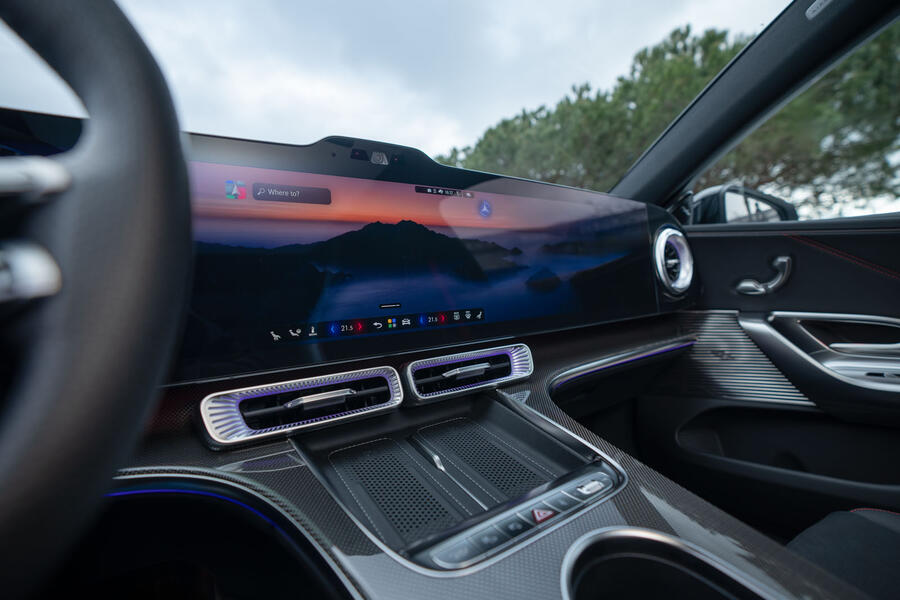
The elephant in the room is the absolutely massive screen in front of me. Running across the entire width of the dashboard, it’s actually the largest you will find in any production car at present, measuring 39.1in.
I’m surprised to find I don’t mind it. There’s a sense of theatre about its sheer scale and the graphics are quite pleasant if you aren't having to pay attention to the road.
However, I do wonder if I’d prefer proper climate control buttons if I were driving, rather than having to prod the screen. And some of its features, such as the camera view that pops up in the centre when you stop at a traffic light, might prove a little overwhelming.
Final judgement will have to wait until we’ve driven it.
On the road
We move off with little fanfare. It's surprisingly relaxed for a car with 483bhp – in this launch C400 specification – that can be as quick off the mark as an old V8-powered AMG C63 if you want it to be.
There’s a real sense of luxury about the way the C-Class EV flows down the road, with a relaxed, long-legged gait. You get an occasional nudge from a drain cover or a pitter-patter from the road surface underfoot, but both are very well isolated and ebb away at higher speeds.
The drive modes make a noticeable difference here: Comfort is, naturally, plush, yet not too wallowy either. Sport feels noticeably firmer and more alert to my driver's steering inputs, with a fair bit more head-toss even in regular driving. I'm sure I can sense greater involvement from the rear-wheel steering as we negotiate roundabouts.
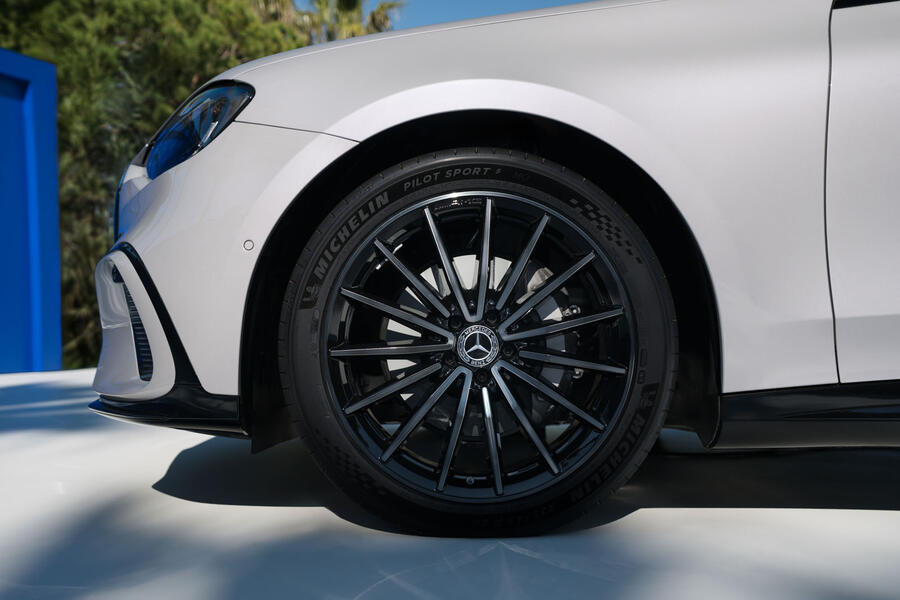
I'm relieved once the thrill ride is over and we're back in Comfort mode; to change from football boots back into house slippers.
Escape the cut-and-thrust of town and refinement becomes perhaps the most impressive attribute of all. Tyre roar is almost inaudible when pootling around and, as we reach the German equivalent of an A-road, I’m still able to talk to my driver without raising my voice.
First impression
It remains to be seen how the C-Class feels from the most important seat in the house. But from the passenger side, all signs suggest the result of the BMW-Merc showdown – coming to Autocar as soon as we’re able – is not a foregone conclusion.
One of the oldest rivalries in the book is raging just as strongly as ever, and the cars are quite possibly better than ever before.

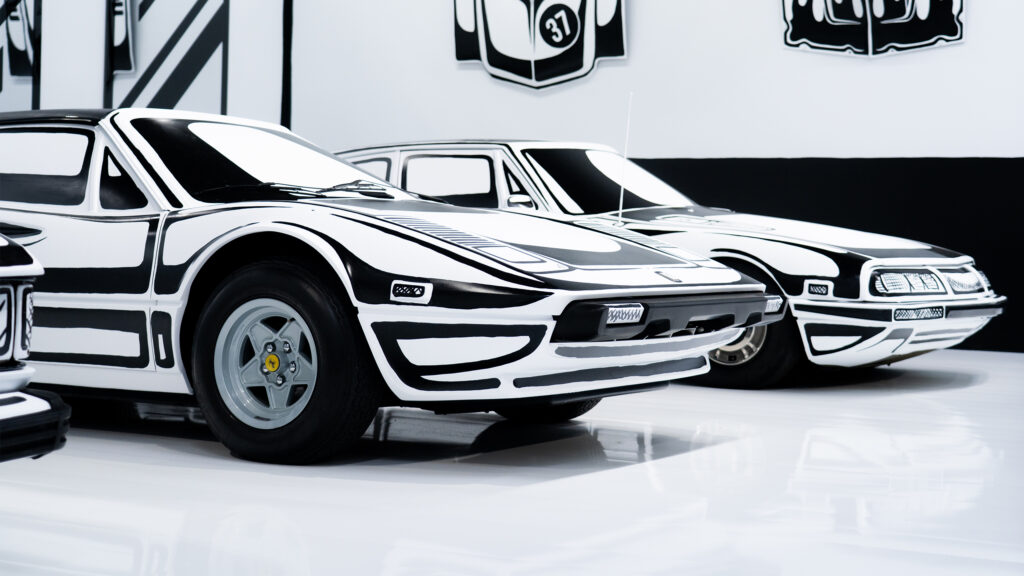
Joshua Vides Transforms Classic Cars into Comic Book Art at Petersen Automotive Museum

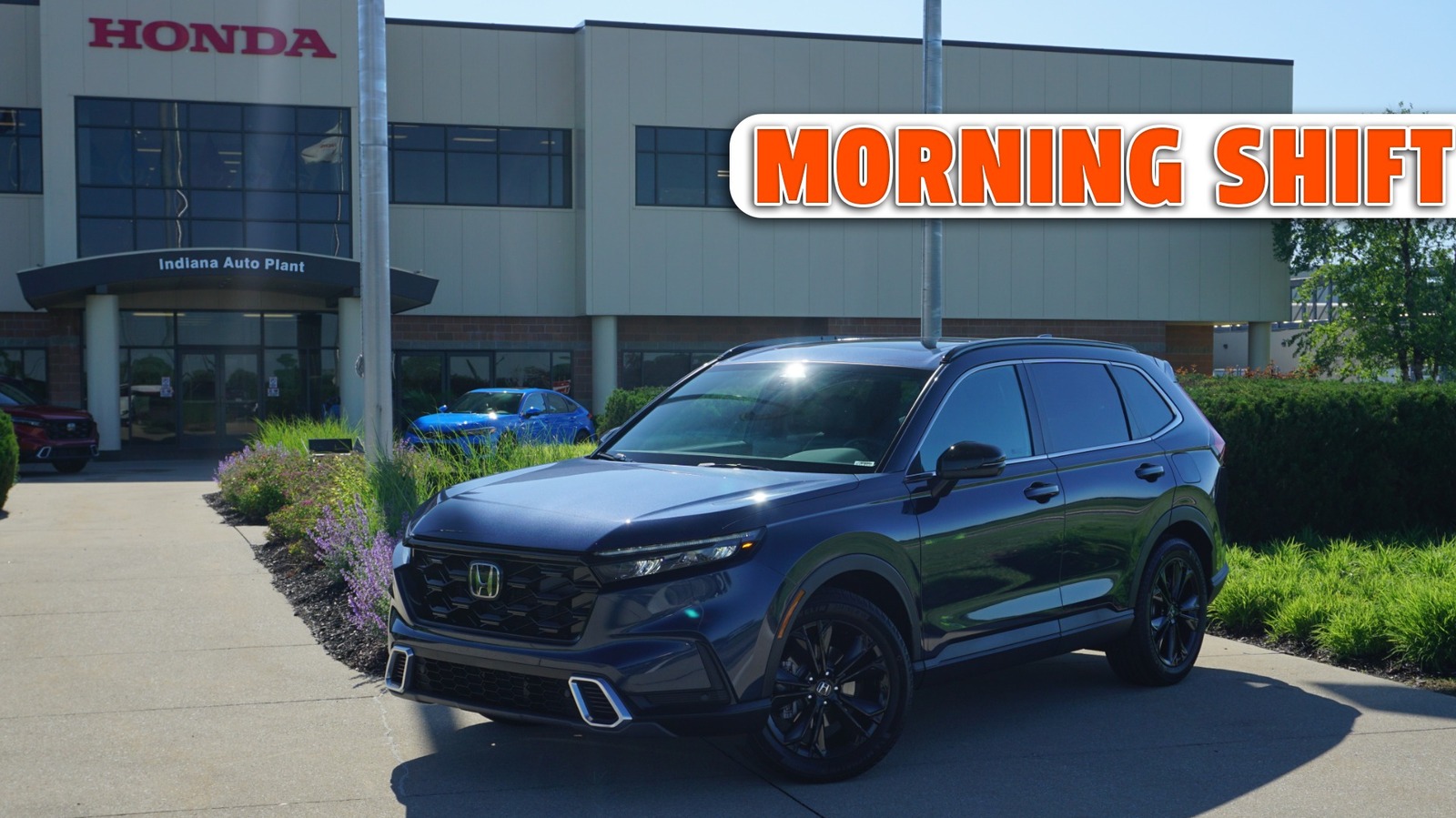
Honda CR-V Poised to Overtake Rivals as 2026 Sales Leader Amid Shifting Industry Strategies

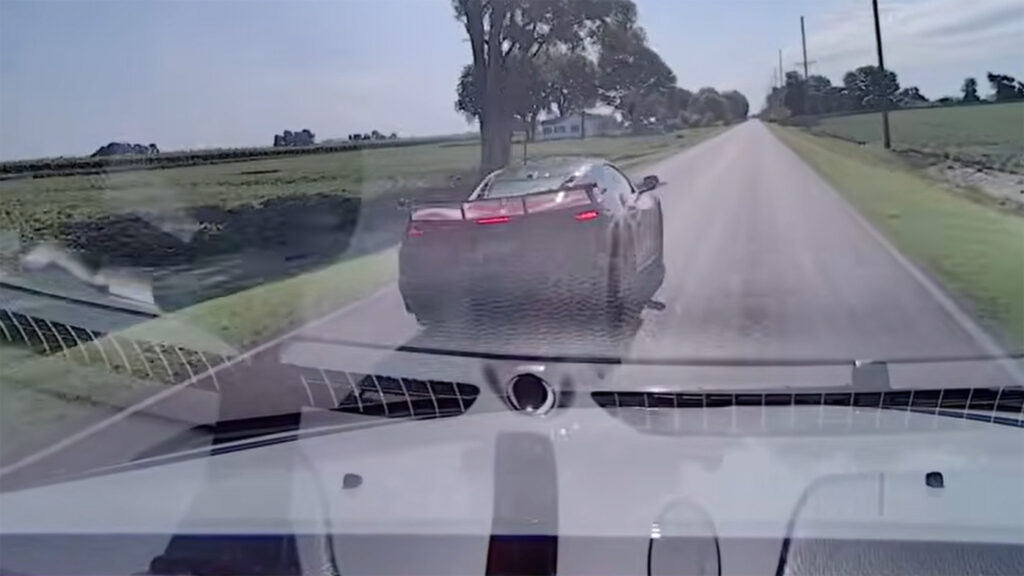
Corvette Pursuit Highlights High-Speed Evasion, Cross-State Policing, and the Limits of Deterrence

Saab 99 GL Value Tested After Four Decades of Single Ownership


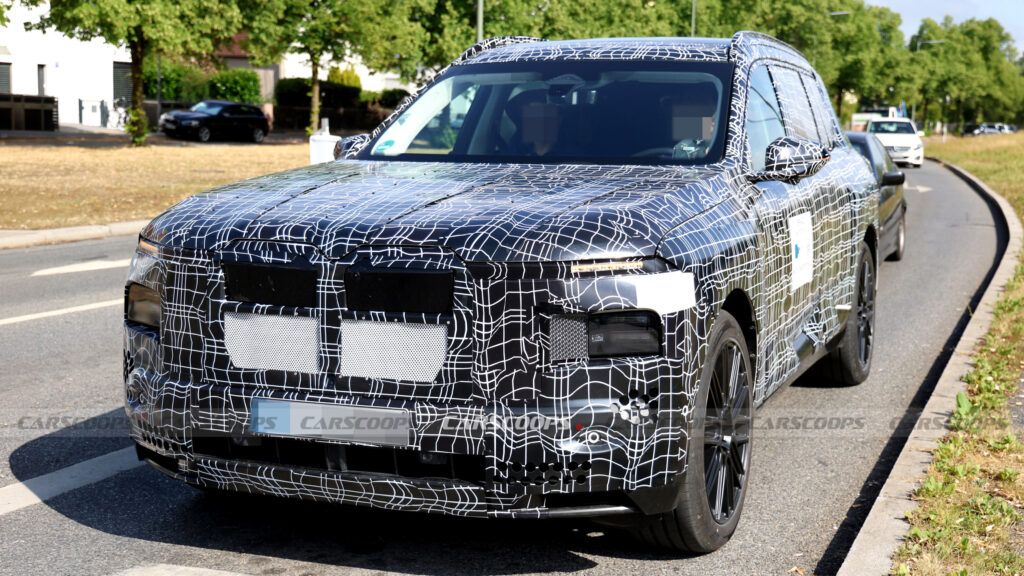
BMW iX7 Redefines Flagship SUV with i7-Inspired Design and Expansive Electric Power

Renault Scenic E-Tech Redefines the Family EV with Range, Comfort, and Practical Innovation
 From a boot that swallows everything to a rear armrest that holds your kid’s tablet, here’s why Renault Scenic E-Tech electric might just be the ultimate family car
Finding a family car that ticks every box is harder than it looks. It needs to be genuinely spacious without feeling like a bus. It needs to be clever, calm and comfortable enough for long journeys, but engaging enough to remind you why you enjoy driving. It needs the kind of safety technology that lets you breathe a little easier, and the sort of running costs that don’t make the monthly budget groan.
Renault Scenic E-Tech electric makes a compelling case for being all of those things. It boasts a maximum five-star rating from What Car?’s test team, and was named What Car?’s Best Electric Family SUV at the 2024 Electric Car Awards, and it’s not hard to see why. Underpinned by an 87kWh battery with a WLTP range of up to 381 miles[1], packed with family-friendly features and priced to undercut many of its closest rivals, Scenic has been built with real family life in mind rather than just a set of brochure photos.
Here are six reasons Scenic is the best family EV you can buy right now.
Learn more about the Renault Scenic
#1 A boot and cabin that take family life in their stride
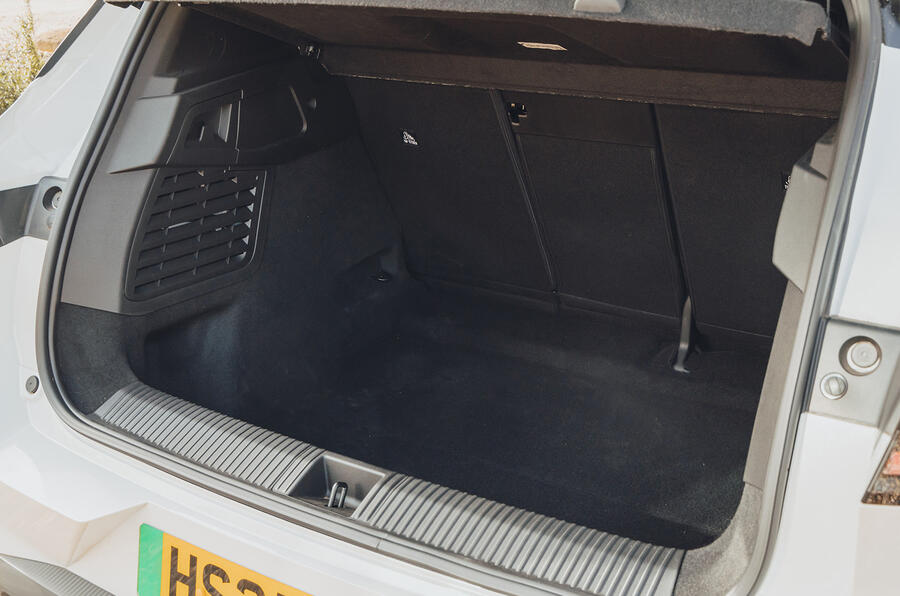
The first question any parent asks about a car is simple: does it have enough space? Scenic’s answer is a confident yes. The boot offers 545 litres with all seats in use – enough for up to seven carry-on suitcases below the parcel shelf, with room to spare for a soft bag on top. Fold the rear seats using their 40/20/40 split and that figure grows all the way to 1,670 litres: small van territory, that’s incredibly useful when you’re loading for a week’s holiday or collecting flat-pack furniture. A height-adjustable boot floor means you can also tuck your charging cables out of sight, so they don’t eat into your luggage space.
Inside, the clever thinking continues. There are more than 38 litres of storage space distributed around the cabin, from the deep centre-console cubby to door bins that easily swallow a large water bottle. Rear passengers benefit from a foldable centre armrest with two USB-C ports and a pair of device-holding arms that swing out – ideal for keeping tablets propped up during longer journeys. As What Car?’s New Cars Editor Lawrence Cheung noted after testing Scenic: “There’s plenty of room for all 5ft 11in of me in the Scenic’s back seats, and I appreciate the seat base being longer and more supportive.”
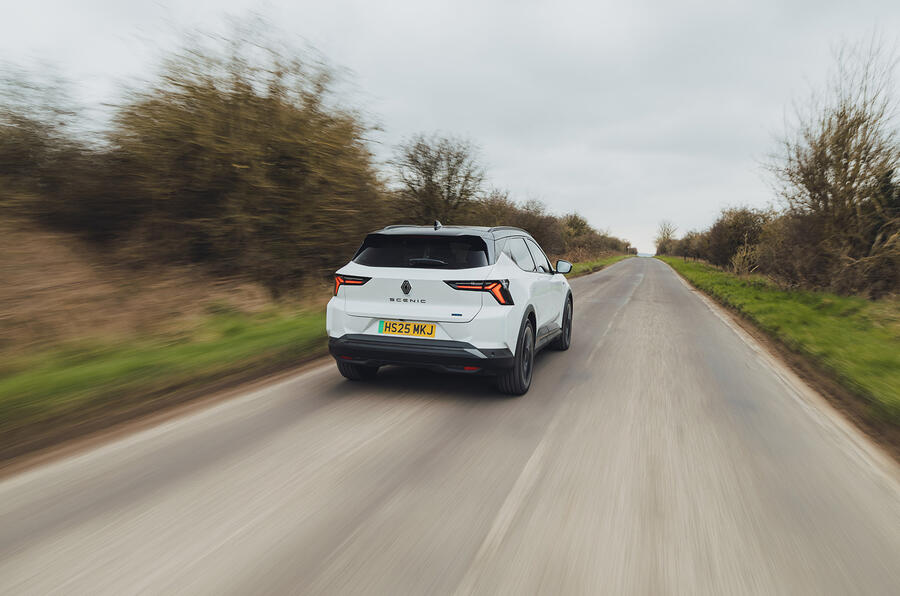
#2 A range that kills road-trip anxiety stone dead
The biggest barrier most families still cite when considering an EV is range, and Scenic addresses it head-on. Its 87kWh battery delivers a WLTP-certified range of up to 381 miles in entry-level Techno trim – a figure that beats the Hyundai Ioniq 5, the Kia EV6 and the Skoda Elroq outright.
What that means in practice is that Scenic can handle the vast majority of family trips – school runs, supermarket dashes, weekend escapes to the coast – without a second thought about charging. For longer journeys, rapid DC charging at up to 150kW means a 15-80% top-up takes around 37 minutes[2]. Plan that around a motorway services lunch stop and the car should be ready to get back on the road before you are.
Scenic also comes with a heat pump as standard. That means the range figures remain far more consistent in cold conditions than in EVs that lack one – a genuinely important real-world advantage for a family car that’ll be used year-round in Britain, with its up and down temperatures. And, you can schedule charging automatically to run during cheaper off-peak tariff windows, keeping the energy bills in check.
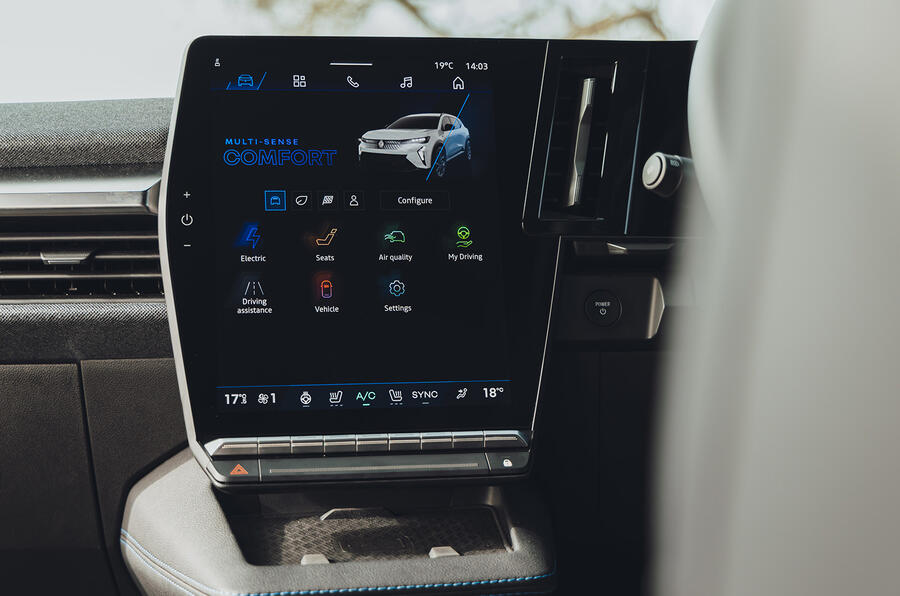
#3 Tech that makes every journey smoother
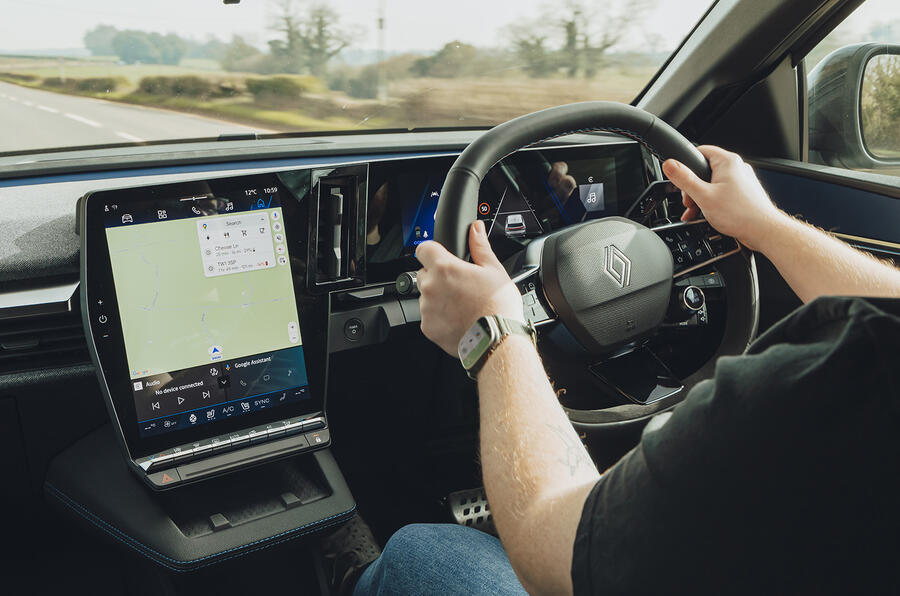
Scenic’s openR link multimedia system with Google built-in[3] is one of the best infotainment setups available. Two 12-inch screens dominate the fascia, but because Google Maps, Google Assistant and Google Play are integrated directly into the car’s own software – rather than simply mirrored from your phone – the whole system is faster, more joined-up and genuinely more useful on the road.
Renault’s version of Google Maps means that if you enter a destination beyond your current range, the system will automatically plan a charging stop, factor in real-time traffic and even precondition the battery before you arrive at a rapid charger. For families setting off on long trips, the ability to simply say “Hey Google, navigate home” and have the system handle everything – routing, charging stops, live traffic – is transformative. So integrated is the Google Built-in system that you can even control functions such as the air conditioning, heated seats, or solarbay roof with a simple voice command.
There are over 50 apps available through Google Play, including Spotify, Amazon Music and, particularly usefully for families with children, the Vivaldi browser – which lets passengers access YouTube, Netflix or Disney+ through the car’s own screen while you’re charging. Physical controls for the air-conditioning fan speed and temperature sit below the screens, making adjustments on the move simple and intuitive. Google Maps and Google Assistant connected services are provided free of charge for five years from delivery.
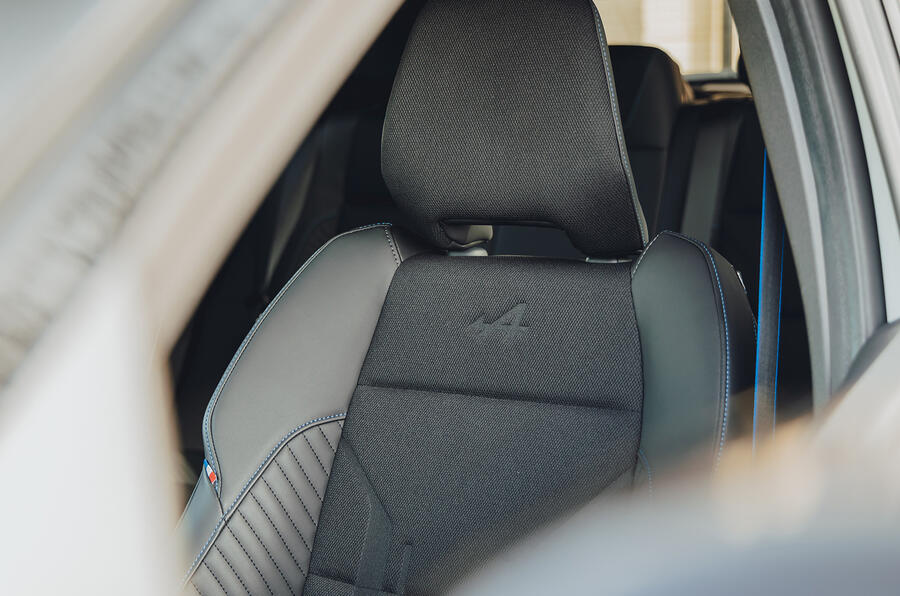
#4 Comfort and calm from the first mile to the last
Long family journeys have a way of revealing a car’s true character, and Renault Scenic’s is a good one. Its suspension has been tuned with comfort in mind, and it shows: it absorbs road imperfections smoothly and stays composed on longer motorway stretches. As Lawrence Cheung noted in the What Car? review, “it’s almost refreshing to get into a car like Scenic that’s not trying to be sporty at all – it’s clearly aimed at being comfortable.” Scenic is also noticeably quieter on the motorway than rivals such as the Kia EV6 and Tesla Model Y, with low levels of tyre and wind noise helping to keep the cabin calm on longer journeys.
The solarbay panoramic sunroof – available on iconic esprit Alpine trim – is one of Scenic’s standout family features. Spanning 1.65 square metres, it can switch between clear and opaque at the touch of a button (or a voice command to Google Assistant), and crucially it can be tinted in sections. That means you can keep the back of the car shaded for children while letting sunlight into the front, all without anyone needing to fiddle with a manual blind.
The front seats are ergonomically designed and come with heated settings for driver and front passenger. And, a driver recognition system on higher trims uses a camera to detect who is driving and then automatically recalls your preferred seat and mirror position every time you get in. Small things, but after a long day, they matter.
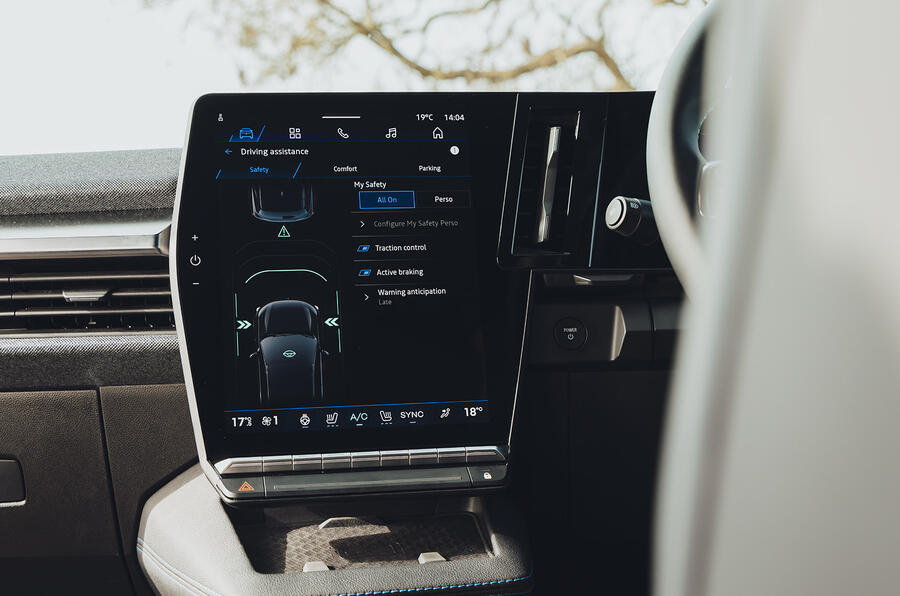
#5 Safety technology that looks out for the whole family
Renault Scenic E-Tech electric carries a five-star Euro NCAP safety rating, and the list of driver-assistance systems backing that up is seriously impressive. Depending on trim level, Scenic offers up to 30 advanced driver-assistance systems[4] as part of Renault’s Human First safety programme – a figure that puts it among the most comprehensively equipped family SUVs on the market. There’s also two ISOFIX points in the rear as standard.
Active driver assist keeps Scenic in lane, maintains safe following distances and regulates your speed according to the road environment – stopping and restarting automatically in slow-moving traffic. For long motorway journeys with tired children in the back, that kind of hands-on support makes a real difference to driver fatigue. Occupant safe exit alert warns you if a vehicle is approaching from behind when you’re about to open a door – particularly valuable when children are clambering out on a busy road. Rear cross-traffic alert and automatic emergency braking for cars, pedestrians and cyclists are also included.
The top-spec iconic esprit Alpine trim adds hands-free parking, a 360-degree around-view camera and a smart rear-view mirror that uses a camera feed to give you an unobstructed view even when the boot is full or the back seats are occupied.
#6 An eco-conscious car built for families who care
For families thinking about their environmental footprint, Renault Scenic E-Tech electric makes a strong case beyond simply running on electricity. It is 89% recyclable by mass[5], and the interior reflects a genuine commitment to sustainable materials: all the upholstery textiles across every trim level are made from 100% recycled material[6] – on the Techno, that means the front seat and headrest fabric is made from recycled PET bottles.
Scenic is the first 100% electric Renault family SUV to be built in France, which keeps its production footprint closer to home for UK buyers. Together, these sustainable approaches mean Scenic is eligible for the full Electric Car Grant.
For families who want to make a positive choice without compromising on space, comfort or technology, Scenic offers something genuinely rare: an EV that feels like it was designed for family life from the ground up, not retrofitted around a battery pack. The result is a car that’s as easy to live with on a Tuesday morning school run as it is on a Saturday afternoon heading to the beach.
Learn more about the Renault Scenic
[1] Model shown is Scenic iconic long range with up to 369 miles. 379 miles based on Scenic techno long range. WLTP figures shown are for comparability purposes only. Actual real-world driving results may vary depending on factors including the starting charge of the battery, accessories fitted after registration, weather conditions, driving styles and vehicle load.
[2] Indicated rapid charging time requires use of a 150kW charger, available only on public charger network - visit MyRenault for coverage details. Charging time may vary depending on charging conditions, including charger type and condition, on-site power usage, battery temperature as well as ambient temperature at point of use, battery age and state of charge, and if battery safeguarding technology is activated.
[3] Google, Google Maps and Google Play are trademarks of Google LLC
[4] It is your responsibility to stay alert, drive safely and be in control of the vehicle at all times. Driver assistance features have speed and other limitations and should not be solely relied on.
[5] Vehicle Family Type homologated in accordance with European directive 2005/64/CE (type-approval of motor vehicles with regard to ensuring that at the end of a vehicle’s life, its component parts and materials can either be reused or recycled or recovered) and as certified by UTAC and certified 89.72% recyclable by CNRV.
[6] 100% on techno. Front of seat and headrest fabric made from recycled PET bottles, excludes back of seat, headrest and armrest.

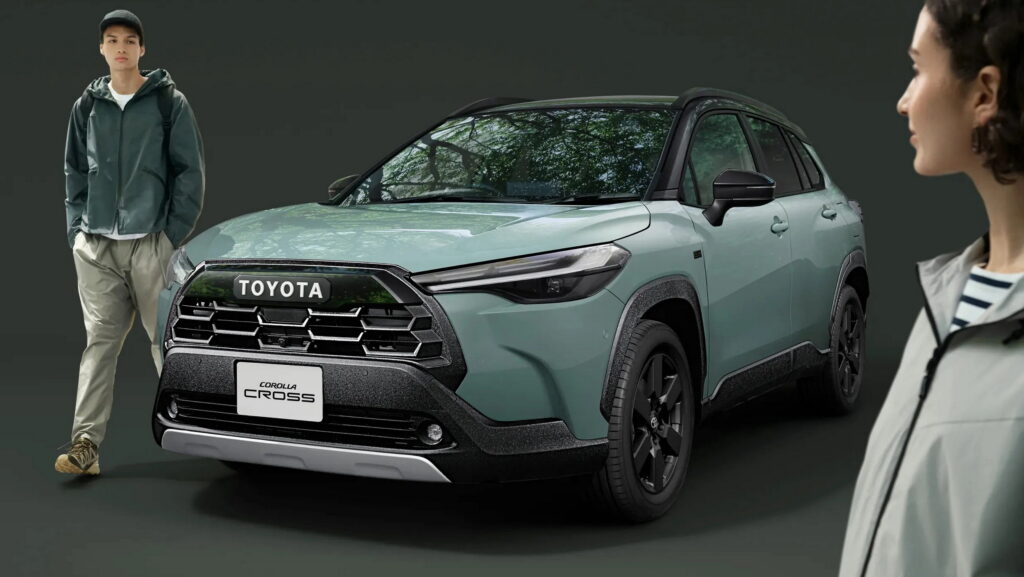
Corolla Cross Z Adventure Marks 60 Years with Rugged Styling and Enhanced Safety for...

Land Rover’s Relentless Pursuit of Off-Road Excellence Despite Urban Demand