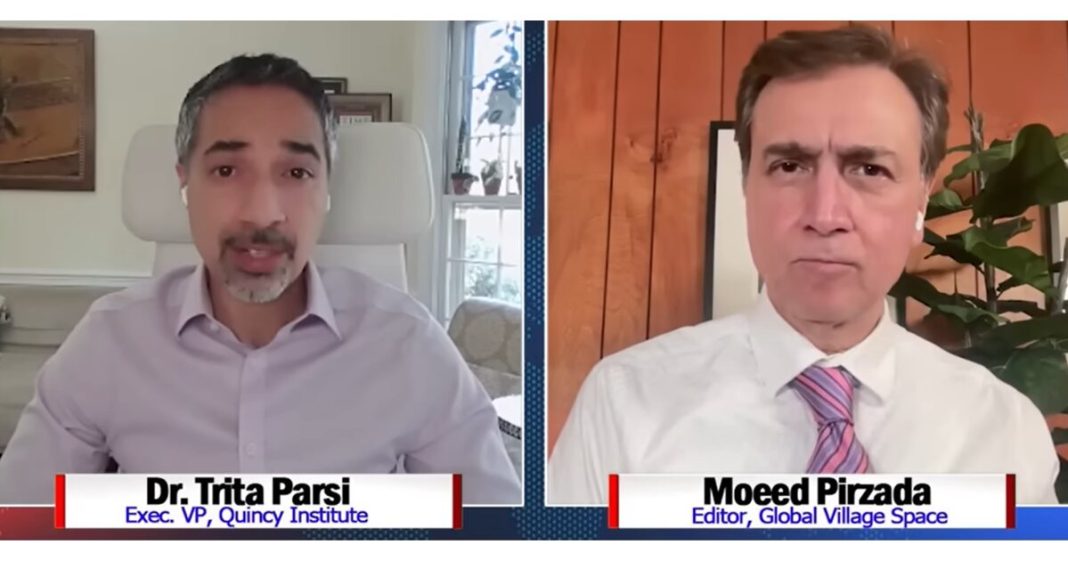
Dr. Trita Parsi is a leading authority on US-Iran relations and the author of Treacherous Alliance, A Single Roll of the Dice, and Losing an Enemy, offering deep insight into decades of diplomacy and conflict between Washington and Tehran.
Dr. Moeed Pirzada, editor of Global Village Space, sat down with Dr. Trita Parsi to discuss the current US-Iran tensions, the prospects of a peace deal, and the political pressures within Washington along with Israel’s role in shaping and influencing these negotiations through a broader historical lens.
Title:Trump in Big Trouble- Why Ending War with Iran is Harder than Starting it? Peace vs War Lobbies
Date: 18 Apr 2026
Dr Moeed Pirzada: Assalamu alaikum and a warm welcome to all of you. Today I have the privilege of inviting Dr. Trita Parsi to this discussion. Dr. Parsi is the co-founder and executive vice president of Quincy Institute in Washington DC. Anyone who has been watching the US Iran war for the past 50 plus days or has been studying the conflict between United States and Iran for the 20 plus years knows his thing that Dr. Trita Parsi is the foremost scholar and expert on the subject.
He has written, spoken, and advised extensively on all issues of this conflict. And I come straight to the point Dr. Parsi in the past 24 to 36 hours we have seen two contradictory statements from Washington.
One from the president United States who says that he may go to Pakistan to sign a peace accord with Iran and the second from the secretary war who stands next to the chairman joint chiefs and says that United States is ready to strike it Iran at moment’s notice. What do we make of it?
Dr. Trita Parsi: This is not contradictory within the logic of how the US pursues negotiations. It always has a very present military threat, very prominent, thinking that that is what will make the other side move. Often it is not. Sometimes, of course, it is needed. But I think the potency of American military threats within the context of diplomacy has been defeated by Trump himself through this attempt at a war to uh force Iran to surrender. and instead, we are seeing that Iran scored a strategic victory.
Now, nevertheless, as a superpower, the United States always will be more inclined than other countries to point to these types of a hard threats as a key reason as to why its negotiations may be succeeding. Most states tend to do this at times, but the superpower is more addicted to that than other states are. So, I don’t think it is a surprise, but when you scratch the surface and see what has happened, you see that there are concessions coming from both sides to bring an end to this conflict, which is exactly what always happens even when a superpower signs peace.
Dr. Pirzada: Dr. Parsi no one may understand this pulse of this issue better than you. Is there any appetite left in president his team or the Washington politics for another military escalation at this point after 50 days?
Dr. Parsi: Not at all. This is part of the reason I think that some of these military escalations and signals are a bit um how should we say it a little bit beyond unconvincing because the idea that Trump having now experienced what war actually looked like being on the verge of seeing his entire presidency destroyed by this war would be so foolish to go back into this war now when he finally has achieved his key objective which is to get into a ceasefire. I find it unlikely. You cannot rule it out because Trump is unpredictable because the pressure from Israel is immense. But I think um it would be extremely foolish and quite shocking if he went in that direction.
Dr. Pirzada: Dr. Parsi, you mentioned pressure from Israel. I was wondering about the same. If president de-sanctions Iran, as Iran naturally expects and we are also hearing about it, then from Israeli point of view Iran suddenly emerges with normal trading and economic relationship with the West and with the world and from an Israeli perspective, it will emerge stronger and victorious after 50 years of conflict. Do you think that the powerful Israeli lobby entrenched within the United States Congress, the beltway politics and the media will let that happen?
Dr. Parsi: Well, first, you are right. The Israelis are the primary opponents of lifting these sanctions. And from the Israeli standpoint, what they want is to see Iran’s prolonged weakening. You can achieve that through war, which would take care of it if it went well in a shorter period or you can have this constant degrading of a country through decades of sanctions. For the Israeli standpoint, it is bad enough that Trump has ended the war and accepted a ceasefire. But for Trump to then actually, lift the sanctions which would enable Iran to live up to its full potential would be a devastating strategic defeat. and they will do everything they can as they have in the past to undo such a deal. We saw that the Israelis have sought to prevent diplomacy when diplomacy is happening.
They have sabotaged diplomacy. If they failed to sabotage it and a deal has been reached, they have done everything they can to get the US to cheat on the deal to walk out of the deal, which is what they succeeded in doing by getting Trump to leave the JCPOA.
So, for them to accept that the US will even lift sanctions, it will be a huge pill to swallow. If Trump chooses to go down that path, he gets a big deal with Iran, ends the enmity, lifts sanctions, secures nuclear concessions, he’s going to have quite a headache with the Israelis, and he is going to have to put pressure on them like he’s never put pressure on them before.
Dr. Pirzada: Dr. Parsi but now look at from the other side of the spectrum from Iran’s perspective. If after this disastrous war president is unable to lift the sanctions on Iran. What Iran gets out of this war? What can it sell to its own people? It either must get the lifting of the sanctions, or must it get toll from Strait of Hormuz?
Dr. Parsi: So, if there is a scenario in which Trump decides he is not going to take this fight with Netanyahu, he is not going to lift sanctions, then he will walk away. I do not think he will go back into the war. Iran will continue to control the strait of Hormuz. It will collect fees, but it will not get sanctions relief. The Israelis will not be happy, but it is much better from their standpoint than a deal that lifts the sanctions. It will be a new status quo, not particularly stable, but one in which the Iranians will have lost the greatest or they have forged the greatest benefits that they could get, which is to get the sanctions relief. They will still be in a position in which they can say they have won because they have beaten back two nuclear powers.
They have strategically defeated a superpower, and they are now in control of the trade of war. They will be collecting fees. But the biggest win that they could have achieved is the lifting of the sanctions they did not manage to get. Whereas Trump got the biggest win he needed which was to just get out of this war and not having to be stuck in that type of a debacle again.
Read more: Moeed Pirzada with Afghan Diplomat, Omar Samad: Trump Never Wanted Taliban to Rule Kabul? What Next
So, it will not be a good scenario for the Iranians comparatively. But I don’t think it will be a good scenario for the US because the US now has the opportunity to actually strike a deal that fundamentally changes the geopolitics of the Middle East and can achieve a much more important objective that even Trump has been championing for some time which is get out of the Middle East. If the United States and Iran resolve their tensions, a critical reason for the US to have a military presence in the Middle East will have been eliminated and the United States can finally after more than 20 years of saying that he wants to get out of the Middle East actually do so.
Dr. Pirzada: Moving forward, what do you think of the Islamabad talks? What do you make of what happened in the 15 hours long conversations and negotiation between Vice President JD Vance and the Iranian team mediated or facilitated by the Pakistanis because I was talking to White House reporters yesterday and they think they have a reason to believe after hearing the chatter and the gossip inside White House that Vice President JD Vance almost settled everything completed all the negotiations. But president stopped him from announcing anything because he wanted to announce himself and the Pakistanis, the Iranians and the Americans all knew about it. We did not know about it.
Dr. Parsi: There is a likelihood that at a minimum considerable progress was made. But nevertheless, some time was needed psychologically. It could have looked bad for both sides. Frankly, if they went to the summit and just struck a big deal right away, criticism saying that they were not negotiating hard enough. Criticism says that they gave up too much. Sometimes you do want to drag out the negotiations a little bit to at a minimum leave your home audience with the impression that you really negotiated this hard. I think that could potentially be one factor. But another factor is that contemporary issues came up in those negotiations that made it unclear, you know, exactly how it would be resolved. So, for instance, we are now seeing that Trump did put pressure on Netanyahu to stop the bombing in Lebanon. It has taken some time to be able to get to that point.
Now, could they have done that right away in Islamabad and just announced it that there is a deal and now Israel must abide by it as well? That would have been too difficult. So,
There are varied reasons, but I think one thing that was clear and I said? from day one, neither JD Vance nor the Iranians ever said that the negotiations were over. Vance made this dramatic exit out of Pakistan, but he never said that diplomacy is over. And more importantly, neither side started shooting at the other side. So, it was noticeably clear that diplomacy was continuing. It was just going into a different phase. And all the moves that we have seen so far from the blockade of the blockade to other things are all tactics within those negotiations.
Dr. Pirzada: Just this morning, I read a detailed analysis in New York Times filed from Israel that says that Israelis are extremely upset. The ceasefire in Lebanon is extremely unpopular with Israelis, who see this as a strategic defeat for Israel and for Netanyahu. And they think that Prime Minister Netanyahu is coming under immense pressure from President Donald Trump first on Iran and now on Lebanon. How do you think is Netanyahu going to react to this series of reversals?
Dr. Parsi: It is certainly a strategic defeat because the Israelis were thinking that they were now going to completely disarm Hezbollah which clearly, they would not because they have not been able to defeat Hamas either despite every destruction that they have brought upon Gaza. But the Israelis had really thought that this was their opportunity because the US was allowing them to do these things. So was the larger international community. They were doing ethnic cleansing in southern Lebanon.
They were doing the same in Beirut as they were doing in Gaza City. And now they were told to stop and to Trump just had a tweet about a half hour ago in extraordinarily strong words saying that the Israelis are no longer permitted to bomb Lebanon. So clearly it is a defeat for the Israelis. This whole thing at the end of the day they were hoping to see a completely new security environment in the region in which Hezbollah would have been defeated, eliminated, disarmed. Iran would have been set back 50, 60, 70 years and would have ended up being no challenge to Israel’s designs for hegemony in the region.
In an equivalent way that the defeat of Iraq in 2003 took Iraq off the geopolitical chessboard. That is what they were hoping for. Instead, you have an Iran now that despite taking huge, huge hits and suffering a tremendous amount of setbacks to his infrastructure and industrial base, nevertheless is coming out of this strategically stronger, controlling the straits, potentially getting sanctions lifted, but more importantly showing that war with Iran was tried by the United States and it utterly failed.
Dr. Pirzada: Dr. Parsi, I want to draw your attention to the analysis of Professor Robert Pape of the University of Chicago. He is very eminent, and a profoundly serious political scientist in this country. He first in an article in Substack and then in the series of interviews with the media argued that as a result of this war, which he had taken a position against and which he thought would be disastrous for United States, Iran can now emerge as the fourth major power center in the world after United States, China and Russia. What do you make of that?
Dr. Parsi: Bob is a legend. He is a fantastic uh political scientist. I have known him for some time, and it is very pleasing to see the extent to which his analysis is a very sharp analysis has been able to be popularized, and it is getting everywhere. I do think and if I understand his argument correctly is that the control of the straits gives the Iranians this very strategic exactly leverage that enables them to become that power. I think in the short term there is some validity to his argument. I do think however that what will happen if the Iranians fully control the straits, charge their tolls, the rest of the world must accept it because they cannot do much about it.
But it nevertheless will then spur the production of alternative pipelines throughout the Arabian Peninsula and elsewhere to make sure that the dependency on the Persian Gulf and the strait of Hormuz is reduced. It is currently about 20% of the oil flow. There already some pipelines that have been built by the Saudis. It would take another 7 years to build that infrastructure fully and that would dramatically decrease the dependency on the strait of Hormuz. It would go down to 10% even lower. That would reduce Iran’s leverage. It would still have some leverage. But when you get a leverage of this kind, you automatically incentivize everyone else to try to protect themselves against that leverage.
The same can be said about the way of the United States to use the US dollar as a tool to financially sanction countries that it does not like and kind of force them to move away from the dollar. We have seen how the dollar, which if I remember correctly 73% of global trade was done in the dollar in the year 2000 and by 2020 was down to fifty-nine.
It is because countries are hedging against the dollar by starting to trade in other currencies precisely because the dollar gave the United States so much leverage. The same thing will happen with the strait of Hormuz which will give the Iranians leverage but going as far as saying that it will become a force source of power, I think might be taking it a bit too far.
Dr. Pirzada: Dr. Parsi, I think I have also seen this analysis in Reuters and the cost of these pipelines over 25 years seems to be enormously exorbitant. What if Iran has a different strategy? What if Iran charges less than $2 million per ship and less than $1 per barrel? What if Iran invites United States into the whole arrangement? What if it charges in dollars instead of the cryptocurrency or the yuan? What then?
Dr. Parsi: So, I do not think the cost currently is exorbitant. I mean we are talking about 1% on the barrel. Uh the insurance cost during this war was 310 15%. Um the risk premium in and of itself is even more. So, 1% is deliberately low precisely because you say that they want to make it as attractive as possible and the alternative to it of course is extremely unattractive, which is war. nevertheless they’ve tried to make it as um palpable as possible in order to establish the pattern and the mechanism but it is not the cost that necessarily will decide whether the pipelines will be built or not alone it will obviously be a factor it’s the reliability of this mechanism if Iran will be seen as a responsible state that will keep the straight open and will not take excessive advant advantage of this leverage then perhaps the incentives to build these pipelines will reduce.
If at the same time there is a scenario in which the security environment remains very uncertain and there is a fear that war will once again break out and even if the Iranians don’t want to close this trace but as a tool in that war that they may not have started it will be used and again the risk will be such that the necessity of building those pipelines will still be there. So cost is one factor, but it is not the top factor. It is the risk scenario that is the factor and it requires significant stability and peace, reliability on the Iranian side. The absence of hostility from the United States to create enough of a safe environment that would disincentivize the building of those pipelines.
Dr. Pirzada: I was listening to Mike Waltz, United States Ambassador to United Nation who argued that if Iran is allowed to charge toll on Strait of Hormuz, then Turkey can charge toll on Strait of Bosphorus and Malaysia, Indonesia and Singapore can charge tolls on Strait of Malaka. What do you think of that?
Dr. Parsi: Many countries already do collect fees. I mean it is not as if this is an unprecedented thing. You have scenarios in which other countries have been collecting fees for passage. Now, of course, in some of those instances, such as the Panama Canal, etc., they are controlling both sides of the waters. Uh, but what the Iranians have proposed that this would be a joint Iranian Omani mechanism, and because the Omanis control the other side of the straight, it would be somewhat similar.
Now, there’s legal bases that the Iranians will try to dig up and present, and there will be extraordinarily strong legal counterarguments against this as well. At the end of the day, however, it would be a bit odd for the Europeans, for instance, to challenge this on a legal basis. I am not saying that they should not or that it is wrong, but it would be a bit odd, mindful of how comfortably they have set aside international law when it came to Gaza.
And, even when it came to this war, many of these European states embraced the war and even said the legality of it is something we can debate later. Well, if you’re willing to set aside international law and say that it’s not something that is actually constantly in effect, but only when you want it to be in effect, you’ve already undermine your own position in trying to make an argument on the basis of international law in this scenario.
And I think raw power will end up determining much more than legal arguments. But that is a world that the Europeans themselves have helped create with the manner in which they have systematically uh moved away from their traditional position of standing up for international law.
Dr. Pirzada: Dr. Parsi, several years ago you had written and I read somewhere but I don’t remember the exact name of the article in which you had argued perhaps in the run-up to the JCPOA negotiations between Obama administration and Iran in which you had argued in this piece that there is a competition of affection.
There is a competition for affection and importance between Israel and Iran because Israel fears that if Iran gets a normal trading, political and economic relationship with United States and with the West, then Israel’s overall importance of the Middle East would decline. And the same also holds true for Saudi Arabia. Do you remember that?
Dr. Parsi: In my first book, ‘Treacherous Alliance- The Secret Dealings of Iran, Israel And The United States’ I deal with that specific issue extensively and show for instance that in 1991 when the United States put together a UN alliance to get Iraq out of Kuwait, they had to strike a deal with the Arab states who could stomach fighting alongside the US against another Arab power but could not stomach fighting along the US and Israel.
So, Israel needed to be kept out. And what emerged out of that was that the United States struck deals with Syria and started moving closer to many of these Arab states and increasingly started to treat Israel as a strategic liability in the region. The Cold War is over. It did not need Israel any longer as a ball work against Soviet penetration. If in that scenario on top of that the United States would be normalizing its relations with Iran as the Iranian president at the time Raf Sanjani wanted.
Then the Israelis were terrified that their own strategic position in the region would plummet. They do not have oil. They do not have many of these other things. They do not have a strategic position. They are not controlling the Strait of Hormuz. They do not have the longest coastline to the Persian Gulf.
Dr. Pirzada: Not even the population.
Dr. Parsi: I mean Iran has the population of course and this is before the internet revolution and all these things that enabled Israel to become a major IT power. But anyways at the time there was a tremendous amount of panic in Israel about how Israel would be losing its strategic position in the Middle East and in the eyes of Washington. And a critical thing that needed to be prevented as part of the larger effort to evade that scenario was to prevent the US and Iran from becoming friends. And it is at that time in late 1991, early 1992 that suddenly you see the Israelis starting to depict Iran as the greatest strategic and ideological threat. Prior to that, throughout the entire 1980s, it was the Israelis who in Washington were telling the United States to arm Iran, to talk to Iran and not pay attention to Iran’s anti-Israel rhetoric because back then the geopolitical situation was different.
Dr. Pirzada: I never heard this. Israel was all that do not be afraid of Iran in ’90s?
Dr. Parsi: Yes. Well, in the 1990s, they started to talk about Islamic fanaticism as the greatest strategic threat to Israel, the United States, and the West as a whole. Suddenly in the 1990s, they started to talk about how the basis of Israeli American relations is based on common values, which was never said during the cold war because then there was a clear strategic reason for the United States and Israel to have a relationship because Israel was in the western camp.
But once that strategic reason was lost, they had to grasp straws and produce a new basis for it. And that is when you start to hear this idea that they are allies because of common values that phrase they hardly even exist before that.
During the 1980s, the Israelis were terrified that Saddam Hussein would win the war against Iran because then Iraq would have become the most powerful state in the region and it would turn its focus towards Israel. So, the Israelis were selling arms to Iran. They were convincing the Iranians to uh the Americans to talk to Iran. They were violating the US embargo by selling the Iranians, providing them with spare parts Iran’s American military or weaponry, etc. So, it was a completely different geopolitical situation.
What was fascinating, however, is how quickly it shifted. Once the two common threats that had brought Iran and Israel together already back in the 1950s, the Soviet Union and strong Arab nationalist states, once those were defeated, the Soviet Union collapsed.
The last standing Arab army in Iraq was also defeated. A new geopolitical environment emerged in which the Israelis increasingly started to view Iran not as a partner but as a rival. And that is when they flipped and suddenly were pushing for sanctioning Iran. Do not talk to Iran, view Iran as the core source of instability in the region. And part of the move towards getting a two-state solution was precisely because of the fear that if they did not move in that direction, the United States would move closer to Iran. And they tied the peace with the Palestinians to the demand that the US then must sanction, isolate, and contain Iran.
Dr. Pirzada: I wonder if you have heard of the Israel’s Yinon plan of 1982, which was part of the peripheral strategy that if the central authority in the neighboring states in the periphery of Israel is destroyed then Israel would emerge as the strongest state maybe perhaps as the greater Israel after destruction of Lebanon, Iraq, Syria, and Libya, Iran is perhaps the only strong state in the neighborhood of Israel. I wonder what you make of it.
Dr. Parsi: So, what you had from the early 1950s is that Israelis had a doctrine that was called ‘The Doctrine of Periphery’. The idea that Israel security would be achieved by creating alliances with the non-Arab states in the periphery of the Middle East in order to balance the vicinity of Israel which was all Arab states and three key periphery powers emerged Turkey, Ethiopia and the most important one Iran. Iran not only because of its strategic position, its strength, but also because it had oil. Neither Turkey nor Ethiopia had that. Iran provided 80% of Israel’s energy needs during the time of the Shah. But by 1990, the Israelis flipped this. The Arab vicinity was completely defeated and was weak. They had either signed deals with the Israelis one way or another and as a result could no longer challenge Israel.
The new threat they said came from the Persian periphery was a complete inverse of Ben-Gurion’s doctrine. And that is where we have been since the early 1990s in which the Israelis are constantly talking about Iran as the main challenge, as the source of instability, as most dangerous actor in the region. And within that it was critical for them that the US sanctioned Iran, contained Iran and never engaged in any diplomacy that could resolve the US Iran tensions. So, sustaining the US Iran tensions was a critical element of the Israeli strategy.
And this is precisely going back to what you and I talked about earlier on, why I think the Israelis will do everything they can to sabotage any deal that Trump would strike with Iran, because it could potentially be the deal that finally puts an end and buries the hatchet between the Iranians and the Americans. Not in the sense that they will become best friends, but in the sense that they are no longer viewing each other as lethal and existential enemies.
Dr. Pirzada: Dr. Parsi, I am painfully aware of the fact that we are running short of time. So let me revert to the last set of questions. Uh where do you see Pakistanis in all that? I mean what is the exact role of the Pakistanis? Are Pakistanis the initiators of this process? Have they started it? Are they mere facilitators or they are mediators? How do you look at Pakistan’s role?
It was the United States that took the initiative to get Pakistan to play the role and thankfully Pakistan was willing to stick out its neck and help and so far, it has done a highly effective job. Clearly uh part of it is facilitating but often facilitation does lead to at least to a degree of mediation. Earlier on the United States was using Qatar and Oman and Oman did a particularly excellent job. They managed to get a particularly good deal, but Trump committed a mistake did not accept it. chose war instead.
And by that it became exceedingly difficult, I think, for the Omanis to continue to play that role because twice under Omani mediation, the United States and Israel had bombed Iran during those negotiations. This really was humiliating and an insult to the Omanis who had done such a marvelous job for the US and many other places including with Iran as being an amazingly effective mediator. But that paved the way for the Pakistanis who had not traditionally played this role in the past to step up and play that role play the role of a host.
I think it was the American side that had suggested the Pakistanis and I think we should be very thankful that in this environment particularly one in which previous mediation had ended up despite their success leading to the humiliation of the mediator that Pakistan was still willing to stick out its neck and take this.
Dr. Pirzada: Dr. Parsi I still find it unreal you know that the President of United States Donald Trump is going to Pakistan to sign a peace accord with Iran. This is going to be such a shocking rebuke to the power politics of the beltway not only of the Israeli lobby but also of the power politics of the GCC countries in Washington.
I mean look at the whole regional apple cart in Middle East can be disturbed with Iran providing cheaper energy to India, Pakistan and to Turkey. A new trading relationship and opportunities and possibilities between Pakistan, Turkey, and Iran. This is going to challenge the ascendancy of the GCC countries, Saudi Arabia and the Emiratis. Your thoughts?
Dr. Parsi: I think from the Israeli standpoint, as I mentioned, this will be seen very negatively, and I think the Saudis and the and the Emiratis in particular of course will be very hesitant about this. The Saudis do view Iran as a major rival, of course. But at the end of the day, if this is the decision that Trump has made and he, unlike Obama, does not just lift secondary sanctions, but lifts primary sanctions, it will be exceedingly difficult to reimpose those. And I think the Saudis will then be mature enough to adjust and recognize that they too have a tremendous amount of benefit from completely opening the economic space, being able to trade and create the type of independencies economically that actually provided Europe with 70 years of peace after the second world war.
For the region to move towards interdependence and collective security, inclusive security would be a fantastic thing. It would truly be able to be moving towards an era of peace in that scenario. It does not mean that everything will be great. Does not mean that there won’t be challenges or that there won’t be problems that could be quite intense but it would be a fundamentally different scenario than what we have seen in the past decades and it would give Pakistan’s role in in helping bringing that about would also give Pakistan an opportunity to continue to play a very pivotal role in that environment.
Dr. Pirzada: Dr. Parsi. Thank you so much for finding time, for sharing your insights. I appreciate it. I know how busy you are and I would like to continue these conversations.
Dr. Parsi: Absolutely. My pleasure.