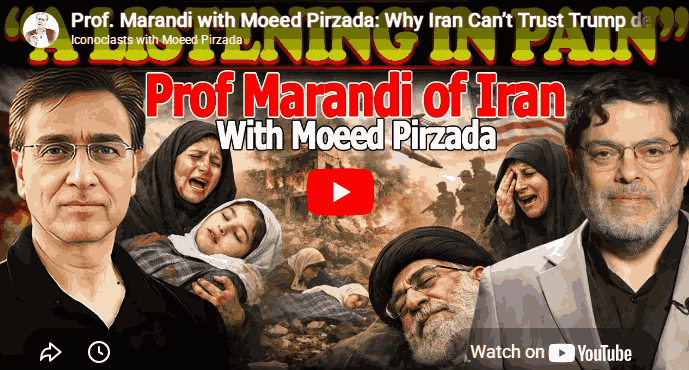
Dr. Moeed Pirzada and Prof Marandi discussed the distrust of Iran towards the U.S., despite the ceasefire in Lebanon. Dr. Marandi criticized Trump’s unpredictability and the influence of Zionists on U.S. policy. He highlighted the U.S.’s brutal actions, including the bombing of a school in Qom, and the ongoing genocide in Gaza.
Prof. Marandi emphasized Iran’s principled stance on sovereignty and support for Palestinian causes. He also mentioned the potential for economic pressure to force the U.S. to prioritize its own interests over Israel’s. The conversation concluded with skepticism about Trump’s intentions and the possibility of future negotiations.
Dr Moeed Pirzada
You see no difference between the Americans and the Israelis in terms of choosing the targets.
Prof Marandi
No, I think the United States is just as brutal and barbaric the regime you we all remember, how did the Iraq War start? Trump is saying is, he’s making a lot of he’s saying a lot of lies. Three, four days from now, he could be saying, well, the Iranian has promised all these things, but they’re not doing it, and this is unacceptable, but we have to go to war. I mean, he’s the guy who waged war. He’s the guy who began the war by murdering 168 little girls before any major war, before any major battle, first targets are very carefully vetted. That school was on all apps, Iranian and American. Those children, many of them were the children of military officers.
Dr Moeed Pirzada
Donald Trump wants to get out of the war, but maybe the Abu Dhabi and Saudi Arabia would not like to get out of the war, and maybe the Israel doesn’t want the war to end. So how do you see things progressing from this point onwards?
Dr Marandi
Think that there is a strong possibility Trump will want to restart the war Saudi Arabia today were to say that I will work against the Israeli regime. The balance of power would shift if the Emirates any of these countries. So I think it was inevitable that the talks would not succeed. The real forces behind the scenes were Zionists that Trump will want to restart the war. He will say one remember one day he says, I’m on good terms with Iran. The next day he says, I’m going to wipe out the civilization and the United States did not win the war.
Dr Moeed Pirzada
Assalamualaikum, and a very warm welcome to all of you. Today, I have the privilege of inviting Professor Mohamed Morandi from Tehran, who is joining me right now. It’s a privilege to have you, Professor, you do not need any introduction. I think the whole world now knows you. Almost everyone in Pakistan knows you. And I can say in the upfront, at the very beginning, that I think no other country has felt the pain of Iran more than the people in Pakistan felt. I think about 30 people on 30 people died, you know, within 24 hours of the attacks on Iran. So the people in Pakistan feel the pain of Iran. I have seen in the last about 24 hours, about 18 hours, two of your discussions, one on CGTN, which is the Chinese platform, the other on a social media platform with Rania Khaliq breakthrough. And you do not seem to be very optimistic about the prospects of peace at a time when many in the western world think that Donald Trump desperately wants to have peace with Iran. I mean, that is why he has pressured Netanyahu against netanyahu’s own instincts to force him to stop the war or the attack in Lebanon by issuing that social media tweet and says, Amethyst, Enough, stop it. So why are you not optimistic at this point?
Prof Marandi
I think there could be a number of reasons that I could very quickly point out. One is the nature of Trump himself, and that he is, that he is constantly changing his position, and that he is surrounded by Israeli first service and Zionists, his ambassador to you saw his interview with Dr Carlson, and you would imagine that after saying what he said, that if the Israeli regime took the entire region, that would be fine. You’d think in a normal country that Ambassador would be removed or rebuked or punished. Nothing happened. So that basically, to me, shows that he reflects thinking in Washington that would be the unofficial policy of the United States.
I would imagine, in reality, goes far further than Trump. But Trump is not sophisticated. He’s incapable of holding his thoughts to himself or keeping his thoughts to himself. And of course, there are other reasons too, the sheer power of the Zionist lobby. After all, we’ve been living through two and a half years of genocide in Gaza, no force in Washington or in Europe has shown any interest in flopping the slaughter, and then the slaughter in Lebanon has been a repeat of what we saw in Gaza. And the Western media, Western journalists, they were fine with the massacres, and they tried to paint it as Hezbollah targets being struck, or Hezbollah strongholds being struck in order to hide the fact that the Israeli regime was targeting families and apartment blocks and so on. So when you look at the reality of where power lies in the West, and then. Look at the personality and character trauma. I think it’s a lot of skepticism. We should have a lot of skepticism. That doesn’t mean that Iran, the Islamic Republic of Iran, the Axis of Resistance and and those who resist this evil entity, this evil, racist and supremacist entity called Israel, should not engage with its adversaries or with the West, but we should be very cautious, and we should not be deceived. After all, you and I both come from countries and from parts of the world. Well, almost the entire world is like this, but you and I as well that have a very dark history with imperialism and Empire, and that history has always been full of deceit and deception. Empires do not suddenly see the light and change their behavior. By nature, they’re aggressive and by nature, they’re brutal and evil. So I’m skeptical, but at the same time, if the Iranian government says, should we engage, I would obviously say, if certain conditions are met, yes, so I was not opposed to the negotiations in Islamabad. And if the government and the state thinks that we should negotiate again in future. I would not be opposed to that, but I would stress that. I would tell people that I know to be very cautious, to be skeptical and not to be optimistic in general about those who’ve been carrying out genocide.
Dr Moeed Pirzada
How do you look at the Islamabad talks? What are your impressions of the talks?
Prof Marandi
Well, I to be very open and so that your audience would not misunderstand. In general, I steer clear of anything that is behind the doors. But I learned at after a point I became involved in media, I learned to steer clear of behind the scenes action, because when you’re involved with think tanks and media, if you know things that, if you know things that are not out there in the open, or if you know secrets, let’s say then you may inadvertently say something that harms the cause that you believe in. So I try and I mean, I I’m sure I have more background information than most, but I but, like, if it’s something that’s secret that people don’t know, I would rather not know. So my information about what happened in Islamabad is therefore limited. The United States didn’t the US Representative, meaning Vance. If you look at the symbolism, I mean, if you look at the image of him sitting between two Zionists whose priorities are, no doubt, Israel, not the United States. And then you that he will constantly make a phone call the US Vice President, the number two man, Indian is the different people. Of course, as I said, the White House is full of Israeli first serves, and then one of those people is actually Benjamin Netanyahu. And Netanyahu, later we see, says that the US Vice President reported to him, as do other senior American officials every day. So when the US Vice President reports to this puny colony somewhere in the Mediterranean, that says a lot about the authority and status of the US Vice President. So I think it was inevitable that the talks would not succeed, because the real forces behind the scenes, behind the scene were Zionists and
Prof Marandi
real reason why Iran in the United States cannot come to terms with each other, the real reason why for 47 years, there has not been ra Shema. Israel, spoken about here and there, going to Tehran by both worked in the world and academics after leaving government, they wrote this book, and they speak about many of the myths on Iran. It’s a book I’d advise you and others to read. And in it, they after dealing with all these myths that are constantly repeated by person in the media, they give a roadmap. They provide a roadmap for engaging with Iran and for rapprochement, they were crushed. They were attacked by all sides of the political spectrum when they published the book. But if these analysts have, instead of being, you know, bound to Zionism, they had been pursuing the interests of the United States today, you’d have normal relations
Dr Moeed Pirzada
many, many people in Washington believe that the 15 hour negotiation that Islamabad, between the JD Vance and the Iranian team was sort of successful, but JD Vance was not allowed to announce the success, because Trump wants to announce the success himself. And that is why he says that he is prepared to go to Islamabad, because he thinks that he can take the credit of ending 47 year or 50 year old conflict. I mean, he thinks that this can still be some sort I mean, it is his thinking that this can actually be basis of his Nobel Peace Prize. So you don’t see any such thing happening over there, the thing that things were settled, more or less, and both sides know it, and they’re passing through the emotions of it.
Prof Marandi
You know, when you live in, I’ve lived in Lebanon, I’ve, of course, I’ve lived in Iran all my adult life, except for a brief period when I lived in the UK for my PhD three years. But I’ve lived in Lebanon. I’ve been to Iraq. Often, I’ve been to Syria. Often, when you look at the reality of US policy in our part of the world, death, destruction, slaughter, extremism, funding ISIS al Qaeda, the worst of the worst. And you live through all that, if you come to have any faith in the United States, having any good intentions, and I mean the state, I don’t mean ordinary Americans. I think ordinary Americans are increasingly becoming victims like the rest of the world, but that’s another story. I think that any optimism about the intentions of the United States would be utterly naive. Does that mean that I oppose, like decreasing tensions? No, definitely not. If it’s done in a way in which our sovereignty and our dignity, or the dignity and sovereignty of the Palestinians and the Lebanese and others are preserved. Of course, in all cases, we should move in that direction, but we’re talking about Trump, who murdered General Soleimani at the basically he was going to do it with Netanyahu, and Netanyahu pulled out at the last moment, which indicates how foolish Trump is. And then Trump wages war against Iranians. He allows the Israelis to carry out genocide in Gaza, which is, you know, the most horrific, the most horrific event in, I think, since
Dr Moeed Pirzada
it started under Biden,
Prof Marandi
yes, but it doesn’t matter. This continue, this continuity doesn’t make Biden or Trump really any different from one of the I don’t, I’m not of the belief that Trump is somehow fundamentally different from previous US presidents. He’s he’s less politically correct. Obviously, by far that would be an understatement. He is less I don’t know what word to use, because wisdom is nothing. Not wisdom is it has a positive connotation, and none of these people are decent people, but he’s, he’s less rational, let’s say and but that doesn’t mean that by nature, they were any different. Biden is a partner in this genocide, and there’s no difference, in my opinion, between the Hitlers of the world, the Saddam Hussein’s of the world, the Netanyahu of the world. World and the Bidens and the and the Trumps of the world.
Dr Moeed Pirzada
So Professor, at what point you realize the the tyranny, the injustice, the hypocrisy of the West? Because at some point when you studied, you opted to study English literature in Iran, and then you did your doctorate in Britain. That means you you had a sort of intellectual relationship. You actually were sort of impressed, or you belong to them, or maybe you thought they are human values. So, so at what point you got totally disgruntled or disappointed, and you saw the other side of the West?
Prof Marandi
Well, again here, I have to be very cautious about wording, but And when I’m when we’re talking about the West, obviously, we’re talking about Western elites. I have many friends in Western countries, and disproportionately in the West, I have Jewish friends, disproportionately. I mean, I have lots of Jewish friends, all of them anti Zionists, obviously. So when we’re talking about the west or anywhere else, I mean, for example, I’m very critical of Erdogan and and his political party. I believe that Erdogan is is not a friend of our, of the Palestinian people. He’s not a friend of the Iranian people. He’s not a friend of the Lebanese people.
Dr Moeed Pirzada
And then, are you against this political structure?
Prof Marandi
Yeah, let me just, let me complete this so I don’t I’m not misunderstood, but I’m very fond of Turkey and torque here. Or for example, I have been, I spent very little time in Pakistan, but I really enjoy being in Pakistan. You know what I mean? So being among people is one thing, or talking about the people who are talking about governments, because I criticize Erdogan a lot, and so some of my some people from Turkey. May think, well, he doesn’t like turkey? No, of course not. Actually, it’s one of my favorite places, but and the people, I mean, but so the United States, when we speak about the West, I’m not speaking about, you know, all those millions of people who went to the streets and protested against the genocide and in Rome and in Spain, across Spain, in you know, across the UK or elsewhere. But my skepticism towards the West in the political establishment, in that sense, I think, began before the revolution. I was 12. I and 11 and 12 when the revolution was taking place. 12 and I recall how the Western the American media, crow Shah and depicting the protesters and Iran was probably the revolution in Iran is probably the only real, true revolution in world history, where in every city across the country, every literally every day, people were protesting somewhere, and in some cases, everywhere, simultaneously, day after day, and in huge numbers for many months, that was unique. It still is unique in that respect. So you saw the people were out there protest testing against the Shah and Western media, even though I was a child, but since my parents were politically active, I understood a bit about politics, and I could see how the Western media was demonizing the revolutionaries and praising the Shah and that. And there was one instance which I’ve mentioned elsewhere. There was a cartoon that they made where Ayatollah Khomeini, Imam Khomeini, he was sitting in a bathtub, and he was playing with blood. And this was like, well, the Shah’s soldiers, his troops were gunning people down in different cities, but somehow he is the one who’s playing with blood. In other words, they just reverse. And that image I still, it still is, is with me, and probably the second moment was, I’ve survived two chemical attacks, and those chemicals were given to Saddam Hussein by the West with money from the Arab regimes in the Persian Gulf and Germany. Taylor is guilty of crimes against humanity, and they’ve never apologized or paid compensation, of course, because they are Europeans and they’re, you know, superior to the rest of everything they do is fine, I suppose. But I survived two chemical attacks. But what? There were two instances which did not affect me personally, that were very dark. That I had one was when I went to the city of halabcha, an Iraqi city in northern Iraq, a Kurdish city after it just been chemically attacked and 6000 6500 people were were killed in a minute or two. In a minute
Dr Moeed Pirzada
or two,
Prof Marandi
yeah, because they they use nerve agents. So kids were playing in the streets, moms were cooking, and they just fell and Strang, and you know, you’re you’re strangled, because I’ve experienced nerve eight. I didn’t see the bodies when I went there. The bodies had all been taken by the Revolutionary Guards and the Kurdish people. And, you know, the survivors taken away. But just walking through the city that it’s a small city, it was a big town. Let’s say this. Walking through it was very, was very painful. The doors to the houses were open, the doors to the the yards were open. It was just, it was just, you know, suddenly everyone died, as or not died, they strangled, you know, they were strangled simultaneously, in in a few minutes as they were just carrying out their lives. That is something that still bothers me, even now, I don’t want to get emotional or anything, but it still, it’s it still makes me very upset when I’m thinking. So right now, since I’m trying to explain it to you, I think about it more deeply than usual, and it’s becoming a problem right now. And the second was once when I went to visit a hospital in Tehran during the war, and they had brought in large number of Iranian soldiers who had been injured by another nerve agent called mustard gas. And I also survived a mustard gas attack. Once I survived a nerve agent, and on another occasion, I survived a mustard gas attack.
Dr Moeed Pirzada
You
Dr Moeed Pirzada
said that the Arab states were financing Saddam Hussein. Why were the Arab states financing Saddam Hussein? Where is this coming from?
Prof Marandi
Well, from the very beginning in the revolution, they felt threatened, because this was a popular revolution. The Shah was like them. He was a despot. He was a proxy. He was an agent of the United States. Basically, you know that the US and British ambassadors would meet him and speak with him. I mean, right now, a foreign ambassador in Iran would only see the would never see the leader, but would only see the President when he is giving his or her credentials. But in, you know, but the Shah status was so low in the West that, you know, the US ambassador and the British ambassador could easily get and not have an audience. And he did, just like what Saudi Arabia does purchase. He purchased huge amounts of weapons, brought in 10s of 1000s of advisors. These advisors basically did not, would not allow the Iranians to learn anything about the sophisticated weapons that they bought, and they were making huge amounts of money. It just it’s another Saudi Arabia. And one thing that I learned about Iran during the war in the 1980s because this was soon after the revolution, was that Iran was very poor under the Shah, because I went to the provinces near the border, and that’s where the fighting was. And so I knew, I learned about the province of hosistan and Elam and and Kerman Shah and Rumia and Kurdistan, these, these provinces, I knew well, because I’d regularly go to the war fronts. And it was amazing how impoverished they are. They were, and it was only after the revolution that we had universal education during war. So, for example, the West, which always makes this says nonsense about women in Iran, the strong majority of women in Iran before the revolution were illiterate and then during the years of war, even though Iran was spending its money to fight the aggression that the West imposed upon us through Saddam Hussein, where female education doubled more doubled in a decade. I mean, the number of women educated, the percentage of women educated, doubled in just a decade during the that’s very
Dr Moeed Pirzada
true. That’s true that the Iranian Revolution brought more education to everyone. It’s a more egalitarian society, and women got educated, women universities, women colleges. But at the same time, there is a certain kind of liberal woman the Revolution had put. Problem with what exactly, if you explain in few sentences, is the problem which we hear in the West again and again, that women have been treated very badly, especially since 2009 what is the essential fault line?
Prof Marandi
I think most of it is basically Western propaganda. It’s the demonization in Iran. You know, in Iran, obviously, in Iranian religious culture and Iranian the commodification of women is something that is believed to be in the interest of of certain a certain segment of male society, and that this is not emancipation or liberation, but but in general, the demonization of Iran, whether it’s women or human rights, terrorism or the nuclear program, all of this is based on on The political necessity of the empire in order to crush, let’s say the resistance and rebellion against empire. Otherwise, the status of women in the in the West is not anything to be admired, nor is it to be admired in its proxies in our region. Or not women, anyone. The minorities or the middle class in the west now is, is, is, is falling apart because the oligarchy and the Epstein class accumulate wealth and unprecedented manner, but the best way in order to a preserve your society’s, let’s say obedience is to other eyes. So you say, oh, look over there at the evil Iranians. What they do to women. So you should be happy that you live here in the west and things here are good, or look how evil they are. So don’t be too upset that we’re carrying out genocide, or we’re bombing Iran, or we’re slaughtering people in Lebanon because they are bad people, and we’re trying to liberate them,
Dr Moeed Pirzada
Professor, sometimes you’re a professor of literature, you think that Islamic revolution could have done something politically different to avoid itself being, you know, clobbered on both sides, one from the Zionist, the other from the Arab states and the rest. I mean, it has three principal enemies, the Imperial western states, the Zionist and the Arab states. Could it have conducted itself differently to avoid this kind of, this kind of pressure?
Prof Marandi
Well, when you look at at, you know, things at the personal level. I could, I could have done things every day that would be better than whatever I’ve been doing during the, you know, my, you know, the day. I find, if I go over my actions every I’m sure every single day was I think, that the these Arab family dictatorships are not representative of the people on the streets
Dr Moeed Pirzada
agree.
Prof Marandi
And although they they have, they’ve used their wealth to demonize Iran and to create sectarianism, not because they are religious, but because Qatar, for example, or Saudi Arabia, their leaders are not religious. They are utterly corrupt, but they will use sectarianism racism in order to preserve power. So they would love to see their people hate Iran or hate the Shia, and they would spread disinformation about Shia or Iran or anyone who they feel may be disruptive to their corrupt rule.
Dr Moeed Pirzada
So can you describe in one or two sentences that what’s your critical What’s your criticism of erdogan’s politics?
Prof Marandi
I think he’s complicit with Empire. I think he’s not he has no intentions to liberate the region. He’s not an anti colonial figure. He’s not an anti Imperial figure. He is a part of the empire. But, you know, he uses the Palestinian cause to benefit himself and to make himself more popular, just like qatab does. But has he ever really supported the Palestinians? Has he done anything to harm the Israeli regime? No, I mean building a couple of hospitals in Gaza, which can easily be bombed and destroyed, that’s not helping Palestinian cause is that does that reflect on the Turkish people? No, of course, not just like what the Saudi government does, or the Emirati government does, or any other regime that. Bound to the West that does not reflect on the people Iran under the Shah was the same as these Arab family dictatorships, and it was only because of the popular revolution that which was bloody and which the West did everything to block that Iran changed.
Dr Moeed Pirzada
But Professor, Professor mahaldi, I mean, with this yardstick, which Muslim countries leadership is not beholden to the Empire?
Prof Marandi
Well, every you know, everything is is relative, and there are different degrees to which countries exert agency. And I, if you know, when I speak about pathad, does that mean that everyone in Al Jazeera? I just like, No, I have friends in Al Jazeera. I have friends in these I have friends in the Akka party. Actually, my connections with the ruling party in Turkey go back decades, and many of them quietly agree with me, and many of them would like to bring about change, but I’m talking about in general terms. Iran, under the Shah, was supporting apartheid South Africa. It was providing 90% of the fuel there or and it was supporting the Israeli regime and sending oil there. And it was involved in their military, in the development of a miss of a missile program. So the revolution, you know, so I’m speaking in general terms, Iran, back then played the same role as these regimes do. Now, if just a couple of the governments in the region had joined the Axis of Resistance, the Israeli regime, or had cooperated with the Axis of Resistance Israel would that would, under no circumstances, be allowed to do what it has done over the past two years, two and a half years, it would have been impossible if, let’s say, Turkey, instead of cooperating to destroy Syria and bring the rise of ISIS and Al Qaeda something that the Israelis and the Americans saw it. If they had played a different role under Erdogan, Israel today would be much weaker. If one of the if Saudi Arabia today were to say that I will work against the Israeli regime, the balance of power would shift if the Emirates, any of these countries, if they turned against the Israeli regime, things would be much worse for the west than they are now, but none of them do so. There are countries that have played a more positive role, like Algeria as an example, but, but I’m talking, I’m speaking in general terms, and again, none of what I say reflects upon the people of any of these countries,
Dr Moeed Pirzada
but Professor Moran, but Professor Morandi, the countries that resisted the Zionist and Israel were all destroyed. I mean example of Iraq and Syria and Libya and Lebanon. I mean, so there are some very harsh examples for the other small Arab states. They’re weak, they’re afraid, isn’t it true?
Prof Marandi
Well, they cooperate in this. In the case of Iraq, Saddam Hussein, I think, did more to help the Israeli regime than most his foolishness and his constant wars. And, you know, launching a war against Iran than launching a war against Wade and then just symbolically fight you missiles when he was defeated, towards the Israeli regime in order to gain popular support that was not really sincere. Yes, the Arab world conspired to destroy. I mean the Arab world, meaning these regimes conspired to destroy Libya, Qatar and Saudi Arabia and others were involved in the overthrow of Syria. They were using with the West al Qaeda to overthrow Syria, and then they used the same al Qaeda against sorry, Libya, and then they used the same al Qaeda against Syria. So yes, you’re right. These dictatorships were involved in destroying Libya and then Syria. Saddam Hussein’s own barbarism helped to give an excuse to destroy Iraq, you’re absolutely correct. But in any case, I’m talking about these regimes, whether you know, I don’t you know, these regimes that are now in the Persian Gulf, they have actually been the most destructive because they’ve used their immense Well, basically to pursue you, to follow us policies. They paid for US policy in our region. So they paid for Israel’s policy.
Dr Moeed Pirzada
So the way we look at the situation, Professor Morandi that Donald Trump wants to get out of the war, but maybe the Abu Dhabi UAE and Saudi Arabia would not like to get out of the war, and maybe the Israel doesn’t want the war to end. So how do you see things progressing from this point onwards.
Prof Marandi
I hate making predictions, because they they then I become they push me, my thinking in a particular direction. I don’t know what is going to happen. I think that there is a strong possibility. That Trump will want to restart the war.
Dr Moeed Pirzada
Will
Dr Moeed Pirzada
restart the
Prof Marandi
war? May say, Yes, I think there’s a strong possibility of that. You will. You would respond to me by saying, but you know the United States is public opinion is against it. The United States failed in this war for 40 days, and Trump is losing his supporters, and I would agree with all of that and that it doesn’t make sense, but that doesn’t mean it won’t happen, because we’re speaking about Donald Trump, but that doesn’t mean I think that there will definitely be war. Could it be that Trump backs down and moves in a different direction, possibly, but most probably, whatever Donald Trump does, based on my understanding, my personal understanding is, of course, a very limited understanding, is that I think that he will just continue to be
Prof Marandi
a sinister force, and he will constantly zigzag. Now, he may do the right thing at times out of self interest, but I think he will constantly zigzag because he will say, one remember, one day he says, I’m on good terms with Iran. The next day he says, I’m going to wipe out the civilization. One day he says, we’re talking and everything is fine. He just makes it up, of course, and then three days later, he says, killed all their leaders. And this is a new regime. You know when,
Dr Moeed Pirzada
when the Vice when the Vice President, JD Vance, came back, he created the impression in some of his talks to television channel also in Georgia, the President wants to create a comprehensive economic package with Iran. He wants a settlement. And the hint is this that they’re thinking of taking off or de sanctioning Iran. Were you in Islam when you were in Islamabad, you and the other colleagues had some feeling that Americans want to take off the sanctions in return for Iran giving them something.
Dr Moeed Pirzada
No,
Prof Marandi
you know, I wasn’t in the room. But the fact is that the United States wants you to complete and to give up sovereignty. And that’s the revolution. You know, the revolution and the United States did not win the war for its even have such expectation. They lost the war. They did great damage to our country, but they still, but Trump still lost the war, and Netanyahu too. Most interestingly, what most what was most interesting to me was that Vance was constantly making phone calls to Trump?
Prof Marandi
Yes, and well, if Netanyahu was very satisfied from his from what we were hearing him, from what he was saying that they he reports to me that does not give me the confidence to say that you know Vance or Trump are sincere,
Dr Moeed Pirzada
but could it be that’s Vance wanted to find out from Netanyahu if they can stop the war in Lebanon, because that was what the Iranian delegation wanted.
Prof Marandi
Maybe that’s what they wanted. But the issue is they did not do anything about it. In fact, I didn’t see this personally, but I’ve been told and correct me if I’m wrong, that Vance criticized Iran, saying, why was Iran, why was Lebanon so important for Iran, when, you know, it could have had a ceasefire or something like that. I don’t, I didn’t see the wording, but someone told me that Vance was criticizing Iran for being, you know, supposedly obsessed with Lebanon, well, they’re carpet bombing the country. They’re slaughtering women and children, and on that day, when within 10 minutes, they murdered hundreds of people. They murdered anti Hezbollah families. They murdered kids. Yeah, they bombed everyone. So yeah, of course, Iran is going to be utterly angry, because, contrary to Western regimes, the Iranian government, the Iranian state, has principles. It has moral principles. That’s why we support the Palestinian cause. We don’t gain from supporting the Palestinian people, especially when these Arab dictatorships are constantly promoting sectarianism and racism and even trying to turn Palestinians against Iranians, my Palestinian friends often tell me that a lot of the very strange things that are said about Iranians, among some Palestinians and Iranians see that because The Persian language media in the West that’s controlled by Western intelligence agency, intelligence agencies constantly translate this into Persian and tell Iranians that the Arabs and the Palestinians and Sunnis, they hate you, but to the immense credit of the Iranian people, they they ignore this, and they continue to support. Or the victim. So, yes, when Ban said, Why is Iran like? Why does Iran care so much Lebanon, because they’re human beings, and we care, we care about human beings, just like in Gaza. But the point is that, you know, Vance may want to deal, but I but Netanyahu at that point, did not at all seem dissatisfied. Now, what Iran is trying to do, what is Iran is trying to do, is trying is that it’s trying to make the problem the economic problem or crisis for the United States so big that the United States comes to the point where it says, here I have to prioritize my interest over Israel’s interest.
Dr Moeed Pirzada
Isn’t it happen so far in the perception in Washington is this that that state has already reached because of the employment data, because of the inflation, because of gas prices, and while many figures may not be visible to the general public. The government, the White House, is actually getting the figures, and they don’t have I mean, I was speaking to Trita Parsi, Dr Trita Parsi of the Quincy Institute, and he, in the beginning, his assessment is this, that Donald Trump and his team have no more appetite for another war. They want to end the war, but they do not know how to end the war, because they’re not in a position to give Iran what Iran wants. I mean, Iran wants end of sanctions. Iran wants
Prof Marandi
this is, this is the problem, isn’t it? They’re not in a position to give Iran, well, that basically. Why are they not in the position? That’s the ruling government, that’s the ruling authority, and that’s and I would say that part of it is legal. Yes, some sanctions cannot be removed because of Congress and the law
Dr Moeed Pirzada
because of the Congress. Congress, sinus
Dr Moeed Pirzada
lobby,
Prof Marandi
true, but the point is that they’ve not done anything else of any significance that they can do. They’ve they’ve done the opposite. They’ve imposed a siege on Iranian courts. So the point is that, actually, they haven’t broken away from Israeli first policies the United States continue. The United States, since the revolution, has been hostile towards Iran, and it’s basically
Dr Moeed Pirzada
but the revolution was also hostile towards United States like us. Diplomats seized an embassy for 440, days and something. They keep on repeating this every time. When someone comes who’s against Iran, he says, Look, they were marching on a flag. They were they imprisoned. They hijacked the diplomats. They took them hostages,
Prof Marandi
yes, but that is the logic of empire, isn’t it? It’s like saying that, Oh, those rebels in the Indian subcontinent during the anti colonial era, they killed the British soldiers. Well, you know, you’re an occupation force in Iran, the US government, as we all know, in 1953 alongside the British, carried out a coup and then installed the Shah for 25 years and created his brutal secret police, the SAVAK. And during the revolution, the United States supported the Shah. In fact, after the most bloody slaughter of people on the streets called Black Friday, the next day, literally the next day. Jimmy Carter, who was like the good human rights president, he called the Shan gave him his full support the very next day after Black Friday. So and then after the revolution, the United States began. The US Embassy was the center for conspiracy to undermine the state, just like 1953 and then the US gave refuge to the Shah, and the Iranian students who took over the embassy thought that this was the beginning of the repeat of 1953 so the Shah was a mass murderer. It’s like, well, I used to give this example. I used to say it’s like Iran giving refuge to Osama bin Laden. How would the Americans feel? My views on what actually happened?
Dr Moeed Pirzada
They have, they have. They have forgiven us. They have forgiven us. But Professor winding it up, so primary sanctions, secondary sanction, straight reformers, the right to enrichment. Iran says it doesn’t want to make a nuclear weapon. There is much that can be I mean, if Iran, Trump is actually giving the picture here that Iran has agreed, as a result of Pakistani mediation, that Iran is going to give him solid guarantees, which Iran has already, have always been saying that we don’t want to make the nuclear weapon. But I think Trump, for the past 15 days, is making a big issue of it that Iran is going to tell the world that they’re not going to make a nuclear weapon. So that’s a good, good start. And then,
Prof Marandi
yeah, but that’s that’s not true. Iran has always said that we’re not making nuclear weapons. I mean, but he’s selling
Dr Moeed Pirzada
it, but he’s selling it to the American public. He sells. Talking about
Prof Marandi
that’s not what he’s saying. What if you look at the tweets that he did yesterday, they’re all just fabrications, that Iran is going to give up its nuclear program, that Iran is going to stop supporting Hamas and Hezbollah, that Iran is going to stop none of it is true. He’s just, you know, putting nonsense together. And this is where I wonder. This is where I wonder, and I don’t know. I’m not saying that there’s going to be a second war or not. I’m not going to I’m not saying that that there will not be progress at the negotiating table or there will be progress. I’m saying that we should remain skeptical about the United States, because the Empire never has good intentions. But Trump’s what, what, what Trump is saying Could, could possibly, and I’m not saying that this is and what is going to happen is he’s making a lot of he’s saying a lot of lies. Basically he said a lot of lies yesterday. And then what this could mean is that three, four days from now, he could be saying, well, the Iranian has promised all these things, but they’re not doing it. And this is unacceptable, so we have to go to war. So after the ceasefire, or after a period of time, this could be a scenario, and I’m not saying it is going to be. He needs something.
Dr Moeed Pirzada
He needs some time from Tehran to sell to his own people so that he can give a shut up call to the Zionists. They said, I got something. Iran is not making the nuclear weapon. They’re going to get the enriched uranium to Russia. You did. You gave 25,000 pounds enriched uranium to Russia in January. 2016 right? And now you only have 940 kilograms of pounds, actually, only 440, kilograms of enriched uranium. You can actually always give it up,
Prof Marandi
yeah. But the thing is that we’ve, we’ve done, we’ve, we’ve, you know, we’ve done all these things before. You
Dr Moeed Pirzada
didn’t get
Dr Moeed Pirzada
anything. Only
Prof Marandi
made things worse. And Trump is, is, is probably the worst of I mean, he’s the guy who waged war. He’s the guy who began the war by murdering 168 little girls.
Prof Marandi
He began the war with slaughtering little school children. And it was by it was intentional in the eyes of Iranians. You think, remember,
there was not a
Prof Marandi
mystery, I think, yeah, no, no, no, I don’t think so, because I know a thing or two about war in before any major war, before any major battle, the first targets are very carefully vetted, because they are, they are important for you to get momentum. So those primary targets are discussed and discussed again. And Jessica, after a few weeks, you know, an officer may be seeking a new target, and he may be in a rush, and he may make a mistake, and primary targets are all well chosen. That school was there for years. That school was on all apps, Iranian and American. That school was on all maps, but those children, many of them, were the children of military officers, and they wanted to teach the Iranian military officers a lesson. And if anyone thinks that that this is not really possible for American soldiers. I would advise them to go and look at a few pictures of Gaza. It is more than
Dr Moeed Pirzada
possible. You see no difference between the Americans and the Israelis in terms of choosing the targets.
Prof Marandi
No, no. I think the United States is just as brutal and barbaric the regime we all remember. How did the Iraq War start? Shock and Awe. Shock people put them at awe make we all recall what American soldiers did in Fallujah. They were ill. It was an illegitimate war. Iran hated Saddam Hussein. I hate Saddam Hussein. I’m glad he’s dead. He was a monster. He was like Netanyahu. Netanyahu was worse, but he was a monster. But Iran was opposed to the US war against Iran. Iran say it. Hassan Nasrallah spoke out against it, and many, many Iraqis were angry with him, but he spoke in principle. But all these Arab dictatorships, and, sadly, NATO members, they assisted the war. Even though they were his allies, they had funded him before. But the principle of us, so the US war was illegitimate, the occupation of Iran that aside US soldiers in the in Iraq committed countless, countless crimes against humanity, against Iraqi people. And is Israel worse? Yes, of course, Israel is worse than the Americans because they are Zionists and Zionists. Just openly support genocide. If you pull ordinary Americans, they would definitely be opposed to genocide. But Israel’s are Israelis are supportive of genocide. So but in nature is the US armed forces like fundamentally different from the Israeli regime. No, it is an, it is a, it is a army of the Empire. Professor, what’s
Dr Moeed Pirzada
the way forward? You know, what’s the way forward? Every war, every conflict, every tragedy, ends with some sort of negotiation. So, what’s the way forward?
Dr Moeed Pirzada
I understand the Empire as a
Dr Moeed Pirzada
person.
Prof Marandi
You know, throughout history, I think it’s always been the same. If you want to be able to live with dignity and honor, you must be you must be willing to make sacrifices. Resistance is key. And of course, Iran is deeply influenced by a culture of resistance because of the story of the grandson of the Prophet and his sister and Karbala against the despot and the supporting the oppressed against the oppressor, that is very key to Iranian salt culture and society and the axis of resistance. That resistance is necessary for you to be able to reach a point where the oppressor is forced to back down. If the oppressor backs down, you can you can normalize. You don’t have to like the oppressor, but you would have a different relationship. Again, I would advise people to read going to Tehran by Clinton Hillary Leverett, if the United States had pursued the policy that these two very decent people, the husband, Christian, Catholic, the wife, Jewish, two very brave intellectuals with outstanding moral principles And who served in the White House and who were highly educated. If they had instead of pursuing the policies that they’re pursuing today, if they pursued what the policies that they were advocating, we would not be where we are today. It doesn’t have to be this way, and we don’t want it to be this way. We would rather live in peace. We do not like war.
Dr Moeed Pirzada
So where you are. You are in Tehran.
Prof Marandi
We did not just one point. We did not start any of these wars. I agree. We did not start the 1980 war of Saddam Hussein. We did not start last year’s war, and we did not start this year’s war. Some analysts were saying that was saying Iran has imperial ambitions. Iran has when after Saddam was soundly defeated by the Americans, after the American invaded Iraq, Iran could have taken a piece of Iraq. Iran could have taken a piece of Iraq for itself, or said that while Iraq was down and weak, and said that, okay, we want these changes. Iran did not do that. Do you know that Iran, because of the US sanctions, Iran has been providing free gas to Iraq, Iran, which is under maximum pressure sanctions, for years, it doesn’t get as Iraq owes Iran many billions of dollars. The Americans won’t let them pay. But the Iranian government, the leader say, you know, give them gas. People need electricity. Iraq is very hot in the in the in the summer.
Dr Moeed Pirzada
So we’ve been hearing that something like $27 billion the Trump administration has perhaps agreed to to pay back, which is Iran’s money, which is stuck in Korea, which is stuck in which is Iran’s money, which is stuck because of the secondary sanctions, in Japan, in Korea, in Qatar, in Iraq, and in China, even in China, this is $27 million ready cash, but you have something like 100 million dollars of funds, oil revenues, stuck across the world, and then your trade is restricted. You can’t sell your oil at the normal prices, you are not able to do normal trade with Pakistan, with India, with Turkey. So if there is a deal that actually takes care of these things, and you hand over the enriched uranium, and you already said that you don’t want to make a bomb. So is there any harm in going for the deal, or you don’t trust that a deal is there on the table?
Prof Marandi
No, there are a couple of things, doing a deal in itself. There’s no problem with that, but Iran is not going to give up its sovereign right to have a nuclear program or to enrich any anything that Iran is if from today they say Iran is not allowed to do this, and Iran is no longer a sovereign, independent country, you can do a deal to to, let’s say for confidence building, but to say that Iran permanently cannot do this, that’s out of the question. And also, Iran is not going to forsake the Palestinian people. Have no doubt about that. The Iranian support for the Palestinian people is a, is a this is a prince. Cause. We make sacrifices for the Palestinian people because we believe in the Palestinian cause. Just like we supported and continue to support Cuba, we continue we support Venezuela. We went bought when no one was helping Bosnia, when Bosnia was about to be wiped off the face of the earth, we went and supported Bosnia
Prof Marandi
to what benefit for Iran? None, none, none whatsoever. But they, Iran helps prevent the the extermination of the Bosnian people.
Dr Moeed Pirzada
I remember
Dr Moeed Pirzada
90s, mid 90s, 1994 and 95 so Iran’s brother
Dr Moeed Pirzada
of
Prof Marandi
the brother of one of my friends was actually martyred there a young man. His name was now Nava or Nawab. But the point is that for us, the Palestinian cause is the ultimate, the ultimate humanitarian cause of the world that we live in today. It is the standard by which we assess who is human and who is evil. After coming,
Dr Moeed Pirzada
after coming back from istanabad, the next day, the Iran offered United States five years EU enrichment, which Trump projected, apparently, JD,
Prof Marandi
vans, oh, there is no no, no, there’s, there’s no clear offer. But at the moment, there are no clear offers on any area being made by Iran. Everything that you see in the Western media is is misleading. But in any case, if whatever Iran offers to do, whatever it may offer to do in future, would have to be provisional. Whatever it is, Iran will not give up sovereignty again. This goes back to the revolution. The Islamic revolution was a revolution about dignity, about sovereignty, about honor and independence, and about Principle and the Palestinian cause, going back to that was a key issue. Remember when apartheid South Africa was empowered the Iranians after the revolution not only broke off ties with apartheid South Africa, but it began to fund and support the resistance movement in southern Africa. And one of the first countries that Nelson Mandela traveled to after being freed was the Islamic Republic of Iran. And he went and he came to my university. I was a student back then. He received an honorary doctorate, and he went to see the leader and said My he called him my leader, out of respect for what Iran had done. So these, these Iran has, unlike the United States, which is an utterly unprincipled foreign policy, Iran has a principled foreign policy.
Read more: Trump shares letter calling India and China ‘hellholes’
Dr Moeed Pirzada
It’s just
Prof Marandi
Yeah, again, I’m not saying that. Oh, so are you saying that Iran is utopian and that Iran never makes no but comparatively speaking, when we look at on the map, who has sacrificed for the Palestinian people, it has been Iran who has not. It is the governments across the world. Is does that reflect upon people across the world? No, because people across the world their hearts today or with Palestine, whether in Latin America, whether in Africa, or whether in Europe or Asia, we see that people’s eyes have been opened to Zionism and the reality of Zionism and their hearts are with the Palestinian people.
Dr Moeed Pirzada
So one last set of questions that we are just four days away from the deadline of the ceasefire, Iran has opened up the Strait of Hormuz at was as was initially envisaged in the in the 15 day ceasefire, the Lebanon ceasefire has taken place for the 10 days. At this point, do you not see a second round taking place? Pakistan’s army chief was there for the two days. He came on better stay. He was probably still in Tehran. I don’t know whether he has left Iran or not. Is he still
Dr Moeed Pirzada
is he still
Dr Moeed Pirzada
left? He left. He left today. He left you last night.
Prof Marandi
I think he left last night.
Dr Moeed Pirzada
Yeah, so he left last night. So
Prof Marandi
Iranian, there were Iranian jets in the air in Tehran last night, fighter jets, and they were to escort him.
Dr Moeed Pirzada
We thought that Pakistanis escorted you from to islamabad to Tehran. We heard that. Is this true? When you were coming back,
Prof Marandi
they escorted to the border. And so out of respect, Iranian jets, Iranian fighter jets, escorted him back.
Dr Moeed Pirzada
Okay, so that was a matter of respect, because we, we were made to believe that.
Prof Marandi
Well no, it was. It wasn’t just a matter of respect. Remember when we were on our way to Islamabad? I think that was when it happened. The Washington Post published a an opinion piece saying that the United States should murder the negotiators
Dr Moeed Pirzada
exactly
Prof Marandi
I remember that we were in Islamabad and planning to return. We all thought. Thought that our there was a high probability that our plane would be shot down. And to the credit of all the men and women in the delegation, not a single one of them stayed back. Because they could have said, well, we want to stay here for a few days and look around and now that we’re here, and then we’ll, we’ll take the land route back to run, as you know, that would have been more than acceptable to anyone and understandable, especially, let’s say the younger journalists and so on, who were not key members of the delegation, but everyone took the plane and they during the fight, we were waiting for missile to hit. It wasn’t inevitable. But, you know, we can’t, you would think about that. So we are dealing with a ruthless and barbaric enemy whose own media advocates crimes against humanity. This is the world that we live in today,
Dr Moeed Pirzada
agreed. So we’re four days away from the ceasefire deadline, Iran has opened up the Strait of Hormuz. United States has managed to end the war and for the 10 days war in Lebanon. But you don’t, you don’t have any information, or second round in Islamabad, the army, she has left.
Prof Marandi
Yeah, I don’t think, I don’t as far as I know, and this morning that I speak with you, I have not spoken with anyone about the situation. I’ve only checked the news like for a bit before speaking with you online. As far as I know, yesterday up to yesterday, a decision has not been made about a second round, but it could happen. It’s plausible. Again, I’m when I say I’m skeptical, I’m skeptical of the United States. Does that mean that I believe that progress cannot be made? No. If the United States comes to the recognition that its interests, that sacrificing itself for the Israeli regime after a certain point is dangerous for its own stability and its own future, and it decides to make a more reasonable take a more reasonable position, a lot of progress can be made if the United States prioritizes its own interests over the Israeli regime. Huge progress can be made, but the Israeli regime would never want to see that happen. So we have to see how things play out. And the reason why Iran is putting economic pressure is to make the Americans come to a point where they say, Look, our interests are more than interests of a genocidal Zionist regime.
Dr Moeed Pirzada
Professor, last question, so what Donald Trump saying in the last 24 hours that if I have to sign a peace accord, I can actually go to Pakistan to sign a peace accord with Iran. That actually is a huge political capital investment because, I mean because, by just saying this thing that I’m so desperate to sign a peace accord with Iran, he damages himself politically in the beltway politics, you understand there are powerful lobbies that would never like the president of United States to go and sign a peace accord with Iran and going to Pakistan. That is unacceptable. So you don’t think that he’s serious when he says this thing. You don’t think he’s still serious. It’s a huge commitment saying, yes, if I have to sign a peace accord, I’ll go and sign a peace accord in Islamabad.
Prof Marandi
Any peace accord would have to take into consideration the 10 Point Iranian plan, and that is basically that Iran’s allies across the region, in Palestine, in Lebanon, in Yemen and Iraq, they have to feel secure and safe. Iran’s sovereignty has to be preserved, and there has to be reparations. Now, the reparations these family dictatorships in the Persian Gulf that are constantly being milked by the United States, they can pay. But someone launched this war against us, and it was, you know, it’s not Pakistan. So we, you know, any agreement will have to fulfill requirements. And let me give you a small example. Iran and North Korea, of course, are infinitely different. And although the, you know, the West demonizes everyone, and I don’t mean to demonize North Korea, but I think that Iran is the Axis of Resistance, and the resistance against Empire those who’ve been protesting across the world and boycotting across the world, they’re all shining stars of humanity, whether it’s a young 17 year old or 18 year old Korean woman who’s standing in front of the Israeli. See, or if it’s a courageous resistance fighter of Hezbollah fighting in the south, whoever, or someone from Hamas or Islamic Jihad, or Iranians and so on, or protesters in Madrid, they’re all heroes. But you know, at the at the end of the day, what I think is I forgot what I was going to say, but I’m growing old. Sorry. I don’t know. I have no idea what I was saying when I reached this point, I I get a bit emotional about these people. You know when I you know when, when the genocide in Gaza started? I remember, there was a picture of a woman in Seoul in South Korea. And now I remember what I was saying. I’ll get back to it. And every day she protested alone on her own in front of the Israeli embassy. I’ve never met this woman. I know. I have no idea who she is, but it is these people who then cause to two more people to join, then four more people to join, and then 50 more people to join. These are all heroes. These are all heroes wherever they are in this world, whatever their race or religion or sex, whatever, they’re all heroes of humanity, and they’re they’re, they’re, they’re, they are our hope. But going back to North Korea, after Trump visited North Korea, I mean, after he had a talk with the North Koreans, the Iranians, Iranian officials met the North Korean foreign minister, and they said, What was Trump like? They said, actually, when he spoke, there are no problems he you know, there are pleasantries and so on. But when he left the room, he was back to normal. The people around Trump were hostile, were antagonistic. They’re inflexible, they’re demanding, and there’s no progress. So at the end of the day, it doesn’t matter what Trump says, It matters what Trump does, and for us, we just don’t want to see bombs dropping on Gaza or Beirut or in Tehran, and we don’t well. We can take care of ourselves, but we don’t want to see every hear the news every day, which is literally what’s happening every day. Israeli snipers having fun shooting kids in the head in Gaza. That for us is unacceptable. It will never be acceptable to us. It will never be acceptable to the Islamic Republic of Iran. Come What May
Read more: Netanyahu reveals prostate cancer diagnosis
Dr Moeed Pirzada
Professor Morandi, thank you so much. Maybe we should talk in few days. You know, let’s see if the second round takes place and what happens. And 22nd april deadline passes. You know, these are very crucial dates in between, but I’m so glad, and I’m
Prof Marandi
great inshallah. But, but do read that book going to Tehran, and maybe it would be good.
Dr Moeed Pirzada
So the next time when we talk, I have already, I would have already got it on the Kindle, and I would read it.
Prof Marandi
And maybe it would be a good thing to speak to Hillary or Flint man. Hillary man, leverage with flint.
Dr Moeed Pirzada
Are they in the US?
Prof Marandi
Yes, they live in the Washington area. I will track them and both, yeah, both of them are, are? Are among those heroes that i i speak up.
Dr Moeed Pirzada
Do you have the contacts, the emails, or contacts or something?
Prof Marandi
I think I Yes. I do have the phone number of Hillary. I don’t know if it’s her phone number, but it is her WhatsApp. No,
Dr Moeed Pirzada
you can ask her and then connect me, because I was trying to get in touch with you for number of months, but I wasn’t really finding any contact. I mean, till I was given this telegram number, so it wasn’t really possible. I mean, no one
Prof Marandi
I will, I will send her a message, reminder, check check with right after this, I have a couple of things to do, and I’m very forgetful.
Dr Moeed Pirzada
Yeah, I’ll remind you,
Prof Marandi
terribly.
Dr Moeed Pirzada
I’ll remind you and connect me, connect me with them, and I’ll definitely plan a discussion
Dr Moeed Pirzada
with them, sure, and
Dr Moeed Pirzada
I look forward to stay in touch with
Prof Marandi
you, sure, of course.
Dr Moeed Pirzada
Thank you, Professor, thank you.
Prof Marandi
Thank you for having me.
You can watch the full interview here