Fathom Undercuts EV Truck Barriers as Ford Bets on Affordable Innovation and Manufacturing Reform

Automaker Software Updates Redefine Expectations for Connected Cars


Alpine A110 Ownership Reveals Why Classic Engagement Outshines Modern Refinement
 Roger Hick scoured France to find his dream A110 – and then he found it in Milton Keynes
"Alpine comes first in the name, as in Alpine Renault. There's never been a Renault Alpine."
So says Roger Hick, with sufficient authority for me to doubt my memory of cars such as the Renault Alpine GTA Turbo and Renault 5 Alpine Turbo. In any case, you don't question a man, in the presence of his Alpine A110 1300 S, who has owned two Alpine Renault V6 Turbos and whose daily driver is a current-model Alpine A110.
"I bought my A110 1300 in 2000, largely in this condition but there's nothing I haven't changed," says Roger. "I'd seen pictures of the model and thought: 'That looks pretty. I'll save up for one.' So I scoured France for one and found this in Milton Keynes!"
The car had been restored by its then owner but, says Roger, he couldn't get on with it for some reason: "I took it to a club track day once and a chap came up to me and said: 'You're doing well in that. The last time I saw this, it never faced the same way twice in a lap!'"
Bristling with lights and plastered with contemporary sponsorship stickers, the car looks every inch a works team special. However, it was never campaigned and has simply been converted to look the part. Not that it's all mouth and no trousers.
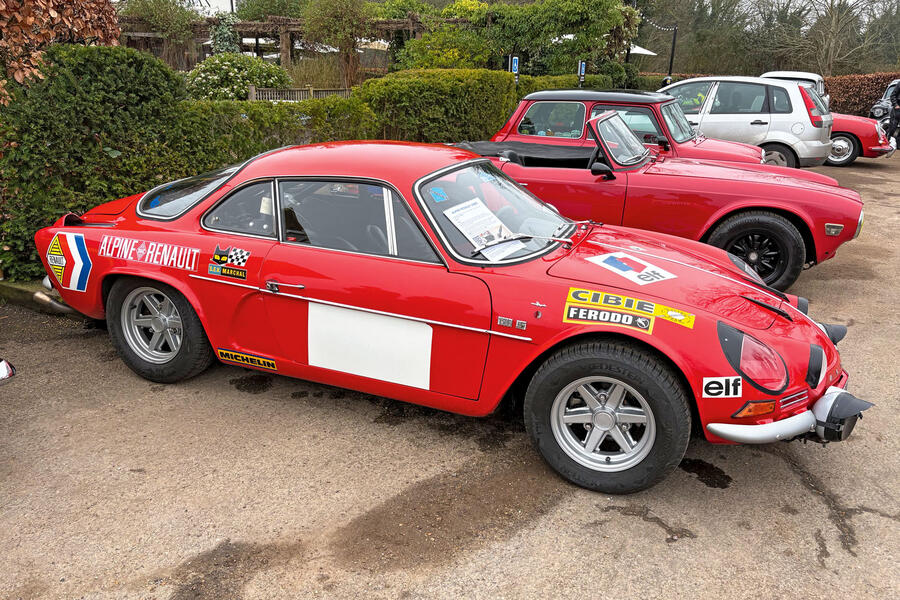
Its R8 Gordini cross-flow engine has been converted to works spec with larger valves, forged pistons, Saenz H-beam conrods, specially made wet liners, an in-period Renault 'Kit' camshaft and a finned aluminium oil sump. Thanks to all these goodies, the pushrod engine now produces around 130bhp at 7200rpm (in standard form it would have produced 80 horsepower), but when the rev limiter is raised to 8000rpm, it puts out 134bhp.
"It's a lovely, free-revving engine and, in a car weighing no more than 625kg, the power is more than ample," says Roger, beaming. All that sauce is directed to the rear wheels via a five-speed gearbox.
Elsewhere, the car has a quick steering rack and powerful works 'Big Brakes' with calipers at the rear from a Matra ("they were hard to find"). The wheels are Gotti Bi-Metal items with steel rims and cast aluminium centre spokes. The glassfibre body is mounted on a steel tubular chassis.
Of course, the car's motorsport tech is highly appropriate. The original A110 has an illustrious competition record, at the height of its powers locking out the podium of the 1973 Monte Carlo Rally and, the same year, winning the inaugural World Rally Championship.
Roger's 1300 S is a 1971 car. "It's hilarious to drive - noisy and quite physical," he says. "You need a good legful to stop it. The steering is very direct too. You don't lift off in corners because the back will come out immediately. Instead, you do a bit of lift-off to turn it in, then power out. Understanding how it will behave is key."
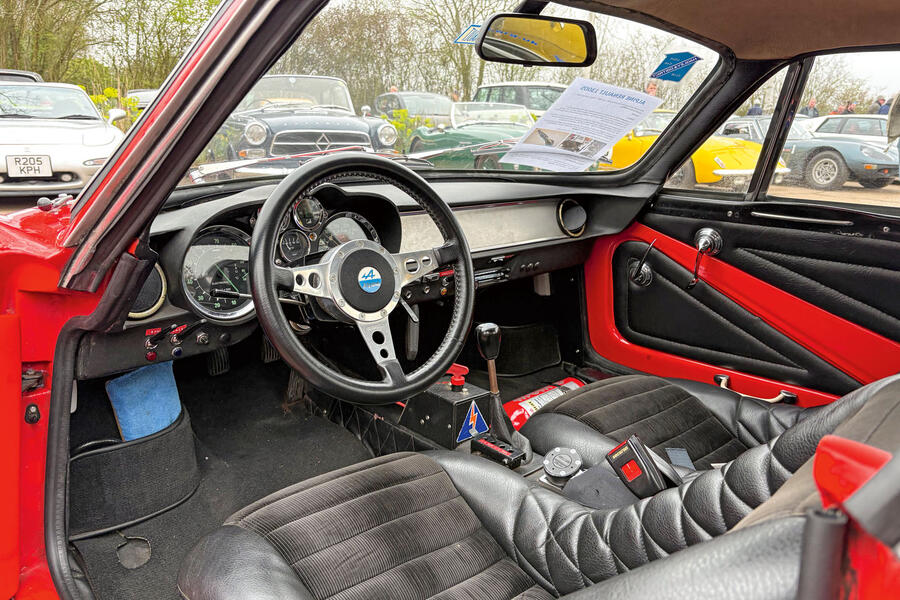
Roger loves his new A110 and has done 62,000 miles in it but is in no doubt which of his 110s he prefers. He says: "If I had to choose, it would always be the older one. It's just so engaging. I paid £20,000 for it in 2000 and now they're about £75,000. If I had to sell it, I'd get a lot less, but if I had to buy one, I'd have to pay a lot more! I think I'll stick."

Polaris RZR Pro R Boost Redefines Side-by-Side Performance With 275-HP Turbo Power and Advanced...

Destrier Reimagines Medieval Power Through Radical Race Car Design


Bugatti Destrier Reimagines Hypercar Luxury Through Sculptural Design and Historic Inspiration
 Firm's latest Solitaire one-off uses Bolide underpinnings to allow strikingly elegant, low-rise design
Bugatti has unwrapped the Destrier as its tribute to "the most beautiful car ever built", using the underpinnings of the Bolide to create the ultimate luxury hypercar.
The Destrier is the latest in the brand's run of multi-million-pound Solitaire one-offs, following the FKP Hommage (a reimagining of the legendary Veyron) and the Brouillard.
It's inspired by the Type 57SC Atlantic, which also utilised the same underpinnings as a track car – the Type 57G 'Tank' – but wore stunning coachwork that landed it a place in motoring history.
The Destrier is based on the carbonfibre monocoque of the Bolide and reprises its sibling’s 8.0-litre quad-turbocharged W16 engine, which puts out 1578bhp.
But despite the mammoth power output, performance wasn't Bugatti’s main ambition for the new hypercar. It instead sought to recapture the sheer desirability of the Type 57SC Atlantic, and the low-set chassis of the Bolide was instrumental in this ambition.
Design chief Frank Heyl explained: “The Bolide gave us the most extreme proportions we have ever created, and by freeing them from the Bolide’s relentless pursuit of downforce, we let them speak as pure sculpture.”
To that end, the Destrier is the shortest Bugatti yet, measuring just a metre tall. Its stance, with staggered wheels – 20in up front and 21in at the rear – is meant to resemble that of a pedigree horse.

Inside, it's a more overtly luxurious proposition than the Bolide, trading emergency stop and fire extinguisher buttons along its central control panel for ignition switches and being upholstered in tan leather, suede and copper thread.
Exact performance figures have yet to be confirmed, but the Destrier is likely to be a close match for the Bolide, which can dispatch the 0-62mph sprint in 2.2sec.
Its price has yet to be disclosed but is likely to run well into eight figures.
Like the Bolide, the Destrier will be allowed to drive only on race tracks or, more likely, concours lawns.
However, British specialist Lanzante recently converted a Bolide for road use, suggesting the same could be done for the Destrier if its owner so desires.
It will make its debut at the Pebble Beach Concours d’Elegance – and Heyl said he “believes Destrier will be gracing concours lawns 50 years from now”.

Aston Martin Sells Majority of Branding Rights to Secure Lifeline, Triggering Bondholder Backlash

Fleet Management Faces Prolonged Uncertainty as Policy Shifts and Electrification Reshape Operational Strategy
 Unstable policy, shifting tech and complex operations are the new normal, says one of UK's leading fleet bosses
Fleet managers need to prepare for years of unstable policy, shifting technology and complex operations, according to an industry expert.
Matthew Walters, head of consultancy at Ayvens UK – the country's second-largest leasing company, with 320,907 cars and vans on its books – told Autocar that fleet managers need to plan further ahead when selecting vehicles and adjust policies yearly to keep up with an unusually fast-moving operatig landscape, having traditionally operated in a sector favouring long-term stability.
Policy remains challenging, especially for electric cars. The Department for Transport has committed to a “mid-point review” of the UK's zero-emission vehicle (ZEV) mandate in 2027, which could affect vehicle supply. Annual EV sales targets from 2031 haven’t yet been confirmed.
Fleets are also facing a need to recalculate operating costs once the pay-per-mile tax system for plug-in hybrid and electric cars is finalised.
Walters expects that the 2030 deadline for new pure-ICE cars and the 2035 date for all new cars and vans to be EVs will go through a consultation process in the near future.
The uncertainty is such that Ayvens is running quarterly customer briefings on legislation, manufacturer developments and wider political and economic events that can affect fleets’ costs and the supply of vehicles.
“Larger fleets typically have dedicated teams and more resource to keep up with new products, tax rules and legislation. Smaller fleets don’t have the same capacity, so they’re more exposed when things move quickly, and right now things are moving quickly,” said Walters.
That complexity is exacerbated by fast-expanding vehicle choice, he added, noting that 116 new models are due for launch in 2026, many of which are from Chinese manufacturers.
Some fleets are welcoming these newcomers, while others – particularly larger corporate ones – are weighing up the technology against how that brand might represent the company.
Electrification also creates a more varied set of operating costs than with petrol and diesel cars. The gap between public and home or workplace charging prices means two drivers on the same job in the same car could be generating totally different expenses, while “fairness becomes a live issue” if one of them can’t plug in at home, Walters said.
That complexity has led Ayvens to offer more detailed total cost of operation (TCO) calculations, including driver efficiency, uptime and charging behaviour. Frequent charging beyond 80% can affect battery health and residual values when vehicles are auctioned at the end of the contract.
“What we'd say to fleets is 'build in flexibility; don't lock into rigid three-year plans on the assumption that today's technology, tax rules or residual values will hold, because in this market, that's usually where the opportunity is',” said Walters.
“Good practice now means moving away from short-term thinking. Rather than just planning for the next renewal cycle, fleets need a three-to-five-year strategy that's reviewed regularly, not set and forgotten. That way, decisions on vehicle choice, charging set-up and driver policy are made with the bigger picture in mind, not just the next 12 months.”

Mercedes-AMG GT 53 Expands Electric Super-Saloon Range with Lower Price and Longer Battery Life
 New dual-motor model trades performance and two synthesised cylinders for lower price and big range boost
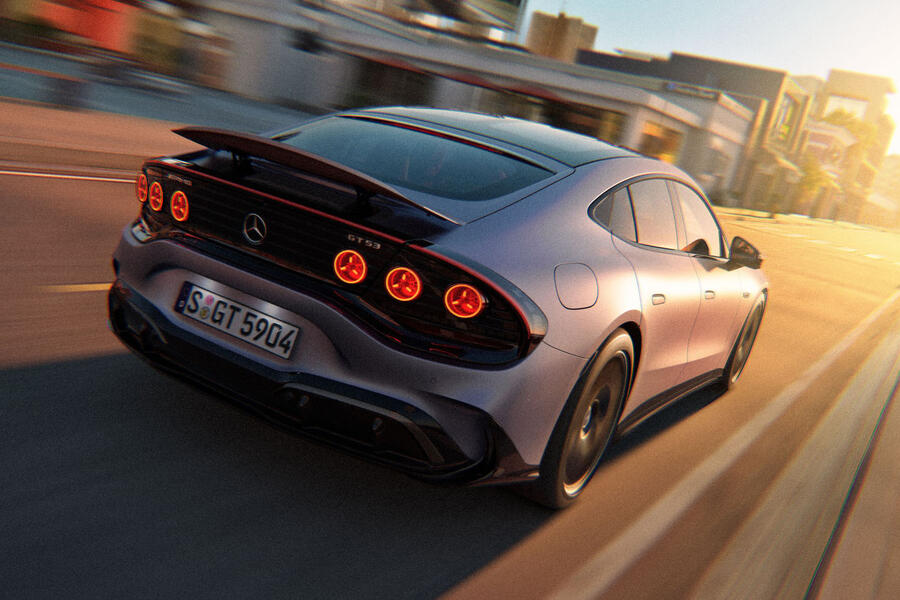
Mercedes-AMG has expanded its GT 4-Door Coupé line-up with the 53, a lower-powered and more affordable version of the new electric super-saloon to rival the Porsche Taycan 4S.
The biggest difference from the GT 63 lies in the drivetrain: it has one fewer motor (for a total of two, giving four-wheel drive), so its combined outputs drop from 1180bhp and 1033lb ft to 544bhp and 590lb ft.
This trims straight-line performance, the new GT 53 accelerating from 0-62mph in a claimed 3.5sec compared with 2.4sec for its more powerful sibling.
Top speed is electronically limited to 143mph as standard or 155mph with the optional AMG Driver's Package, whereas the GT 63 can be specified to reach a limited 186mph.
Although it retains the GT 63’s simulated engine and gearbox, it trades that variant’s fake V8 sound and power delivery for one based on a turbocharged 3.0-litre straight six.
AMG said it sampled the six-cylinder powerplant’s sound to reproduce the aural character of a traditional AMG drivetrain.
The GT 53 utilises the same 800V electrical architecture and 106kWh liquid-cooled battery as the GT 63, but dropping one motor has boosted its official range from 424 miles to 503 miles.
DC charging at up to 600kW is claimed to recover up to 332 miles of range in just 10 minutes under ideal conditions.
Compared with the Taycan 4S, the GT 53 offers identical combined power but an additional 66lb ft of torque, a 0.2sec quicker 0-62mph time, almost double the maximum DC charging capability and between 102 and 156 miles more WLTP range, depending on whether the Porsche is equipped with its standard Performance Battery or optional Performance Battery Plus.
The GT 53 also shares the GT 63's air suspension with adaptive damping and torque vectoring. It likewise receives active aerodynamics, including a rear spoiler that varies its angle according to speed and driving conditions, while an optional active rear diffuser is designed to reduce drag and improve high-speed stability.
The first right-hand-drive customer deliveries are expected to begin later this year.
UK pricing has yet to be confirmed but is expected to start just above £100,000. In Germany, it will be priced from €115,430 (£99,000).
The GT 53 will form the new entry point to AMG's electric GT range ahead of additional models planned over the coming years.

Toyota GR 86 Prioritizes Dynamic Refinement and Safety Upgrades Over Engine Changes in Latest...