Airline Policy Shifts Highlight Passenger Demand to Avoid Trump International Airport


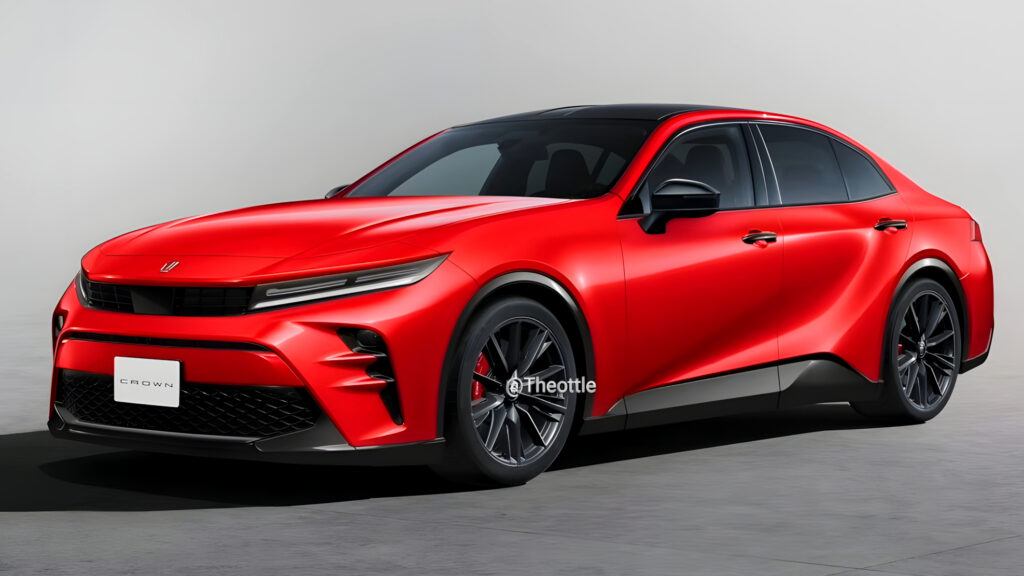
Toyota Crown Sports Sedan Concept Reveals Missed Opportunity for a Rear-Drive Performance Flagship

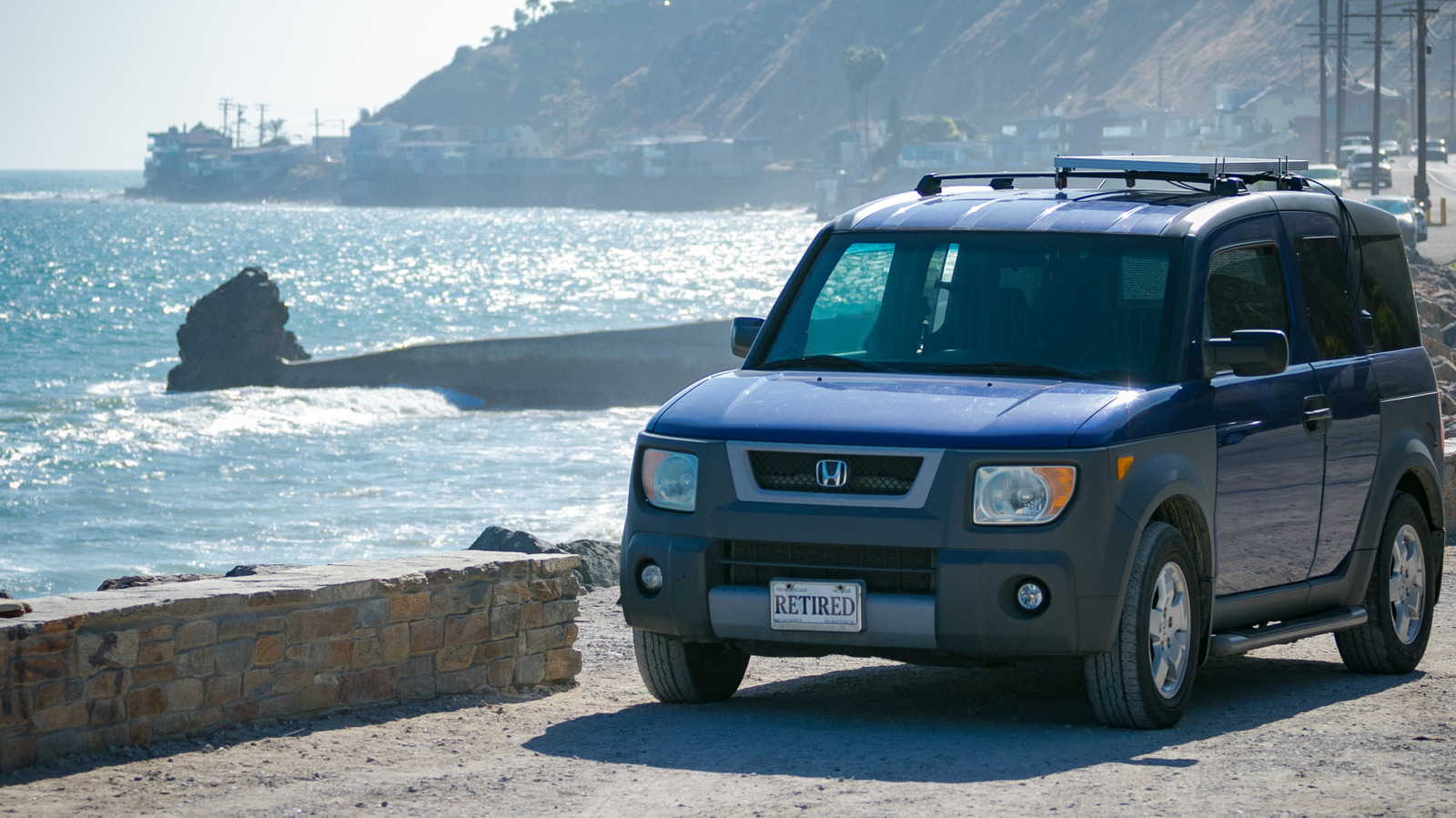
Beach Cars Reveal Surprising Preferences for Practicality Over Flash

Fiat 500e Price Cut Reshapes UK EV Market Amid Stricter Emissions Mandates
 Retro city car becomes UK's third-cheapest EV, while Abarth 500e hot hatch now starts from £24k
The Fiat 500e has become one of the UK’s cheapest cars after being approved for the top band of the government’s Electric Car Grant (ECG).
The ECG provides either £1500 or £3750 off the price of a new EV based on several factors, including the emissions from the production of its battery and the full vehicle, as well as several warranty requirements.
The new £3750 discount on the 500e cuts its starting price to £17,245 – which makes it cheaper than the forthcoming 500 Hybrid by £1750.
Indeed, the only cheaper cars currently on sale are the Kia Picanto (£17,095), Dacia Sandero (£14,765), Leapmotor T03 (£12,995) and Dacia Spring (£11,995).
The significant cut in the 500e’s starting price will come as welcome news for Fiat, which has so far struggled to find a market for the model.
Autocar understands fewer than 1000 examples were registered in the UK last year. Meanwhile, Fiat’s sales for the first half of 2026 were down by 39% compared with the same period last year, to 3748.
Improving the sales performance of the 500e will prove crucial as Fiat looks to comply with the UK’s zero-emission vehicle (ZEV) mandate, which requires car firms to increase the proportion of EVs they sell here annually.
This year, every one in three cars sold by a firm must be electric. Alternatively, it must sell a sufficient number of low-emissions ICE cars to convert savings in emissions into ‘credits’ that can be traded for de facto EV sales.
Manufacturers that do not meet their targets face penalties of £12,000 per combustion-engined car sold over their allowed quota.
The majority of Fiat’s UK sales this year have been mild hybrids, Autocar understands. Ramping up sales of the 500e would give the brand crucial flexibility to sell its most popular cars, such as the mild-hybrid 600 crossover. It will also be instrumental in allowing Fiat to expand its range with new offerings such as the pure-petrol, manual-gearbox Grande Panda.
The 500e is due to be updated next year in a bid to make it more competitive with the new wave of small European EVs, such as the Renault Twingo.
It's earmarked for a revised battery pack with a greater energy density (therefore capacity), which should improve its range from the current 118 miles in Urban Range form or 199 miles in Standard Range guise.
The latter car now starts from £20,245, following the 500e’s qualification for the ECG.
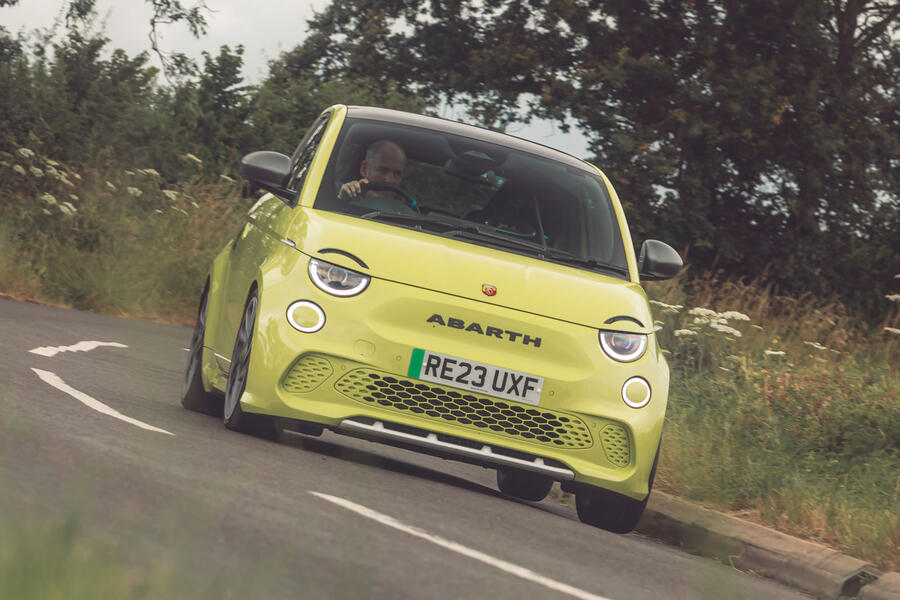
The Abarth 500e hot hatch – built in the same factory in Pomigliano, Italy – now also qualifies for the £3750 grant, cutting it to £24,245.

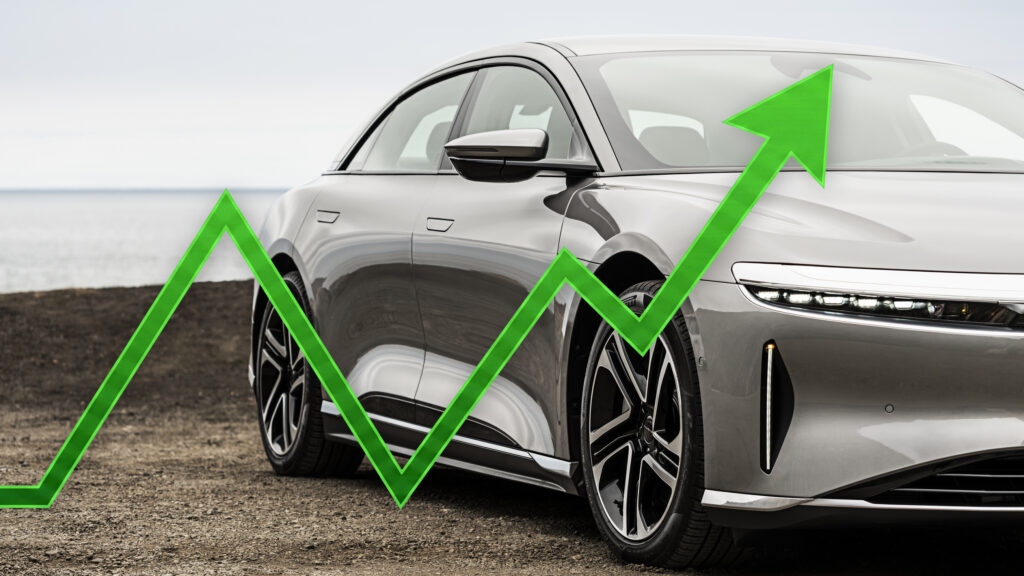
Lucid Confronts Bankruptcy Rumors With Legal Threats as Stock Volatility Exposes Investor Nerves

Army Vehicle Modernization Weighs Humvee Replacement and Strategic Mobility Needs


Aston Martin Dreadnought Reimagines the Off-Road Supercar as Military-Inspired Concept for Virtual and Real...
 New Dreadnought 4x4 melds V8 Vantage looks, V12 power and – hang on, is that an airstrike button...?
Aston Martin has revealed a wild new military off-roader as a virtual concept for the new Call of Duty videogame - but Autocar has been up close with the real thing.
Making its debut at a gaming convention in New York, the Dreadnought is named for a revolutionary British warship from the early 20th century - which tallies with its hulking, functional design and battle-ready conception.
Measuring just under five metres in length and 2.1 metres wide, the Dreadnought is slightly smaller in footprint than a DBX - but far more imposing.
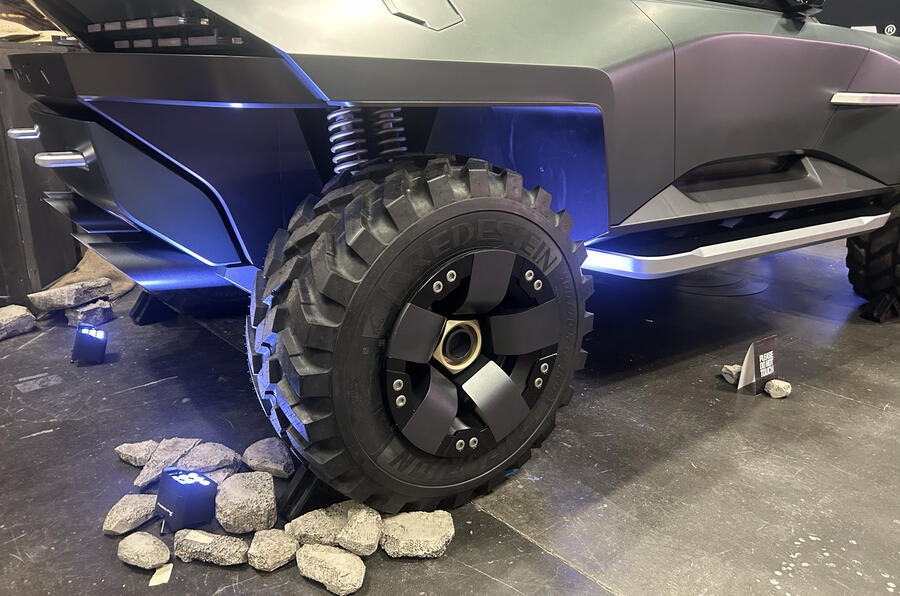
It is (virtually) powered by the same 824bhp twin-turbo V12 as in the Vanquish GT, and while Aston has not revealed any performance stats, the huge JCB tyres, Dakar-style dual-shock suspension and lofty ride height should mean it can maintain supercar levels of pace across all types of terrain.
Nods to other models in the line-up include the Valhalla-style quad-exit exhaust, the Valour-inspired rear deck and the brake lights, which are modelled on the Valkyrie's. It's also finished in Chiltern Green – a signature colour that Aston has offered on its cars since the DB7 launched in 1994 – and features fog lights in its grille, like the original V8 Vantage.
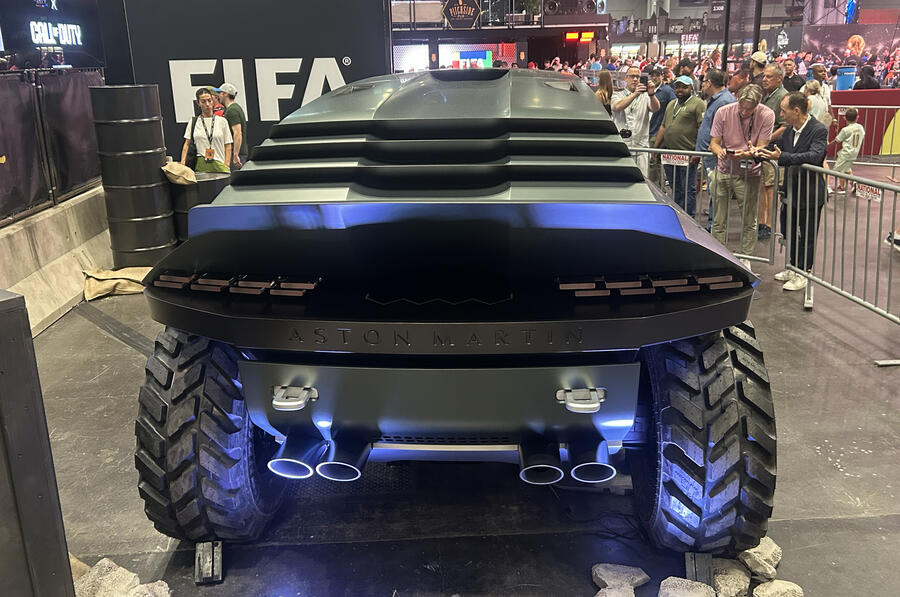
The twin tow hooks, LED light bars and exterior grab handles – to allow the two-seat Dreadnought to carry as many troops as possible – are all bespoke to the concept, though.
Autocar understands that even though the Dreadnought's designers were unconstrained by legislation, they kept the real world in mind - and it could hypothetically be made real by Aston's bespoke division upon customer request, like the one-off Victor supercar from 2020.
As it is designed for the (virtual) battlefield, it is markedly less luxurious inside than any real-world Aston Martin, placing greater emphasis on functionality. A large screen displays the driver’s speed, direction, pitch and roll and – because the Dreadnought has been developed for the latest Call of Duty video game – how many opponents the driver has eliminated. This function is unlikely to make it to any future production car.
In keeping with the broader industry’s return to physical buttons, the Dreadnought has a suite of toggles and switches for easy access to the most commonly used functions: raising its bulletproof shield, priming the external guns, or calling in airstrikes.
There is also dedicated assault rifle storage inside the doors, and the traditional cup holders in the centre console are swapped for a grenade rack.
While the Dreadnought has no direct production intent, many car makers have used videogames as a platform to preview shifts in design - including Aston itself, which previewed the Valkyrie with the DP100 racer for Gran Turismo in 2014.
An Aston off-road supercar is also not as incongruous a concept as it may sound; Autocar reported in 2024 that the firm was mulling a super-4x4 to rival the Mercedes-Benz G-Class. That car was internally referred to as Project Rambo.

Humanoid Robots Reshape Hyundai’s Factories as Labor Tensions Mount Over Automation’s Advance


BMW M3 Evolves With Manual Option and Distinct ICE-EV Choices Amid Regulatory Pressures
 Super-saloon will be offered with both electric and combustion power – and a manual is still on the cards
The combustion-engined version of the next-generation BMW M3 has surfaced in tests at the Nürburgring – and the super-saloon could continue to offer a manual gearbox.
Speaking to Autocar at last week’s Goodwood Festival of Speed, BMW M boss Frank van Meel said the division's petrol performance cars will offer manuals for “as long as possible”.
He highlighted that sales of the smaller M2 coupé in the US – a market traditionally dominated by automatic gearboxes – are actually split 50:50 between autos and manuals.
He also pointed to the engagement fostered by rowing your own gears: “We want to have this mechanical connection, shifting by yourself. It's an emotional thing, it's not just an engineering thing, and it's still there.”
But offering a stick shift in a mainstream car is becoming harder, van Meel added: “The supplier base is getting smaller, and with all the driver assist systems it's getting more difficult to disconnect the drivetrain. Then you're disconnected from your driving assistance system as well as all the mild hybridisation systems.”
Yet this “doesn’t mean it isn’t possible”, he said, adding: “We intend to keep the manual as long as possible.”
M3 keeps its signature straight six
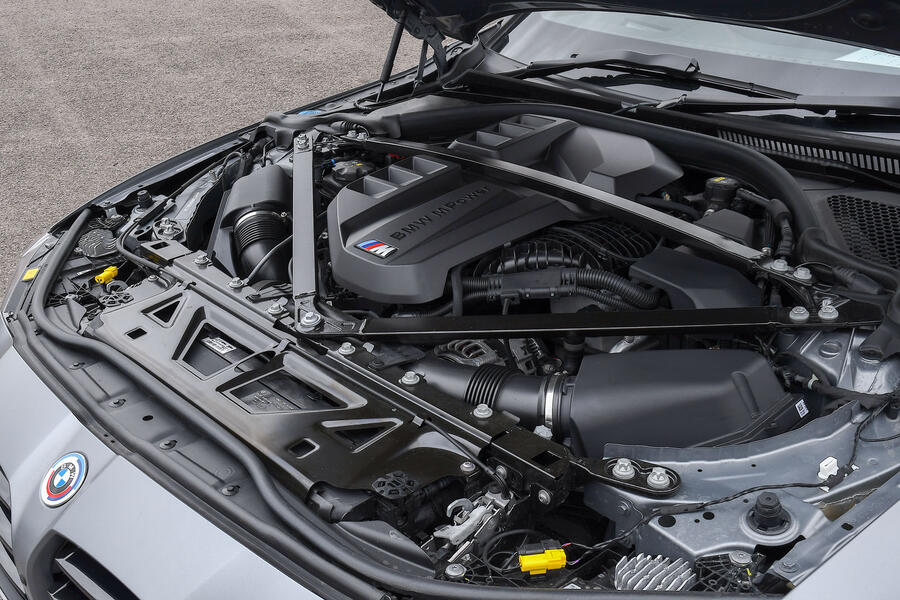
In either case, key to the appeal of the next combustion-engined M3 will be the retention of its turbocharged 3.0-litre petrol straight six.
This diverges from the path followed by BMW's German rivals: the Audi RS5 kept the RS4's 2.9-litre V6 but added plug-in-hybrid hardware, while the Mercedes-AMG C63 moved from a V8 to a four-cylinder PHEV system.
BMW's ‘S58’ engine, also used in the M2 and M4 coupés, was recently updated to meet the Euro 7 emissions standard in a significant engineering effort.
It was redeveloped for pre-chamber combustion, in which a small amount of fuel is detonated in a small space just before the fuel reaches the main cylinder. This creates a highly energised 'jet' that then lights the fuel in the main chamber.
This, BMW claims, is much quicker than a traditional spark plug, which brings several benefits. Chief among them is increased greater energy efficiency, and therefore greater fuel efficiency, which reduces emissions.
Van Meel told Autocar last year: “The whole story is about driving with lambda one [when the air-fuel ratio for combustion is perfectly matched], so you have to keep that. And there's no cooling; normally, if you are in high-performance situations, you cool using the fuel. With Euro 7 that’s impossible, so you need to find different ways of avoiding temperature build-up.”
The new combustion process also helps to alleviate premature fuel detonations (knock), which allows it to be run at a higher compression ratio, thereby boosting power.
The updated engine also gets new variable-geometry turbochargers.
These measures meant BMW could mitigate any loss of power from adjustments made to meet the requirements of Euro 7 – and the firm claims they also create a throatier induction and exhaust sound at high revs.
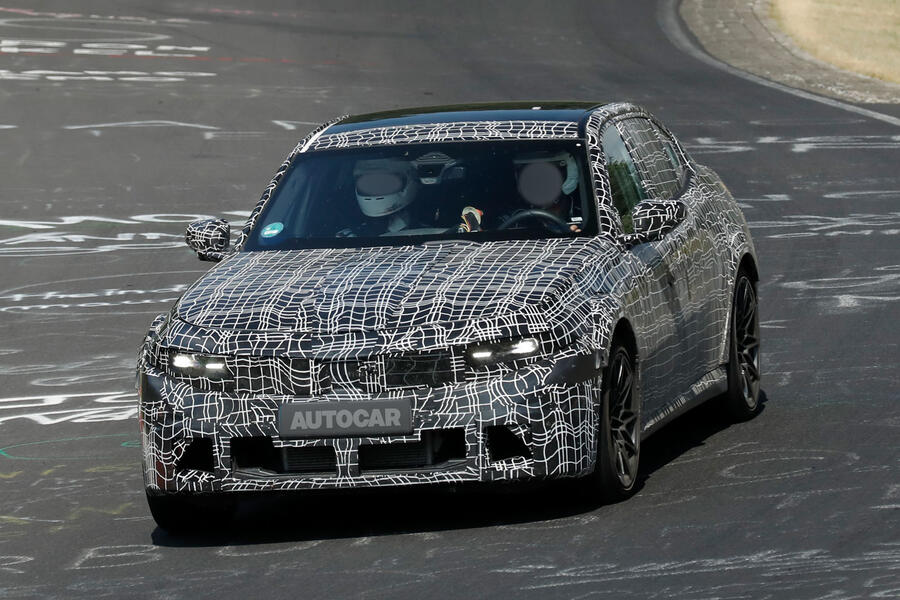
BMW has previously confirmed that “power outputs will be unchanged from those of the corresponding outgoing engines”. For reference, the current M3 puts out 523bhp and 479lb ft of torque.
Speaking to Autocar last week, van Meel said: “We're leading with the M3 today and we're not going to give that up. That's why we first said [at the start of the development programme] that we’re going to bring the current engine to the EU7 level; then that’s already done.
"If we look into the next-generation M3, we already have the drivetrain. The engines are already there, and we are of course already working on the combustion-engined M3 as well; that's in the books.”
Van Meel added that he is “confident we can keep up the power” but highlighted cooling as an issue brought by the new engines: “If you go on track, of course, temperature is an issue. We improved cooling to counteract; the challenge with the big engines and the big coolers that they need to be even stronger."
This manifests in the large open grille at the front end of the next combustion-engined M3, behind which a large intercooler is stashed.
Asked by Autocar whether there is still potential to improve ICE performance cars, in light of tightening regulation and investment being diverted to electrification programmes, van Meel answered: “Yes.”
Choice of ICE or EV is key
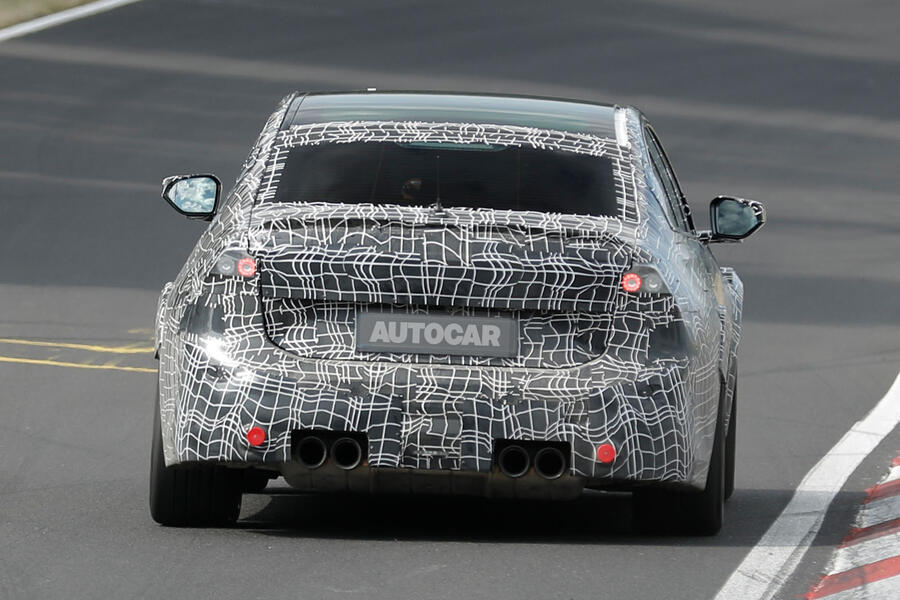
Although the petrol and electric derivatives of the next M3 will be based on different architectures, effectively making them two completely distinct cars, the ICE car will have the same styling as the EV.
The design of both cars was previewed with the recent M Concept Neue Klasse. Key differences include the large front grille but also a smaller rear diffuser.
The electric M3 will take advantage of the lack of an exhaust by maximising the size of its underbody aerodynamics, but this will not be possible for the ICE car, which retains a quad-tip exhaust.
Van Meel pointed to the updated engine as an example of how M will negotiate the years to come and said it's important to offer customers a choice between combustion engines and EVs.
He elaborated: “There might be customers who say ‘I want to have a combustion engine because I like the sound or the exterior or I cannot charge’. That’s fully okay. If you are into racing or driving dynamics, you might [prefer] the electric one. I always say in case of doubt, buy both: the combustion-engined one and the electric one, and then you can make a new choice every day.
“But the customers [for both versions] will actually be the same, and they can choose like they can today: they can choose if they buy an M2, M3, M4 or an M Performance model. Now they can choose: ‘Do I want to drive electric or combustion?’ We promise the way the car drives and the way it makes you feel is always there.
“We bring this decision-making process to the customer, not to us. We just want our offering and the customer can decide.”
To that end, BMW M sales boss Sylvia Neubauer recently told Autocar the ICE M3 will be priced in the “same ballpark” as the EV.
“Obviously we will not convince 100% out of the petrolhead target group to buy an all electric BMW M3,” she said. “But out of 100 people that try it, we will be able to convince some. And for everybody else, we will still provide combustion engines.”
Neubauer added: “There will be functional differences that lead to a different design in some areas of the car, but when you look at them, you will see that they are twins.”
M3 Touring to return
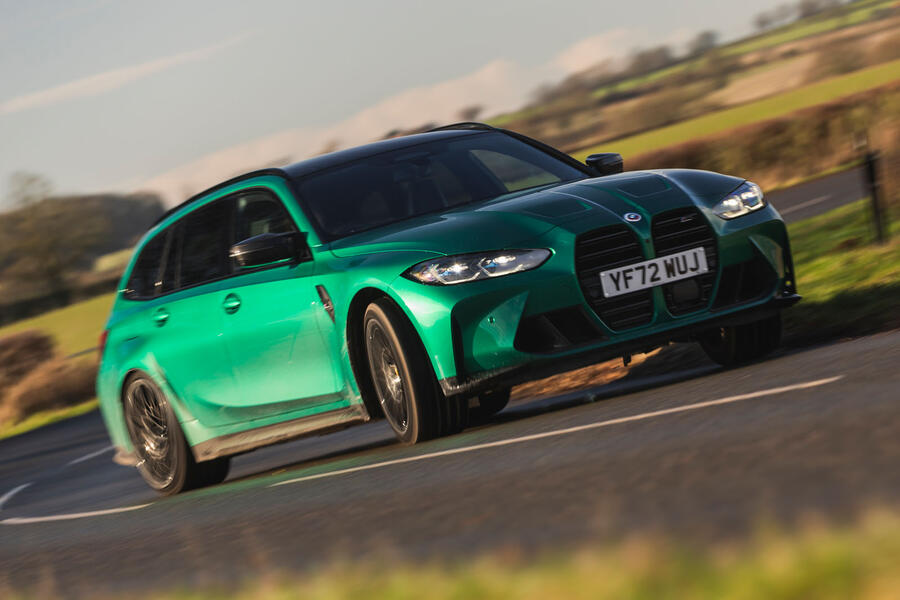
The Touring estate is expected to remain part of the M3 line-up.
"The M3 Touring is one of the best models that we have in our portfolio," said Neubauer.
She added that it had been an unexpected success in China, while the larger M5 Touring had exceeded sales expectations in the US. Neither market had typically been big on BMW’s estates.
Indeed, the M3 Touring is the only way to buy a 3 Series Touring in China.

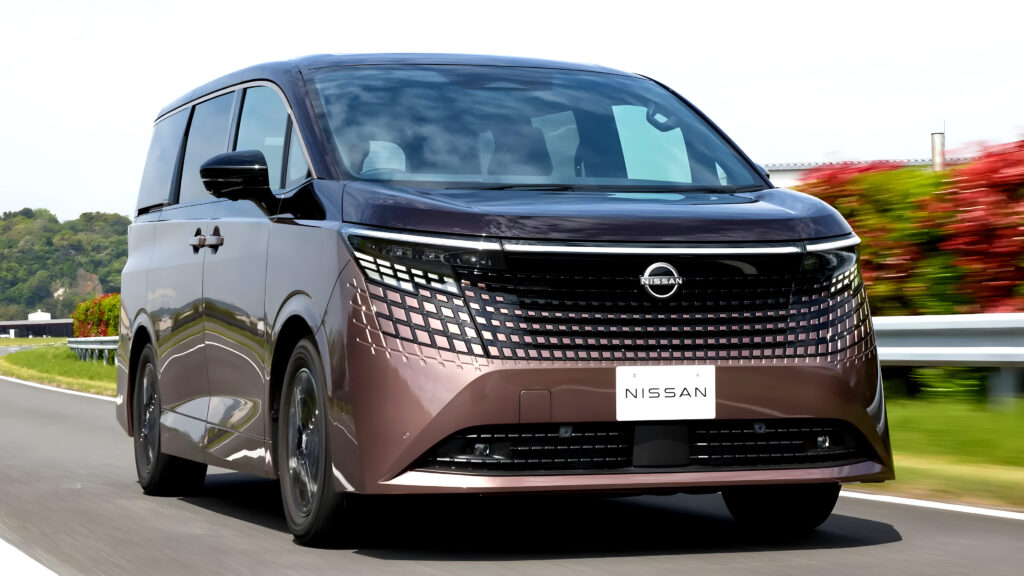
Nissan Elgrand Reinvents Japan’s Luxury Minivan Segment With Bold Design and Hybrid Innovation