Ruf Flat-Eight Supercar Prototype Signals Breakthrough in High-Performance Engine Design
 Legendary Porsche fettler adds a pair of cylinders to 911's flat six for monstrous power – and noise
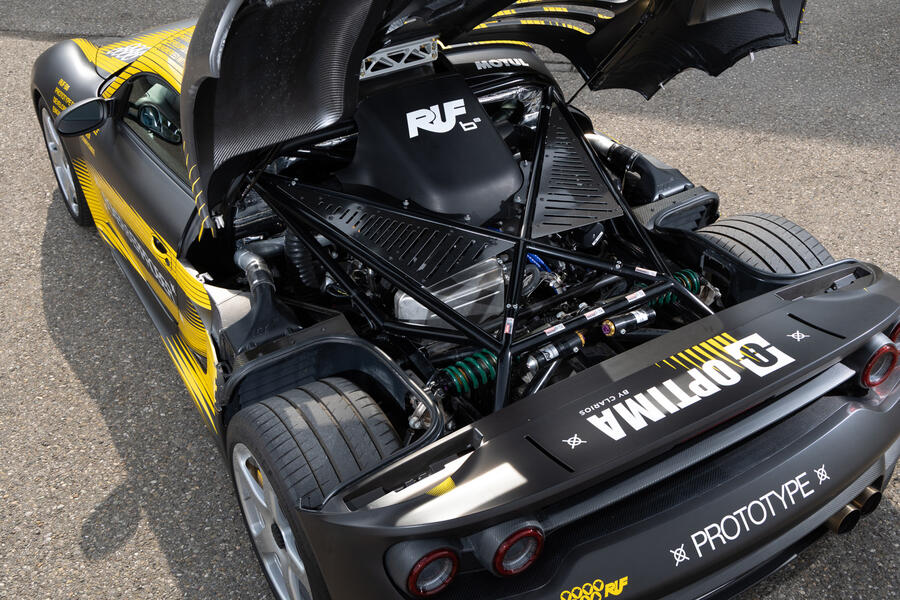
Storied Porsche tuner Ruf has taken to the Goodwood Festival of Speed to show off a wild new prototype supercar with a flat-eight boxer engine.
Known as the B8, the mule is powered by a twin-turbocharged 4.8-litre horizontally opposed lump at its rear - the same format as the 911 has always used – but with two extra cylinders.
Ruf claims it develops more than 986bhp and 737lb ft of torque - far more than the six-cylinder CTR3 on which the new car is based.
Ruf refers to the prototype internally as the Erprober ('tester'), which is reflective of the fact that it is "not yet a production model but serves as a dedicated testbed for technologies that will shape a future Ruf model".
The German company said that all its cars begin life "long before the world sees them", so it's likely that work on a production-ready flat-eight car is well advanced.
Ruf noted that neither it nor any other company has deployed such an engine "in this form" and said the prototype's appearance at Goodwood was "a new chapter in automotive history".
The test mule itself gives few clues to the eventual production model, being largely identical to the CTR3 on which it is based but extended by 100mm to accommodate the longer engine block.
The engine sends its generous reserves to the back axle through a six-speed manual gearbox, but Ruf hasn't said whether this configuration will carry through to the final car.
Of special note is the B8's striking livery, which features a distinctive graphic in Blossom Yellow - a shade inspired by Ruf's best-known model, the Nurbürgring-slaying CTR Yellowbird.
Porsche itself has experimented with this unusual engine arrangement in the past, creating a concept for a 918 Spyder successor called the 904 (below), which would have used a 5.0-litre flat eight producing around 750bhp and 738lb ft.
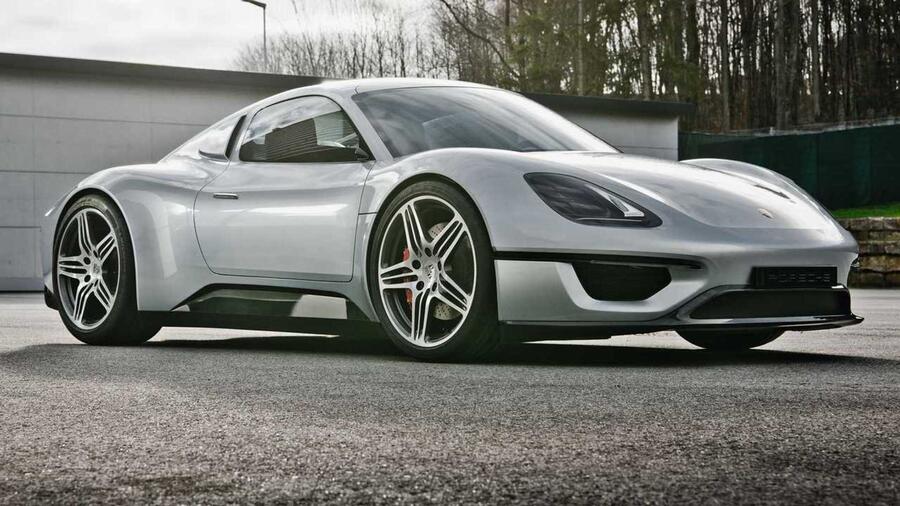
The concept was created in 2016 but never evolved into a production car and was only made public in recent years as part of an exhibition of unseen Porsche show cars.

Mitsubishi Dealer Lawsuit Challenges Toronto Police Over Collapsed Auto Theft Case and Career Ruin

O’Reilly’s $10 Billion Bid for Napa Signals Potential Shift in Auto Parts Market Power

Driver Monitoring Systems Redefine Car Safety in Europe as Privacy Risks and US Adoption...


Mercedes-AMG’s Advanced Electric Powertrain Signals Performance Shift Beyond the CLA45

Gunther Werks F-26 Pushes Porsche 911 Legacy to New Limits in Goodwood Hillclimb Challenge
 Race-honed, £1.2m recreation of a Porsche legend will go for gold in the hillclimb shootout this week
Californian Porsche tuner Gunther Weeks will bid for class victory on the Goodwood Festival of Speed hillclimb this week with a 1000bhp-plus reimagining of the iconic Porsche 911 Slantnose.
Project F-26 – numbered for the amount of examples that will be built, at around £1.2 million apiece – is a fighter jet-inspired recreation of the distinctive 935 Slantnose of the 1970s, based on the 993-generation 911.
It's powered by a twin-turbocharged (but still traditionally air-cooled) Mezger 4.0-litre flat six, co-developed with a racing firm to produce a colossal 1067bhp – a little more than the Ferrari 849 Testarossa, for reference – and some 750lb ft of torque.
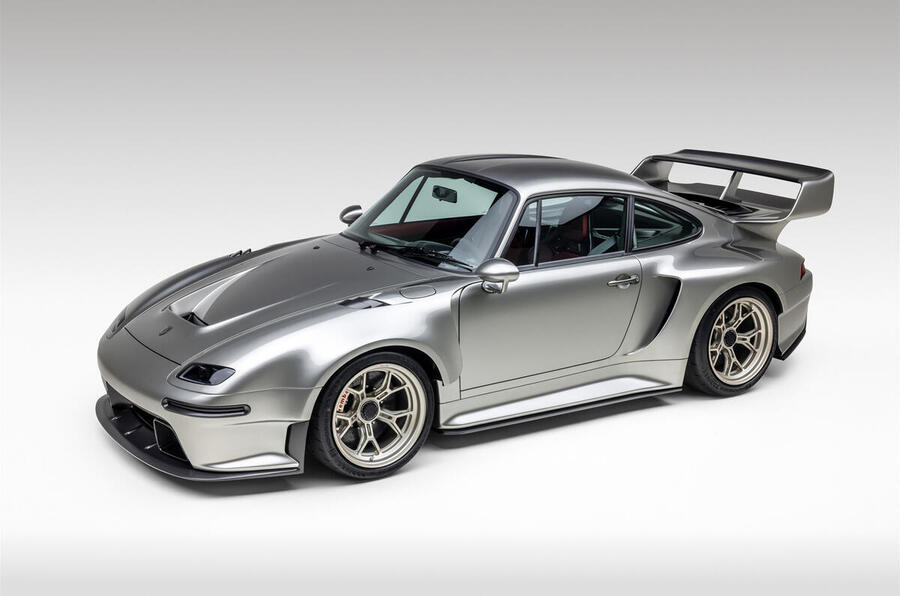
Sent through a six-speed manual gearbox and limited-slip differential to the rear axle, those outrageous reserves should be good for true supercar performance figures, given the carbon-bodied F-26 weighs only 1225kg dry - less than a Lotus Emira.
Gunther Works is hoping it will take the fastest time in its class when it runs up the hill at the Sussex festival next weekend, with ex-Formula 1 and Nascar driver Scott Speed at the helm.
The company will field the F-26 in the production road car category, the fastest of which at 2025's event was the Koenigsegg Sadair's Spear, which ascended the 1.16-mile climb in just 47.14sec.
The outright hillclimb record is still held by Gloucestershire-based McMurtry, whose 1000bhp electric fan car, the Spéirling, went from bottom to top in 39.08sec in 2023 - a record that's unlikely to be broken for some time.

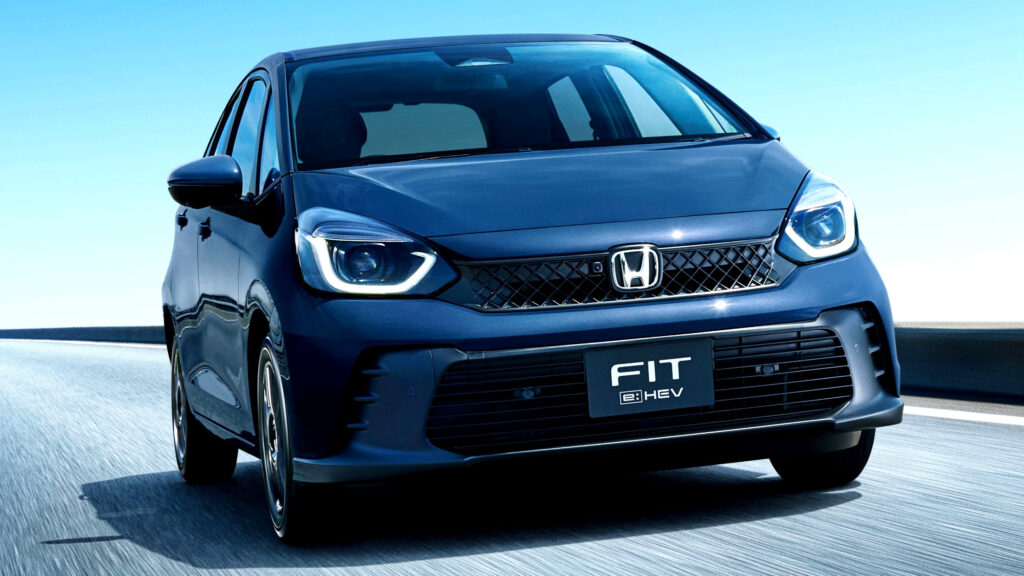
Honda Fit Marks 25 Years in Japan With Hybrid-Only Flagships and Refined Trim Strategy

Race Car Drivers Readers Would Befriend Reflect Diverse Generations and Series

Mercedes-AMG CLA 45 Redefines Electric Performance with 671bhp, Supercar Acceleration, and Immersive ICE-Inspired Dynamics
 CLA 45 goes electric with supercar-baiting pace, choice of saloon or estate and 416-mile range
Mercedes-AMG is aiming to convert hot hatch buyers to electric power with the new CLA 45, which brings supercar-baiting performance, advanced torque-vectoring technology and an ICE-aping exhaust note that even pops and bangs.
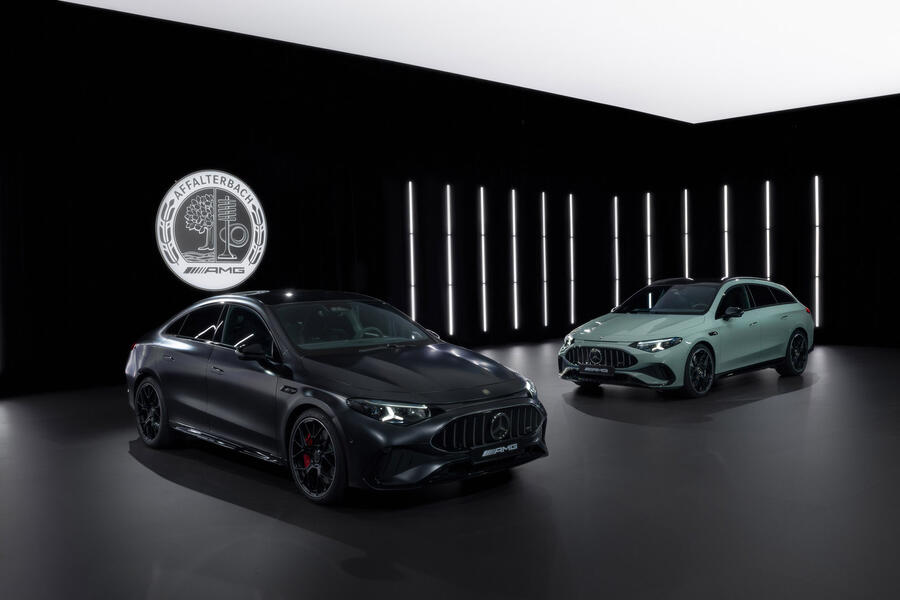
Available as both a saloon and a Shooting Brake estate, the first electric 45 model is substantially different under the skin from the regular CLA. It combines three axial flux motors developed by Oxfordshire firm Yasa with the larger, 94kWh battery from the forthcoming C-Class Electric and an aggressive design overhaul aimed at improving downforce without compromising range.
The tri-motor set-up - with two drive units on the rear axle and one up front - has a maximum output of 671bhp through all four wheels. The rear motors alone can combine to offer the full output, however: power is limited by the maxmimum throughput of the battery, and future updates could unlock more. This also enables a tyre-shredding drift mode.
The front motor engages only when extra traction is required, such as when setting a hot lap or driving in adverse conditions.
The generous reserves mean the 2.3-tonne saloon can hit 62mph from rest in 3.0sec (3.2sec for the Shooting Brake). That makes it quicker off the mark than many of AMG's most hardcore models, including the SLS AMG Black Series (3.6sec), and almost as quick as the F1-engined AMG One, which took 2.9 sec. The CLA 45 goes on to a top speed of 155mph, or 168mph when fitted with the optional AMG Dynamic Plus pack.
Acceleration is slowed slightly if the 'AMGForce' simulated engine and gearbox are engaged. This system replicates the sound and power delivery of the outgoing 45 models 'M139' turbocharged four-cylinder - the world's most powerful of its configuration in series production - and runs it through a synthesised eight-speed gearbox.
Vibrating motors are fitted in the front seats to ape the rumble of the petrol engine in the occupants backs, and the sound can be heard both inside and outside the car, with pops and crackles on the overrun. It has both quiet and loud modes, and Mercedes says the latter rivals aftermarket exhaust systems for audible impact.
The system engages when the S+ drive mode is selected, but it is disabled in the track-focused Race mode to maximise the car's outright pace.
AMG has also developed a predictive battery management system that maximises performance over the course of a fast lap by adapting power outputs based on where maximum performance is most needed: deploying full power around the entirety of a longer track would raise battery temperatures and force the car to limit its output, paring it back through bends reduces the heat and allows maximum thrust to be delivered for the length of a long straight, such as the Nordschleife's Döttinger Höhe.
Braking is performed primarily by the electric motors, which can supply up to 300kW to the battery. The hydraulic system has also been upgraded, with 390mm ventilated discs and six-piston calipers up front, and 350mm ventilated discs with single piston calipers at the rear.
Completing the dynamic overhaul is a wider track, which stretches the CLA by 24mm horizontally compared with the standard car, plus adaptive dampers and an active rear spoiler.
The rear spoiler and more aggressive stance clearly differentiate the car from the regular CLA, but further stylistic tweaks include the optional replacement of the front light bar with a new air duct, giving a more purposeful look. It rides on 19in alloy wheels as standard, although 20s will also be offered, and at the rear end is the largest diffuser yet fitted to an AMG hot hatch.
In the Eco, Comfort and Sport drive modes, the spoiler is reclined until 90mph in order to reduce drag and preserve range, but it is permanently raised in S+ and Race. Its position can be overridden using the steering wheel controls.
The CLA 45 saloon is claimed to be capable of covering 416 miles between charges, while the Shooting Brake manages 398 miles. This is thanks in part to not only the large battery but also a system that disconnects the front motor when it is not needed, which reduces energy waste from friction. In the normal drive modes it is disconnected up to 100mph or until additional traction is required at the front axle, at which point it engages within one millisecond.
A heat pump is also included as standard. When using the CLA's built-in sat-nav, this automatically pre-heats or cools the battery before reaching a planned charging stop to maximise the charge rate accepted by the car. This allows it to take 330kW, allowing a 10-80% refill in 22 minutes - or, according to Mercedes, the equivalent of 168 miles of range in 10 minutes.
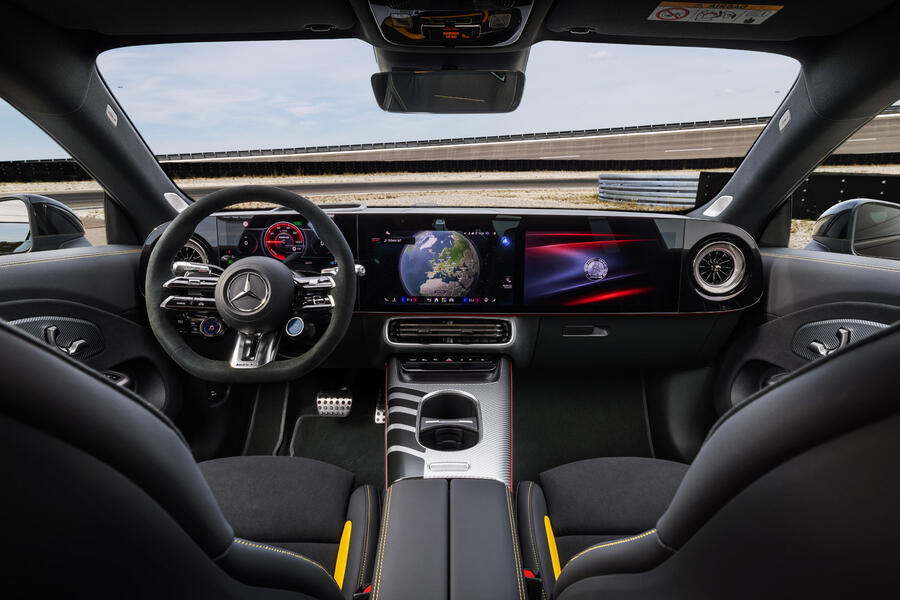
Inside, the CLA's sporting overhaul comprises standard-fit bucket seats with thick bolsters, new finishes for the centre console and seatbelts and an AMG-specific steering wheel with drive mode dials. Notably, it also swaps the rear-seat bench for two individual rear chairs, making it strictly a four-seater.
Deliveries of the CLA 45 will begin next year. Prices have yet to be confirmed but are expected to top £70,000, given the previous petrol-powered car started just below that mark. Its closest competitor will be the Hyundai Ioniq 6 N, priced from £65,800.

MG Go Concept Reimagines Affordable Electric Hatchbacks With Heritage-Inspired Design Aimed at the Renault...