

Fiat Multiplina Reimagines Urban Mobility with Retro-Inspired Four-Seat Electric Microcar

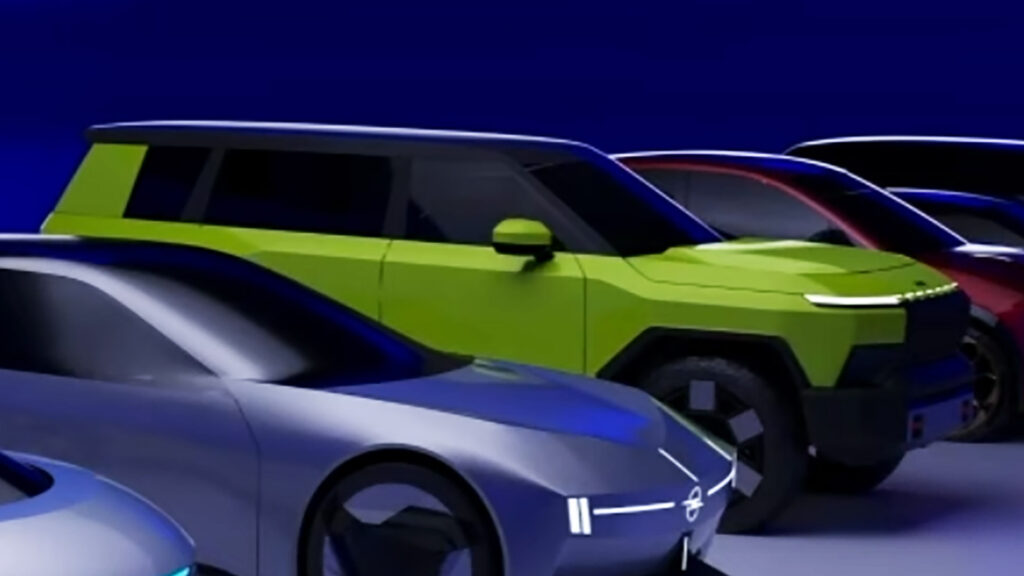
Multiplina concept was previewed in a Fiat presentation, and enhanced here by AutocarMultiplina is a four-seat sibling to the Topolino – with the same footprint as the original Fiat 500
Fiat will launch a new tiny four-seat EV called the Multiplina, which will feature retro styling cues and be around the same size as the 1950s 500, as part of its continued focus on small vehicles.
The new urban runabout has been previewed with the Multiplina Concept, shown during a micromobility event at the Vatican City.
The 2028 production version will sit above the Italian firm’s current two-seat Topolino but below the current Fiat 500 and the affordable electric city car due to be shown later this year.
Plans for a four-seat microcar were first hinted at with mention of a new 'Quattrolino' model during a Stellantis strategy presentation last month.
Fiat boss Olivier François showed an image of the new Multiplina (enhanced above by Autocar) during a presentation and said it would be revealed later this year, likely at the Vatican in October or November.
François said the Multiplina would “be super-important for us, because it's really the missing link between Topolino and the traditional city car”.
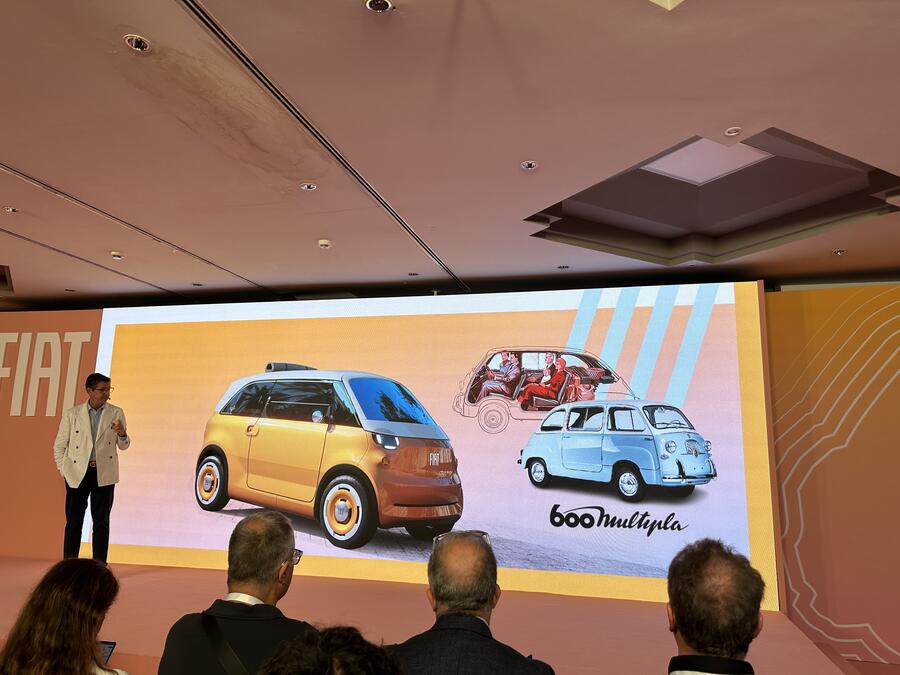
The new Multiplina concept takes its name from the 600 Multipla of 1956, which Fiat called the “original people mover”, but the firm also noted that it has a similar footprint to the 500 of 1957. That would make it just under three metres in length, compared with 2.53m for the Topolino.
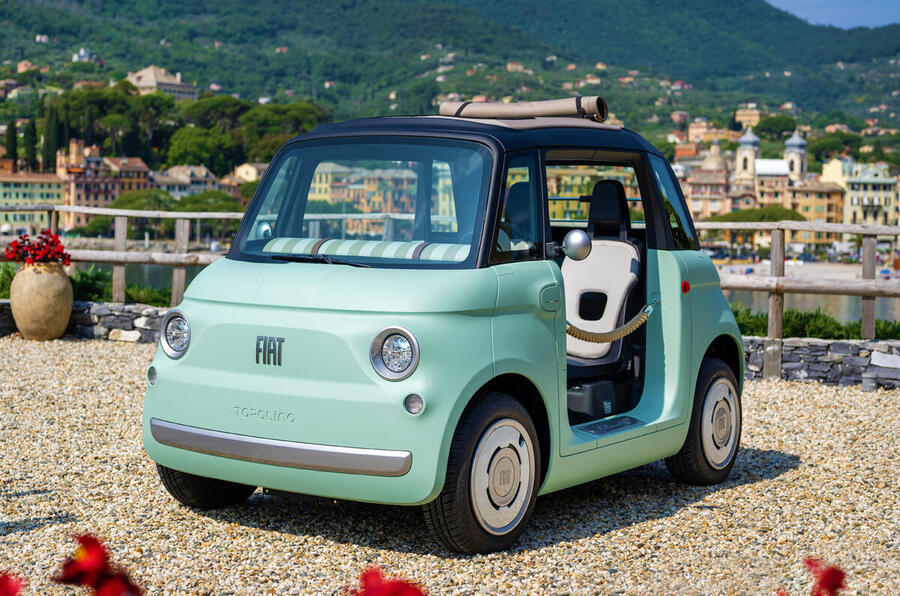
While the Citroën Ami-based Topolino sits in the L6 quadricycle category, the Multiplina will be built to the L7 regulations, allowing it to be more powerful and faster.
The Topolino is limited to 28mph and gets a range of around 46 miles from a 5.4kWh battery, but Fiat claims the Multiplina will be able to reach a top speed of 55mph – the maximum allowed under the L7 regulations – and offer an “extended range”, which should make it a far more versatile offering, able to operate outside of city centres.
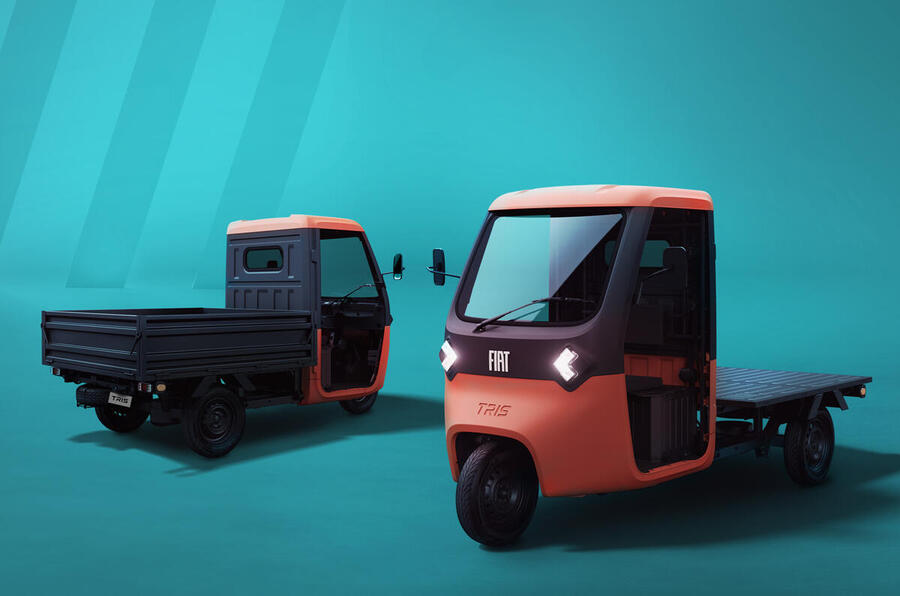
The Multiplina will use the same basic platform as the Topolino and the three-seat Tris commercial vehicle, but this will be extensively reworked to offer more space, range and a larger battery.
The styling of the new concept makes clear callbacks to the original 600 Multipla, including the overall silhouette, vertical nose and round headlights.
François said it would “play a lot on our DNA and be rooted in our style”, adding that it shows that “Fiat will be the brand within Stellantis that will really go all in on micromobility”.
The expansion into ‘urban mobility vehicles’ – the category below full-sized cars – is part of Fiat’s continued focus on small and affordable vehicles, centred around the existing 500 and Panda, the latter of which continues to be sold in Italy.
The forthcoming Grizzly is a Dacia Duster-rivalling C-segment SUV and will be the largest vehicle the firm will produce.
The Topolino was launched three years ago in italy but is only now being introduced in the UK, where it will be priced from £8995.
Commercial division Fiat Professional also now offers the Tris, a three-wheeled commercial delivery vehicle.
Fiat to help Vatican go electric
Fiat has also agreed a new partnership with the Vatican City State, the world’s smallest country, to provide dedicated fleet of 30 light electric micromobility vehicles.
The mix of Topolino two-seaters and Tris trucks will be used to support daily operations in the city state, an enclave within the Italian city of Rome. The home of the Catholic church measures just 0.19 square miles.
The new vehicle fleet is intended to help the Vatican City State meet its goal of a zero-emissions vehicle fleet by the end of the decade, as part of a programme called Ecological Conversion 2030.
The first 20 vehicles in the fleet were presented to the governate of the city state by Fiat boss Olivier François.
What was the original Multipla
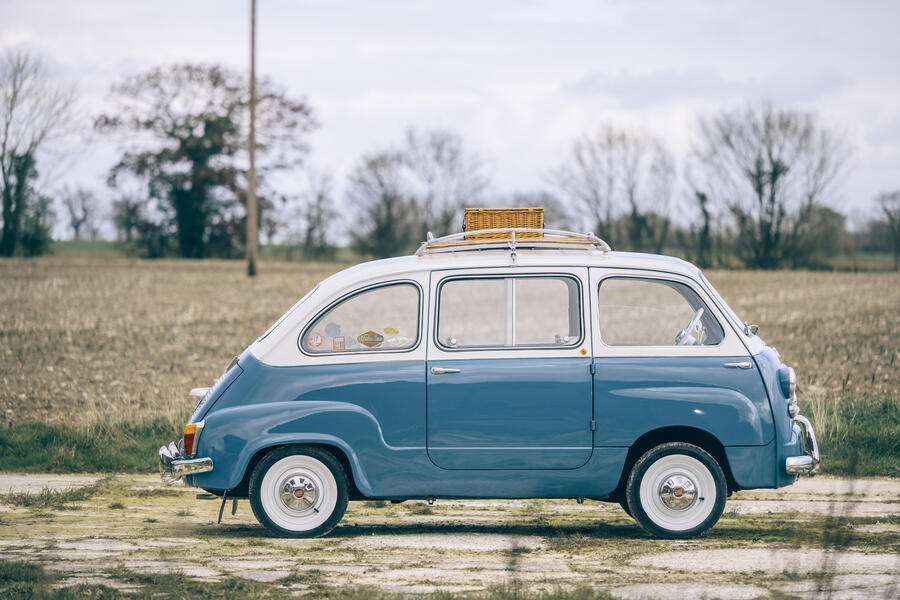
The original 600 Multipla was produced from 1956 until 1967, with Fiat shifting around 240,000 examples.
Described by Autocar in 1957 as “one of the most original and ingenious small car designs to appear since the war”, it featured the drivetrain from the 600 and the front suspension from the 1100.
It measured just 3531mm long yet could seat six people, in part because of its boxy design (we wrote that “the outline of the Multipla is no more than a modified rectangle” but praised its “attractive, chunky look”) and the fact the driver’s seat was located directly above the front axle.
Fiat subsequently revived the Multipla name for a radically styled – and much larger – Bravo-based MPV in 1998.

Ford Recalls Nearly 750,000 Vehicles as Transmission and Assembly Flaws Undermine Quality Gains

Automakers Rethink Touchscreens and Production Strategies Amid Industry Cost Pressures


Mazda MX-5 Faces Its Final Combustion Era as Lightweight, Manual Tradition Confronts Electrification

Air Fresheners as Everyday Car Customization and the Sensory Impact of Scent on Driving...
 Not to be sniffed at: just a couple of quid can transform the experience of driving your car
Stay with me.
You probably won't be surprised to read that, as a member of the Autocar team, I have a lot of opinions about cars - but one of my strongest is about air fresheners. For me, there really is nothing worse than getting into a car that honks (no pun intended) before a long journey, and I marvel at how hanging one of these ultra-cheap dangly devices from the rear-view mirror can transform the experience.
I remember the unpleasant smell of the leather seats in my mum's Saab, in which the previous owner had smoked for probably about a decade. It still lingered, but one of those Very Cherry Jelly Bellys (you will surely never read that again in this magazine) made our regular journeys between London and Devon infinitely more pleasant. Because your car smelling overwhelmingly like a jelly bean is far better than the funk of feet or whiff of wet dog, right?
Personally, I'm a huge fan of the California Scents fresheners - you know, the ones that come in little cans. They seem to last forever and are far better at masking odours than the traditional Little Trees.
But it's the wide selection of scents that I like most about car air fresheners. It seems their makers never run out of ideas. You can even get a piña colada one. For me, though, I don't think there's a better scent than Coronado Cherry: that smell always seems to be overpowering (in the best way), covering up all manner of stinky sins.
It's like a very budget-friendly and accessible form of car modification for the otherwise uninterested driver - and, actually, changing the aroma of your cockpit will have a far more tangible impact than fitting a mahoosive performance air filter or some slightly grabbier brake pads.
Since you're indulging me, let's go a little deeper: there are also a lot of different types of air freshener to get your head around. Obviously you've got your standard cardboard conifers, but they don't work for very long. There are the cans I mentioned earlier, which are by far the better option. There are some that you can fix to the air vents so that the smell circulates when you've got the air conditioning or heating on. And you can even get sprays nowadays.
And now car makers themselves are getting involved, including BMW, which will try to flog you an 'Ambient Air Package' that features a customisable fragrance system located inside the glovebox, while Bentley has gone the other way and developed an aftershave flavoured with inspiration from the interior materials it uses in its cars. Eau de dashboard, anyone?
Shapes are also more varied these days. You can get air fresheners made to look like fruits, animals and even cassette tapes.
You should choose carefully, because I think your air freshener says a lot about you as a person. You might be fun and choose the mojito scent in the shape of a cocktail glass, or maybe you're a bit more sensible and opt for the first black ice tree you see (no offence).
It's a fun and fascinating little corner of the car world that you might not have thought about for years (particularly if you're lucky enough to enjoy the heady scent of new car chemicals whenever you climb aboard), but why not indulge your inner aromatherapist and treat your cabin to a new fragrance next time you stop for fuel?
Maybe avoid the dill pickle option I've just spotted online, though.

Jeep Expands European Lineup With Chinese-Built Flagship and New Small SUVs to Regain Market...

Used Porsche Taycan Prices Signal Rapid Depreciation in the Electric Luxury Market

In-Wheel Motor Innovation Drives Renault 5 Turbo 3E and Redefines EV Engineering Limits
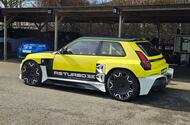 British firm takes its radical new EV propulsion tech to the showroom with Renault's mad hyper hatch
Patience is a virtue, the saying goes, and in Protean Electric's case, persistence and hard work have paid off.
Protean's in-wheel motor (IWM) technology is being adopted by Renault to power its 5 Turbo 3E, which is due to go on sale in early 2027 as the first European car to be fitted with IWMs.
Protean has been working on IWM technology for around 17 years and has been exhaustively pursuing solutions to its potential pitfalls for production cars. These include unsprung mass, water and dirt ingress, the integration of a friction brake and thermal management.
During that time, the firm has found solutions to technical challenges and exposed others as long-standing misconceptions. It has found ways to integrate friction brake systems, keep the tightly packaged electronics cool (each IWM has its own integrated inverter) and simplify communications between individual components and wheels. The IWMs have been developed to last a vehicle lifetime of more than 186,000 miles, withstanding shock and vibration, potholes and kerb strikes.
The 5 Turbo 3E is rear-wheel drive and will produce 550bhp, with 3540lb ft of torque. Performance will be staggering: the 4m-long car will hit 62mph in less than 3.5sec.
Protean had only two years to develop motors specifically for the project. Its most powerful 'off- the-shelf' IWM is listed as the PD18, which produces 138bhp, so two of those would total 276bhp. The extra power for the 5 Turbo 3E is the result of further development and set-up from the Alpine engineering team, says Renault, no doubt in collaboration with Protean engineers.
One of Protean's biggest challenges has been addressing the potential impact of unsprung mass due to the extra weight of an IWM compared with a conventional wheel hub. The firm has commissioned several independent studies by third parties and Lotus Engineering also worked on the Protean-Mahle VW Golf.
The key conclusion, says Protean, was that the effect on ride and handling due to unsprung mass could be offset by adopting stiffer suspension components and stiffer settings.
As for the brakes, the disc brake rotor is bolted to the motor assembly and the caliper to the suspension acting on the inside diameter of the disc. Protean has been working with brake manufacturer Alcon since 2011 and testing has established that the brake performance matches that of standard, non-EVs, with testing on vehicles of up to 3500kg.
Thermal management involves both hardware and software with a patented cooling system design.
Overall, Protean holds more than 320 patents and its portfolio of IWM solutions covers light commercial and autonomous vehicles as well as cars. It has also developed the Protean360+, a wheel corner module that, as the name suggests, can rotate through 360deg to move a future urban mobility vehicle in any direction.

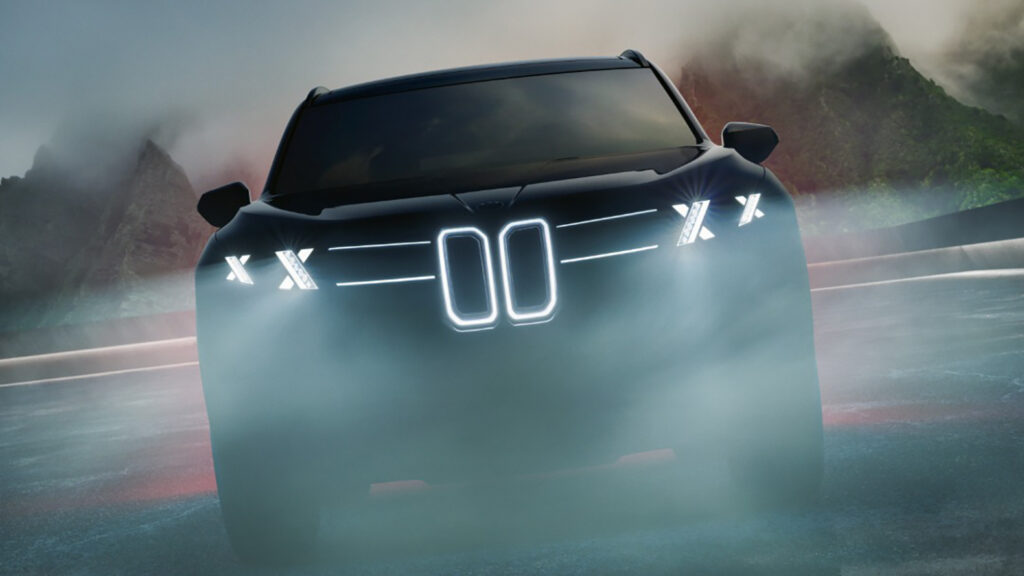
BMW X5 Redesign Trades Split Tailgate for Neue Klasse Styling and Controversial X-Shaped Lights

Fuel Finder’s Uncertain Impact on UK Fuel Prices as Motoring Groups Debate Effectiveness
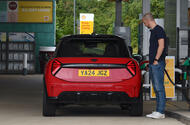 Service was launched in February to help drivers compare the price of fuel at nearby filling stations
Motoring and industry groups say it remains unclear whether Fuel Finder, the Government's scheme that lets drivers compare fuel prices at nearby petrol stations, is influencing where motorists choose to fill up.
The service, which is available through apps and websites including Waze, Petrol Prices and the AA, was launched four months ago. It now covers around 95% of UK forecourts, according to the Department for Energy Security and Net Zero (DESNZ).
The Competition and Markets Authority (CMA) says motorists could save up to £9 a tank by switching from the most expensive to the cheapest retailer within a 10-minute drive.
Geoff Steadman, a senior director at the CMA, said: "We know higher prices at the pump in recent months are putting real pressure on drivers’ pockets, so using Fuel Finder-backed services will enable them to find the cheapest petrol station nearby and save money.
“But we’re concerned that weak competition in the sector is leaving drivers paying more. By making prices more transparent, Fuel Finder should push petrol stations to compete harder and drive down prices in the long run.”
However, the RAC and the Petrol Retailers Association say it is too early to judge whether or not the scheme is working.
Simon Williams, the RAC’s head of policy, told Autocar that “the jury is still out”, adding “the price of diesel should really have fallen faster”. However he said he was “hopeful that it could make a difference”.
Gordon Balmer, the executive director of the Petrol Retailers Association, said he doesn’t believe that Fuel Finder has “had a material effect on buyer behaviour”.
“Prior to its launch, consumers already knew that supermarkets price their fuel keenly and that you will pay a little more on the motorways,” he said.
“At the start of the crisis in the Middle East, supermarkets experienced a spike in fuel sales as consumers filled up to try and beat price increases, however I don't think that was due to improved price visibility.”
He said that it was up to the government “to assess its success” but confirmed that he hadn't seen any data including usage of fuel pricing apps.
Is Fuel finder actually helping?
The AA, however, takes a different view. Luke Bosdet, its head of policy, said that he observed that many motorway service areas cut their prices when petrol wholesale prices were rising.
He said: “Petrol at 185 pence a litre earlier on in the war is now 176 pence at notoriously expensive locations like Chieveley (Berkshire) on the M4.”
He attributes to Fuel Finder: “We have been surprised at the speed of the reductions and concluded that this is the influence of Fuel Finder: retailers seeing how much rivals are cutting their prices and, knowing that drivers can see the same information, having to respond.”
DESNZ did not answer questions about how many motorists use Fuel Finder-backed services or whether the scheme is influencing where drivers buy fuel.
A DESNZ spokesperson said Fuel Finder was "playing a crucial part in our work to tackle the cost of living head on", adding that the department estimated it could save households that own a car around £40 a year.
The CMA said it expected to publish a more detailed assessment of Fuel Finder's impact later this year as it continues to examine competition in the fuel market.
Autocar also contacted VE3, which built the platform, for this information. However, it hadn’t responded at the time of writing.