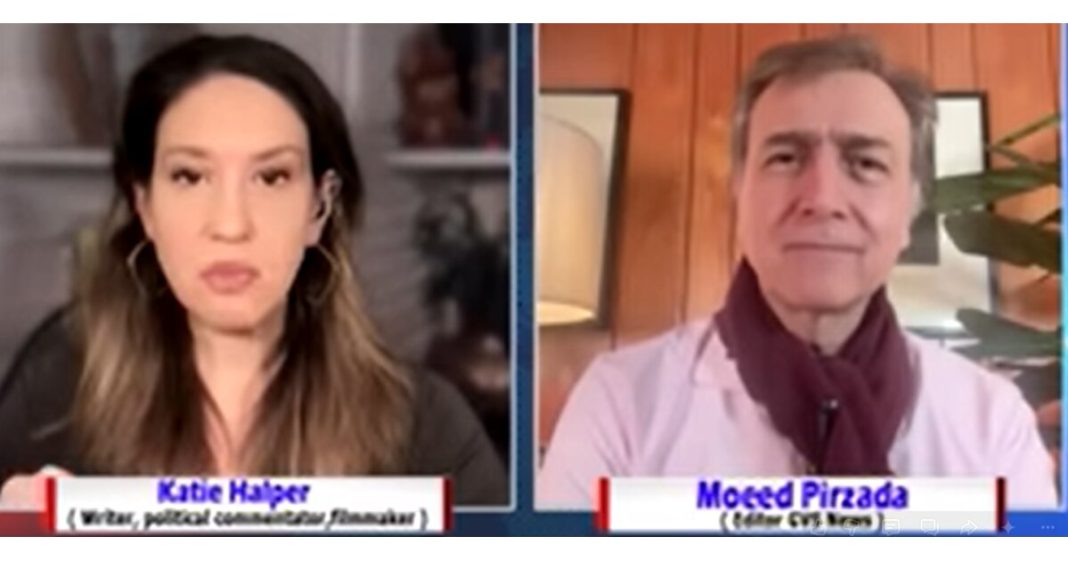
In this compelling conversation, American political commentator, podcaster, and filmmaker Katie Halper joins GVS Editor Moeed Pirzada to explore unexpected political and cultural intersections — from global power narratives to the rise of Imran Khan as a political phenomenon.
Katie Halper, host of The Katie Halper Show and co-host of Useful Idiots, is known for her sharp progressive commentary and fearless critique of mainstream narratives. Raised in a highly intellectual New York household with a psychiatrist father and an English professor mother, she developed a strong analytical and cultural awareness that later shaped her career in journalism, comedy, and documentary filmmaking. Her work has appeared across major platforms including The New York Times, The Nation, The Guardian, and MSNBC, and she has never shied away from controversial political positions, including her outspoken criticism of Israeli policies.
In this interview, Moeed Pirzada engages her in a wide-ranging discussion about how she came to take an interest in Pakistan and its political landscape, particularly the figure of Imran Khan.
Title:DISCOVERED PAKISTAN BECAUSE OF IMRAN KHAN – KATIE HALPER WITH MOEED PIRZADA
Date: 28th Jan, 2026
Dr. Moeed Pirzada: So, how come you got interested in Pakistan?
Katie Halper: Honestly, how did I get interested in Pakistan? I just noticed this.
Dr. Pirzada: Was I the first person you brought in your show, the Katie Halper Show?
Ms Halper: Were you? Let me think.
Dr. Pirzada: Was there anyone before me from the Pakistani descent?
Ms Halper: Yes, I had Asad Haider. He passed away in December. He was a brilliant political philosopher. He wrote a book called ‘Mistaken Identity’ actually about identity politics and the weaponization of identity politics that I highly recommend. His brother Shuja is brilliant.
Dr. Pirzada: Oh yeah yeah. Shuja Nawaz. So you had Shuja Nawaz on the show.
Ms Halper: No Shuja Haider. He’s at the Nation. He’s an editor at the Nation but he’s a journalist who writes a lot about um music
Dr. Pirzada: He is of Pakistani origin?
Ms. Halper: Yes. But that wasn’t their focus. Their focus wasn’t Pakistan. But I will say that a lot of Shuja’s family really appreciated the interviews that I did with you. Didn’t I have Aleema Khan before you or after?
Dr. Pirzada: Yes. You had Aleema Khan more than once.
Ms. Halper: Yeah. But I think she was the first but I wanted to have you on.
Dr. Pirzada: Then you had Mariam Mariam who’s the sister of Bushra. Then you had barista Shazad.
Ms. Halper: And then I also had Hassan Ali who had a very spirited debate with Mariam.
Dr. Pirzada: My question is how this interest grew. I mean because all your life being a filmmaker, a journalist, a writer?
Ms. Halper: I guess I was drawn to the story of what happened to Imran Khan. I thought I liked Junaid Ammad’s writing about it. I liked Ryan Grim’s writing about it. I found him to be a fascinating figure. So I wanted to know more about it.
Dr. Pirzada: Why do you find Imran Khan a fascinating figure?
Ms. Halper: This is not to reduce him to this but it’s a really cool story that you have this cricket player who turns into a prime minister. You and I have slightly different politics so it’s interesting because I think you and I probably describe him somewhat differently because we probably like different things about him. But he strikes me as a populist, somewhat socialist definitely someone who challenges the elites.
I was stunned by how little coverage he got. And of course, to be honest, the real thing that got me interested in him was that he was very charismatic. I like that he’s a charismatic populist on the side of good as opposed to a populist on the side of bad. Actually it’s interesting because there’s another thing that I find very dangerous, and again I’m going to cite and give major props to Thomas Frank. He wrote a great book called ‘The People, No’ and that’s about populism and there’s a dangerous false equivalency where there people kind of say you can be a populist on the right or a populist on the left and his thesis and I share this although it’s almost a winning battle rhetorically but that it’s not like you can be a populist on the left or the right.
Populists are on the left and then there are people on the right who co-opt populism but he was a populist who was not on the right who didn’t co-op populism for the right he was on the left so I found him to be an important figure. And then of course when I learned that the you know the national security state of the United States didn’t like him that’s kind of an immediate like bonus for me. That’s a sign that you’re doing something.
Dr. Pirzada: But you might have seen that how his opponents were able m to describe him as an Islamist, as a Taliban Khan.
Ms. Halper: Who was able to call that?
Dr. Pirzada: His critics and his opponents.
Ms. Halper: Yeah. but I didn’t buy it.
Dr. Pirzada: Then you look at the Epstein Epstein emails.
Ms. Halper: Right. Exactly. I mean that’s a great endorsement of being insulted by Epstein. Like his family should put that on a website for him. They should point that out.
Dr. Pirzada: Well, tell me one thing. As a journalist, you have been in this business of narrative shaping for the past so many years. How would you understand and tell us that Pakistan which is the fifth largest nation state in the world and a second largest Muslim country with a huge diaspora and a US ally from the 1950s finds no space and interest in the US media.
Ms. Halper: I don’t know. I mean you would know better than I why that is. I guess it’s not convenient. I don’t think it fits that neatly into any political narrative. Perhaps that’s why I think there’s also people who just don’t know a lot about it. Our media doesn’t know a lot about it. You know, for Western media, it’s like you either have to fall on one side of the there’s like the axis of evil and there’s the ‘war on terror’and then there’s like the shared values of Israel. And I think outside of these dichotomies people like Jake Taber have no idea what he’s talking about and people in the media don’t understand.
Dr. Pirzada: Are you then saying that Pakistan has to be one of the two extremes? Either it has to be the evil like Iran, the excess of evil?
Ms. Halper: Maybe. I’m not saying it has to be. I’m saying maybe that explains why it doesn’t get more media attention because it’s not easy to fit it into the kind of stupid and reductive framing that the media so enjoys. You know, you can see this so much the way that they report on Israel. It’s all like, you know, Hamas, Palestinians are terrorists and Israel are defending themselves. I mean, all the way that the Israeli propaganda has been so successful in penetrating western media kind of tells you everything you need to know in terms of how critical western media is.
You know, they just regurgitate narratives more than anything else. And I guess there aren’t that many, you know, there isn’t like any path for Pakistan.
Dr. Pirzada: But I think there are two different streams. One is the Pakistani-American community that wants Pakistan to be more visible in the media. The other side is the Pakistani military that is trying to hobnob with the Israelis. So I think they’re also trying to become part of the of the narrative in a positive way.
Ms Halper: Right.
Dr. Pirzada: I don’t know which side I don’t know which side will win in the end
Ms. Halper: Yeah. And then of course adding more confusion to it then then you have I mean India loves bragging about its relationship with Israel.
Dr. Pirzada: Have you been to India?
Ms. Halper: I have. I’ve been to, in fact, I was there when Benazar Bhutto was killed.
Dr. Pirzada: 2007
Ms. Halper: Yeah, December 2007.
Dr. Pirzada: But you’ve never been to Pakistan?
Ms: Halper: No, I’d like to go but I haven’t been. We have good friends in Puna.
Dr. Pirzada: Puna is India.
Ms. Halper: Yeah. No, I know. I’m explaining why I went. Well, my dad is in love with India. He’s always loved India. I don’t know if ever since college he loved it and he went there after college but then we wanted to go to India and also visit our friends in uh Pune.
So we have a friend who he’s my age. He’s a couple years older than me but good family friends. Their son went to India to study. He’s an ethnomusicologist and he met his now wife at Satar classes.
Dr. Pirzada: Satar classes.
Ms. Halper: Yeah.
Dr. Pirzada: Interesting. but your Ketty Halper show doesn’t focus on issues in India?
Ms. Halper: We have sometimes like when there was some repression, attack on journalists, we’ll focus on it then. We don’t actually pay that much attention to, I mean basically if there’s an interesting story I will just look into it and bring on a guest to talk about it. I’ve had VJ Prashad a bunch and he talks about India.
Dr. Pirzada: This is crucial to understand what interests the US media. I mean India is so big but India is not triggering in your show. What interests the media? What triggers the media’s interest.
Ms. Halper: I mean you choose your topic. I mean I’m okay but there’s a difference between my show, my media and establishment legacy media, right? like what interests me is, you know, for instance, I used to focus a lot on Russia and Ukraine because I felt like there was a lot of warmongering from our media. I thought that there was a lot of oversimplification. I mean, I don’t like Putin, but the idea that he’s a Hitler is so ahistorical and it’s also dangerous because it makes it hard, it makes diplomacy toxic because, you know, the big takeaway of the Holocaust is you can’t negotiate with a Hitler.
Hitler was not someone you could negotiate with, but Putin, guess what, is not Hitler. And I think that is an example of such irresponsible framing. I think maybe one of the things that provokes my interest is when I notice that the media is reporting on something in a problematic way that is basically pro-war.
I also just became interested because I really became interested in what Junaid Ahmad had to say. I found his analysis really interesting.
Dr. Pirzada: What do you find interesting about him?
Ms. Halper: Oh, just the way he kind of tied what was happening to Khan to the larger context. He is so outspoken about Israel Palestine. So I knew my views kind of aligned with his and so he had a lot of credibility for me. Then when I read what he was talking about I read his work on in Pakistan I became interested in that. But it is I’m not trying to make myself super special but like you know what motivates me again is not what’s going to motivate others. I’m lucky because I’m independent so I don’t have to worry about things like corporate media pressure or toeing the line.
Dr. Pirzada: If I were an Israeli TV host my first question to you would be how can a Jew be against Israel?
Ms. Halper: So a couple things. One is, I just have to clarify, I am more leftist than liberal which is maybe not that important a distinction for some people but actually you know I find myself critiquing liberalism more and more but that’s kind of a different conversation um.
Dr. Pirzada: Well, that’s interesting to me as well. I’ll come to it as well. What’s the difference between liberalism and being left.
Ms. Halper: You wanted me to answer that now.
Dr. Pirzada: Just go on, Just remember this t if I have to, I have to ask my questions. You know, many get actually very upset. They said, “Why do you interfere ?”
Ms. Halper: No, I understand.
Dr. Pirzada: But you know, if you were not finished, you will say, “Let me complete that thought, you know.” So, just go ahead.
Ms. Halper: Great. Okay. So I would say that how can I be a Jew who’s critical of Israel?
Dr. Pirzada: To the extent that you’re being fired from the Hill TV.
Ms. Halper: Yeah. So, I got fired. Okay, there are a couple things. Let me back up before getting into the specifics of the hill. But just in terms of more philosophically that question, I mean being a Jew is not the same thing as being a Zionist. And one of the ironic things is that as much as Israel likes to claim that that’s true, that’s actually it can be argued that that in itself is a kind of anti-semitic stereotype because the argument is that all Jews are a monolith and we’re actually loyal to Israel. Now, that is known as the dual loyalty trope, which used to be a big thing. It still is a thing in some ways.
And in fact, the very people like the ADL or APAC or the Israeli government and all of its defenders, the very people who claim that someone like Ilhan Omar is guilty of perpetuating the anti-Semitic dual loyalty trope, they themselves are perpetuating it every time that they claim that being Jewish is the same thing as being pro- Israel. So, that’s ironic.
Dr. Pirzada: So what’s the difference? What’s the flaw in the logic?
Ms. Halper: To me it’s like saying, well, if you’re Muslim, why aren’t you pro-ISIS? To me, it’s almost as similar as those two things. Now, that parallel doesn’t totally work because I would say that the Jewish support of Israel is much bigger than the Muslim support of ISIS because Israel is a government. ISIS isn’t a government. But I’m just using it as an example of things that aren’t connected. And in fact, I would say it was actually less connected because at least you could argue that ISIS is a total perversion of Islam.
To me, there’s nothing actually that Jewish about Zionism. I mean, Zionism started out political Zionism was Christian at first.
Dr. Pirzada: That’s very interesting. Political Zionism was Christian to begin with.
Ms. Halper: Yeah. It started out as Christian and it was a lot of people had Christian religious support for Jews going back because that would be I guess trigger the rapture but then you also just had you know basically anti-semmites who were Zionists who wanted to get rid of Jews and the way to do that is you send them to another country.
Dr. Pirzada: You are making me very confused. Anti-Zionists were pro-Israel?
Ms. Halper: You mean Zionists? I would say that there’s a big overlap between Zionism and anti-semitism.
Dr. Pirzada: But anti-semitism means being anti-Jew?
Ms. Halper: Yes so I know it sounds crazy and there’s a fabulous rabbi who you should have on your show. His name is Rabbi Yakov Shapiro and he wrote a book called ‘The Empty Wagon: Zionism’s Journey from Identity Crisis to Identity Theft’.
Dr. Pirzada: You’re showing me his book.
Ms. Halper: Yeah. And it’s all about that.
Dr. Pirzada: Introduce me to him. I will talk to him
Ms. Halper: So, there’s a lot to talk about here. So, one again is that you had a lot of people who wanted to get rid of Jews and so sending them to Israel or another country was a good way to do that. Then you have and this is also crazy. You have a lot of early Zionists and of the Jewish Zionists a lot of them were what I would call self-loathing. And that’s funny because Jews like me get called self-loathing because again the premise which is false is that to be Jewish means you support Israel.
And if you read the words of people like Ben Gurion who was the first prime minister of Israel. If you read the words of people Jabatinsky, they have said they said they wrote things that were very anti-Semitic. They talk about the Jew this, the Jew that they’re disgusting. They’re the ashes of of history. They talk about the diaspora Jew. That’s their term for basically Jews who were living in exile, which was most Jews because, you know, Jews had been living in exile.
Dr. Pirzada: So what kind of dichotomy was this? If Ben Gurion and the others were anti- anti-Jew or anti-Semite, why were they founding a state for Jews?
Ms. Halper: Well, because they wanted to create a new Jew. That’s a great question actually. A new Jew. And the new Jew was going to be everything that the old Jew wasn’t. So, the new Jew was going to be armed, militaristic, work the land, all the things that Jews in exile couldn’t do and didn’t do. Later on after the Holocaust, the image of the Jew as going to their slaughter like sheep, like lambs. That was the stereotype about what happened to Jews during the Holocaust. So, Israel was going to be everything that that Jew wasn’t. It wasn’t going to be the praying Jewish rabbi in the corner cowering as the cosaccks came through and raped his mother, sister, wife, whatever.
Dr. Pirzada: You are referring to the Polish?
Ms. Halper: I’m talking about the preholocaust. I’m just talking about all the kinds of tropes and the histories.
Mr. Pirzada: But that’s also part of the history. The cossacks attacking the Jews are part of history.
Ms. Halper: Yes.Right.
Dr. Pirzada: Ashkenazi. You’re an Ashkenazi too.
Ms. Halper: Yeah.
Dr. Pirzada: Were Ben Gurion and the others also Ashkenazi.
Ms. Halper: Yeah. Bengurian wasn’t his real name. I forget what his real name was. Netanyahu’s real name is like Milowski Milikowski or something. They made up these fake Israeli names, Hebrew names that weren’t real. And again, that’s another thing is that they had a lot of self-loathing for the Ashkenazi culture. But they were Ashkenazi and they also, this is really crazy, they were also racist against the Misrai Jews. Misrai Jews are the Jews who were in the Middle East.
Dr. Pirzada: Who came from North Africa and Middle East
Ms.Halper: Yeah. So, they were mistreated. That’s a whole other story. After the Holocaust, they needed to bring in more Jews to Israel. So, they brought in a bunch of Misrahi Jews. I’m very aware that you will, I will sound like a conspiracy theorist to you, but it’s all documented.
Dr. Pirzada: I’m trying to understand, you know, if you actually study another culture, it’s not always that easy to grasp it in the first place.
Ms. Halper: I understand. Yeah. Well, okay, let’s back up a little bit. So, you probably know a lot of leftist Jews, right? There’s that whole history of leftist Jews.
Dr. Pirzada: Everyone I know is very liberal.
Ms. Halper: Yeah. Right. So, there’s that history and part of that comes from you know the fact that there was such a big diaspora community. There are a lot of theories about this and I also want to be clear like Norman Finkelstein talks about this a lot. It’s not that most Jews are this way. I would say it’s that they are over represented in these groups.
So I would say like in the civil rights movement for instance a lot of the white supporters of civil rights were Jews. A lot of the American communists were Jews, and you know that’s a charged term. A lot of people are anti-communist, but whatever. Especially pre- Stalin, being an anti-communist meant basically fighting for economic and racial justice.
Dr. Pirzada: How are the Ashkenazis different from Mizrahi and Sephraic Jews?
Ms. Halper: Well, they’re very different culturally. When I say something so Jewish and I say that kind of affectionately, you know, like Larry David is so Jewish. He’s actually very Ashkenazi, right? He is very different from Yemeni Jews or Iraqi Jews. And the thing I was going to say before was that you know there’s a great historian Avi Shlaim who wrote a book called ‘Three Worlds’ and he’s a Jewish Iraqi who was born in Baghdad then moved to Israel and now lives in England and he actually did research on this.
Everyone knows that there were bombings in Iraq of Jewish places and that led to a lot of Iraqi Jews going to Israel, but there were a lot of rumors that Zionists were involved in that. And then he documented that at least five of those, don’t remember if he found three of them or two of them, were definitely done by Zionists. Not all of them necessarily but they were done by Zionists and this is a great example. Zionism values a national political project over the lives of Jews.
Dr. Pirzada: Bernie Sanders is also Jew I believe right?
Ms. Halper: Of course. He is. He’s very Jewish.
Dr. Pirzada: Professor Jeffrey Sack at Columbia University is also Jew.
Ms. Halper: Yeah.
Dr. Pirzada: What is this schism? I mean let me let my viewers understand who are mostly of Indian and Pakistani origin. What is this schism? Some of the most highly educated American Jews are against Israel or have been in the past 3 years.
Ms. Halper: Well, because there are a couple things. One is that I’m a Jew who actually doesn’t believe that Israel should exist as a Jewish state. There’s that. Now, Bernie Sanders and Jeff Sacks, I don’t think believe that. I do. But I don’t even know if Norman Finglestein believes that. But what any Jew, even if you’re a Zionist, and that’s such a loaded term, I’m anti-ionist. But any Jew who’s Zionist, I would say, and a lot of people with my politics kind of cancel people out if they’re Zionist, even if they’re liberal Zionists. I don’t really think liberal Zionism can exist. But, but let’s just pause that if you identify as a Zionist, there’s still no way that you can be a remotely moral person if you don’t oppose the genocide.
So, there are different levels. Like, again, I’m anti-ionist. Um, but I have friends who are liberal Zionists who believe in some abstract way that there should be a Jewish home. But to me the most urgent question right now, and people will disagree with me because I have friends who think no, you anti-Zionism is the most important thing to be working on. Now, for me, I’m more of a I guess pragmatist, and I think that you should bring people in wherever they’re at and that you can probably actually show them why Zionism is dangerous. But the most pressing thing in my opinion is to stop the genocide. I also believe that occupation needs to be ended.
Dr. Pirzada: But when you say that Israel should not be a state for the Jews that means you’re basically saying that you are rejecting the two-state solution and you are basically saying there should be one state for all with the equal rights of Christians.
Ms. Halper: Exactly. Equal rights. Yeah. It shouldn’t be a theocracy.
Dr. Pirzada: But Israel is not a theocracy?
Ms. Halper: If you don’t want to call it a theocracy, and you could argue it’s a theocracy because I mean this is a not that extreme version of it, but you can’t get married by even a reformed rabbi. You have to get married by a conservative rabbi. Things are closed on Fridays, you know, so there’s not a total separation of synagogue and state, if you will. I would say it’s an apartheid system. We don’t have to call it theocracy, it’s an apartheid system.
Dr. Pirzada: And this is the word that actually lost you your program at The Hill.
Ms. Halper: Yeah.
Dr. Pirzada: What were you saying? What were you saying there?
Ms. Halper: I was basically just arguing that there are two systems, two sets of justice. There are no separate customs in Israel. Palestinians in Gaza in the West Bank they’re called 48ers. Those are Palestinian citizens of Israel. And so there are different rules for them and there are rules about not being able to live in certain places. I mean what’s scary is that Netanyahu actually made it worse. Usually like as time goes on uh governments try to be at least nominally more liberal and tolerant but he didn’t even do that. They did the nation state law which made it more of an apartheid state. So, I guess I just want to say that, you know, my Jewish culture and heritage, the one I come from, is one that really values equality, social justice.
There’s even a concept that comes from Judaism. It’s not in the Torah, but it’s in some commentary in the Torah, tikun alum, which is to repair the world. Now, it’s getting even more complicated. I’m not really religious, but I do think that there is a prophetic tradition. There’s a social justice tradition in all religions, I would say, whether it’s Islam, Christianity, or Judaism. But for me, my Jewish background, again, I come from a secular family. I went to a left-wing summer camp where we had to share our care packages. I’m trying to think of the kind of the signifiers that are less New York centric, even being from the Upper West Side
Dr. Pirzada: But tell me, were you shocked when Hill Television fired you from the rising program?
Ms. Halper: I was shocked because I had said things like that. I had been very critical as a guest on the Hill, but this was different because I was guest hosting. So, I was a weekly guest. I would go. >>
Dr. Pirzada: You were hosting Rashida. Rashida Tlaib.
Ms. Halper: I’ve had her on my shows before, but that wasn’t this.
Dr. Pirzada:You were saying that as a host they were less tolerant. If you had said things as a commentator.
Ms. Halper: I think maybe there are a couple theories but I made this video. I wrote it and I said that because Rashida Slab had been attacked for saying that Israel was an apartheid state and she was attacked for saying that you couldn’t be progressive without being progressive on Palestine because there’s even a term it’s called progressive except on Palestine. So she was saying that’s not a possibility. I defended her because she was attacked by Jake Tapper who loves attacking her. She was attacked by Debbie Wasserman Schultz. She was of course attacked by um ADL’s Jonathan Greenblat. And when I argued I kind of made a very good I mean airtight case about it being an apartheid state. And the way I argued it was very hard for Israel defenders to to push back on because I quoted international law. I quoted you the UN.
I quoted probably most damningly for these people. I quoted actual Israeli politicians like former prime ministers, ministers of various sorts saying that either Israel was an apartheid state or was heading towards an apartheid state and then I cited South African leaders. So I cited obviously Desmond Tutu, Archbishop Desmond Tutu, Nelson Mandela and Nelli Pandor Nettle Pandor who is an a who was a South African minister, who actually was instrumental in bringing the genocide case against Israel.
Dr. Pirzada: So you made your case. You made your case.
Ms. Halper: I made my case and it wasn’t just like my feelings or I have a feeling, you know, I laid it out and so then they wouldn’t air it and I pushed back. I wasn’t even that aggressive about it. I was just like, I think you should air this. Can you air it and then air an opposing monologue? Why don’t you do that or have a guest that pushes back? And then they had me speak to this high up at the Hill and he was like, “Well, we always have the right to pass on a piece.” Which is not what happens. I mean, Ryan Grim himself said he had probably submitted his piece during his tenure.
Dr. Pirzada: Ryan Grim had also been at Hill?
Ms. Halper: Yes. So he had submitted Yeah. He followed Crystal and not right away, I don’t think, but he eventually followed Crystal and Sagar. So he was like, “Um, no, I submitted like hundreds of radars and they literally did the editorial process cuz basically this guy Bob Kuzzac was trying to pretend that they had an editorial process.” And of course that sounds reasonable. Every outlet can pass on a piece. But when you are a host there and you’re writing a monologue, there’s no editorial process.
Literally all they do is they upload it, as he said, they upload it into the teleprompter like errors and all typos and all and you just read it. So obviously this was something different and then they said to me that I was no longer needed even as a guest. So they were turning away from my labor.
Dr. Pirzada: Let me come to New York. You know what was the experience of growing in one of the wealthiest and the most elitist parts of the United States and the world you know on the upper west side in Manhattan. I mean growing up in a home with the father as a psychiatrist and mother as an English professor and novelist. What was that kind of experience?
Ms. Halper: Well it’s very much out of this movie called Annie Hall but that’s by Woody Allen and there is a whole I mean I am a stereotype of this he even says to Carol Kane’s character he’s like Oh, Upper West Side. He says Central Park West. I grew up on Riverside Drive. Upper West Side, Central Park West. Very strike oriented family, socialist summer camp, and that’s all that is my family. But it’s also not quite as elite. I mean, I’m not denying that I grew up with a lot of privilege, but my parents got that apartment before that neighborhood was super fancy. I mean, it was really nice, but they definitely My mom has this really good eye. She grew up very working-class and she had to. She was kind of like the caretaker for her mom. Her mom was kind of charming but basically became a speed addict and so my mom did a lot of the parenting. You can read my mom has a great fictionalized memoir. I used to have them but um Norah Eisenberg is her name. So she wrote something called ‘The War at Home’, which is about her upbringing, but so yeah, I definitely grew up with privilege, but you know, a lot of my haters call me like a trust-fund socialist, which I’m not.
But even if I were, that’s great. I mean, being a class trader is admirable. If you support policies that you don’t benefit from directly, that’s even more admirable. Was Roosevelt bad because he came from a patrician background which I don’t come from but this whole idea they call me I and I did go to a private school called Dalton so they call me a Dalton socialist but again it’s interesting because you know Nerra Tanden this this Democrat neoliberal. I would say she loves to talk about how you know she was at the center for American progress. She was a big Clinton fan and she was a big part of the online bullying army.
Dr. Pirzada: Is this the background that makes you liberal or left?
Ms. Halper: Yeah. Well, I was just going to just one thing I cuz I think it speaks to the values that I have from my parents which is why she would call me a Dalton socialist and she always talked about how she lived in section 8 housing and welfare and that’s great except like I wasn’t. I didn’t live in section 8 housing and I wasn’t on welfare but I support things that are better for those people. She was on those things and she’s a sellout who turns around and is a Democrat but a Democrat who’s all about slashing the welfare state. So to me I’m just bringing that up as a kind of like a value system. My dad is a psychiatrist .
A lot of people have this image that he was like a psychiatrist being very fancy and Freudian and sitting with people analyzing their dreams. He started out as an internist and then he switched to psychiatry. I mean he’s a great therapist but his focus is really on biochemistry.
Dr. Pirzada: He is more on the biochemical side of psychiatry, on the side of the analysis. Who had more influence in shaping your ideas, your father the psychiatrist or mother the novelist?
Ms. Halper: Probably my uncle who was my mom’s brother. I mean both sides of my family were quite left and my dad’s aunts, my dad’s uncle, it was his father’s sister’s husband. He was blacklisted during the McCarthy era. He was the head archivist at the UN’s archives in Geneva and he was fired because he was a member of the John Reed Society which is this communist organization at Harvard when he was in undergrad. So he was fired summarily and this guy who was a Harvard undergrad then did his masters in, I think Chapel Hill and then was an archivist. He then spent the rest of his life selling medical equipment because there was a guy we call a fellow traveler, you know, with the same politics and he employed a lot of people.
He had a stethoscope business. So, a lot of these communists who had been blacklisted found up working for him. So, both sides were leftists. My dad’s uncle died in the Spanish Civil War. That’s also a big you know, part of that trend of leftist secular leftist Jewish New Yorkers. Although he was actually from LA but that’s neither here nor there. The leftist secular Jewish tradition from which I come from. The Spanish Civil War was a very important moment historically because the Spanish Civil War was actually considered the dress rehearsal for World War II. So the people who fought in the Spanish Civil War were called premature anti-fascists. And this is interesting, there were something called the international brigades. Those were the brigades that fought to defend Spain from Franco. And they all had different names and the name for the American one was the Abraham Lincoln brigades.
And that’s because back when the communists were trying to be very patriotic and kind of reclaim American patriotism and the ideals of Lincoln and Jefferson. So I bring this up because my dad’s uncle who died in Spain was killed by fascists. He was part of the Abraham Lincoln Brigade. But guess what? Among all of the international brigades, guess what the most common language was? Guess what it was among all the from all over the world?
Dr. Pirzada: Spanish or English or Yiddish?
Ms. Halper: Yedish. Yedish. Exactly. Yeah. Yiddish. Because so many Jews saw this as leftist Jewish tradition because they were kind of aware of Hitler’s anti-semitism. They were aware of it. They also were a large part of the anti-fascist movement. So there was of course some self-interest in it.
Dr. Pirzada: I’m learning new things. I never realized that the Jewish element was so strong in terms of the struggle in Spain. Well, one of your films I think one of your films which you directed is perhaps the first la memorialia a vega right all about the Spanish struggle.
Ms. Halper: Yeah. So I made that as an oral history project and then a documentary. I did that when I was an undergraduate. I went abroad to Spain and I visited this really monstrous monument built out of the bowels of a mountain and on top of it is a crucifix. It’s like a 500ft tall mountain. Then there’s a big cross on top of it. And it was basically, the fascist Franco, Francisco Franco.
At first it was to be the burial place of the founder of the Spanish fascist party, the Fanke, and that’s Jose Antonio Primo de Ria. It was to house his grave, but it was really done for Franco to have a place to be buried. And at first it was very clear in the language. It was very overtly partisan and a vindictive monument where it was to honor those who fell for God in Spain. Now in the Spanish Civil War that was very apparent if you that language was the side of Franco. They fought for God in war and the other ones were fighting for like the antichrist. That’s basically how they described it. So, it was very one-sided. And then over time, because of the Cold War and Spain kind of ingratiating itself into the West, they pretended over time that it was actually a monument built for everyone for both sides of the war. But what was very sick about it is that they had the losers of the Spanish Civil War, they used prison labor. So, the losers of the Spanish Civil War built this disgusting monument that was paying homage to the people who defeated them.
I made a documentary about that. And what was fascinating is, I didn’t even know but coincidentally there was this huge explosion in historical memory when I was working on this. And there were a lot of people unearthing literally unearthing graves, mass burials because Franco and his forces would just kill people and throw them into pits. And so there’s a real revival of historical memory and people are doing DNA tests and finding their relatives. There was also this transition in Spain from dictatorship to democracy was considered very model by a lot of people, kind of a teachable moment but it was also very problematic. I mean it was smooth but they didn’t have the truth and reconciliation committees that they had in South Africa for instance.
Dr. Pirzada: Do you sometimes fear that in the United States we are at the verge of a civil war?
Ms. Halper: I mean, I go back and forth on that question. I do think that Trump is and sometimes my fellow leftists. I think there are two kinds of tendencies and neither one is the right one. There is a tendency to kind of downplay how unique Trump is and then there’s a tendency to exaggerate how unique he is. The truth is like he is in some ways definitely an aberration but then in other ways he’s more of a continuation than I think people like to admit. Like a lot of the immigration policies I just had on a lawyer to talk about this on my show the other day really did start under Bill Clinton. Trump and his sadism could not happen without the kind of enabling of the Democratic party.
So but that’s not what you asked me. You asked me about a civil war. so I bring that up. The truth is I don’t know. I could see it going either way. But I think the big problem is that there’s no class consciousness.
Dr. Pirzada: Do you think everything is being created by Trump or Trump is a symptom? Trump is a creation.
Ms. Halper: I don’t know. Trump is definitely a symptom and a creation and could wouldn’t didn’t come out of a vacuum and again he does a lot of the things that he does were kind of trailblazed in some ways by the Democrats and a lot of the cruelty that we see in Trump’s immigration policy is actually the cruelty of Bill Clinton. What the difference is there is the discourse and I’m not downplaying the significance of discourse but there definitely is the spectacle. So sadism is on display with Trump in a way that it wasn’t under other Democrats where they kind of downplayed it.
Dr. Pirzada: If Trump is a symptom of the circumstances, something that was growing. What was that thing that was growing? I don’t know if you have read the book by Ezra Klein ‘Why we are polarized’ by the New York Time’.
Ms. Halper: I haven’t read it.
Dr. Pirzada: Ezra explains that all this has been going for the past 30-40 years. How do you see this polarization?
Ms. Halper: Well, I don’t know what he attributes it to, but in my opinion a really good book is by Thomas Frank. It’s called Listen Liberal. It’s about whatever happened to the party of the people. And his focus is kind of how the Democrats’ failure to take on the wealthy is what enabled the Republicans and why people are voting against their best interest because of their self-interest. He wrote a book called ‘What’s the matter with Kansas’ and that was all about why poor people voted Republican.Why would they vote against their own self-interest and then and that did really well and it was on like he was on MSNBC all the time and then he wrote a book called ‘Listen Liberal’ whatever happened to the party of the people and that looked at why poor people didn’t vote for Democrats and that indicted the Democrats and so guess what he obviously didn’t get invited on to MSNBC.
I think it is the retreat from class-based politics and instead of doing organizing around class there’s been kind of a microtargeting approach by the Democrats because I think the Democrats and to me this all goes back to you can see all of these trends in the 2016 and 2020 race where you had Bernie Sanders and Hillary Clinton and Bernie Sanders would talk about class and greed and the banks and the billionaires and what did Hillary Clinton do? What did she say in response to that? She gave this speech which crystallized it perfectly where she goes, “Is breaking up the banks going to get rid of racism and sexism?” No.
And that was such a dishonest thing to say because in the first place, first of all, Bernie Sanders never said breaking up the banks would get rid of racism and sexism. So, it was a strong man argument. But the other thing is that breaking up the banks would have had a big effect on racism because it was so racialized like the housing crisis was so incredibly racialized. But for me that represents how the Democrats chose to go with the Hillary side, the Hillary camp instead of the Bernie Sanders camp. And a lot of people would smear Bernie Sanders as even daring to speak to Trump voters. And that’s what you need. You want people to compete with the bad guy. You want someone who lands with the bad guy with supporters of the bad guy and to peel them away from that person. And it was so stunning to me that people would criticize Bernie Sanders for being someone who Trump voters would be drawn to. Like what? How else are you supposed to win elections? Anyway, that’s a whole other discussion.
Dr. Pirzada: But do you think we’re going to grow out of this polarization after Trump or this is going to continue?
Ms.Halper: No, I think a lot of people are mistaken. And they think once we get rid of Trump, all will be well. and that I mean now Trump is a disgusting figure and a divisive figure and polarizing and he runs off of you know he’s kind of openly sadistic but again these things don’t come out of a vacuum and if the Democrats want to actually you know and this is another thing that Thomas Frank talks about. I grew up naively thinking that the Democrats were just cowards and kind of inept and they just couldn’t get their stuff together. And then when I read the Thomas Frank book, it’s like, no, they actually just agree with the Republicans on a lot of things, on social issues, not so much.
But you can’t really separate social issues from class from economic issues, right? Which is why again going back to that is well, breaking up the banks and sexism thing. Bernie Sanders was for minimum wage, raising the minimum wage, that was part of his platform. Hillary Clinton wasn’t. Now, Hillary Clinton, and this is how I think I became a popular kind of voice in the podcast scene because I was a feminist and a woman and a leftist, and I was very insistent that the feminist candidate in the race was Bernie Sanders, not Hillary Clinton.
Bernie Sanders supported raising the minimum wage. Hillary opposed it. Now, the majority of minimum wage earners are women of color. So, that’s just an example of how you can’t separate those things out. And that’s why it was so disgusting when Hillary made her that speech about well breaking up the banks and sexism. Again, the implication being that Bernie was out of touch, sexist and racist white guy who didn’t care about women or people of color when obviously all of his policies actually benefited both of those groups.
Dr. Pirzada: I still found a comedian, you know, at some point you were a stand-up comedian, you used to mimic people’s voices.
Ms. Halper: I always impersonate Bernie. I can’t help it. He sounds like my family. My mom’s side of the family.
Dr. Pirzada: Do you think Trump would actually take Greenland?
Ms. Halper: Oh, I don’t know. Honestly, I have no idea what he’ll do. But that’s part of his sticktick, right? It’s Yiddish word. Pete Hegseth called it like strategic unpredictability. He’s erratic. I think he tends to listen to the last person in his ear. He’s not an ideologue. He’s an opportunist, which means that sometimes he’ll be better and sometimes he’ll be worse than Democrats on certain things. But the things that he’s doing to undocumented people is it’s very hard to watch and not be very upset by it.
And, you know, I think people use the word fascist a lot the first time, and I don’t think it was correct. I think it is correct this time. There’s a big difference between Trump one and Trump two.
Dr. Pirzada: Oh, really? Last set of questions. In the last two or three years, the US social media. I mean, people like yourself and the others have taken a very strong position on Israel. I don’t think this has ever happened before. What do you think? What triggers it? Just Gaza or something else? There’s something happening.
Ms. Halper: Well, Gaza is huge. I mean, there are a couple of things. They’re literally live streaming their crimes. I don’t want to say lucky but Israel being as enabled and coddled and their sense of impunity is actually very useful in showing the evils of Israel. I would say because they just literally live streaming it like they’re live streaming what they’re doing. You have these soldiers, they think it’s funny, and then every now and then Israel has to kind of be like, “Guys, stop live streaming this. It’s really embarrassing and this is not a good PR move.
There are a couple things. I mean, for me, my interest is this is a sick regime. I It’s not even as Norman Finglestein says, it’s not just a state project. It’s a national project. And that’s something we can talk about another time. Unfortunately, it’s not just like, Netanyahu. really has buying from most of Israeli society. So you have that for someone like me. Then as someone who’s a Jew, I’m very sickened by people trying to hide behind Jews or weaponizing Jewish identity or fooling Jews into thinking that we live in a safer world when you have Israel live streaming a genocide and saying it’s in the name of Jews. I mean, again, I care about this because I care about Palestinians and human rights, but how does any Jew think it’s good for Jewish safety for Israel to be doing this? I mean, even self-interest alone should make you realize that this isn’t going to be good for the Jews.
Live streaming a genocide, like what? They do terrible things to kids and then they’re saying that this is what Jews want. It’s even if you don’t care about Palestinians, which I do, but even if you don’t, how do you not think that this is going to backfire on Jews? I mean, that to me is incredible. But then you have people on the right who really fell for Donald Trump’s America first agenda.
And this is obviously not America first. I think that also though you have people there’s a real generational gap because you have people who are kind of brainwashed by Zionism and then you have younger people who have access to alternative media or social media and what they’re seeing is just so undermines the claim that Israel cares about democracy and cares about civilians.
You know, they use surgical precision while Hamas they try to kill as many people as possible. All these things you just literally have to open your eyes and if you’re not incredibly brainwashed then it becomes clear. I mean there’s no way unless you’re brainwashed that you can look at what’s happening and see it with any kind of ambiguity. It’s fairly black and white.
Dr. Pirzada: Let me finish with a complex question in this fluctuating shifting changing American media landscape. The Pakistani community is not very large but its reasonably affluent community. It’s not as large as the Indian or the Chinese community, but they are physicians, they are IT people, they’re engineers, businessmen and entrepreneurs. What can they do to become part of the American narrative?
Ms. Halper: I’m not sure. Yeah. I mean, they can go into the media. That’s a good question. I’m not sure. It’s a complex question. I think there’s probably an opening now for people to see especially your position because Khan is very good on Palestine, right? So there I think maybe there’s an opening for people who care about this issue and if they don’t know anything about the Khan and then they find out there’s a guy who’s very vocally supportive of Palestinians and critical of Israel, that’s a way to get that particular story in there.
Another way given this what’s happening now with Israel and Palestine is of course if you attach how dangerous Modi is. you show how he’s so chummy with Netanyahu that’s another way to show the relevance of that geographical area.
Dr. Pirzada: It is an interesting comment. You think Moody is very dangerous. Why?
Ms. Halper: Well, he’s not very democratic. He’s fairly anti-Muslim. He loves Netanyahu. I don’t know if he’s dangerous on the scale that Netanyahu is. No, he’s not dangerous on that scale. but he’s fairly bad. I mean I think he does a lot of damage within India.
Dr. Pirzada: It’s an interesting comment and many Indians are not going to like it because he’s very very popular there as well.
Ms. Halper: Yeah. I mean a lot of bad people can be popular too. That’s the scary thing we have to figure out. And then you have to figure out why they’re popular and then you have to figure out how you can compete with them.
but you know a lot of people compare him to Trump, right? Like he scapegoats people, right? Doesn’t he scapegoats the Muslim community a lot, fearmongers. He is a populist in a not very egalitarian way.but again for better or for worse. I’m just being strategic here like people know that he’s a fan, he’s an ally of Netanyahu. So, if that’s a way that you can kind of get this issue into it. And then just one other thing I want to mention that I’m working on if that’s okay.
And we have to do another episode where I break down more of the history of because anti-ionism used to be a popular strain for Jews. Jews didn’t want Zionism because most Jews were anti-zionist because they wanted to live where they were at. They wanted to be assimilated and they didn’t want the world to look at them as being loyal to another government.
And that’s why it’s so ironic that Israel is doing this. And you can see with the Hannibal directive that Israel is fine with sacrificing Jews. Like this is not about Jewish safety. If this had been about Jewish safety, they would have negotiated with Hamas and they would have gotten prisoners hostages traded and released. they wouldn’t have bombed areas where they knew the hostages were being held. And you have hostages saying that they were more afraid of Israeli bombs than they were of their Hamas captives. and one thing I’m doing actually now to kind of push back on this narrative that what Israel is doing is good for the Jews, and that Israel is about Jewish safety is I’m making a documentary about Holocaust survivors who are protesting the genocide in Gaza.
And they’re basically saying like, not in our name, never again is now. Don’t use what happened to us, what we survived to justify uh, doing something similar to another group of people.
Dr. Pirzada: I thank you for now but we will continue to be in touch and I think we can actually have a dedicated discussion on the issue of Jewishness and Israel you know why all I think that’s a huge subject and we should talk about it.
Ms. Halper: You should definitely introduce yourself to Yako Shapiro because you’ll be blown away.
Dr. Pirzada: I would love to talk to him. Thank you Katie. Thank you so much.
Ms: Halper: Thanks so much. Thank you.