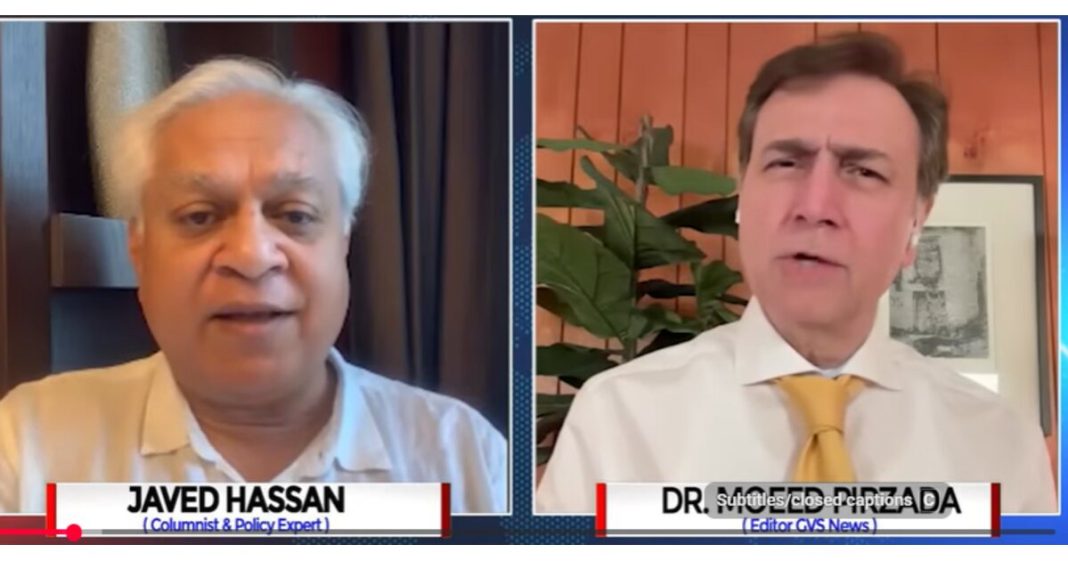
In this insightful conversation, British-Pakistani scholar and former policymaker Javed Hassan joins Editor Global Village Space Dr Moeed Pirzada, from China to discuss Beijing’s evolving view of Pakistan, India, the United States, and the changing global order. Drawing on his recent interactions with Chinese academics, policymakers, and students, Hassan offers a rare insider perspective on China’s strategic thinking, economic transformation, cultural evolution, and foreign policy priorities.
The discussion explores China’s admiration and concerns regarding India’s rise, the future of CPEC Phase II, Pakistan’s strategic importance for Beijing, security challenges affecting Chinese investments, and China’s approach to international affairs based on non-interference. Hassan also shares observations about Chinese society, innovation, education, social values, relations with the West, and how ordinary Chinese people perceive Pakistan.
Title: How China Looks at India, Pakistan & America? Powerful Discussion! Moeed Pirzada & Javed Hassan
Date: 18th June, 2026
Dr. Moeed Pirzada: Assalamu alaikum. This is Moeed Pirzada in Washington, United States. In today’s session, I’m joined by Javed Hassan, a Pakistani banker, a former policy maker, a writer from Shanghai in China. Javed, I come straight to the point. Why are you in China?
Mr. Javed Hassan: Thank you very much, Moeed. It’s a pleasure being on your show. I’m in China because I was invited by Sichuan University to talk in a closed-door discussion about Pakistan. This is a friend of mine and colleague who’s the associate dean there. He invited me, and it was a closed-door policy discussion, and just an update on Pakistan economy and situation.
But I have a long running interest in China. Last year, I was invited by Fudan University as senior visiting fellow. I maintain my contacts with the professors, the academics there. So that’s really the reason I’ve taken this opportunity to do a travel log across China.
Chengdu where I was invited, Sichuan University. I started off there. I obviously spent quite a bit of time talking with colleagues there in the university, but after that, I’ve taken a few days off and decided to come first to the Anhui Province, Hefei City, which is a technical city, which high-tech city, that’s where a lot of AI development is taking place including EV development in the villages nearby, and now making my way back through various cities in China, including Nanjing, Shanghai, back to Chengdu, and then I’m going to Lhasa on the 15th.
Dr. Pirzada: Very interesting. I thought that you were there to basically learn about China, about the Chinese policies. I didn’t realize that there is, in fact, a Pakistan dialogue taking place somewhere in China. So, I mean, what was the Pakistan dialogue about?
Mr. Hassan: Well, it’s a closed-door conversation, so obviously I. Need to be careful about in what I can talk about, because there was a certain degree of confidentiality about it, but it really is about the economy in Pakistan. How that’s progressing, the almost continuous need for liquidity injection that is required, or asked from China, how is that going to transform, and to a certain extent, the progress on CPEC-II. There is concern here that while there’s a lot of talk, there’s lots of MOUs. Probably CPEC-II has not progressed in the manner the Chinese would have liked, so there’s a certain degree of disappointment, but there’s always hope, and they’d like to see much more progress on CPEC-II.
Dr. Pirzada: Is this dialogue a recurring running institutional feature, or is this a new thing? How many people participate in this dialogue? I mean, are they all Pakistanis and Chinese, or their other people part of this dialogue.
Mr. Hassan: There are many other people. I must say, I’m not the only person they invite. This is a regular series of individual scholars, policy makers, the universities. I must add that has the largest South Asia center and has considerable number of scholars who look at South Asia, and this is not just Pakistan, but also India, Nepal, Sri Lanka. There are a number of PhD students there who I had the chance to interact with, and they’ll look at this place at our region very closely, and the one thing one must understand about China. This is a very academically oriented society.
Dr. Pirzada: Academically oriented society, what does it mean?
Mr. Hassan: It means it has; it places a lot of premiums on scholastics. It tries to understand countries, unlike in Pakistan, I would say Pakistan, there’s virtually no China expert who knows Chinese language extremely well. There might be one or two, I know one name, but there are very few people who would know the entrails, the details, the history, the background of China. What makes these people tick? What makes this country govern itself in the manner it has? That is something missing, but here you’d find at least 20 scholars who would know the details about Pakistan, about India, about Sri Lanka, and then you have probably hundreds of PhD students who are looking at the region, and I must say, this is not just South Asia, which is neighboring. They have similar sort of scholastic attitudes, and I have to say these scholars are advisors to the NDRC, to the Polit Bureau. Some of their policy advice apparently reaches right up to Xi Jinping.
Dr. Pirzada: Interesting, so you said that Pakistan doesn’t have any expertise on China, but what about the China?
Mr. Hassan: I didn’t say any, but I said limited expertise, I wouldn’t want to say something like that.
Dr. Pirzada: Do you think about the China Center, which the former senator, Mushahid Hussain Syed. I don’t know if he’s still the senator or not, but he established his son was very active with it. They frequently traveled to China. They invited the Chinese experts and scholars. I mean, what do you think of the China Center’s role?
Mr. Hassan: To be honest, I don’t know enough. I think they’re probably doing a commendable job, but I don’t think, for a start, anyone there, there’s anyone there who’s conversant in Chinese. If you’re going to be a China expert, and I, for immediately, put up my hand, I’m not a China expert. Don’t even pretend to be one, don’t even come close to one. You need to know the Chinese language, unless you know the Chinese language, you won’t understand the texture, the feelings, what moves it, the poetry, the history that goes behind. You will have a glimpse of it, but you hope you can’t really get that complete texture, the granularity of what makes this society tick, and that I largely think is missing.
Dr. Pirzada: What about what about the premier institution, National Defense University in Islamabad, which I mean, do you think they have expertise on China?
Mr. Hassan: I would say I don’t know enough about NDU, so I would hesitate to talk about it, but from what I have seen, and what I’ve seen written in public discourse, there doesn’t seem to be much expertise. I’ll tell you how I came to that conclusion. There’s very often talk in Pakistan about the China model, and it’s said very glibly, very easily, and very often meant to be taken as an authoritarian model. A coercive model is a China model. It’s far from that. China model is something with the Chinese. When you tell them about it, that Pakistan wants to adopt the China model, they laugh. They say simply, it’s not possible. What are you talking about it? Has taken 3000 years of history to bring us where we are.
There is Taoism, there’s Confucianism, there’s Legalism, there’s the history of 100 years of humiliation by the European powers, the colonial powers, the Boxer Revolution, then there’s Nationalist period, that the fight with Japanese, everything has had a role in framing how the Chinese think, how they see the world, how they frame it for the future, and how they see their society, and where it should be. And it’s a society, as I said, which is very deeply embedded in valuing scholastic thought. This is one of the first society that developed what you call policy makers, bureaucrats, mandarins, by and large, used to run China, and that was very much so the highest attainment in China, in traditional China, was not being a billionaire, even today, probably billionaires are light, and people probably annoy them, but the highest attained one was being a scholar.
Dr. Pirzada: So, basically, the when the Pakistani military, the top military brass, and the general headquarters think that they want to run Pakistan with a strict hand, and it would be like the Chinese model, a sense of direction from the top. You think this is not the thing with China. Is China being different?
Mr. Hassan: China is very different. I mean, we must understand that there are many layers in China. The Communist Party is obviously dominant, but the Communist Party depends very much on the legitimacy among the people, it is very careful about the fact that it constantly seeks legitimacy in terms of delivering to the people. That’s why, if the growth rate slows down, if poverty is not reduced, if amenities are not provided, the Communist Party is extremely concerned.
So, there is this constant need to go back to the people and seek legitimacy. Now, you might say, as the Chinese say, when you talk to the academics here, it is democracy with Chinese characteristics, and within the Communist Party, there’s a considerable element of what may come meritocracy, for a start, but there is an element of democracy as well, so really it doesn’t seem anything like a top down, we know it all sort of authoritarian state in the way that people imagine it to be, and their concerns when it turns towards because China has had a history of sometimes having very authoritarian model and it has proven to be disastrous for the country.
Dr. Pirzada: I mean, correct me if I’m wrong, I thought that the present Chinese model is basically a creation of the of the Chinese Communist Revolution and the Civil War of 1948 -49 and the Cultural Revolution amongst it and he said that no, the historical layers are there part of this administrative and political structure.
Mr. Hassan: I think one can’t see a country without understanding its culture, its societal norms, and the societal norms are very much driven by many of the ideas of Confucius, Confucius, so Confucianism is very deeply embedded in this society, that sort of family coherence of being a good person or being responsible, these all drive from in our part of the world, we might say from Islamic values, but they have a very strong sense of, and this does not come from a sense of retribution, that if you don’t do good, you’ll go to hell. It is the way of life, so you must be honest, because that is a better way of life. You lead a better life, you must be hard-working, because that is a better way of life in this life. It is said that China is one of the few countries that did not have the concept of God.
Yes, there’s Buddhism, but there was no central deity with China, for you know, so many 1000 years hasn’t had. So, this, this is a society where the culture, the society, the norms, the philosophy is very much embedded, even Mao Zedong, even though he may have been a communist, and they may have quoted Marx, he very much always reflected on the Confucian thoughts, there’s other thoughts, I was in a place which is Du Jiang, which is a effect, it’s not really. Dam, but an irrigation project, a dam, and this is near Chengdu. Now, what is interesting, this was 2300 years old structure. It’s still functioning, it’s still supplying irrigation to the plains of Sichuan, it is the Sichuan basin, which is probably the food basket of the country in many ways.
Now, this was constructed on a basis of 1000, where they say you flow with nature, you don’t oppose it. So, there is, and I use the word dam. I should have corrected myself. There is no dam. What it looks at very carefully in managing how the water flows in different seasons through the depths of the various canals, canals. It’s a wonderful place. I mean, engineers still marvel at it. They did this without slight rules, let alone computer. They simply did it on the basis of their own mathematics, as it was there, but again, so you can imagine, and every time people come, they go to Virginia, and after anywhere you go in China, you will see in historic places, unlike in Pakistan, it is jam-packed, so that connection with history is extremely strong.
Dr. Pirzada: I just want to bring you back to the from where we started. You said there is, in fact, a desire to understand different systems. Is there a desire to understand India and Bangladesh and Sri Lanka? Is there a desire to understand the West at the same time? Did you come across centers that specialize in understanding in India, for instance?
Mr. Hassan: Absolutely, I mean, in Furan University, there’s a South Asia center, and one of my colleagues, Jedong Jang, who I wrote a small column about Pakistan as well, is a South Asia specialist, and his specialty is India. He has two PhD students from India studying with him or doing their PhD with him, and they again, the South Asia Center in Sichuan University has the associate dean there, who is an India specialist, knows India extremely well, and I can tell you there are numerous such studies, I’ve met a person who’s in fact, I met several people who speak Hindi fluently.
They write Hindi, so there is a deep desire to understand what makes India, and I’ll have to say, unlike say our part of the world, there’s an immediate even though there may be rivalry between India and China, and there is deep rivalry, and there is some criticism as well, but there is as well admiration for India. There is an acceptance that there are some things they might be getting right. There isn’t just a blanket attitude that India is primitive or backward, it’s been left behind. There’s almost a fear that India, given its structures, may in the end prevail.
Dr. Pirzada: So, Javed, I have not been to China in recent years. I think it’s more than 20 years ago I spent about a week, so between Shanghai and Beijing, I was living in, yes, a different country. I heard from so many Western diplomats that every now and then, when they come back to China, they feel that China has sort of reinvented itself, you know. The American diplomats told me, the British diplomats told me, but I was, I and Najma, my wife, were there, and we spent about a week or so between Shanghai and Beijing, and I went to certain bookshops, very large bookshops, and I came across the students, which are high school students, and I talked to them about Pakistan and India, and they told me they, in their course curriculum, has very limited information on Pakistan, but there’s a lot of interest and a lot of information on the history of India. I mean, so is it the same that their desire to understand India is more than the desire to understand Pakistan
Mr. Hassan: This, this is an observation that was made through one of my very close friends here, who is at Fudan University, is an associate professor. He says most of the experts, 70% of the experts in China, the scholars looking at South Asia, are India specialists rather than Pakistan specialists, but we must understand also India is a much bigger neighbor. The trade relationship with is much bigger to India. They export China exports something like 100 and $10 billion worth of goods and imports something like $15 billion so altogether something like 100 and $30 billion of trade between India and China with Pakistan, despite the closer relationship, it’s closer to sort of 15-20 billion, probably 20 billion now. So, it’s, if you can imagine, it’s about a sixth of the size of trade volume, so by. But I must add, I must add, while there may be greater focus on India, and one must understand reasons for that, given the trade relationship, given India’s size among the common people, there is an automatic sense of affection for Pakistan.
I mean, it is a bit like I could probably get away to some places without paying my bills. Oh, really? It is anytime I’ve gone in the smallest places in, and these are very common people in an evening when the cleaner is sweeping the street and he sees me, asks me where I from, from Pakistan, he comes and shakes my hand and says and says and he says Steel Brothers, Steel Brother, so that, and this is not one time but several times, and I just fear, and among the academic, there’s also this realization that Pakistan is a strategic ally, it’s a very strong ally, but there are concerns, and some of it we can talk about, some of it we might want to ignore, but the fact of the matter is this is a relationship we cannot afford to lose, because it’s so deeply embedded. Sometimes the heart rules over the mind, so among the people it’s the heart that rules, where among the scholars it’s the mind, and in the mind, there is a certain degree of question, there are certain degree of questions and some degree of disappointment.
Dr. Pirzada: and among the expertise, among the institutional expertise, I mean, when they say, when they think it’s a, it’s a strategic relationship. What is the meaning of that strategic relationship? Why is Pakistan important in terms of strategic relationship?
Mr. Hassan: I think if you have that, if you look at historically, there are two countries over the last 30-40 in fact, longer, 50 years that have unequivocally stood with China. There’s been no moment where Pakistan has criticized, and this is the same relationship with North Korea.
Dr. Pirzada: I was thinking North Korea, I was thinking, what was the other country? Will be really.
Mr. Hassan: It’s not going anywhere. There’s sort of unequivocal understanding that that country will support us. Pakistan has been largely that since I mean one may have many criticisms over Yukon, but he must be given credit that period, probably the foreign minister.
Dr. Pirzada: When he was the foreign minister,
Mr. Hassan: Yeah, and also the bureaucracy that there were, despite American pressure to not develop this relationship, they developed this relationship, which I think Pakistan, for Pakistan’s survival is critically important, much more so than I think than any other relationship, so there is there is a very strong bond, and they recognize it, and we have to remember, and it’s a good time we are talking.
This is the seventy-fifth anniversary between the relationship, the diplomatic relationship between Pakistan and China, so it’s a very appropriate time that we are talking about this. We have a deep sense that Pakistan is a strategic ally. There isn’t that kind of formal defense agreement that they might have with North Korea, but there the history was different. There it actually, China intervened. If you remember, in the Korea War against America, they crossed the river to beat back the Americans. In Pakistan’s case, there hasn’t been similar direct intervention. Having said that, but China has been a constant supporter in our defense procurement in our defense development, so really that the relationship is very deeply embedded
Dr. Pirzada: Is there a feeling in the academic circle? So the Pakistani Foreign Office and the Pakistan has also played a role in opening up the communication channels and an understanding between United States and China in the 1960s and 70s, because I was reading in Henry Kissinger’s books that Kissinger wrote that the Pakistanis told us and convinced us that China is less about communism and Marxism and is more about Chinese nationalism, so they understood China better than we understood. I mean, he wrote these comments in his books, you know, the years of upheaval in White House.
Mr. Hassan: I think what is interesting, if you look back in history, there was considerable Pakistan was in some ways one of the strongest allies in the 60s and late 50s of America. It was part of SEATO and CENTO. So it really depended on American aid and especially the military aid for its development, so it was in many ways beholden to American largeese, but I think despite American pressure, the Foreign Office, the regime ensured the development of the relationship with China, and it became a pivotal relationship.
So, this is despite, I think, there was considerable opposition, which probably Mr. Kissinger will not write about, from, from, or Dr. Kissinger might not write about, but that the reality was there weren’t too keen to see us develop relationship with China, so that relationship was built really on the initiative of Pakistanis, and it has stood this time, the test of time. In fact, it has to be said, the 1971- July trip by Henry Kissinger was orchestrated by Pakistan, and at the time when America decided that it wanted to develop relationships with China as a counter force to Soviet Union, Pakistan was there, and our relationship, our acting on our sovereignty, actually proved helpful for even America.
Dr. Pirzada: Unfortunately, unfortunately, whenever I read an article in Foreign Affairs, Foreign Policy, New York Times, on the China opening, Pakistan’s role is seldom. I haven’t ever seen Pakistan’s role acknowledged over there. I mean, apart from Henry Kissinger himself, who in his books acknowledged that role, I haven’t seen other American policy writers ever acknowledging Pakistan’s role.
Mr. Hassan: Well, it’s sad because Nixon and himself very openly remember this trip, I think was July 7, 1971, and he spent a few days. In fact, the rumor is that basically the way it happened was it was said that Kissinger was not feeling well, and he disappeared to Murray for a few days, but in reality, he had flown to Beijing. Then he flew back to DC, and at that time he took an invitation from Mao Zedong to Nixon,
Dr. Pirzada: President Nixon,
Mr. Hassan: President Nixon. It must be remembered Kissinger met Joe in line, not Mao Zedong. So, the protocol was kept, and Nixon then met later Mao Zedong. Now Nixon announced the fact that on 15th, I think of July again. Correct me if I’m wrong about the fact that we have established this link with China, and I’ll be visiting China, and he specifically mentioned Pakistan in that announcement.
So, there is ample historical record about Pakistan’s role in facilitating, now there’s another point I would like to make here, and slight digression, this was all done, and people will say different times, no social media, but this was all done without anyone knowing about it. There was not even the slightest indication that this was happening. Nobody had a clue.
Dr. Pirzada: In terms of the Kisser, the Nixon thing was open, right? In terms of the Kissinger secret diplomacy.
Mr. Hassan: That was the critical thing that laid the foundation. That is what Nixon was just making an announcement, but all that happened, and it was six months prior to that, the discussions had been going on, there was not a single leak. There was not a single, and this is in context with what recent negotiations that have been taking place, which I don’t want to digress. Where every day there has been some leak or the other. Now, the reason I think partly that is this was based on large element of the foreign office working on this process, and it has
Dr. Pirzada: Every single day there is a leak in Pakistan or in Washington.
Mr. Hassan: Well, I think some of some of the leaks, if you’ve seen them, also emanated from, I don’t know, if it’s Pakistan, but Pakistani journalists, and it’s been unfortunate. I think this whole process should be, and I think that’s what the Foreign Office said should be done with a great deal of discretion and confidentiality. And we have the 1971 model, which proved to be very technical.
Dr. Pirzada: 1971 China opening by the Yahya administration, or the role which they played in it, gave them the confidence that China and United States both will help them in the 1971 war with India on the creation of Bangladesh, but it didn’t materialize into that, you know, China didn’t do anything for Pakistan.
Mr. Hassan: You know, it’s interesting you say that. I’ve had that thought, and I was hoping you’d not bring it up, but you’re right. These external winds don’t necessarily translate into internal domestic winds, and in fact, I would go so far as to say that sense of confidence, over confidence, because there was this view that China and America would be protect our back, actually allowed us to take the extreme actions in East Pakistan, which we might not have, but this is really a billion dollar question, what we might or might not have done, but the fact of the matter, there was a sense of overconfidence that we took actions which actually led to the creation of Bangladesh in the manner that it was created.
Probably Bangladesh was an inevitability, given its distance, its operation, its cultural differences. Nevertheless, in the manner that it happened probably was a result of the overconfidence of the regime at that point, that somehow the other United States, with its fifth lead, I understand, and China, with its support, will come to us. In fact, one of the things I think is said in the book, or one of the papers, where apparently Zhou Enlai said to Kissinger that remember who facilitated this, be good to them. So, there was this, I think, overconfidence, and I think it’s a very good point you make, but again, this is history. It’s a million-dollar question. We’ll never know the answer,
Dr. Pirzada: Because that overconfidence is still being exhibited by the Pakistani establishment when they’re dealing with issues, whether it’s in Baluchistan or right now in Azad Kashmir. I don’t know if you’re watching what’s happening in Azad Kashmir.
Mr. Hassan: I have been. I’ve not had that much sort of close interaction, but I just saw yesterday 11 people unfortunately perished, died, you know, circumstances that should never happen. It’s extremely sad, you know. It is. We must be careful at external, external wins, which again we are not even too sure right now if it has been a victory, because it’s the negotiations are on and off.
Dr. Pirzada: you mean you refer Iran and United States.
Mr. Hassan: Yeah, so where we have played a mediation role, so let’s, let’s, let’s put that on hold, but that should not be a reason why our focus for my internal issues should be deviated, and and it does not give any government, any regime, any system to be extra harsh with its own people.
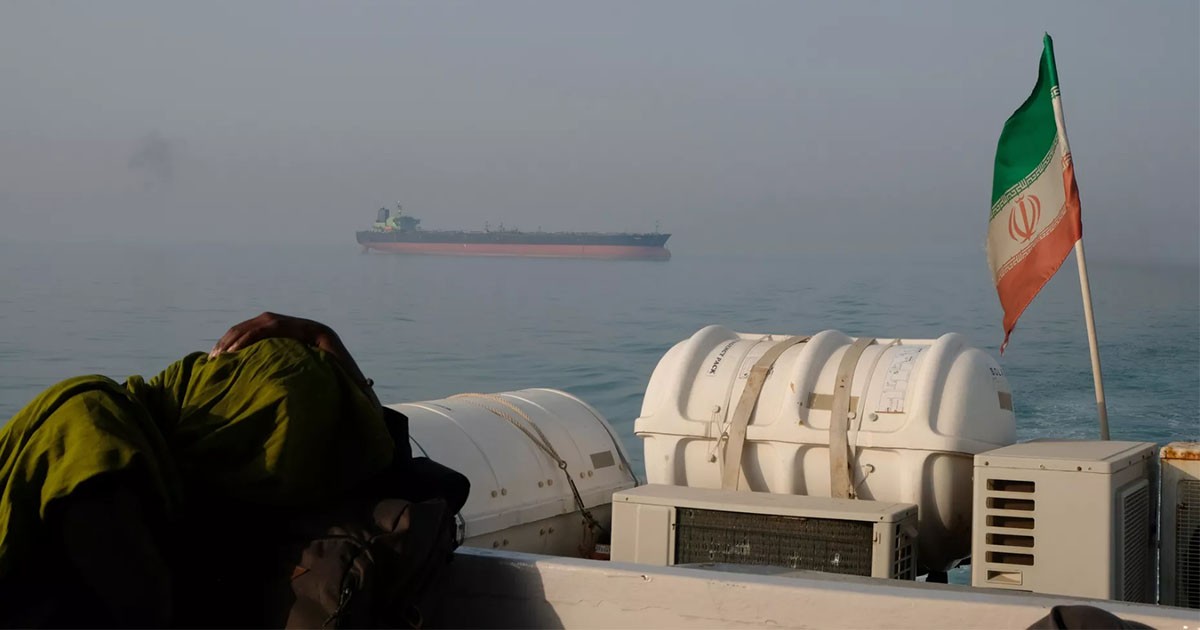
Dr. Pirzada: Since you mentioned the, you referred to the Iran thing, how has the Iran-US- Israel conflict has been seen from within China?
Mr. Hassan: Well, China has been paying a huge price in where they have been drawing on their strategic reserves, which were said to be about a billion barrels, so they have drawn up, and they, they can, they used to import about 7.5 million barrels every day, so now, now that has apparently come down to something like 300 400,000 barrels, and instead of, you know, importing, they’re drawing on their strategic reserves. This is one way the international prices have probably not spiked up to, you know, 121 30, which many people feared.
It’s one of the main reasons, I think, is because of the reduction in the imports from China, and China has two reasons for doing they want to keep the oil prices at a sustainable level. If it goes up to sort of 100, it will affect their consumers, but nevertheless, this, this is a price. How do they view it? I think if you talk to most people, even academics, they, the sympathy is with Iran unequivocally, and that is the tone also coming from the Ministry of Foreign Affairs in China, but they also see Iran interestingly, while the trading relationship may be much more than Pakistan, in fact, in some ways one might say the strategic importance for China in Iran is much more than Pakistan.
It’s arguable, but that, that could be said, but the affection among the people have to say is overwhelmingly much more so for Pakistan, and it’s almost embarrassing, and I have to tell you, I mean, I’ve had Indian friends walking with me, and we’ve been somewhere the vast, where, and they’ve said India, and they said I’ve said Pakistan, and each one has got it very differently.
Dr. Pirzada: Really, Increase, so the increase in trade is not going to change the dynamics of this relationship.
Mr. Hassan: It will, it could, I think, eventually, if, if we don’t improve our economic situation, if we are constantly there asking for more aid, more investments, rather than investment coming on on its own accord, and India continuing to grow. I think gradually as trade relationships develop, the attitudes also change, probably not at a at a grassroots level, but gradually at least the trade businessmen level, and the businessmen have a huge impact on how people think as well. So, yes, I think there is a danger of it. One cannot avoid it, but, but as I’m just speaking, as things stand at present, but yes, the future we need to be careful, and the fact of the matter is, the one of the greatest concerns they have is about the security of the personnel working in Pakistan, whether it is in Dasu dam or in Karachi, or those few incidents of terrorism have had a very negative impact, probably on the mindsets.
Dr. Pirzada: is this feeling that Pakistanis are incompetent, or Pakistan is a dangerous place, and they’re not sensitive to Chinese security. What is the feeling?
Mr. Hassan: There’s a wide range of feeling, ranging from a view that it is, it takes it too casually, the securities issues of Chinese workers to the sense that they haven’t made enough efforts to capture the culprits, but these are, as I said, divergent views, but one of the critical views also now that is developing is what are the underlying reasons why there is this prevailing security situation, and that’s something which is beginning to, I think, gradually get understood by the Chinese, and that’s something we need to be also focused. It’s not simply the question of having more troops and having Chinese boots on the ground, because there’s an understanding, or there’s a feeling that that by itself will not solve the problem if there is underlying fuel.
Dr. Pirzada: So, have you heard of any discussion, or a desire that there should be Chinese security presence in Baluchistan in different areas to protect the Chinese interest in the workers.
Mr. Hassan: I think there has been talk between the two countries. Again, this is what I’ve heard. I don’t – I’m not privy to really internal discussions of this sort, but I can tell you some of the academics that I’ve spoken to, some of the people I’ve spoken to, there is this view that Chinese boots on the ground is really not a good idea, and one of the main reasons of why it’s not white won’t be a good idea is that once you have Chinese, it will actually give credence to some of the terrorists, the people who do anti-state activity, that the Chinese are actually there to exploit the Baluchistan resources.
So if anything, it would be counterproductive to the Chinese efforts, and Chinese are not unlike the Americans, they’re not too keen on having bases and boots on ground in other countries. This is a country very much internally focused and very keen to have internal coherence, and each country develops its own security needs. They’re very, very insistent on non-interference. This is something again, one hears even when one argues that you know you should possibly think about that or say that about economy or something. They say our policy and our attitudes is noninterference. We don’t want to dictate to any country what it should do. We can talk about it, we can raise issues, but so your question regarding boots on the ground, I think that that might have, there might have been talk about it, but from my perceptions, I don’t think the Chinese would be very keen to do so.
Dr. Pirzada: Javed, you’re someone, if I come to this, if you are someone who has spent a lot of time across western centers of professional circles, I mean, in London, perhaps in Singapore, I mean, you spend time in, of course, in Islamabad. You were part of policy making at one time with Prime Minister Imran Khan. You’re familiar with the American working culture as well. Do Chinese speak openly about the world the way Britishers speak, or the Americans speak, and. Western speak, can you make out what they think?
Mr. Hassan: Absolutely, this is one of the great surprises when you come here in private conversations over Baiju, which is their local alcoholic bear brew. The conversations are as open as frank as you’d get in New York, anywhere in some of the restaurants, or wherever else you have a discussion, they are as critical as analytical as you’d get anywhere in a Western country, and moreover, they don’t need to tap their shoulders, they don’t need to use hidden code, they speak very openly that this is a society quite contrary to sort of Western perception, does talk is very critical of its own government at times. Yeah, absolutely.
And so, this is quite contrary to, you know, we have this idea of open society and West being an open society, and China not being an open society. Absolutely not. I’ve talked to PhD students, I’ve talked to various students, some of them, very critically expressed their views about not only the state but how it goes.
One of the great concerns is that China has done remarkably well from sort of 1990s to present time. It has sort of from early 2000 it must present 2018- 2015 It grew by about 9.3% which is never in history, never in history. In one generation has a poverty rate of about 60%-50% They’ve brought it down to near zero, extreme poverty. Now it hasn’t happened in any other country yet. Yet people are very concerned here at this moment. They feel that we have done incredibly well right now, and this doing well has come about partly because Europe has been, and America, the Western world has been very open, has allowed us to export, has allowed us to interact, has allowed us to learn from them. Many of the Chinese scholars presently in China were trained either in America or Europe, or when they are for education, and they’re very concerned that we might not have that access any longer. So, there is this concern there.
There’s also this concern that while Chinese are incredibly good at taking things from one to 100 and extremely fast, where they might be lacking is going from zero to one, and that’s an important concept to appreciate, because America is extremely good in the new innovation, the going from zero to one, that sense of, you know, whether it’s Elon Musk or Apple, or that sense of discovery of innovation, which is a hallmark of America. The Chinese, probably, I feel quite incorrectly feel that they might be lacking that, and that might, they might be.
Dr. Pirzada: I was discussing with two American neuropsychiatrists this thing, that what society will be more creative, and they actually had a long pause, and they said ultimately the American society has to be creative, because there’s free thinking. Americans question everything. I mean, look at the Iran war, I mean, the American left, the American liberals in the American papers have totally taken a position against the American government. So, the free thinking itself is creativity. Is this what they feel? They don’t really have the American way of free thinking.
Mr. Hassan: There is concern about that, and, but this is the good thing. There is concern about it, and there’s discussion about it, even in, you know, some of the top universities, and there’s also thought that we might be working too hard for our students. They are focused too much on just getting grades and passing rather than being creative and being slightly radical and slightly different, that that sense of creativity. So, I am very confident that they will find a way out of this, and you can see there’s a university I visited, which is quite amazing, and the place people must go to.
It’s that’s where DeepSeek came out of alumni from that JJ University, and there you have again, if you go to the environment, the university environment, they’re very deliberately created it in a way which is very hospitable, very fun. There are lakes, there’s parks, there’s places to play, so they’re quite deliberately trying to create that environment, but the culture, you must remember, in one generation where there was extreme poverty to know to. Being placed where per capita GDP, it’s about quarter or 25th of America is remarkable progress. I’ll give you an example. So, my friend, who invited me first here, lives, and I went to his village a few days back, a remarkable place. Then I have to say, the village is still a village. The paddy field across. He told me about how in the morning he had to wake up and first go with his father, because they wake up 435 with their son, go to the paddy field, work on the paddy field, and then go to school, and he said till 1985 there was no electricity in the village.
Today, if you go to the village, there’s BMW parked out there, there’s the latest BYD, there’s electricity, there’s every modern facility, all the roads are paved. The one thing you find in China constantly, constantly anywhere is spotless cleanliness, so you know, Gandhi might have said cleanliness is godliness, but he would have been incredibly happy in China. It’s clean, Fenn relates this to me, he said that very often they would eat, and I’ve met of that generation who are about 45- 50, those, those who said we have known periods where we would have not eaten for two days, they have known not starvation or not famine, but they have known starvation, virtually anyone who has been 50-55 probably late 40s. They have known starvation, but now you go across, and in fact, one of the things I felt is that the tables are full of 10 different dishes, and often the food is much more than what is consumed, so it probably is being wasted. So, this is a land of plenty from there’s been remarkable progress.
Dr. Pirzada: So, this novel-rich phenomena, what we call ‘nau daulatiye” in the sense that the American system has created its wealth over 200 years, right? I mean, industrial revolution, then the nuclear age, the space age, the computer age, and so on. So, with this no rich phenomena, has it? How has it changed the culture, the behavior, the values, the ethics, the respect for the elders, the family system, the relationship between the husband and wife, the man and the woman? How has it affected this quickly 30-40 years of, you know, getting rich?
Mr. Hassan: Okay, I’ll push you back on this Nova- Rich concept, and this is a very Pakistani view of probably in Europe as well, Barchester Chronicles, even in England, you know, the Nova Rich were always made fun of, the industrial North industrialist was looked on upon.
In China I would say this is the great difference between China and say Chinese elite and our elite. Our elite were basically those groomed by the British, the colonial law legacy. They have a sense of entitlement, they feel they are better, and they often are the people who call themselves Khandani, and essentially not very differently to the British, they essentially look down on most people.
And the number of times I’ve heard in Pakistan and India as well, those common people, what do they know? They’re ill manner in China, it’s quite opposite the elite after the cultural revolution came, and after the revolution came from the ordinary people. It came through a process of great hardship, great trials and tribulations, and it is from the people. Now you have an elite here as well, they are billionaires here, they are the people in the Ministry of Foreign Affairs, the bureaucrats, the Communist Party members, but they are people who have built a country which needs to win acceptance from the from the people, it needs to deliver to the people, it seeks, as I said earlier, legitimacy from the people.
So, it is a very different nature of elite to what is Pakistan. So, in fact, here I would say no worries, reach is admired. So, I, with my friend, went round on a table dinner. There was one person who was going to list a company, an AI company, potentially could become at some point hundreds of billions of dollars. If not, he was a son of a peasant, and he proudly said he’s a son of a peasant. My friend, his parents were peasants, so you will find any number of people, and there is a distinct joy in saying where they came, and this is probably true in America. So, I think I think my question was.
Dr. Pirzada: different. My question is not this, whether they liked it or not. My question is this: that novo rich, of course, are liked everywhere. I mean, Jeff Bezos is an override in a way, I mean, he’s one of the richest persons, he wasn’t that rich in 90s, it was very middle class, but the point is this, when the economic, when economic reality changes very quickly, how has it affected the relationship between the genders, the sexes, the parents, the older generation, the newer generation, how has it transformed? How has it changed? Because all of that happened from Deng Xiaoping’s time, from late 80s onwards.
Mr. Hassan: I think that’s a very valuable and useful question. And yes, there are a lot of social tensions. Again, talking to my friends, that while families used to be very close together, closely met, families have separated. There isn’t that kind of cohesion that there was. It’s far more unitary. There’s another very big factor that is taking place. Not enough people are falling in love and marrying, because of the one child policy, there’s a much higher level of entitlement, any number of people have come across it, young ladies and gentlemen, and I’ll ask, are you going to get married? And there is almost a reluctance to get married, so that is one of the quite big concerns.
Dr. Pirzada: What is the average age of a woman, a man getting married?
Mr. Hassan: I would say about 26/27.
Dr. Pirzada: So, are they cohabiting in the American way before 26.
Mr. Hassan: Oh, very much so. Yeah, look, in this way the social norms are very similar to the West. Having said that, it is still a very patriarchal society, people are still very traditional in some attitudes, in sexual modes, but nevertheless, I think the reality is this does not have the same taboos as, say, so this,
Dr. Pirzada: This culture of being liberal, this culture of being like the West Cohabitation, and all that between the young man and woman, this happened after Deng Xiaoping’s 1980s reform, or was this also before that in 70s?
Mr. Hassan: I think it has been long there. It’s part of the communist ideals, I would say, treating equal women, you know, cohabitation, those are things that those social taboos were never there post revolution, and I think this is a society very much in terms of those attitudes very open and progressive, but there are certain norms. I would say one of the things we have to understand, and this is extremely true, it’s a fact, I mean that women were sometimes left behind in terms of education, but basic education, universal education, women’s participation and inclusiveness was as much as that.
Now, what happened in some families if they were, say, three kids, and you must remember one child policy only happened after Deng Xiaoping. It was not before that. Before Deng Xiaoping, people did, China had a very high birth rate, and if there were three kids and there were two girls and one boy, the two girls would not sacrifice their future for this one boy, so in that way it was still quite a patriarch that has changed now.
I think women are as demanding, but you’d be surprised the number of times I’ve come across young ladies who are saying if you go to university departments, if you go to there are not enough women right at the top.
Dr. Pirzada: Even the West is not the same. I mean, in London, you find men and women are more able to express affection for each other in public places, like touching each other, than perhaps across United States. In United, and also, I mean, in France is even freer. United States is far more conservative, maybe New York and Boston are more relaxed, and LA is relaxed, but rest of the United States is very conservative. So, you see this kind of liberalism in China, in large cities like Shanghai and Beijing, where you see it everywhere.
Mr. Hassan: I mean, just around the corner, if I go down, this is sort of near the whole colonial quarters, the sort of French concession immediately, you’ll see people, young men and women, walking hand in hand in some places in the parks, they’ll be hugging each other, so it’s probably Shanghai, slightly different, but that’s true.
Dr. Pirzada: State has no policy, does state have no policy to inhibit all this?
Mr. Hassan: Absolutely, none.
Dr. Pirzada: So, then, what is their position on other religions? For instance, is there any reflection on that the Uyghurs in Sinkiang are not being treated very fairly? I mean, the concentration camps and all what the American media keeps on saying. I mean, is there any feeling for the human rights of the Muslims? What is the problem there?
“US State Department has said it’s a mistake for the United Nations human rights chief to visit China amid concerns that the Chinese will not allow proper scrutiny of the state of human rights in the country. The visit is to include the western region of Xinjiang, where ethnic Uyghurs, most of the Muslims, have been unlawfully detained and mistreated issued out when she had favor with your senior, for me, she found Egypt.”
Mr. Hassan: I have seen no discrimination against Muslims. I’ve met Muslims in academia, Chinese Muslims who are doing extremely well, and I’ve met Uighurs who tell me that there isn’t the kind of stories. Yes, there has been some issues with state policies, which are much more restrictive, and trying to bring them up to the same standards of education as the rest of China, there was also some – I wouldn’t say concentration camps, because that’s a very Western terminology, but there were what, what we’re training camps for vocational training for changing, but there wasn’t that kind of, you know, brutal repression with the West Act talks about.
I have friends who are Muslim friends in Ürümqi, they don’t speak of it in that manner. Yes, there was discrimination, but there is now very active role to involve the minority, so to speak, the Muslim minorities. One of the most popular social media ladies is a young Muslim girl from Shin Yan Province. She was one of the leading dancers, and specialty is doing the sort of traditional ethnic dances, so if there is this perception created by CNN or New York Times that there is a desire to suppress ethnic culture, I don’t see that you go to any restaurant here. In fact, given that I’m from Pakistan, they would take me all the time to the Xinjiang restaurants because they’re supposed to cook halal, they wear the small cap, they have Bismillah, and they serve halal food, and the other Chinese, the Han Chinese like it as much as other food.
In fact, they’re quite pleased I’m around, because they get an opportunity to go to these restaurants, so in every city in Shanghai, there’s a mosque. In Chengdu, there’s a mosque in a, in a small village, or not small town, like Du Jian, where I went to, where the dam was. There was a mosque, I photograph of that, and there were Muslims there coming to pray, both ladies and but the good thing, you’ll be interested to know, in the hall where there were men praying, there were ladies also praying, so there was no segregation, no segregation.
Dr. Pirzada: No segregation based on the sex. But can you travel to Urumqi, a foreign tourist who comes to China? Can he travel to Urumqi?
Mr. Hassan: I was going to go on the way back to Urumqi, there’s a flight from Islamabad to Urumq. Yes, absolutely. There’s nothing. The only restricted place to a certain extent where you need to get a permit, probably for health reasons, is Tibet. But I’m very lucky, I’ll be traveling there next week.
Dr. Pirzada: So, I mean, why do you need a sort of permit to go to Tibet? I mean, for health reasons, or what?
Mr. Hassan: I think altitude sickness is an issue. They want to make sure that people don’t go there and get sick, but there might be other reasons as well. I don’t know, but one does need a permit to go to Tibet.
Dr. Pirzada: Few four minutes. I mean, one of the major, you know, elephant in the room, we haven’t really discussed what is there, you know, fears about United States. What is the feeling about United States? This confrontation, the Trump, you know, all that. What are the feelings?
Mr. Hassan: Okay, I’ll start by one thing. The feeling is initially, and to start with, of great admiration.
Dr. Pirzada: for United States
Mr. Hassan: There is not one academic you will meet here who will say that United States is a declining power.
Dr. Pirzada: This is an American fear that we are a declining power.
Mr. Hassan: It is a paranoia in America, but in China there is a desire that the level of openness that was there should continue. Countries should, and I’m not saying this as a party line or just to support, there is talking to us that the discourse that was there, the between academics sharing cultural exchange, which has considerably the academic exchange has considerably lessened. There’s a deep desire that that should have continued, and in fact they feel that maybe to the detriment to of China, there isn’t this sort of what you hear in papers, there isn’t this desire for America to decline and fall and collapse, none of that.
Chinese and China are very internally focused. What they are more concerned about is its own stability, its own progress, the next stage of development, and they would want America to continue to progress, because after all, America is a great importer, an engine of growth for the country. So, I think the attitudes in China are very different towards America than the attitudes in America towards China. So, there’s a certain degree of perplexity about why America views it, but I think among the scholars they understand, they also understand then the concept of Thucydides trap, but to be honest, that is not something how they would like to see the world go towards.
Mr. Pirzada: American academics and policy makers also split, I mean, there’s no dearth of the American policy makers that really appreciate China’s progress, and they think that China and United States can work together, but then there are right of the center academics as well that see China’s rise as a threat, and they say China is a tyranny, it’s an authoritarian regime, it’s going to take over, they’re planning to control the world, and so on, you know, I mean, there’s a split opinion.
Mr. Hassan: Yeah, it’s interesting. I mean, one thing, I mean, this is a casual observation. I don’t have enough data to support this, so I take it with a huge handful of salts, but I’ve noticed that a lot of the China hawks tend to be ultra Zionist and Hindutva as well, so there might be that angle as well, that China’s rise might, might reduce the overwhelming power that Zionism or Israel has to certain extents, also dilute India’s.
Dr. Pirzada: Makes perfect sense, because Tucker Carlson actually made a comment on that a few weeks ago, when he actually said that the Zionists have calculated, estimated this thing, that they’re not going to get any space in the hand culture of China, so they want to cultivate more support and affection within the Indian diaspora, which is in fact more than 30,000,030 2 million, or 40 million strong diaspora across the world. So, they want to basically, they think that Indians are going to look up to them, and they can be friends, and Chinese are not going to be different. So, what is the feeling about Israel in China?
Mr. Hasan: I think there’s, look, China, in some ways, and this is from Mao’s time, while it may not want, Mao was probably much more intervening. It supported revolutionary movements across the globe. After Deng, that very much declined. They don’t want to interfere, but it’s still very much in that way believer in people’s rights, in Palestinians’ rights, in anti-apartheid movement, so those values are very deeply ingrained in Chinese society and Chinese policy makers. So, the view towards Israel is that unfair treatment, I think brutal treatment, completely apartheid treatment of Palestinians is unacceptable, and I think that any number of Chinese scholars, policymakers who have made that point.
So, what I’m saying is nothing remarkable. It’s well known that while they have diplomatic relationships with China, I’ve met some senior think tankers who have done their PhDs in Tel Aviv and Israel. Nevertheless, they are very cognizant of this problem, and they fundamentally continue to support the Palestinian rights, and there is no two ways about it. I think in some ways that you know there’s fair foreign policy is a common friend, Eric, what’s his name, foreign fair foreign policy, just foreign
Dr. Pirzada: policy, Eric Sperling,
Mr. Hassan: Eric Sperling, I’m sorry, I’ve just been in contact with him recently, Eric. Selling is very clear that America needs to pursue fair foreign policy. I think it’d be happy to see in China that is very much the policy of China, a fair foreign policy, whether it be paid, whether it be defense, whether it be internal affairs, and where they do care about is the rights of individuals, so in some ways you would say, while America may have lots of freedoms in its own domain, it denies, it helps deny a lot of freedoms elsewhere in the world, whereas in China, it’s probably you might question how much democracy there is, but as they say, Chinese democracy with Chinese characteristic, but they are very concerned about the fundamental rights as per UN Charter.
Dr. Pirzada: The big difference is that, whereas the West and the United States talk a lot about human rights and democracy, they have never actually intervened and supported democracy anywhere in the world they only use the stick of the democracy and the human rights when they want to put pressure on a government, say the Pakistani military or Saudi Arabia, or whatever, but the Chinese policy is totally noninterference. So, what is. I mean, for instance, Pakistan is a close ally, things have deteriorated, but they’re not going to tell Pakistanis to improve the situation, they’re never going to make a statement. What about Myanmar, where things are very bad, which is a Chinese ally? The Myanmar military is a Chinese ally.
Mr. Hassan: haven’t, I must be honest, I haven’t spoken about Myanmar at all while I’m in China. I haven’t had the chance, and it’s not because I was avoiding the subject, it’s just not come across. I would say it’s very much the same, non-interference. It’s an important country. They have strong trading relationships. There are investments in Myanmar, but it is fundamentally driven by non-interference. When I said they believe in sovereignty of nations, in fundamental rights of, say, of the Palestinians or the Africans in South Africa, and those times, that is the nature, but you know, in terms of democracy, that China does not pursue in other countries, it’s it believes each country has its own political system, which comes through the evolution. We may disagree with that, but that’s really the Chinese way of thinking.
Dr. Pirzada: What about North Korea? It’s President Xi just concluded his trip to North Korea. The American papers were full of the speculation that he’s going to advise the North Korean president to de-nuclearize. I mean, what is the feeling about North Korea?
Mr. Hassan: I’d be surprised if they asked North Korea to denuclearize, but one thing for certain is that this relationship and President Xi’s visit there doubly sort of reinforces how strong this alliance is and how strong it will remain. I do not think that they are going to ask to de-nuclearize, they know the minute North Korea denuclearizes, it will be treated adversely, though.
So, the regime’s spread there, and survival depends on it being a nuclear country. So I do not see any, any pressure being exerted, and we must remember it has been doing incredibly well recently in terms of economy, and yesterday there was, I think, a Wall Street Journal article about how well North Korea is doing economically recently.
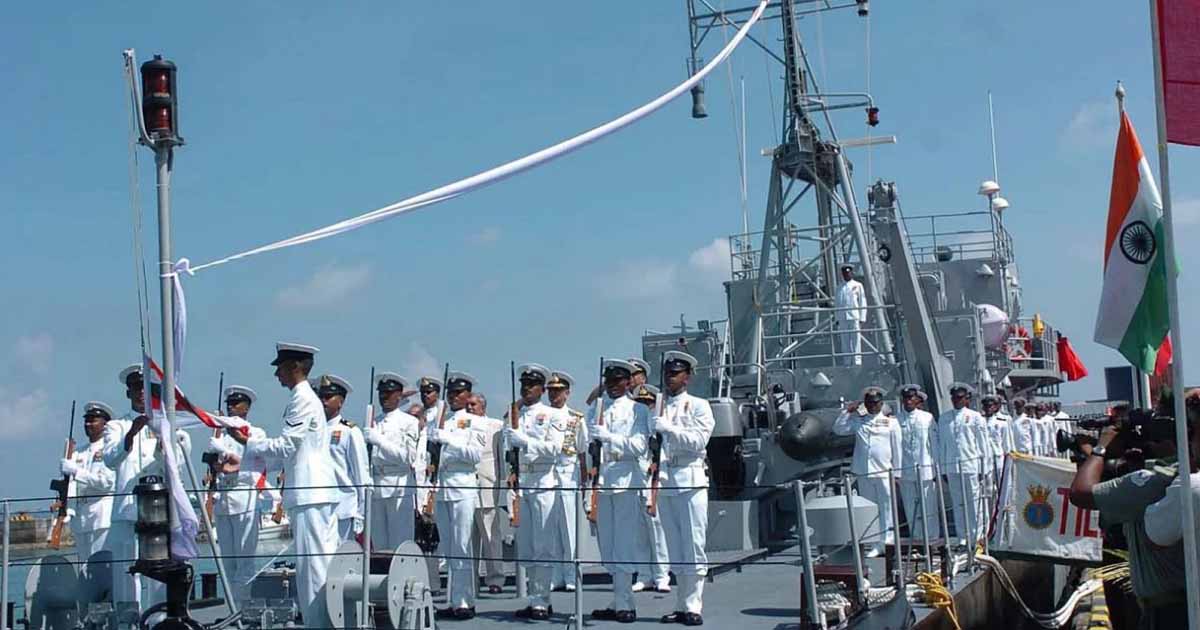
Dr. Pirzada: Last question, India being one, the largest, largest population in the world, China the second largest population in the world, is there a desire that we two countries should be closer to each other? I mean, I mean, India and China?
Mr. Hassan: I think if we go back to history, both Mao Zedong and
Dr. Pirzada: Pundit Nehru
Mr. Hassan: Yeah, very keen on having a very strong relationship, in fact, before 1955 the Bandung,
Dr. Pirzada: 1955 the Bandung Conference.
Mr. Hassan: the non-aligned conference, the relationship between China and India was probably much stronger than the one between Pakistan and, and China, and, and China, there’s a very interesting book, Martha Nash’s, and it talks about this relationship. This is by Amitav Ghosh. If anyone has a chance to read it, it’s wonderful to read.
it’s about opium war, and he had the Irish trilogy, trilogy, but a lot of the Indian opinion in the elite circles is shaped by the colonial legacy, and the colonial legacy was very much to show China in a way which was somehow backward, primitive, not something to be admired, and that is very much embedded in the elite culture. I think Nehru was trying to transcend that, but even he could not fully transistor Mao Zedong, and the Chinese government at then had offered a very, very attractive proposition to solve the border dispute, which India refused to take, and that was the reason that China then had the confrontation, which led to the break in relationship.
Read more: Steve Witkoff, Araghchi Head to Switzerland as Iran Talks Resume Amid Lebanon Ceasefire Strains
So, I think it’s a great pity in some ways, these two nations, but I think they would want to have better relations, and I think we saw that yesterday. There was talk of the Foreign Ministry spokesman in from China, he said something to the effect that these are three important countries. These are three important – Russia, China, and India are three important non-aligned countries, which non-aligned three important growing countries, and they will continue to grow, and they need to continue to work together. So, I think there will be moves, but I think the suspicion from India is much greater than in China.
Dr. Pirzada: Are there 1000s of Indians working, studying, researching in China in different cities?
Mr. Hassan: Very much so, and there are quite a few in the high-tech IT industry that come from India, in terms of universities, there are many more Indians than Pakistanis. I am saddened to say it’s talking to some of my colleagues, they say the Indian students, by and large, are better, are more serious than the Pakistani students because most of these Pakistani students come on scholarships, yet they don’t take it as seriously as some of the Indian students do. Even though the Chinese students I interact with, they still like the Pakistani students more.
Dr. Pirzada: Javed, it has been a pleasure listening to you. Thank you so much for finding time for me, I wish you safe traveling, and I would like you to stay in touch, and I would like to invite you in other panel discussions, not only on China, but on the other issues. You are a polymath in my, in my view. I’ve seldom come across someone from the world of finance and banking who has such a fine-tuned command on history and geopolitics, you know, so I look forward to stay in touch.
Mr. Hassan: Thank you, Moeed. Thank you for having me on.
Dr. Pirzada: Thank you, thank you.