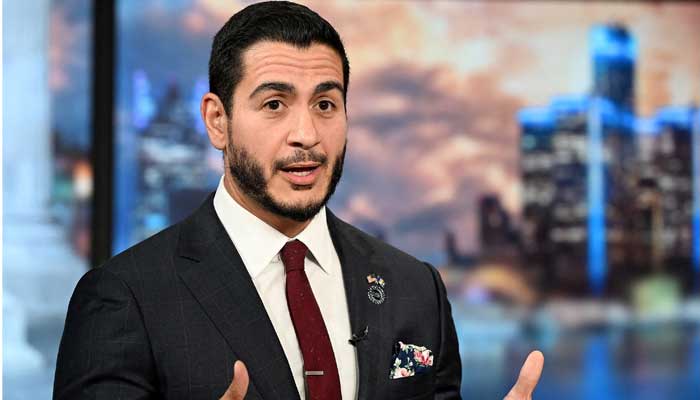
Progressive candidate Abdul El-Sayed held a narrow lead over US Representative Haley Stevens in Michigan’s Democratic US Senate primary on Tuesday, though the outcome of a race viewed as a major test of the Democratic Party’s future remained uncertain.
With 70% of the estimated vote counted, CNN showed El-Sayed leading Stevens by 49.8% to 46.3%.
Money out of politics.
Money in your pocket.
Medicare for All.Michigan…
We won. I am so proud to be your Democratic nominee for US Senate. Let’s win in November. pic.twitter.com/RItVmqrzob
— Dr. Abdul El-Sayed (@AbdulElSayed) August 5, 2026
The contest has emerged as one of the clearest tests yet of the direction of the Democratic Party, pitting El-Sayed’s campaign against Stevens, an establishment-backed moderate supported by Democratic leaders and pro-Israel groups.
The race was being closely watched for clues about whether Democratic voters in a crucial swing state are receptive to candidates who challenge party leaders and champion an agenda focused on lowering costs, expanding healthcare coverage and restricting the role of big money in elections.
The winner will face Republican Mike Rogers in November in a race critical to Democrats’ hopes of regaining control of the US Senate.
BREAKING: Abdul El-Sayed, a progressive public health advocate, has won the Democratic nomination for the US Senate, overcoming more than $60m in campaign spending, mostly from pro-Israel groups, NBC has projected.
🔗: https://t.co/uINtHkg48d pic.twitter.com/KOUt9xqBmk
— Al Jazeera English (@AJEnglish) August 5, 2026
Battle between progressives and moderates
The Democratic race is the latest battleground between progressives and moderates over US support for Israel, an issue that has played out in primaries nationwide this year. But unlike contests in liberal bastions, this is a statewide race in a Midwestern swing state for a seat Democrats must win in the fight for Senate control.
Michigan is both a presidential battleground and home to one of the country’s largest Arab American communities, making it an important testing ground for Democrats’ electoral and ideological future.
US Representative Debbie Dingell, a Michigan Democrat who stayed neutral in the primary, said the party needs to quickly coalesce behind its nominee because too much is at stake.
“This race is about how people are hurting,” she said in an interview while voting was under way, citing cost concerns over groceries, gas, rent and healthcare as the issues that will matter in November.
For the first time in American history, Michigan just helped an Egyptian-American, Muslim socialist Democrat win the primary for Senate.
AIPAC spent $30 million against Abdul El-Sayed and he still won.
The perfect example that when people in America unite we can move…
— Ariana Jasmine (@arianajasmine__) August 5, 2026
Israel’s favorability rating among Democrats fell from 59% in 2018 to 22% in May, according to Reuters/Ipsos polling. But the primary is also a test of broader voter frustrations over economic concerns and the party establishment.
An expected 2028 impact
The race is likely to be scrutinised by prospective 2028 presidential contenders searching for a message to reconnect with voters after the party’s 2024 defeat. A victory for El-Sayed could intensify debate within Democratic ranks over the political appeal of economic populism, anti-establishment campaigning and a tougher approach toward Israel.
A Reuters/Ipsos poll released on Tuesday found self-described liberals now make up 71% of Democrats, up from 55% in 2012, while large majorities said universal healthcare, expanded abortion access and higher taxes on corporations and the wealthy are essential policy positions.
The poll also found deep Democratic skepticism of US support for Israel, a central issue in the Michigan race. Only 16% of Democrats backed continued military and economic aid to Israel, while 57% opposed it.
Ballots cast in Michigan, four other states
Voters in Michigan, Virginia, Missouri, Kansas and Washington state decided on US House candidates in Democratic primaries on Tuesday, including a handful that could determine whether the party retakes the lower chamber. Four of those races are considered general election toss-ups.
Democratic US Representative Marie Gluesenkamp Perez of Washington and state Senate Republican Leader John Braun advanced to the general election in the state’s top-two primary. The progressive candidate, Brent Hennrich, finished a distant third.
In two Virginia districts expected to be competitive in November, Democrats nominated former US representative Elaine Luria and Henrico County Commonwealth Attorney Shannon Taylor.
And in Missouri, progressive Democrat Cori Bush failed in her bid to unseat US Representative Wesley Bell in a rematch of 2024. A pro-Israel super PAC spent more than $8 million to help unseat Bush, a vocal critic of Israel, last cycle and more than $3 million this cycle to keep Bush out of Congress. Bell is heavily favored to win in November, as the St Louis-area district is safely Democratic.