Ashok Kumar knows that Narendra Modi changed his life for the better.
Ashok remembers, as a child, watching his farmer parents struggle to make ends meet – and how things changed after Modi became prime minister in 2014. His government expanded benefits like cheap cooking gas and direct farm subsidies, giving Ashok and his younger brother Abhishek hope for a better future. Their parents rewarded Modi with votes in three elections.
But last week, 25-year-old Ashok found himself demonstrating against Modi next to Jantar Mantar, an 18th-century astronomical observatory that anchors New Delhi’s main protest site. The protests were spearheaded by the Cockroach Janta Party, a satirical movement that has become the voice of India’s young and disaffected.
The unrest erupted after the government invalidated national medical exam test results for about 2 million students, including Abhishek, after discovering test questions had been leaked.
In India, such standardised tests offer a pathway to the middle class. The world’s most populous country rations access to thousands of public-sector jobs — diplomats and administrators, but also clerks and forest rangers — through gruelling exams for which students spend years and small fortunes preparing.
Success can be statistically harder than getting into Harvard, but the prize includes lifelong security, as well as pension and housing benefits unavailable in the private sector. Meanwhile, corporate job growth has slowed to 3% annually from 11% in the decade before 2020, according to Marcellus Investment Managers.

Since 2014, at least two dozen exams have had their results invalidated due to leaks, according to a Reuters review of public records and media reports. But this time, it sparked one of India’s largest uprisings in decades.
Tens of thousands took to the streets, in Delhi and elsewhere, to express their fury at the repeated mismanagement of an examination system that stands between the masses and an iron rice bowl, an Asian metaphor for job security.
Four years ago, Ashok packed a small bag and moved a thousand kilometres away from his home state of Bihar. In Delhi, he earned a master’s degree and enrolled in a test-cramming school, repeatedly trying but failing to crack elite civil service exams. His younger brother Abhishek later joined him to prepare for a similarly competitive medical-school exam.
Thousands of similarly disenchanted youth have joined demonstrations airing an array of grievances against Modi’s Hindu nationalist government that are often obscured by India’s world-beating growth figures.
The complaints include widening economic inequality, high youth unemployment and an erosion of free speech rights, according to Reuters interviews with dozens of people during six days of protests. Indians under the age of 30 are three times as likely as the average citizen to be unemployed, government data show.
Students held up posters mocking in abusive language the septuagenarian Modi and his ministers, who govern a populace including some 900 million under the age of 35. They punctured the aura of inviolability around a strongman who has electorally crushed India’s once powerful Congress party and, critics say, cowed its historically freewheeling media.
Modi’s office didn’t respond to a request for comment. It has previously pushed back against criticism of its economic stewardship, arguing that claims of an unemployment crisis are overblown and that macroeconomic fundamentals remain robust.
The people’s party
The Cockroach Janta Party (or “people’s party”) takes its name from a disparaging remark made by India’s chief justice earlier this year about unemployed youth.

He later said his comments had been misconstrued.
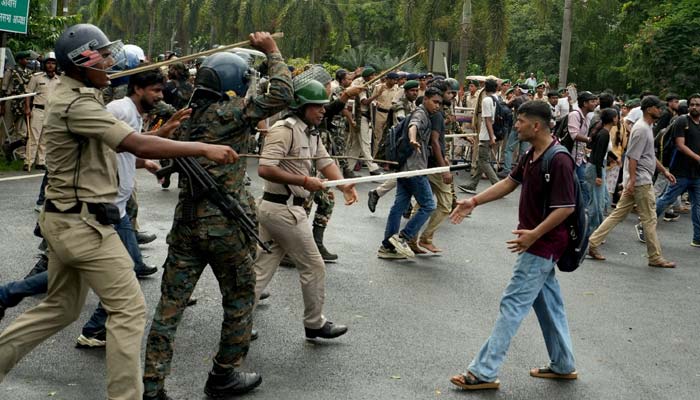
On July 20, more than 50,000 attempted to march on parliament, according to some estimates. They were met with a violent police response but won sympathy from the many more following the protests online. The crowds, which by then spanned age groups and socioeconomic classes, swelled. Bollywood stars voiced support on social media.
“People are usually divided by religion, caste and language,” said Ashok, showing off a bruise he said came from a police baton during a demonstration. “This was the first time they united around education.”

Delhi Police didn’t respond to questions about its management of the protests. It has previously said that the demonstrations were policed professionally and that 118 officers were injured during the July 20 confrontation.
By the end of the week, the cockroaches had their scalp: Education Minister Dharmendra Pradhan, a primary protest target, had resigned. In a rare concession, Modi had bowed to demonstrators’ demands.
Modi’s government has since moved to tighten a law against exam leaks with harsher penalties. He also announced the creation of a panel to review the examination system in a video speaking directly to India’s youth.
The government has additionally agreed to offer compensation to the families of students who died by suicide after exam papers were leaked, as well as to drop efforts to prosecute protesters.
Pradhan didn’t return a request for comment.
Getting by on rice, buffalo milk
One of the world’s great economic booms began in the 1990s, when India cast off decades of protectionism and welcomed global conglomerates.

The country later developed leading companies of its own, providing back-office services to Wall Street and Silicon Valley.
It has for some years been one of the world’s fastest-growing major economies and now claims roughly half a billion middle-class citizens.
That prosperity, however, can seem distant in Ashok and Abhishek’s home state of Bihar, India’s poorest on a per capita basis.
Reuters reporters visited their family home in a remote corner of the eastern state, which depends on farming. They found a buffalo tethered in a courtyard littered with dung. The animal provides the milk their mother sells to supplement her husband’s income from tending a rice plot.
The invalidation of the May medical school exam deflated 20-year-old Abhishek, who unsuccessfully attempted that test three times.
“I thought becoming a doctor would help me get my mother some jewellery, a TV for the home,” Abhishek said at the family home.
Instead, Abhishek found himself dreading asking his parents for money to replace the beaten-up flip-flops he was wearing.

“How much can I study?” he said. “I can’t prepare this much again.”
Ashok, the older brother, had decided as a teenager to pursue a civil service job. Working for the government is one of the few paths available for ambitious Biharis looking to flee the fields.
He started going to exam-cramming schools while living at home, sometimes studying by lantern light when the electricity went off. “I thought hard work alone would be enough,” he recalled.
A series of cheating scandals – many in Bihar – disabused him of the notion. The state briefly became a fixture of global headlines in 2015, when photos of the relatives and friends of exam candidates scaling a building to sneak answers through windows were widely broadcast around the world.
“Cheats Climb High,” one American news website wrote.
As recently as 2024, hundreds protested the alleged leak online of an exam for entry into the state’s civil service. The Bihar government, which Modi’s party helps lead, said there were only limited irregularities and certified the results.
That didn’t help Ashok. He had fallen short of the cut-off to advance to the next round by just 10 points. He had taken the test while preparing for more competitive national exams, and came away embittered at the near-miss result.