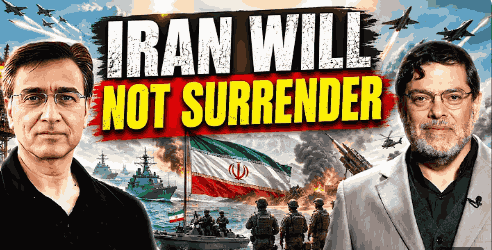
Prof. Marandi and Dr Mooed Pirzada discussed Iran’s resilience against U.S. and Israeli aggression, emphasizing that Iran’s sovereignty over the Strait of Hormuz is non-negotiable. Prof Marandi criticized Trump’s trustworthiness and Netanyahu’s influence, noting that Iran’s military capabilities have grown under sanctions. Marandi highlighted the failure of Arab states to collapse Iran and their complicity in Israeli policies. He argued that Iran’s revolution empowered its people, contrasting it with the empty shells of Gulf states. Marandi stressed that any compromise must respect Iran’s sovereignty and that the U.S. bears responsibility for the ongoing conflict.
Interview originally published on 23rd May 2026
Dr. Moeed Pirzada: Asalamu alaykum, and a very warm welcome to Professor Marandi. Professor Marandi, it has been nearly 34 days since we last spoke, and much has changed in Iran and the wider region since then. I would like to get your comprehensive thoughts on these developments.
To begin, I want to address something of great interest to Pakistanis. International media widely reported that Pakistan’s Army Chief, General Asim Munir, was scheduled to land in Tehran. Pakistan’s Interior Minister had already been there since Wednesday, and the Army Chief was expected by Thursday night—but the trip was suddenly canceled. The only breaking news we have comes from Al Arabiya, which claims that a final deal between the US and Iran could not be agreed upon. What can you tell us about this?
Prof. Marandi: His trip was purely media speculation. While the Pakistani Interior Minister was indeed in Tehran, the rest was just media hype, and one shouldn’t take it seriously at all. Reuters constantly fabricates news using so-called “informed sources,” so this sort of thing happens a lot. What actually matters is that the mediation is ongoing. The gap between Iran and the Trump administration remains large, and we will have to see how things evolve in the coming days.
Dr. Moeed Pirzada: Very interesting. So you believe that all the reporting from the New York Times, Washington Post, Reuters, and Pakistani newspapers was essentially speculation? It seems it all started with Reuters quoting three unnamed Pakistani officials saying the Army Chief would arrive that evening, followed only by Al Arabiya reporting the cancellation. In your view, there was no actual deal or document stalled or unready?
Prof. Marandi: Yes, there is obviously no deal yet. Mediation continues, and the Americans are under a immense amount of pressure. The global economy is heading toward a cliff, and the US economy is tied directly to it. For now, we have to wait and see, but we must assume that unless the United States changes its course, we are heading toward a conflict.
Dr. Moeed Pirzada: When we last spoke over 30 days ago on April 18th, you were already anticipating a military conflict or an attack on Iran, and you were highly suspicious. More than a month has passed now without a major confrontation, yet you still fear an attack. Could you explain why you remain so pessimistic about the possibility of a good deal?
Prof. Marandi: It is not a matter of being pessimistic or optimistic; the issue is that Trump is fundamentally untrustworthy. We have already negotiated with him twice, and on both occasions, he launched hostilities right in the middle of talks. Even after Trump accepted the Iranian 10-point plan as a baseline for negotiations and ceasefire talks began, an agreement was reached, only for Trump to turn around and impose a siege on Iranian ports immediately afterward.
Consequently, whenever we engage in negotiations, our problems with the United States tend to increase rather than decrease. The current mediation process is highly complicated because we simply do not trust the Americans. They are entirely capable of launching an attack while we are actively negotiating or moving through the mediation process. However, that does not mean this conflict will never end. It may take months—no one truly knows—because we are not dealing with a conventional country; we are negotiating with Trump.
Dr. Moeed Pirzada: So, Professor Marandi, three or four times since April 6th, Donald Trump has stated that whatever Iran has proposed is unacceptable and simply not good enough, claiming he expected something else. What do you make of this? Iran recently submitted a 14-point amended proposal. What exactly do you think Donald Trump is expecting or trying to extract from Iran that he feels is missing from this proposal? What is he trying to sell to the American public, or perhaps to the Zionists?
Prof. Marandi: Well, Trump made a foolish and catastrophic decision to wage war against the Iranian people. This is the second foolish war he has pursued within a single year, and it has not gone well for him. He lost the war on the battlefield. The United States failed to achieve any of its goals, resulting in enormous devastation for its proxies and the Israeli regime, as well as severe disruptions to the global economy. Now, Trump is expecting to obtain at the negotiating table what he could not achieve on the battlefield.
Dr. Moeed Pirzada: And what exactly is that?
Prof. Marandi: He wants subjugation; he wants a victory. However, that is an excessive demand and not something he can realistically achieve. He must reconcile himself to the fact that victory is unattainable, and he needs to accept the reality that the Iranians hold the upper hand at the negotiating table. Otherwise, we will continue down the path of conflict.
Dr. Moeed Pirzada: What is the definition of victory here? When you say he wants to achieve a victory, what do you think that looks like in Trump’s mind?
Prof. Marandi: Well, I think we have seen it tens, if not hundreds, of times already. He has stated it explicitly: it means unconditional surrender. It means Iran handing over its sovereignty. He has said this almost daily since he became president, or at least since the first war we had last year. But he has failed. Today, he does not control the Strait of Hormuz, he lacks the ability to impose his will on the Iranian people, and he is driving the global economy toward catastrophe.
Dr. Moeed Pirzada: Professor Marandi, Donald Trump used the term “unconditional surrender” after February 28th and perhaps during March, but he has not used it since. Now, he talks in terms of guarantees; he says it is about nuclear weapons. He demands guarantees that Iran will not develop a nuclear weapon, and he talks about zero enrichment, timelines of 12 or 20 years, and transferring 60% enriched uranium to the United States. He focuses on these kinds of metrics, but I do not actually trust his rhetoric because I listen to him every day. I read all his Truth Social posts and watch his speeches. I believe he wants something else entirely, which he is unable to put down in black and white.
Prof. Marandi: Well, that highlights another problem. He has outsourced US foreign policy to Benjamin Netanyahu. Consequently, it is unclear what kind of authority Trump actually wields and why he seems to lack the power to make independent decisions.
In any case, what matters most to Iran is that its rights as a sovereign nation are respected. Iran is not going to abandon its peaceful nuclear program. When Trump speaks about nuclear weapons, he knows perfectly well that Iran is not pursuing them. His own intelligence agencies have told him so. Even his own appointees—such as Joe Kent, the former head of counterterrorism, and Tulsi Gabbard—have stated under oath that Iran is not pursuing a nuclear weapon. Therefore, it is clear that the issue has never been about nuclear weapons. The real objective is subjugating the Iranian people and allowing the Israeli regime to maintain effective control over West Asia and North Africa.
Dr. Moeed Pirzada: But that has not actually happened, and it does not look like it will happen anytime soon.
Prof. Marandi: No. I think it was very clear from the beginning that they would fail in this war, and we have been saying this all along. Of course, in the West, whatever we say is automatically dismissed as propaganda, while whatever they say is treated as fact and truth. Yet, for some strange reason, it always turns out that we are right and they are wrong.
We maintained from the very start that the United States would not win this war, just as we did during the previous conflict. For years—even before the pandemic—I have stated in well-documented media appearances that if the United States wages a war, no oil will leave the Persian Gulf. This outcome should have shocked no one. We have been warning for a long time that Iran possesses extraordinarily advanced military capabilities, including sophisticated drone and missile technology. Pointing this out does not require genius.
Dr. Moeed Pirzada: It is fascinating when you note that their words are trusted while ours are dismissed for reasons that are allegedly unclear. As a professor of English literature, I think you know the exact reasons. The West views itself as culturally and racially superior.
Prof. Marandi: Of course, I was being ironic.
Dr. Moeed Pirzada: Exactly. They believe they are superior, more sophisticated, and “normal,” while the rest of us are deemed abnormal. They consider themselves legitimate and the rest of us illegitimate. They view their systems of governance as superior and ours as inferior.
Yet, when you look at the track record, it is their governments that carry out genocide, just as they are doing in Gaza, and assisting in genocidal attacks and ethnic cleansing, as seen in Lebanon. They destroy countries through dirty wars and sanctions, as they did in Syria. They strangle nations and attempt to force them into submission, as they do with Cuba. They bomb boats, slaughter people, and take presidents hostage, as they have attempted in Venezuela. That is their track record.
In contrast, the Iranian track record shows that we oppose ethnic exceptionalism in Palestine, we oppose ethnic cleansing, and we actively oppose genocide. Our words are backed by action, and that is precisely why Iran is considered enemy number one, two, and three by the United States, and why they wage war against our country.
Dr. Moeed Pirzada: Do you think everything we are discussing can be neatly described within the framework of Edward Said’s Orientalism?
Prof. Marandi: Yes, absolutely. The concept of Orientalism—which has been articulated by many other scholars both before and after Said—is very much at play in what we are witnessing today. It is highly visible. This Eurocentrism and American exceptionalism prevent them from genuinely understanding the Islamic Republic of Iran and the Axis of Resistance. It stops them from looking at the world objectively and making credible assessments. Consequently, they view Iran as backward, irrational, corrupt, illegitimate, non-democratic, and non-liberal.
Ultimately, because they construct policies based on these flawed narratives, their strategies inevitably hit a brick wall. Yet, every time they fail, instead of rethinking their underlying assumptions and changing how they view Iran, they simply go back to the drawing board and produce new policies based on the exact same old narratives. They foolishly believe that if they just tweak their policy slightly, Iran will prove to be a house of cards that will finally collapse.
If they looked at the situation objectively, they would see that Iran is a highly sophisticated society with a robust constitution and strong state institutions. It is so resilient, effective, and legitimate in the eyes of its public that it can successfully defend itself against aggression from a global superpower. The United States has poured all its efforts into undermining the Islamic Republic—rallying regional proxy coalitions, supplying the Israeli regime with an endless stream of American weaponry, and coordinating maximum-pressure European sanctions—yet it has failed utterly.
You would think that if the West possessed credible thinkers, intellectuals, and experts, they would wonder why Iran remains so effective and capable, even after a blitzkrieg attack and the martyrdom of its leaders. You would imagine they would rethink their views toward Iran, but I have no doubt that their Eurocentric worldview remains completely unchanged.
Dr. Moeed Pirzada: Within my circles here in Washington, I see two distinct types of analysts. On the extreme right, you have figures supporting a hardline stance, like Marc Thiessen, who recently argued in the Washington Post that Donald Trump needs a victory in Iran to win the upcoming midterm elections. Thiessen goes on to explain that current peace overtures are not delivering results.
On the other hand, the vast majority of American experts—such as Jeffrey Sachs, Douglas Macgregor, Professor John Mearsheimer, Trita Parsi, Robert Pape, and dozens of others—do not support this war. They have openly appreciated and warned of Iran’s robust capability to defend itself, highlighting its effective missile cities. They argue that an attack would be fundamentally illegitimate. Therefore, when you refer to “the West” as a whole, do you not see any cleavages or divisions within it? It seems to me that you might view the West as a monolith, whereas I see it as far from uniform.
Prof. Marandi: I have never claimed that the West is a monolith.
Dr. Moeed Pirzada: No, but when you referenced “Western analysts,” I assume you meant those within the corridors of power who actively support Trump and Netanyahu?
Prof. Marandi: It actually goes much deeper than that. The consensus spans those who inhabit the corridors of power, the leadership of the Democratic Party, their affiliated think tanks, and the broader political elite in the United States. When it comes to their core geopolitical worldview, they are largely identical. The prominent independent scholars and experts you just mentioned—some of whom are close friends of mine—hold a scholarly worldview that is simply not tolerated within those actual structures of power. Their perspectives are sidelined and entirely excluded from policy-making circles.
Dr. Moeed Pirzada: That makes perfect sense. When I look at Benjamin Netanyahu’s public statements, his objectives are quite transparent. He initially sought regime change, but now that he realizes it is unachievable, his focus has shifted. He wants to destroy Iran’s missile and drone capabilities, dismantle its industrial manufacturing base, and decapitate the IRGC leadership.
Trump’s ultimate goal, however, remains far more ambiguous. Marc Thiessen—who ironically wrote that the Iranian delegation, including yourself, should be targeted when you traveled to Islamabad around April 10th or 11th—now insists that Trump must remember he needs a victory against Iran to secure the midterms. I suspect Thiessen’s definition of victory aligns perfectly with Netanyahu’s. Yet, Trump himself seems unconvinced. He appears to recognize that such a victory is either unfeasible or would incur massive costs and catastrophic losses across the GCC countries. What is your take on this internal dynamic?
Prof. Marandi: A military victory over Iran is entirely unachievable. It was impossible when he initiated this conflict, and it remains impossible today while both sides are exchanging back-and-forth messages. This reality is as clear as day.
The elements demanding that the United States escalate this war are driven strictly by Zionist interests. They are completely indifferent to the state of the US economy or the global economy; their sole priority is the Israeli regime. They have zero concern for the well-being of ordinary Americans, the working class, or the middle class across the United States. For them, America is merely a tool to be leveraged to enforce their will across our region. Consequently, they are entirely comfortable pushing for an absolute victory. They do not even care about Trump’s political future or whether he wins the midterms; what they want is perpetual conflict to benefit a genocidal regime.
The fact remains that we have already been through two distinct phases of this conflict, and they failed on both occasions. Even as we speak, we are technically at war, because the siege warfare and maximum pressure blockades that Trump is implementing constitute an overt act of war. However, this strategy is a double-edged sword. Just as a conventional hot war means the Iranians will shoot back, a economic siege works both ways. Trump’s siege tactics are actively destabilizing and crashing the global economy. Those pushing Trump further down the path of escalation know that the US economy is moving swiftly toward a cliff—they simply do not care, because it is not their priority.
Dr. Moeed Pirzada: Have you observed any tangible change in the attitudes of the Arab states—specifically GCC countries like Saudi Arabia, Kuwait, Bahrain, the UAE, and Qatar—over the past 40 days? Or do you think their geopolitical positions remain exactly where they were?
Prof. Marandi: It has become obvious that these family dictatorships mistakenly believed they could have their cake and eat it too. They expected the United States to destroy Iran using military bases located right on their soil, all while they maintained a facade of neutrality. While some of these regimes were perhaps less foolish than others, the reality is that they relinquished their sovereignty a long time ago.
Now, they finally recognize that Iran is not the fragile house of cards they were led to believe. They, too, have been deeply conditioned by the West; their perception of Iran is entirely dictated by the same Orientalist narratives, tropes, and biases. Acting essentially as “brown sahibs” or internalized orientals who mimic their foreign overlords, they were genuinely shocked when Iran did not collapse and they suddenly had to bear the consequences.
They became incredibly indignant when they realized they would pay a heavy price for allowing their territories to be used as launchpads to target Iranian infrastructure, leaders, and citizens. The United States does not fund its own military footprint or activities within those countries; those massive expenditures are completely subsidized by the host governments. Therefore, they were active participants in this war. In the case of the United Arab Emirates, Mohammed bin Zayed has gone significantly further than his neighbors. He is deeply entangled with and subordinate to the Israeli regime, which places his malice and hostility toward Iran on an entirely different level.
For more context on the unfolding geopolitical landscape and the breakdown of negotiations, you can watch the full Interview with Professor Mohammad Marandi where these dynamics regarding US pressure, regional proxies, and sovereignty are explored in depth.
Dr. Moeed Pirzada: Why do you think Mohammed bin Zayed chose to steer the UAE toward such a close, intimate bond with Israel?
Prof. Marandi: That trajectory was evident from the very moment of his rise to influence. It is not for me to psychoanalyze his motives, but ever since he gained power, that is the definitive direction in which he has guided the UAE. Ironically, among the five regional countries that assisted the United States in its recent assault on Iran, the UAE actually enjoyed the best relationship with Tehran before Mohammed bin Zayed centralized his authority. He actively pushed the state in the exact opposite direction.
Dr. Moeed Pirzada: Have you heard of this hexagonal, six-country alliance that Netanyahu frequently speaks of? It reportedly includes the UAE, India, Azerbaijan, Jordan, and a sixth country whose name escapes me at the moment. Have you tracked the development of this specific alliance?
Prof. Marandi: Whatever Netanyahu touches falls apart—it is like a reverse Midas touch. He has completely destroyed the international image of the UAE. The Abu Dhabi regime is now deeply despised across the region, and the world at large, precisely because of its overt alignment with the Israeli regime. Anyone who associates themselves with Israel inevitably loses legitimacy in the eyes of their own people.
Let us be frank: almost all the countries in our region, with the notable exceptions of Iran and Yemen, maintain ties with the Israelis. It is an open secret. The Emirates, the Qataris, Turkey, Egypt, Jordan, and the Saudis all have relationships. Some maintain highly visible, functional partnerships—like Turkey and the Republic of Azerbaijan, both of whom actively sustained Netanyahu throughout the genocide by facilitating the transit of Baku oil through Turkish territory to Israel.
Similarly, the Egyptians purchase Israeli gas, and Jordan conducts extensive trade while providing critical operational assistance to the Israeli regime during its military actions against the Iranian people. They are all complicit in one form or another. However, certain regimes take this complicity to a much higher level, and the deeper their involvement, the more they delegitimize themselves. No one should assume that these regimes tied to Israel possess long-term stability; most of them, whether Azerbaijan or the Emirates, are highly authoritarian structures.
In the case of India, the economic hardships the Indian public is facing today are directly exacerbated by the wars the Israeli regime has instigated. The Israelis have proven to the Indian people that they do not care about India’s national interests or well-being. Just as the “Israel-first” neoconservatives in Washington do not care about the United States, the Israeli regime does not care about India or any of its regional partners.
Look at how Netanyahu treated Mohammed bin Zayed, his closest proxy. For his own personal survival and internal political posturing, Netanyahu publicly announced that he had traveled to the Emirates during the conflict and openly declared that the head of Mossad and other senior officials had conducted visits. This was profoundly embarrassing to the UAE, prompting them to issue explicit denials. Why? Because it made the Emirates look terrible across the Muslim world. But the Israelis simply do not care about them, just as they do not care about India or the United States.
Dr. Moeed Pirzada: Could we argue that this is a psychological surrender? Following the Camp David Accords, Egypt—the largest military machine in the Arab world—was isolated. This was followed by the systematic destruction of Iraq and Syria, alongside numerous other strategic reversals for the Arab states. Did they gradually accept Israeli hegemony as an unalterable reality? Perhaps they realized that Israel is fundamentally an extension of American and Western global power, and they simply succumbed to it, just as Anwar Sadat did. They concluded they could no longer resist. Can we make that case?
Prof. Marandi: No, I do not think it is fair to generalize about the entire Arab world in such a dismissive way. Yes, the leaders of the Arab world routinely betrayed their own people. When the Islamic Revolution occurred in Iran, Saddam Hussein—at the behest of the West and backed by the financial power of those five Arab regimes—assaulted Iran. In doing so, he destroyed his own country, devastated our region, and directly benefited the Israeli regime. Anwar Sadat’s actions in Egypt were undeniably a massive betrayal of the Palestinian cause.
However, that does not mean the ordinary people of this region have lost faith in their own capabilities as human beings. We have witnessed the resistance in Lebanon fight heroically over the past few months, effectively beating back the Israeli military. In its frustration and rage, the regime lashes out by bombing civilian families and slaughtering innocents. Meanwhile, the Western media systematically looks away, making itself completely complicit in these genocidal attacks, just as it did in Gaza.
Therefore, defeatism is by no means a universal view. The true will of the Arab populace is simply not reflected by these regimes. The UAE and Qatar are family dictatorships; none of them are ever going to act against the core interests of the United States. In places where there is slightly more political openness, like Turkey, the regime in Ankara remains structurally bound to the West. Yet, the underlying sentiments of millions of regular citizens across the region remain unchanged. If the public were actually allowed to take to the streets freely, you would see massive, unprecedented anti-regime and anti-Zionist mobilizations in every single country.
Dr. Moeed Pirzada: Professor Marandi, I am glad you brought up Turkey. In 1948, Iran and Turkey were the two Muslim-majority nations that formally recognized the newly established state of Israel and established diplomatic relations. Following the Islamic Revolution of 1979, Iran severed all diplomatic recognition and walked away from Israel entirely, whereas Turkey’s recognition has persisted. Even though relations have become incredibly tense and unpleasant between Ankara and Tel Aviv under the AK Party, the formal tie remains. Do you believe that a direct confrontation between the Islamic Republic of Iran and the Zionist movement was a historical inevitability? Or could the post-1979 revolutionary leadership have adopted a alternative foreign policy that avoided making the Zionists Iran’s absolute “enemy number one”?
Prof. Marandi: The way you are framing the question implies that Iran is the active cause of these regional tensions. Iran’s absolute opposition to Zionism is a principled stance against an ethno-supremacist ideology rooted in ethnic cleansing. How else is Iran supposed to respond? Should we mimic Erdogan, who maintains lucrative commercial relationships with Netanyahu even while a genocide is actively being carried out? No, that is not an option for Iran. It is fundamentally immoral and completely unacceptable. It violates the core foundational ideals of our revolution: sovereignty, independence, human dignity, and freedom.
This is precisely why Iran firmly supported the anti-apartheid resistance in South Africa. That is why Nelson Mandela, almost immediately after his release from prison, chose Iran as one of his very first international destinations. When he met the Supreme Leader, he respectfully referred to him as his leader because Iran stood by his people when the rest of the world ignored them.
Dr. Moeed Pirzada: He explicitly called Ayatollah Khamenei his leader?
Prof. Marandi: Yes, he did. The point is that this conflict is not the fault of Iran. The Israeli regime is an inherently ethno-supremacist construct. Similarly, it is not Iran’s fault that we oppose the hidden hand of Western policy—whether it is the decades-long economic strangulation of Cuba, the subversion of Venezuela, or the dirty wars launched against Syria and Libya.
Taking a stand against these interventions does not make Iran a “troublemaker”; it represents a highly principled, consistent geopolitical stance. Iran opposed the forced regime-change projects in Syria and Libya because we recognized they were designed exclusively to serve the interests of the Western empire. Those who supported those interventions, whether knowingly or otherwise, were acting as agents of that empire—largely financed by Qatar, Saudi Arabia, and the UAE.
Turkey, as a prominent NATO member state, has also consistently acted in alignment with the broader strategic interests of NATO and the United States under the AK Party. Iran’s regional influence and entire foreign policy architecture have always stood in direct opposition to Western imperialism, and the most acute, violent manifestation of that empire in our region happens to be the ethno-supremacist regime in Palestine. Tell me, how else could a sovereign, revolutionary Iran possibly act?
Dr. Moeed Pirzada: This brings us to a highly interesting point in our discussion. I ask this because prior to the 1979 Islamic Revolution, both Iran and Turkey maintained excellent, highly lucrative relations with both Israel and the United States. Before 1979, Iran possessed the largest economy in the Middle East, with a GDP of roughly $80 billion. At that exact same time, the UAE’s GDP was a meager $11 billion to $14 billion, Israel’s was around $17 billion, and Saudi Arabia trailed as the second-largest regional economy at $79 billion.
Today, the entire landscape has flipped. Saudi Arabia is a $1.3 trillion economy, Israel is hovering near $700 billion, and the UAE has surged to nearly $600 billion. Even Pakistan has grown into a $400 billion economy. Meanwhile, Iran’s GDP is constrained between $400 billion and $450 billion.
Iran endured a brutal, devastating eight-year war unleashed by Iraq, in which hundreds of thousands of lives were lost. Your economy suffered immensely, and your civilian population has borne the brunt of endless hardships. This economic stagnation is directly tied to the unyielding geopolitical stance Iran chose to adopt against the Zionists and the West. This is the core of my question: Could Iran have managed the Zionist challenge differently to avoid this immense toll? Your country has paid an extraordinary price, while those who normalized relations have enriched themselves.
Prof. Marandi: Well, first of all, your premise once again frames Iran as the inherent problem, suggesting we are the ones who disrupted a stable status quo. Change occurred internally within Iran because our people demanded it; the external powers did not change—they simply doubled down on their hostility.
Furthermore, if Iran is as broken, weak, and lagging behind the rest of the region as your macroeconomic figures imply, then why has the United States utterly failed to defeat us? Iran has effectively won this strategic confrontation. Even prominent American neoconservatives are openly admitting that this conflict has resulted in one of the greatest geostrategic defeats in United States history. Framing Iran as a battered, marginalized nation completely detaches the conversation from the ground realities we are witnessing today.
Donald Trump is currently acting out of sheer desperation. He is actively destabilizing the global economy precisely because he lacks the conventional military or economic capacity to break the resolve of the Iranian people. The singular variable that changed after the 1979 revolution is that Iranians decided to stand firmly on their own feet, protect their national sovereignty, make independent decisions, and actively support oppressed populations worldwide.
These are not radical or irrational demands. Perhaps they appear strange in a contemporary political climate where so many regional actors willingly behave as imperial proxies—where leaders like Erdogan travel to Egypt and place their hand on their chest in submission, or where regional figures are praised by Washington as compliant assets who report whenever they are summoned. For some, that total subjugation is considered “normal” statesmanship. But for a sovereign nation like Iran, it is a complete impossibility.
Dr. Moeed Pirzada: You are referring to the Syrian Al-Qaeda chief?
Prof. Marandi: Yes, exactly, the Syrian Al-Qaeda chief. In the case of the Emirates, when they formalize an alliance with the Israeli regime, perhaps some view that as normal. But for us, that is entirely abnormal; it is completely unnatural. What is normal is recognizing that the Palestinian people are human beings who deserve to be treated with equal human dignity. That is the only normal way of looking at the world. Ethno-supremacism is utterly unacceptable to us. Yet, somehow, holding this principled stance makes us look abnormal while everyone else is deemed normal.
Dr. Moeed Pirzada: No, I am not implying that at all. I fully understand and respect that you maintain a correct moral and ethical position regarding Zionism and Israel. They are tyrants, and Iran is the only country in the Middle East that has steadfastly stood up against Zionist tyranny.
My underlying question was this: even the Shah of Iran was deeply critical of the Zionists. There is a very famous archival interview with an American broadcaster in which the Shah explicitly states that Zionists wield immense control over the United States, which visibly surprises the interviewer. The Shah insists, “Yes, the United States is being controlled by the Zionists, and they are doing severe damage to the Middle East.” So, a structural tension existed between a militarily powerful Iran and Israel even before 1979.
My point is that all the monumental hardships Iran has suffered since 1979—and please correct me if my understanding is flawed—stem from the fact that Iran stood up directly against Western imperialism. For instance, you mentioned that Saddam Hussein was unleashed on Iran. Saddam would have never dared to attack pre-revolutionary Iran; he attacked because they perceived post-revolutionary Iran as temporarily weak and vulnerable. Then, when Iran was on the verge of winning that war in 1988, the United States directly intervened in the Persian Gulf. We all remember the tragic downing of the Iranian civilian airliner and the systematic destruction of the Iranian Navy. At every single historical juncture, the Iranian people have paid an extraordinary price and suffered immensely. Could there have been a different, more practical way out of this geopolitical trap?
Prof. Marandi: But your core assumption is fundamentally flawed. Iran was not a genuinely strong country before the revolution. It was an empty shell, just like Saudi Arabia is an empty shell today, and just like all these other contemporary American proxies. We saw this exact dynamic play out in the genocidal war that the Saudis and Emiratis carried out against the people of Yemen. They utterly failed to win that war despite receiving total Western backing and spending hundreds of billions of dollars slaughtering the Yemeni population. Why? Because their regimes are empty shells.
We saw the exact same reality during the confrontation between Iran and the United States: these regional regimes were empty shells hiding behind the Americans, entirely incapable of fighting on their own. The same was true under the Shah. Despite earning massive oil wealth, the Shah never actually developed the Iranian nation. Well over 50% of the Iranian population was completely illiterate at the time of the 1979 revolution, and the literacy numbers for women were vastly worse than those for men.
The vast majority of Iranian cities and villages completely lacked electricity and running water. The country’s wealth was spent exclusively on select elite enclaves in Tehran, Isfahan, and Shiraz, while massive slums festered in the capital. The Shah spent an exorbitant amount of national resources on personal luxury, and when he fled, he plundered a significant portion of the treasury.
Furthermore, the advanced weapons purchased under the Shah were identical to the arms buys we see today in Saudi Arabia, the UAE, Kuwait, Bahrain, and Qatar—the host nations are never actually permitted to have operational autonomy over the technology they buy. When the revolution happened and Iran suddenly needed to utilize its F-14 Tomcats to defend itself, the Americans cut off all access to the proprietary technology. The Iranians struggled significantly until young engineers within our own air force taught themselves how to repair, maintain, and operate the planes completely independently.
That was the catalyst for Iran becoming truly self-reliant. The Iranians developed their own indigenous military architecture. The sophisticated drone and missile capabilities being debated across the globe today exist solely because Iranian youth engineered these technologies from scratch. Our military strategy, which successfully defeated the global empire, relied entirely on the brilliance of young Iranian officers who thought outside the box to bypass conventional limitations.
Even the Western media is now gradually—albeit reluctantly—acknowledging what we have maintained all along: that our underground missile and drone cities remain completely intact. And they are still not telling the full story. What the CIA has leaked to the Washington Post and The New York Times represents only a fraction of reality. Militarily speaking, Iran is far more prepared for a potential resumption of hostilities today than it was at the absolute beginning of this war.
Dr. Moeed Pirzada: Despite the fact that the Americans and Israelis have conducted thousands of air raids and pounded the region for over a month—
Prof. Marandi: The actual damage they inflicted is far less than they had hoped for and vastly below their calculations, because they consistently underestimated the resolve of the Iranian people. That is precisely what the Islamic Revolution was about: the genuine empowerment of a nation. That is the defining difference. Iran is a powerful nation that simply cannot be compared to any other state in this region, because its populace has been structurally empowered.
Ideologically speaking, this is a society that stands firmly on its own feet. A people possessing self-confidence will always believe in resilience, resistance, and human dignity. Because Iran is a country built on foundational values, it stands unyielding against Zionism and is entirely willing to pay the necessary price. At the same time, it has proven itself fully capable of managing its sovereign affairs and achieving strategic victories against the United States while operating under unprecedented, maximum-pressure economic sanctions.
This resilience is the direct product of nearly five decades of revolutionary independence. After 47 years, Iran is uniquely positioned to state clearly that we stand opposed to US imperial policies in Cuba, Venezuela, and apartheid-era South Africa. We stand resolutely against ethno-supremacism and will always support the Palestinian cause, regardless of the cost, because our people have empowered themselves through the revolutionary process.
In contrast, none of the leaders of these neighboring regimes can hold their heads high. They are all deeply complicit in this ongoing genocide—every single one of them, whether it is Erdogan in Turkey, King Abdullah in Jordan, Sisi in Egypt, or Mohammed bin Zayed in Abu Dhabi. None of them can honestly claim they did anything meaningful for the Palestinian people. Some of them were slightly smarter, cynically exploiting the Palestinian cause for domestic political gain, while others were less intelligent, like Mohammed bin Zayed, who openly antagonizes the Palestinian population and pledges his allegiance directly to the Zionists.
If you examine the broader financial networks, you can see how extensively the elite class in the Emirates is structurally bound to the Western global elite. I view the historical trajectory in the exact opposite light: the revolution in Iran represented the birth of hope, honor, and strategic self-confidence for a principled nation. This is not raw power for the sake of dominance; it is empowerment anchored in principles. The West loves to perpetually frame Iran through a caricatured narrative of evil, abnormal, “mad mullahs” solely to obscure the reality that it is only Iran, Yemen, and their regional allies who are actively pursuing a foreign policy dictated by human ethics.
Dr. Moeed Pirzada: Professor Marandi, I want to delve deeper into the nature of the revolution. However, the irony is that you are comparing a historic civilization like Iran to small Arab principalities that were, until quite recently, tribal fishing and pearl-diving societies or minor protectorates. Historically speaking, Iran ruled over regions like Oman for centuries. Aside from the Hijaz region in Saudi Arabia, there is virtually no other Arab kingdom on the southern side of the Persian Gulf that possesses a deep, independent historical lineage. Iran is the direct inheritor of the Persian imperial order, standing as a continuous civilization for the past 3,000 years. You are comparing a monumental empire to small regional entities, so historically, there is no real basis for comparison.
Prof. Marandi: I understand you are looking at their current economic wealth, but I view this through a completely different lens. First of all, ancient and deeply sophisticated civilizations have always existed within the wider Arab world—look at the thousands of years of rich history in Yemen, Iraq, Syria, and Egypt. So we must avoid painting with too broad a brush.
Furthermore, when looking at the populations living across the Persian Gulf today, do you honestly believe that if those ordinary citizens had the democratic right to choose their own leadership, they would willingly accept total subordination to the American empire? I don’t think so. Not at all.
Throughout the intense periods of this conflict, it became undeniably clear that outside of the state-sponsored Wahhabi and Salafi networks and those directly on the regimes’ payrolls, the regular Arab street was universally cheering for Iran. The ordinary people saw right through the media propaganda. They instantly recognized the decades of manufactured disinformation and sectarian narratives that these dictatorships systematically promote for their own self-preservation as tools of Western empire.
Therefore, this enduring resilience is not about the Iranian people belonging to some inherently different or superior race; this is fundamentally about universal human dignity. The issue of Palestine transcends nationality or ethnicity. If the Palestinians were Jewish, and the regime carrying out the oppression in Tel Aviv happened to be Muslim, Iran’s geopolitical position would remain exactly the same. Iran will always stand with the oppressed against the oppressor, regardless of their religion, race, or ethnicity.
Dr. Moeed Pirzada: So, you are saying that Iran’s core issue is not simply about religion; it is fundamentally about a principled, moral position against injustice.
Prof. Marandi: It is a principled position, but it stems directly from our religion and our ideological beliefs. They are completely intertwined. The 1979 revolution was built entirely on the concept of empowering the oppressed against the oppressor, supporting those who are attacked, and directly confronting tyranny. That has been the core of our foreign policy from the very beginning.
A central pillar of the Iranian religious identity—which is deeply held, though frequently misrepresented by our adversaries—is the legacy of Ashura and Karbala. A key component of our faith is the historical struggle against tyranny and the absolute obligation to defend the downtrodden. Anyone who travels to Iran during Ashura, the anniversary of the martyrdom of the Prophet’s grandson, Imam Hussain, can witness how deeply the sacrifice of his companions and his sister, Lady Zaynab, is embedded within the fabric of Iranian culture and society. If you understand that, you understand our world view.
It is this exact religious identity that compels us to support oppressed peoples worldwide. When we supported the anti-apartheid resistance in South Africa, were they Muslim or Shia? No, it had absolutely nothing to do with that; they were simply an oppressed people. Why does Iran stand with the peoples of Cuba or Venezuela against Western imperialism? Is it because they are communists or Christians? No, it is strictly because they are being squeezed by an empire.
When Bosnia was facing systematic ethnic cleansing, Iran stepped in to support them. Iran has consistently opposed imperial aggression across the board. If the roles were completely reversed tomorrow, and there were Jewish children in Gaza being slaughtered, Iran’s position would be identical to what it is today. That is the true mandate of our religious ideology.
Dr. Moeed Pirzada: My point earlier was that these tiny family dictatorships and kingdoms along the Persian Gulf simply had no deep historical existence; they were essentially artificial creations of the British imperial order in the 19th century, later absorbed into the American sphere of influence. You can compare them to historic states like Egypt or Saudi Arabia, which had actual histories.
Yet, the modern world views Dubai, Doha, and Qatar as the shining, progressive models of the Muslim world, while the rest of the Islamic world is often painted as a dark, backwards continent. What do you make of this profound tragedy? Global elites flock to the Dubai Mall, luxury shopping, and tourism, viewing the UAE as the peak of modern progress. What do you think of this reality?
Prof. Marandi: They are empty shelves. First of all, setting everything else aside, you and I both know the reality of the systemic slave labor that drives the UAE and, to a slightly lesser extent, Qatar. The structural exploitation and abysmal treatment of foreign migrant workers in those countries is well-documented.
These states are empty shelves that happen to sit on massive natural resources with tiny indigenous populations, having completely outsourced their national security to the Western empire. What has Qatar actually achieved for its people? Nothing of substance. They possess enormous natural gas reserves for a citizen population of only about 350,000 people. You would have to be utterly incompetent not to provide basic financial comforts to your population given that ratio.
In reality, Qatar has functioned primarily as an agent of empire. It could have leveraged its immense wealth to fundamentally develop and stabilize the wider region, or to meaningfully empower the Palestinian people. It never did. What has Qatar or the UAE ever done to truly empower Palestine? They build a TV channel, fund a couple of highly publicized hospitals in Gaza, but they never build genuine resistance capabilities.
Instead, the wealth of Qatar and the Emirates was weaponized to help destroy Yemen and Syria. People forget that when the Saudis launched their devastating war on Yemen, the Qatari regime and Erdogan’s government in Turkey actively supported it. It was only later, when Riyadh and Abu Dhabi turned against Doha during the diplomatic blockade, that Qatar shifted its geopolitical stance. If you look back at the Arabic and English coverage of Al Jazeera at the absolute beginning of the war on Yemen, they were actively siding with the Saudi-led Blackwater mercenaries and coalition forces.
Dr. Moeed Pirzada: Exactly. They were fully aligned with the state narrative back then. But returning to the structural nature of the revolution, I want to frame a thesis for our viewers.
Prof. Marandi: Allow me to finish this point. None of these entities operate as real, sovereign countries. They have achieved absolutely nothing of lasting civilizational value for this region, nor have they genuinely developed this part of the world. They behave exactly like the pre-revolutionary Shah of Iran. They are family dictatorships that siphon off a massive piece of the national pie for themselves, while sending the vast majority of their state wealth directly back to the United States via the US bond market, Wall Street, and Western banking systems.
This is precisely why Donald Trump openly boasts that he “milks” these countries like cash cows. He says it because that has been their exact relationship with the empire from day one. The Emirates has roughly 1.1 million citizens; Qatar has around 350,000. All of that God-given wealth has ultimately wound up in the pockets of Western financial institutions and imperial interests.
Dr. Moeed Pirzada: I want to make a definitive statement here, and please correct me if I am wrong. To my understanding, the 1979 Iranian Revolution was a profound social revolution. It structurally empowered regular people by dramatically expanding access to higher education, healthcare, civic dignity, and homegrown technological innovation. Had it not been for the suffocating primary and secondary Western sanctions, Iranian society would have progressed vastly beyond its current indicators.
My question is this: out of roughly 57 Muslim-majority nations globally, why has no other modern Muslim society or polity been able to execute a similar revolutionary transformation to empower its populace over the last century? What is the missing variable?
Prof. Marandi: That is a massive question that cannot be answered casually. It is a historical and sociological phenomenon that requires deep academic study, debate, and consensus among global scholars.
However, we can identify specific ideological characteristics unique to Iran and its regional allies within the Axis of Resistance that made this defiance successful. Within Iranian religious thought, the concept of justice and the absolute duty to resist oppression are paramount. Crucially, our ideology dictates that an unjust or corrupt leadership is fundamentally illegitimate.
If the leadership in Tehran were to become corrupt, turn its back on our foundational moral values, or appease an oppressor, it would immediately lose its legitimacy in the eyes of the public. Cooperation with tyrants is an impossibility under this framework. This unyielding struggle for justice is the core psychological element driving the Axis of Resistance, and it is what makes our alliance so resilient and formidable. You see this exact ideological conviction animating the people of Yemen, the resistance in Lebanon, and various factions within Iraq as they collectively confront the global empire.
Dr. Moeed Pirzada: The defiant stand that Iran has taken, alongside its Axis of Resistance, inherently carries massive geopolitical weight. It means that if Iran succeeds and the Trump administration is ultimately forced to accept Tehran’s structural demands, the traditional American power architecture in the Middle East effectively collapses. Given these stakes, what kind of compromise do you think is realistically possible at this stage—one where the United States can find an orderly way out of the region while Iran continues on its strategic trajectory?
Prof. Marandi: The regional ceasefire framework itself provided a perfect, structured opportunity for the United States. However, they chose to wreck that opportunity. When the active fighting initially stopped, a comprehensive peace layout was on the table, particularly regarding Lebanon.
That framework was meant to be a broader regional ceasefire that explicitly included Gaza. Under those terms, the Iranians were prepared to allow commercial shipping vessels from the five specific nations that actively assisted the United States in its military campaign against Iran to pass unhindered through the Strait of Hormuz. That was the understanding.
But Benjamin Netanyahu completely shattered that arrangement by launching a campaign of carpet bombing across Lebanon, flagrantly violating the ceasefire terms. Later, when Netanyahu briefly paused his assault before returning to the slaughter, Iran showed flexibility, stating, “Very well, we will reopen the Strait of Hormuz in strict accordance with the original ceasefire parameters.”
Yet immediately after, Donald Trump—who just days prior had imposed a choking naval siege on Iran’s primary commercial ports—declared that the US would maintain its blockade indefinitely. He blocked the path to de-escalation. In response, the Iranian leadership naturally stated, “If the United States insists on keeping our ports under siege, we will absolutely not open the Strait of Hormuz to those five adversarial nations.”
It is vital to remember that Iran never enacted a blanket closure of the Strait of Hormuz. Vessels belonging to countries that chose not to enter into direct military conflict with Iran have continued to navigate the waterway without interference. The Chinese, the Russians, the Iraqis, and the Omanis have used the passage continuously. Oman, notably, as a key Persian Gulf state, flatly refused to participate in the US-led war efforts and has benefited immensely. Iran maintains excellent bilateral relations with Muscat.
The remaining five nations actively chose to embed themselves in this conflict. Regardless, Trump possessed a clear diplomatic off-ramp the moment Netanyahu was forced under severe duress to accept that brief ceasefire. Iran offered to normalize transit conditions, and Trump could have utilized that momentum as his exit strategy. He deliberately chose not to.
We do not require a grand, ultimate peace treaty with the United States to de-escalate regional friction and stabilize the current theater. That practical opportunity remains fully open to Washington. However, Donald Trump and his administration must finally accept a hard reality: they cannot achieve through diplomatic coercion at the negotiating table what they fundamentally failed to secure on the active battlefield.
Dr. Moeed Pirzada: To my last question today: The New York Times recently published a highly significant story revealing that Iran and Oman are actively negotiating a new administrative mechanism for the Strait of Hormuz that involves a shared revenue system. While Muscat initially rejected the concept, reports indicate they are now deeply engaged in the proposal. If the United States ultimately accepts this new reality—where the newly formed Persian Gulf Straits Authority regulates traffic and Iran levies specific service fees—do you believe this could serve as the foundational starting point for a broader geopolitical settlement?
Prof. Marandi: Iran has absolutely no intention of waiting around for the Americans to “accept” its sovereign decisions. Iran’s legal authority over the Strait of Hormuz is absolute and as clear as day. These are not international waters. This is a narrow maritime passage consisting entirely of territorial waters legally shared between the sovereign nations of Iran and Oman.
Prior to the outbreak of this war, Tehran intentionally chose a policy of strategic restraint, opting not to rigidly enforce its full administrative authority over passing vessels. However, that era has officially ended. In the post-war architecture, Iran will never again allow the Persian Gulf to be exploited as a forward operating staging ground for imperial aggression against our territory or our populace. That vulnerability is finished. Furthermore, substantial war reparations must be paid to Iran for the immense damage inflicted by this entirely unjust conflict, which slaughtered so many innocent civilians.
Because Iran and Oman share geographic jurisdiction over this strait, the two nations will continue to cooperate closely to guarantee the long-term maritime safety of the Persian Gulf and regulate the vessels transiting through it. Remember, a thriving Persian Gulf directly benefits our economy. This is our immediate neighborhood; these are our sovereign waters. We want commercial shipping to flourish, and we want global trade to flow smoothly. It was not Iran that initiated this war, nor was it Iran that triggered the resulting global economic crisis.
Dr. Moeed Pirzada: As we conclude, do you have a specific message for the people of Pakistan, who are watching these developments with immense anxiety and are deeply eager to see a successful diplomatic mediation?
Prof. Marandi: Ultimately, the success or failure of this entire diplomatic process rests squarely on the shoulders of the United States. The Pakistanis are not the ultimate arbiters here; they do not hold the decision-making cards. The onus is entirely on Washington.
The Iranian people share a deep, unbreakable bond with the people of Pakistan—a relationship rooted in shared history, ideology, and culture. The Pakistani public has shown immense solidarity with Iran throughout the course of this brutal war, and the connection between our two nations remains truly unique.
But whether this crisis resolves peacefully is up to Trump. He must abandon maximum-pressure tactics and act with basic rationality. If he chooses a reasonable, pragmatic approach, the intense strain on the region and the global economy will immediately ease. If he chooses to remain unreasonable, let it be known that the Iranians will never appease Donald Trump.
Dr. Moeed Pirzada: Professor Marandi, thank you so much for sparing your highly valuable time today. I know your schedule is exceptionally demanding right now. I look forward to staying in close touch as events unfold, and I wish you and the people of Iran the absolute best. Thank you very much.
Prof. Marandi: Thank you very much for having me, Dr. Pirzada. It is always a great pleasure.
Dr. Moeed Pirzada: Thank you, Professor Marandi.
You can watch the full interview here