Shadow Police Cars Redefine Road Safety Tactics in South Australia’s Fight Against Dangerous Driving


Car Rationing and Resale Bans in Postwar Britain Reshaped Demand and Market Ethics
 Despite empty purses and a 66% sales tax, demand for new cars was strong – and unfulfilled – in post-war Britain
Porsche recently created a special 911 to celebrate the 75th anniversary of the firm's British debut, at the 1951 motor show in London.
"[The 356's] extremely low build and smooth lines, apart from its being the first German car to be shown at Earls Court since the war, should arouse considerable interest," commented Autocar. "This beautifully streamlined, high-performance coupé, based on modified Volkswagen mechanical components, has a surprising capacity for high cruising speed and low fuel consumption."
Among the 64 car makers present, Porsche was the sole representative of Germany, and one of just 11 from mainland Europe – not that it mattered because, as we pointed out, "none of these cars of Continental origin can normally be purchased in this country. But to the vast majority, nor can any other car. When it will once again be possible for the ordinary mortal to attend the show as a prospective purchaser remains to be seen. Until then, he can but stand – and stare – and wish."
The misery of the war was to blame. Britain's debt had more than tripled, leaving it with £21.4 billion to repay, or £434 per citizen (£16,630 today), despite selling many of its foreign assets, yet it needed to spend huge sums on importing food and reconstructing its bombed cities and industries.
Severe austerity and an export drive was the new Labour government's drastic solution, its motto being "export or die".
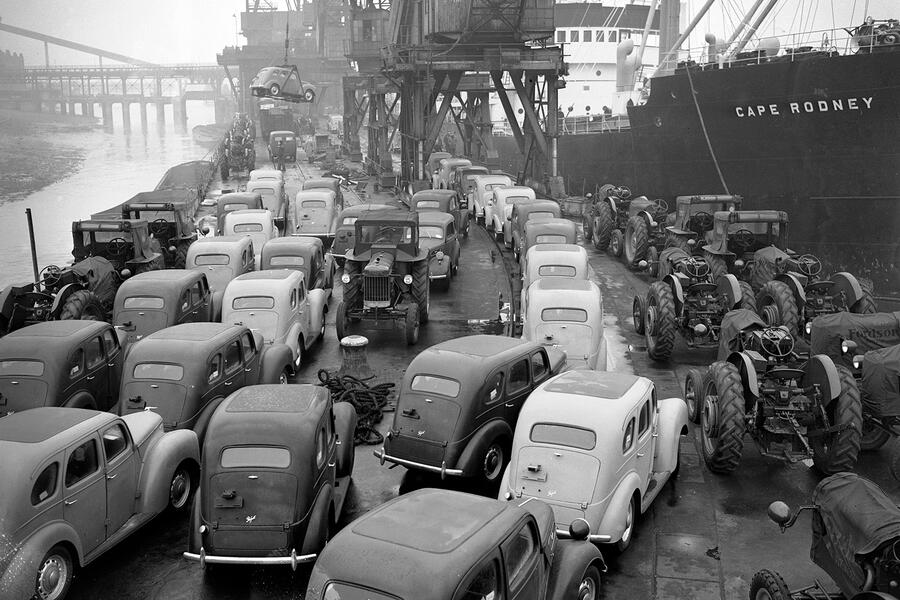
Makers of all goods were set record-high export targets-that for cars being three-quarters of all production. This drive was enforced by the Ministry of Supply allocating steel only to those car makers that hit their targets. With so much reconstruction and such an industrial expansion needed around Britain, demand for this vital raw material far outstripped supply, so it had to be carefully rationed among key industries.
Having switched back from war work remarkably quickly, British factories built 335,000 cars in 1948 and shipped an unprecedented 68% of them abroad-mainly to the US, Empire and Commonwealth. Waiting lists for new cars in Britain grew rapidly, despite empty purses and a hefty purchase tax of 66%, and in many cases eventually stretched to five years.
"The stage, then, was perfectly set for the racketeer and the unscrupulous but 'within the law' trader," we explained. "All that was necessary was to buy as many cars as possible and sell them as quickly as possible. This is not a jungle law; it is peculiar, in its victimisation of others, to civilisation. It has been done with genuine second-hand cars. It would have been done with new cars, to such an extent that hardly a single new car would have reached a genuine buyer at list price plus purchase tax. This is no exaggeration; the corruptive influence of the inflated prices offered for new cars was such that very few people would have had the moral fibre to resist it."
What had stopped such lucrative scheming was a 'deed of covenant' system enforced from July 1946 by the British Motor Trade Association, which bound a buyer not to sell his car within six months without the BMTA's consent, at pain of a penalty amounting to 45% of the list price of the car plus purchase tax.
It took just six months for this to be challenged in the high court – but the judge sided with the BMTA, granting an injunction restraining one Charles Falco from reselling his Vauxhall. The result was important, we reported, in that it established the legality of the covenant.
Another injunction was granted a few months later to restrain "a firm of dealers from inducing purchasers of new cars to break the contract" in the form of a cheeky calendar image. In March 1947 the bound period grew to 12 months, as waiting lists continued to lengthen, worsened by a coal shortage halting factories.
Another notable court case came in late 1948, as London dealers Roy Salvadori (a future Formula 1 star) and William Mansfield were found to have conspired to personally breach the covenant and procure breaches by others, "adopting every available means to cover their tracks and resorting to false names, false addresses and false documents".
The covenant period was doubled once more in December 1950, to our dismay, and remained applicable to certain models until January 1953.

Ballet Cat’s Power Boost and Gendered Features Reveal GWM’s Calculated Appeal to Female Drivers


Patina as Performance How Ludwick’s Garage Transforms Dilapidated Cars into Coveted Cruisers


Nissan Robotaxi Initiative Advances End-to-End AI for Urban Mobility Without Reliance on Maps
 Japanese car maker's plans are part of massive collaboration with Uber, Nvidia, and Wayve
A pilot scheme using Nissan Leaf robotaxis is set to be launched in Tokyo later this year, subject to approval by the authorities. The scheme is part of Nissan's plan to deploy robotaxis worldwide in collaboration with Wayve, Nvidia and Uber.
The major difference between the Leaf-based taxis and regular retail Leafs is that Nissan is developing fully redundant systems for the robotaxi versions. This is a widely used practice in safety-critical technology, such as the fly-by-wire systems used in aircraft, which have two or more totally separate systems to do one job in case one fails.
Level four means it needs no intervention by a human even in an emergency and pedals and steering are not necessarily installed at all. It also means the conditions it can drive in are restricted - to a specific geographical area, for example - and it is aimed at robotaxis and urban delivery vehicles.
The next step up is level five, which defines fully automated vehicles capable of driving anywhere in any conditions. The Drive Hyperion platform incorporates essential hardware such as cameras, radar, lidar, ultrasonics and in-cabin sensors.
As a ready-made platform, it allows engineers to focus on the job of developing automated vehicles like the Leaf. Wayve AI Driver is literally the brains behind the operation and is described as "rooted in end-to-end AI" learning from real-world data and working without the need for detailed high-definition maps and to navigate in real time.
The term 'end-to-end' AI is jargon that essentially means a level of intelligence in the true sense of the word. Show end-to-end AI the finished product and it can work out how to achieve the same result without the need for human intervention to spell out individual steps.
The Leaf robotaxi will have a comprehensive array of sensors to give the robot car full visibility of its surroundings, including cameras covering 360deg combined with forward- facing radar and lidar.
All of that sensing will be used by AI Driver to understand its surroundings and make decisions. It will process the data from the sensors to figure out complex traffic environments and take safe decisions, says Nissan. As it isn't relying on maps, it can learn how traffic situations evolve and it anticipates the impact of its actions on other road users.
Nissan is also planning to continue to refine its cars for use as robotaxis, including features to make the journey more interesting for passengers, such as intuitive cabin displays and communication systems.
Wayve and Uber intend to expand their robotaxi trials to more than 10 cities worldwide. AI Driver is designed to work with any vehicle platform (and so any manufacturer) and across all cities and driving conditions.

BMW Plug-In Hybrid Recall Exposes Ongoing Fire Risks and Design Vulnerabilities

Lexus CT 200h Delivers Prius-Level Efficiency with Upscale Comfort for the Discerning Driver


eVED Reforms Ease Fleet Compliance but Raise Concerns Over Administrative Burden and Timing Ahead...
 Changes to eVED target reduced administrative burden for operators but concerns remain ahead of 2028 introduction
Fleet operators are being urged to prepare for the extra workload eVED (electric vehicle excise duty) will inevitably now bring when it is introduced in less than two years’ time.
The Treasury has confirmed fleet-focused changes to the incoming pay-per-mile tax for electric cars following warnings that the system was complex enough to risk a £260 million annual compliance bill for operators – excluding the tax itself.
Announced during last year’s autumn budget, eVED is set to introduce a 3p per mile tax levy for EVs and 1.5p for plug-in hybrids from April 2028, aimed at plugging a forecast £12 billion hole in fuel duty revenue by the 2030s as drivers buy less petrol and diesel.
The proposal, which was put out for public consultation in November last year, suggested drivers should estimate and pay for the next year’s mileage in advance as part of annual VED (road tax) renewals, then visit an MOT station to have their mileage verified and settle the difference 12 months later.
This attracted widespread criticism from fleets, with warnings that the process of estimating and verifying mileage would be costly and disruptive for operators – especially with job-need vehicles.
Among them, industry body the British Vehicle Rental and Leasing Association (BVRLA) calculated a £75m annual administrative burden and £185m in lost productivity as vehicles were taken off the road for mileage checks. That excludes the costs of implementation, mileage readings and the tax itself.
The Treasury’s response to the consultation, which received more than 5000 responses, includes several carve-outs that streamline eVED for fleets.
Mileage verification will now begin when the vehicle has its first MOT test, typically at three years old. That’s aligned with the length of a typical lease contract, so it removes the need for external checks for most company car and salary-sacrifice vehicles.
Instead, drivers will be able to provide their own mileage readings and settle the balance when vehicles change hands or have their first MOT. The Treasury expects the risk of large eVED settlements at that point will deter people from under-estimating their mileage.
Fleets will be able to manage those estimates centrally, pay for their aggregated mileage in bulk and settle any balances when the vehicle is sold. The Treasury proposed systems enabling them to use data from connected cars, but added that further collaboration and testing with fleets would be needed before eVED comes into force.
Although Dale Eynon, government affairs and policy lead at the Association of Fleet Professionals, is optimistic that those discussions could “iron out further issues”, he added that larger changes are unlikely.
“Our advice to the fleet community is to prepare for the extra workload eVED will generate,” he said. “We will, of course, continue to aim for further changes to the current proposals as well as pushing for a delay in implementation until at least 2030, when the electric car market will have further matured.”
The BVRLA also welcomed the changes, but the organisation’s CEO, Toby Poston, added caution about timing.
He added: “It is great that the government has taken some of the roughest edges off its eVED plans. They’ve accepted that a tax designed around private motorists won’t work for the fleets that are driving the UK’s transition to electric vehicles.
“But there is no avoiding the fact that you can’t create a smooth switch to electric vehicles by making them more expensive to own. The mechanics of the tax may have improved, but the timing is still wrong.”

License Plate Reader Technology Faces Privacy Reckoning as LAPD Ends Flock Safety Contract


ICE Enforcement Tactics Under Scrutiny Amid Community Disruption and Fatal Incidents