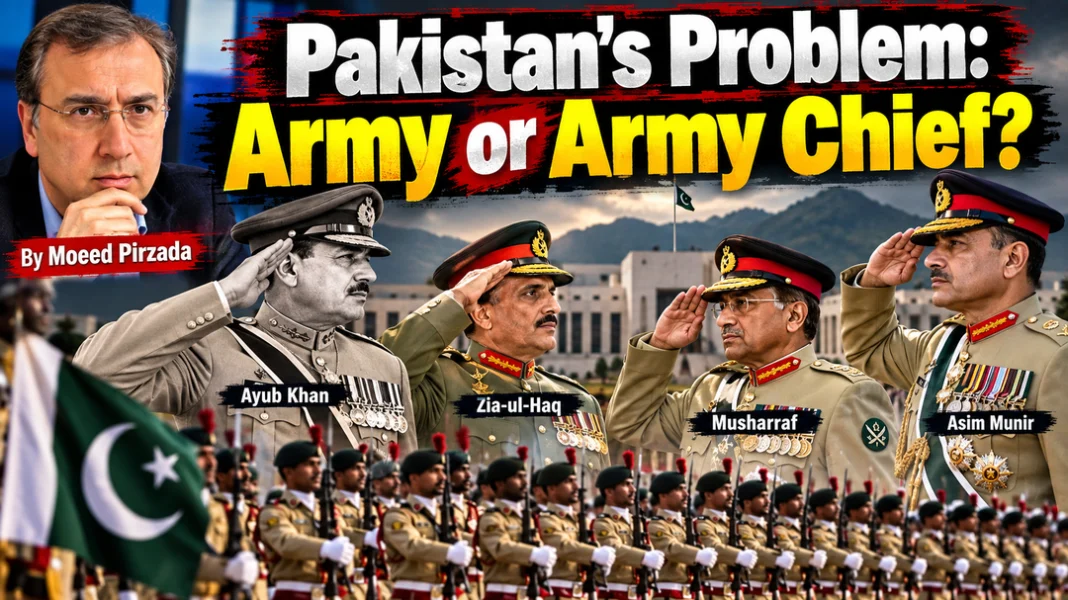
Pakistan’s Real Problem: Pak Army or the Magical Powers of Army Chief?
Enkidu Reborn is a mysterious character. Hidden. Cryptic. Mostly Angry. At times wise and sanguine! No one knows who he is. He lives and thrives on X (formerly twitter) like the cynic ghost played by Vincent Schiavelli, who meets Patrick Swayze on New York Underground Subway, and teaches him to direct all his emotions, his rage to produce results in his quest to save the beautiful, magical, stunning Demi Moore, from thugs, in 1990 film “Ghosts” (I am still in love with that enchantress, Demi Moore, of 1990! Uff!)
But whenever a professional history of Pakistan’s current predicament and struggle of its new rebellious intelligentsia against military authoritarianism will be written, Enkidu Reborn will get a foot note as an indefatigable intellectual warrior fighting 24/7, 365 days a year, to jump start Pakistan’s dead consciousness -as drivers used to do on dark December mornings before the arrival of modern Japanese cars or as cardiac emergency teams do to resuscitate hearts of almost dead patients..jury is still out for Pakistan..
An Army Major Cries Out of his helplessness?
As I mention, Enkidu Reborn is mostly angry against Pakistan’s Military Establishment and its unending power grab. But in a rare moment of remarkable forgiveness he posted a message from an unknown Army Major on X. Purportedly this serving Army Major, asserts that he and many colleagues are deeply disturbed by what is happening in Pakistan but they feel helpless. Major speaks of friends who once supported Imran Khan, of officers uncomfortable with actions against civilians, but ultimately of men trapped inside an institution where refusing orders is not a realistic option – even when it means marching to death in wars they understand little.
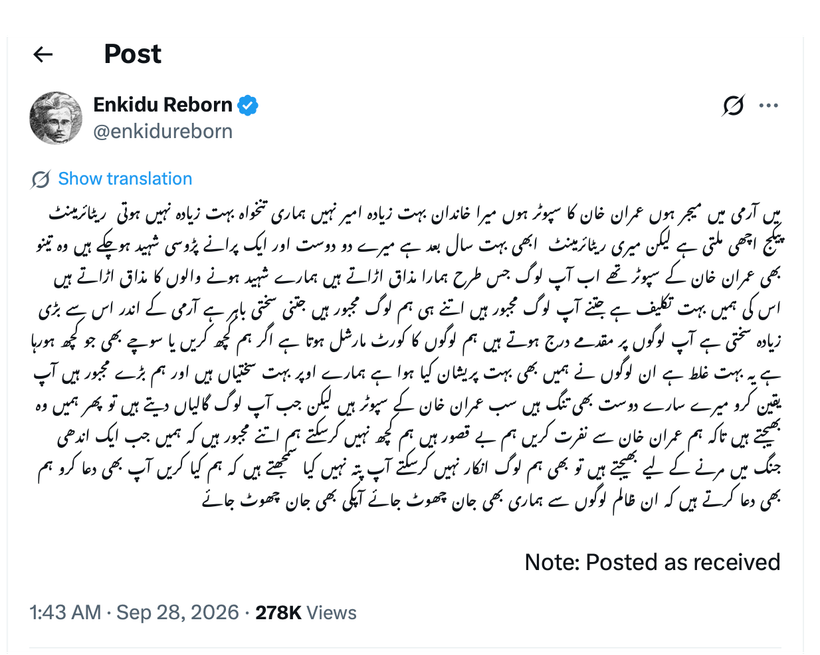
The authenticity of this anonymous message cannot be credibly established, nor can one Major speak for an army that may have thousands of Majors and Colonels in uniform. But his argument raises a question Pakistanis rarely formulate correctly: Is Pakistan’s problem really its Army—or is it the extraordinary concentration of political, institutional and economic power around the office of the Army Chief? Who now is also Field Marshal, Chief of Defense Forces (CDF) and may soon become President of Pakistan?
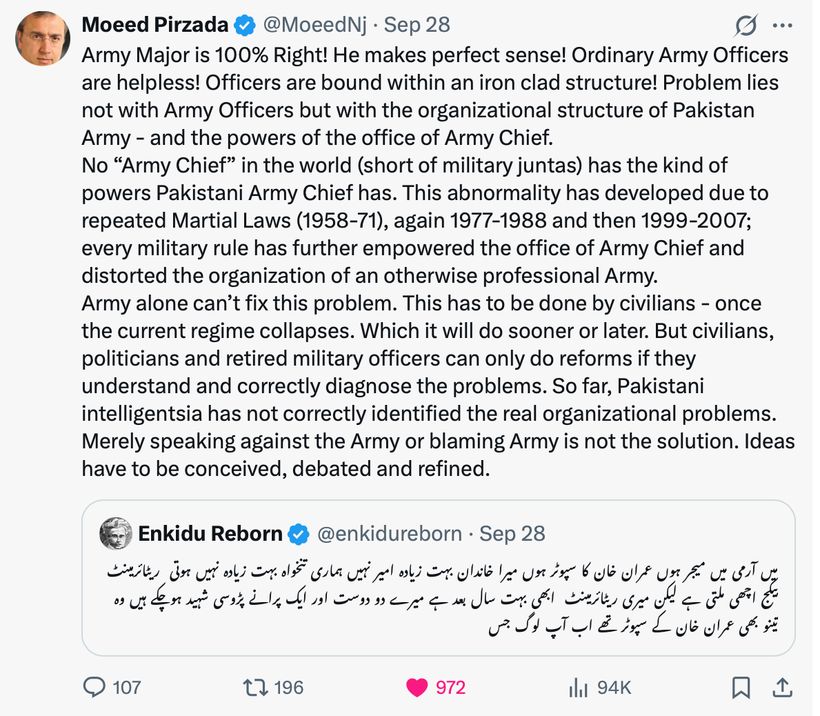
Moeed Pirzada: From “Boot Polish” to Army’s Enemy No: 1- but Why?
But distinction is fundamental. I have been arguing the same intellectual position in my vlogs for the past three plus year – since May 2023.
A cerebral crime, of a sincere patriot, that unfortunately transforms me from a “Boot Polish” to Pakistan Army’s Enemy No: 1, and a voice that needs to be suppressed even if it demands serious pressure upon global platforms like Wikipedia, YouTube, Meta and X to reduce my reach and visibility all across the world. Imagine how important this distinction is. Because those who wield the powers know it’s not about the Army; it’s about its Chief. In one angry briefing, in June 2022, in a safe house in Islamabad, I was told repeatedly by a senior officer: “Chief is Army; Army is Chief”
I am not a starry eyed idealist. I am not 25. I am 61, with years in Central Superior Services of Pakistan, in world’s best universities (that take your years and money and give you useless degrees) and as one of the important insider voices of Pakistani media and system. I understand: Armies cannot operate as debating societies. Military effectiveness depends upon hierarchy, discipline and obedience. A major obeys his lieutenant colonel and colonel; a brigadier obeys his divisional commander; generals operate within the chain of command. On a battlefield, an officer cannot hold a referendum among his troops before executing orders.
But Sir, that obedience is not Pakistan’s problem…
The problem begins when an institution designed to fight wars starts running a nation-state while retaining the same wartime principle of unquestioning obedience to one military hierarchy.
Pakistan has progressively blurred these two entirely different functions: commanding an army and governing a complex nation state of 250 million plus with various ethnicities, sub-nationalities and their fault lines. And this toxic “Chai masala mixed with religious alcohol of Makkah and Medina” this dangerous combo, has been sold to hundreds of unquestioning columnists, media persons and millions of citizens.
How Martial Laws Changed the Army
This did not happen accidentally. Pakistan Army under Gen. Sir Frank Messervey and Gen. Sir Douglas Gracey (1947-1951) did not fancy itself in this dual role. War against the hideous tribals of NWFP, intoxicating Indian Women and consuming imported Wines at the expense of Raj may have been their motto – but they did not fancy running and recreating a nation state. Let’s stop blaming the perfidious Albion and East India Company for everything. This shit happened later under our own brown saviors – who sold us the “Masala Chai” of “Dangerous Wicked Hindu” who has not accepted the partition of British India. Imran Khan’s biggest contribution, I suspect unconsciously, is that he has suffered on the cross like Christ to help us wake up from the mind altering effects of this “Masala Chai”..
Pakistan’s military rulers, as they barged into politics, because of a still born Muslim League, that was “Dead on Arrival”, quickly developed a vested political interest in transforming a hitherto apolitical British trained Army because their power and survival now depended upon its loyalty. Ayub Khan could no longer merely be a professional Commander-in-Chief once he became Pakistan’s ruler in 1958. He needed the military establishment to become a constituency for his regime.
Read more: Imran Khan’s Anxiety Rated ‘Three-Plus’ as Medical Board Recommends Daily Walk, More Family Access
The Ayub period therefore helped establish a system of material privileges around military service. Research on Pakistan’s political economy traces the expansion of land allotments, post-retirement opportunities and other benefits for officers to this era. Scholarship on corruption during the 1960s also finds that Ayub’s manipulation of state institutions for regime legitimacy contributed to deteriorating bureaucratic norms and rising corruption.
Why Gen Zia was the real villain of Pakistan and its Army?
But Gen. Zia-ul-Haq takes the cake – in transforming a professional army into his personal tribe.
Zia institutionalized the lateral induction of military officers into civilian government. Ten percent of vacancies in officer grades in the civilian bureaucracy were reserved for induction of military officers, including positions in elite services whose civilian entrants normally faced competitive examinations. Military officers increasingly appeared in civilian administration, public corporations and other state institutions.
This started to transform Gen. Messervey and Gen. Gracey’s army into something new. An Army officer was no longer being trained merely for command, staff work and national defence. The military institution increasingly became a pathway into the administration and economy of the state itself.
And economic interests grew alongside political ones.
Fauji Foundation had existed since 1954 as a welfare organization, so it was not created by a military dictator. But its commercial footprint expanded dramatically over subsequent decades. Ayesha Siddiqa’s influential study Military Inc. describes the emergence of what she calls “Milbus”—military business: an economic system involving military-controlled foundations, corporations, land and commercial opportunities.
Rise of DHA: How Housing became particularly important?
There was nothing wrong with the initial ideas of a DHA. Army officers, with proverbial limited salaries, should get plots on preferential rates to build decent houses for retired life, But the Defence Housing Authority model expanded into most attractive urban real estate becoming part of the civilian national economy. Research traces the modern DHA system especially to the Zia period; today military-controlled housing organizations possess extensive prime land and employ thousands of serving and retired officers in management. And their “lady wives” are often part of this burgeoning economy.
Land, houses, post-retirement appointments, corporate positions, generous health coverage for all family, golf privileges and Army messes better than five star hotels gradually altered the relationship between an officer and his institution.
This is the dimension Pakistanis need to discuss more openly.
An officer’s lifetime economic security, his whole sense of identity and place in society, could increasingly depend upon an institution controlled from above: promotions during service, desirable postings, land allotments and housing opportunities, followed potentially by appointments in military-linked corporations or government after retirement. Research on Pakistan’s senior military elite finds precisely this unusual combination: considerable bureaucratic professionalism while serving, followed by extensive participation in military-linked corporations, state employment and other influential positions after retirement.
Many would argue that this is not corruption. Welfare benefits are legal institutional entitlements, and they benefit ordinary military families as well as senior officers. But a system of privileges, and their abuse, controlled through a steep command hierarchy can create powerful incentives for conformity. Many officers are known to have secured dozens of plots, as files, under dubious names.
The result is a paradox.
The institution produces disciplined officers—which is exactly what an army requires—but the same linear discipline becomes a recipe for disaster when the institution itself moves outside its constitutional military role to control and run a complex nation state, with its multifarious challenges that defy the linear discipline of a controlled military organization prompting army commanders to create ever new adhoc and contradictory rules and regulations to impose their concept of discipline upon a myriad social order. Military discipline thus ends up creating and multiplying indiscipline all around.
From Professional Obedience to Political Obedience
This is how Pakistan differs fundamentally from normal civil-military arrangements seen from India to the United States.
In a constitutional democracy, a general commands soldiers but does not command judges, journalists, bureaucrats, election officials, businessmen or politicians. Military obedience, however blind it may be, therefore remains largely contained within the professional sphere for which it was designed.
Once an Army Chief becomes an arbiter of civilian politics, and relies upon army for his power, however, the consequences of military obedience escape the barracks. It is no more an army; it becomes something else, perhaps a political party like China’s CCP. But then CCP unlike Pakistan Army is not a structure imposed from the top; it is a political and social organism that grows upwards from the bottom end village and commune towards the complexity of Chinese govt in province and then Beijing.
A DG ISI, a DG Rangers and a Corps Commander who must obey the Chief is no longer merely participating in military operations if the institution is simultaneously controlling media and courts, making videos of judges, influencing elections, writing performance reports of police and district commissioners and ensuring desired domestic political outcomes. The Major who wrote the message circulating online captures this dilemma from below: whatever an individual officer privately believes becomes almost irrelevant when his professional future, his sense of self and place in society all depends upon obedience within the hierarchy.
That is why simply attacking “the Army” or asking them to resign – as many have done under Enkidu’s tweet – fails to diagnose the problem.
Pakistan’s experience belongs to a broader category of states where militaries have repeatedly crossed into politics. Myanmar’s Tatmadaw built extensive political and commercial interests; Sudan’s military establishment developed major economic interests alongside political power; Thailand has experienced repeated military interventions and coups. The precise institutional arrangements differ substantially, so these countries should not be treated as identical to Pakistan. But they demonstrate the danger created when military command, political authority and economic interests become intertwined. With the exception of Thailand, all others look like imploding from within – and fate of Pakistan, with three insurgencies raging from north to south, looks similar.
Every Army Chiefs creates a new Pakistan for himself?
Pakistan’s Constitution, in its original form, says that the Federal Government commands the Armed Forces. Yet repeated military governments—Ayub, Yahya, Zia and Musharraf—progressively reversed the practical relationship between soldier and state. And now under the undeclared martial law of Gen Asim Munir, constitution after the 26th and 27th Amendments is so mutilated that it has lost all its original sense and meaning becoming a tool to justify Army Chief’s hold without the formal declaration of martial law as in Zia era or PCO as under Musharraf.
But this is not all. Every Chief in many ways reinvents army and by virtue of control on Pakistan the whole country gets transformed to meet his requirements and brain waves. Yayah was a womanizer so all top brass loved women and wine; Zia was an Islamist, so all officers accepted Islam, tv became a tool of religious sermons and shalwars were hung in govt. offices for mid day prayers. Musharraf became the symbol of moderate Islam and everybody in Islamabad was found drinking and thinking moderately. Though Gen Kayani had already successfully completed major tribal operations, but Raheel Sharif in 2014 needed a new war against terrorism for his brand development so Pakistan got “Operation Zarb-e-Azab”. Bajwa believed in engaging India, so Pakistan got “Bajwa Doctrine”. He privately counseled media persons to tone down on India and showed restraint in responding to India after Pulwama and attacks on Balakot. Gen Asim has again identified India as existential enemy for his own political reasons. Army Chief is thus like a medieval king; army becomes his “durbar”, Pakistan his playground and people: “Riyaya” of the Ottoman Empire.
Every military ruler -even Gen Asim Munir who has not declared formal Martial Law -is faced essentially with the same political incentive: strengthen the institution whose obedience keeps you in power, reward the hierarchy upon which you depend, and weaken alternative civilian centres of authority. Every new Chief is first among the equal for the first six months as Gen Asim was from November 2022 till May 2023. Within this period, Chief empowers himself as his batch mates retire and he promotes Maj Generals into Lt. Generals, Brigadiers into Maj. General and transfers and places senior officers establishing a system of reward and punishment. After taking full control of his internal ecosystem he then embarks on external adventures turning Pakistan into his laboratory.
Gracey’s British trained army thus became the personal tool of Pakistan’s Army Chief and his ever changing ambitions. Imran Khan had to go not because Army officers disliked him or he was a threat to Army’s corporate interests as an institution, but because Gen. Bajwa struck a personal equation with Nawaz Sharif. May 9 Natak, Feb 8 Election looting and Nov 26 Islamabad massacre did not happen because of army’s institutional interests but because Nawaz Sharif, an astute player of Pakistani power politics, managed to bring Gen Asim Munir as his own Chief, against traditional merit, and a stage was set for a dangerous confrontation that finally took Pakistan to Islamabad massacre in Nov 2024. That may be fading now, as Gen. Munir is thinking of himself, and his legacy, beyond Sharif dynasty and so the brain wave for new provinces.
In authoritarian Pakistan, equation is thus simple: Political power produces economic privilege; economic privilege creates an institutional interest in political power; and the military hierarchy ensures that those below remain dependent upon decisions taken above, from the very top. An army discipline becomes the tool for running a nation state.
Pakistan’s Challenge: How to Convert “Chief’s Army” into “Pakistan Army”?
This explains why changing Army Chiefs has never solved Pakistan’s problem. Pakistanis – including army officers – have repeatedly hoped that the next Chief will be different. One Chief becomes a saviour, another a villain, and another arrives promising institutional neutrality. But personalities change while the architecture of power survives.
The objective of reform therefore should not be to destroy or humiliate the Pakistan Army. Pakistan needs a strong, professional military. The objective should be almost the opposite: to turn the Army back into an army.
That means gradually separating military command from civilian administration: turning ISI into a civilian agency under Prime Minister with civil servants as DGI and DGs answerable to high courts; strengthening the Ministry of Defence and parliamentary oversight; examining military representation in civilian institutions; creating transparency around military-controlled commercial organizations and land; protecting professional officers from political assignments; and restoring an unmistakable constitutional boundary between defending Pakistan and governing Pakistan.
Any one reading this will shout: What the hell: how can that happen? since army controls everything. Answer is: all systems of control ultimately collapse from internal weakness and exhaustion. This system too is heading towards over reach and collapse sooner or later. That will be an opportunity for reform. If that has not happened in the past, its because Pakistani people, media and intelligentsia had neither identified real issues nor debated their solutions. Do they have now? Apparently still not. Shouting against the army is not the solution. Ideas debate is the way forward. Unfortunately the shrillness of social media does not help. It sets the stage for change but can not provide the direction for crafting that change.
The deeper question for media, public and army officers is institutional: Why should the personal authority of one Army Chief determine the political behavior of an entire military establishment—and through it influence the functioning of a country of 250 million plus people?
Army officers are trained to obey their Chief. In war, that obedience is indispensable. When the Army Chief becomes involved in governing the state, however, the very discipline that makes an army effective in war can become the mechanism through which the political system is controlled, society becomes traumatized and indisciplined and state withers and starts to perish. Have a look from Baluchistan to erstwhile FATA to Azad Kashmir: Is this not happening in front of our eyes?
As I mentioned above: I am not a starry eyed idealist. I know the reforms I mention above are easier said than done. Future of Pakistan itself is uncertain now. But Pakistan needs original ideas and genuine debate for its long term survival and progress out of the dark pit it finds itself. Slogans and cliched statements are no solution. Army Chief is the structural problem Pakistan has never seriously addressed. Pakistan needs “Pakistan Army” not the “Chief’s Army”
Moeed Pirzada is Editor Global Village Space; he is also a prominent TV Anchor and a known columnist. He previously served with the Central Superior Services in Pakistan. Pirzada studied international relations at Columbia University, New York and Law at London School of Economics, UK as a Britannia Chevening Scholar. He has been a participant in Chaophraya Dialogue and Salzburg Forum and has lectured and given talks at universities and think tanks including Harvard, Georgetown, Urbana Champaign, National Defense University, FCCU, LUMS, USIP, Middle East Institute and many others. Twitter: @MoeedNj. You can support his research and journalism by becoming a “Strategic Insider” on this Patreon Page.