
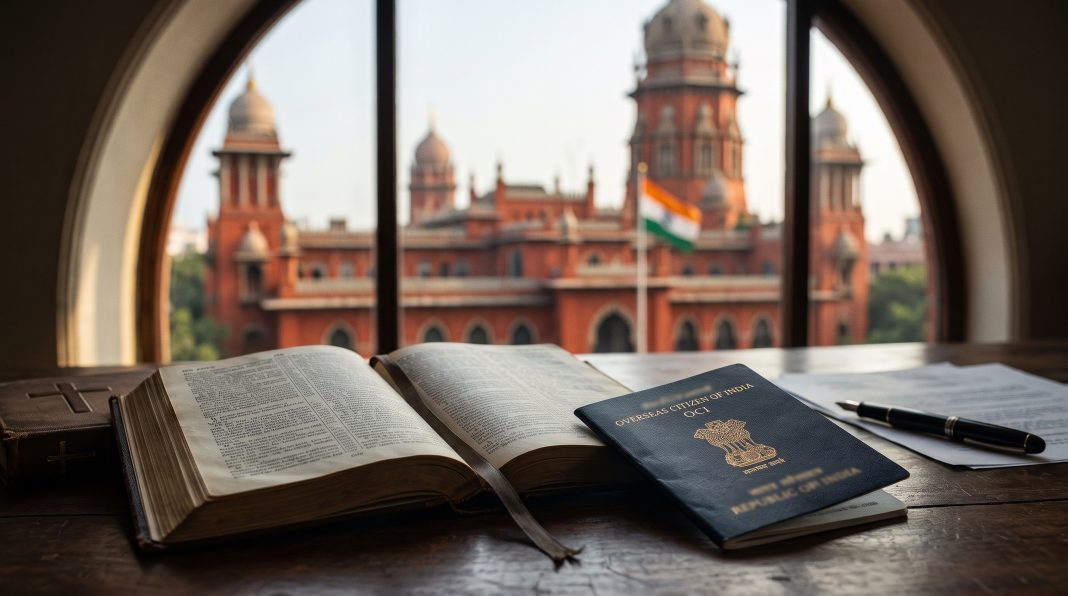
Many Indians who settle in America, Canada or some other foreign country and become citizens of those countries, get themselves registered as an OCI (Overseas Citizen of India). On obtaining such registration they can come to India without obtaining an Indian visa.
However, the Government of India has put some restrictions on OCI cardholders, one of them being that they cannot do missionary activity in India without a special permission from the Government of India
John Daniels is one such person of Indian origin who became a US citizen and got an OCI card. He has many relatives living in Tamil Nadu, and he often visited India without an Indian visa.
However, now the Indian government has cancelled his OCI registration, which means he has to leave India, and cannot visit India again without obtaining an Indian visa.
He challenged the cancellation of his OCI card by filing a writ petition in the Madras High Court, but that petition has been dismissed on 26.10.2026 (John Daniel v. Union of India and Others, 2026 MHC 4303).
The ground given by the government for cancellation was that while in India he conducted missionary activity and tried to convert people to Christianity without permission from the Government of India.
He denied these allegations and stated that he only came to India to visit his relatives in Tamil Nadu, but the High Court held that even if he did not try to convert people, he was doing missionary activity in India without getting permission from the government.
The Court, while dismissing his petition observed:”Substantial materials have been produced against the petitioner, indicating that he has consistently been addressing congregations, gatherings and meetings at various places in Tamil Nadu and Andhra Pradesh and that advertisements have been issued inviting the general public to attend his meetings. Those materials cannot be regarded by this Court as fabricated or concocted. It is one thing to contend that the petitioner is not involved in conversion and is only spreading the message of ‘God’.
Read more:Is Democracy Failing India? Why the Country Needs Development, Not Electoral Politics
However, it is not only for conversion, but even to be a missionary preaching his religion, it is only a prior permission that is mandated. The petitioner has made a categorical and sweeping statement before this Court that he has never been involved in any missionary activities in India and has visited India only to see his mother, family and friends, which, on its face is a lie”
So unless he appeals against this decision before the Indian Supreme Court, and obtains a stay of the High Court verdict, he will have to go back to America, and cannot come again to India without obtaining an Indian visa.
Is this verdict correct ? I am of the opinion that it is entirely correct. The expression ” missionary activity”is wider than trying to convert.
Missionary activity is defined as being sent to share faith and serve others, often across cultural or geographic boundaries. It includes preaching the Gospel, providing education, healthcare, and showing love through daily actions.
Thus, missionary activity is not limited to trying to convert. It includes providing education, healthcare, etc. Many describe missionary activity as an attitude of love and service wherever you are.
It is not only about preaching or traveling overseas — it is about kindness, helping neighbors, and living out faith in homes, schools, and workplaces. Some say mothers, teachers, and health workers are missionaries too when they guide, comfort, and serve others in Jesus’ name.
In this connection an interesting incident may be mentioned. Shortly after the victory of the communists in China in 1949 a delegation of Western missionaries met Prime Minister Zhu Enlai in Beijing to request permission to continue entering China and preaching there, as they had been doing for many years.
Zhu replied:” We will permit as many of your missionaries to enter China and preach here, as you allow our missionaries to enter your countries and preach there.”
As to what religion these Chinese missionaries entering Western countries would preach was not mentioned by Zhu, but was understood by all. Western governments would surely never allow a host of communists to enter their countries and spread communist propaganda there.
The attempt of the delegation therefore failed, and foreign missionaries were expelled from China, and never allowed to re-enter.
Markandey Katju is an Indian jurist and former Supreme Court judge of India who served as chairman for the Press Council of India. He has also worked as Standing Counsel for the Income Tax Department.
The views expressed in this article are the author’s own and do not necessarily reflect the editorial policy of Global Village Space.