
India cannot overcome poverty, unemployment and widespread deprivation without transforming itself into a modern industrial powerhouse, argues Markandey Katju. He calls for national unity beyond caste and religious divisions and a prolonged people’s struggle to bring about fundamental political and economic change.
Today most Indians are like blind people groping in the dark, totally confused about what is happening in our country, where are we going, and where must we go, and how. So let me clarify.
Our national aim must be to transform India from a relatively backward country into a modern industrial giant, like China, ( for which we have all the potential, as we have plenty of bright scientists and engineers, and immense natural resources ).
Unless we do that we will never be able to get rid of our massive and widespread poverty, massive unemployment, appalling level of child malnutrition ( every second child in India is malnourished, according to Global Hunger Index ), almost total lack of proper healthcare and good education for our masses, etc
There are powerful forces, both external and internal, which will strongly oppose this transformation. In particular, the developed countries have a secret but very strong rule ( which they will never openly express ) : to oppose such transformation tooth and nail, because if that happens their industries will not be able to face the competition from Indian industries, since with our cheap labour we will undersell their products, resulting in closure of many of their industries and throwing millions of their workers out of employment.
This there is a direct, irreconcilable conflict of interest between the developed and the underdeveloped countries. The former are determined to to keep countries like India underdeveloped, backward and poor, and for doing this they make Indians fight each other on the basis of religion, caste, language, race, etc, which they do through their local agents, the Indian politicians, of all parties, who polarize Indian society, and incite Hindu-Muslim and caste hatred, to get votes in elections.
However our aim must be to maintain unity among our people, and make India a highly developed and highly industrialized country, so as to give our people a high standard of living and decent lives
How is this conflict of interest to be resolved ?
In my opinion it cannot be resolved by democratic elections, but will require a revolution.
This revolution can only happen if Indians unite, rising above caste, religious and other barriers, and launch a powerful united protracted people’s struggle ( jan sangharsh ), led by genuinely patriotic and modern minded leaders, a struggle which may last 10-20 years, and in which tremendous sacrifices will have to be made.
Read more:Long Live the Great American People! A Triumph of Democracy and Political Balance
This struggle will ultimately culminate in a people’s revolution ( jan kranti ), which will set up a political and social order under which there will be rapid industrialization and steady rise in the standard of living of the people, who will then start getting decent lives.
There is no other way out for the Indian people if they wish to abolish our great socio-economic evils ( mentioned above ), and take their rightful place in the comity of nations. Unless we launch such a mighty united people’s struggle, and make such a historical revolution, we, and our descendants, will remain condemned to massive poverty, massive unemployment, appalling level of child malnutrition etc.
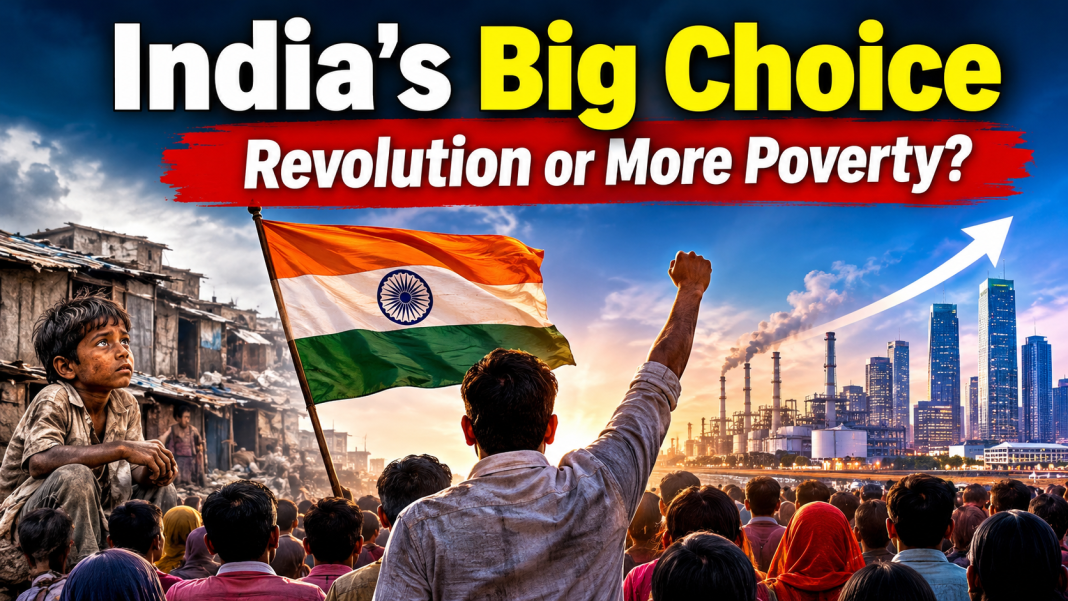
The people of India must now decide whether they are willing to launch such a mighty struggle, make tremendous sacrifices, and ultimately make a historical revolution, or remain in their present miserable condition, and condemn their children and descendants also to remain in the same condition.
Markandey Katju is an Indian jurist and former Supreme Court judge of India who served as chairman for the Press Council of India. He has also worked as Standing Counsel for the Income Tax Department.
The views expressed in this article are the author’s own and do not necessarily reflect the editorial policy of Global Village Space.