
Democracy for Us, Dictators for Them
A staffer who saw Pakistan’s May 9 protests and its defiant February 8 vote firsthand still concluded that Pakistanis “did not want change.” Dr. Zoobia Chaudhry uses that contradiction to examine a long Western habit: celebrating democracy at home while backing repression abroad. She traces the pattern from revolutionary France’s war on Haiti, through Belgium’s Congo, to the 1945 Sétif massacre in Algeria. As the Pakistani diaspora celebrates a historic Democratic wave, she argues it must use its new influence to challenge, and change, the narrative that lets Washington look away from Pakistan.
A Contradiction on Capitol Hill
Not long ago, some of us sat across from a staffer in a Democratic senator’s office. He was thoughtful, well briefed, and eager to tell us he knew Pakistan firsthand. He had spent time there on a fellowship, he said, arriving soon after the 2022 regime change.
He was in the country on May 9, 2023, when Imran Khan’s arrest sent crowds into the streets. He was there again on February 8, 2024, when millions of Pakistanis defied mobile blackouts, a stripped election symbol and a jailed leader to vote for the party the military had tried to erase. Candidates backed by that party won more seats than anyone else.
Then he offered his conclusion: his sense was that people on the street did not really want change.
We let the sentence sit. He had watched a population protest, absorb a crackdown and then turn out in defiant numbers. Yet in his telling, those people wanted things to stay as they were. He was not lying. He was doing something more common and more revealing: seeing exactly what happened and filing it under a story Washington had already written.
Democracy Worked Last Night
Last night, Americans did what Americans do every two years. They voted, the votes were counted, and power shifted. It was the biggest blue wave since 1974, the midterms that followed Richard Nixon’s resignation over Watergate. Democrats took both the House and the Senate, flipping Senate seats in North Carolina, Ohio, South Carolina and Texas.
Michigan sent Abdul El-Sayed to Washington as the first Muslim elected to the Senate. Georgia elected the first Black woman governor in the country’s history. The losing side will grumble, as losers do, and then it will hand over the gavel.
This is the system at its best, and it deserves celebration. Many in the Pakistani diaspora are ecstatic this morning, and with reason: they organized, donated, voted and ran, and their candidates won. But the staffer who told us Pakistanis did not want change worked for a Democrat. Washington’s double standard has never belonged to one party. The same political class that treats a single disputed ballot at home as a constitutional emergency has treated the disenfranchisement of 240 million Pakistanis as a footnote to a useful partnership.
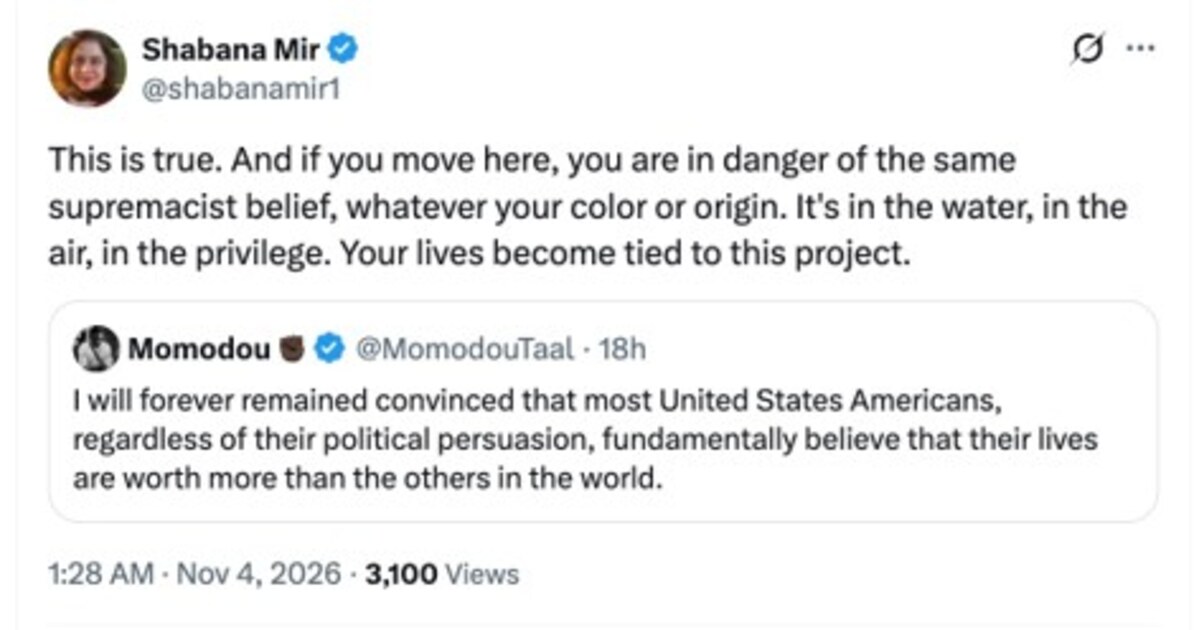
As the results came in overnight, Momodou Taal, a British-Gambian former Cornell doctoral student who left the United States in 2025 after the government moved to deport him over his Palestine activism, wrote on X that he remains “convinced that most United States Americans, regardless of their political persuasion, fundamentally believe that their lives are worth more than the others in the world.”
Shabana Mir, an author and anthropologist at American Islamic College in Chicago, added a warning aimed squarely at people like us: “if you move here, you are in danger of the same supremacist belief, whatever your color or origin.… Your lives become tied to this project.” Our celebration should not make us forget that.
Liberty at Home, the Dictators Abroad
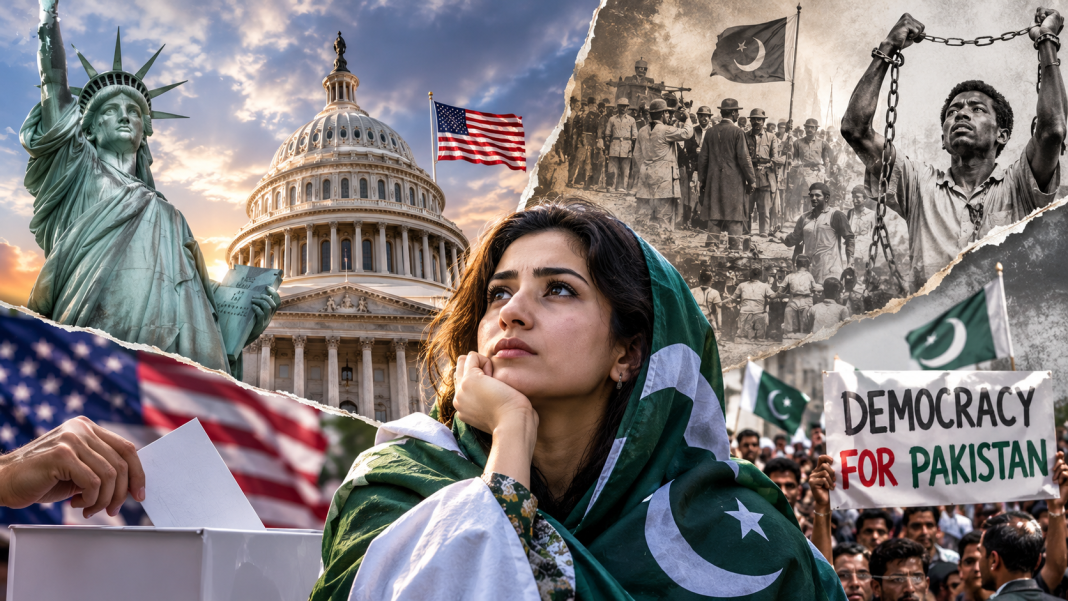
None of this is new. In The Darker Nations, Vijay Prashad writes that the Third World “was not a place. It was a project.” It was forged by people who had been promised the West’s universal rights and then denied them at gunpoint.
The pattern is as old as modern democracy. In 1789, revolutionary France proclaimed that men are born free and equal in rights. Its richest colony, Saint-Domingue, ran on the labor of nearly half a million enslaved Africans, and the Republic’s liberty stopped at the water’s edge. When the enslaved rose up and won their freedom, Napoleon sent an army in 1802 to restore slavery. Haiti won anyway, and France then made it pay an indemnity for its own liberation that took more than a century to clear.
Belgium followed the same script. While it governed itself as a parliamentary democracy, King Leopold II ran the Congo Free State as his private property and forced rubber labor there killed millions. Fittingly, when the colonized world gathered in 1927 to found the League Against Imperialism, a scene Prashad recounts, it met in Brussels. France, meanwhile, learned little.
On May 8, 1945, while Paris danced in the streets over victory against fascism, French forces and settler militias in Sétif and Guelma killed thousands of Algerians who had marched carrying Allied flags alongside their own. Liberty was for Paris. The colonies got the army.
Pakistan’s Turn
Pakistan is living a modern version of the same bargain. American officials will say, correctly, that they do not choose Pakistan’s governments. But silence is also a choice. After May 9, civilians were tried in military courts.
On February 8, mobile networks went dark, and results were altered, PTI and independent monitors allege, to hand a majority to the establishment’s preferred parties. In June 2024, the House voted 368 to 7 to urge an independent investigation into the election.
The Biden administration largely moved on, because a pliant government in Islamabad was convenient on counterterrorism and regional security. The Trump administration went further, hosting army chief Asim Munir for lunch at the White House and courting Pakistan’s critical minerals.
Read more: Trump under pressure on Iran war after Republicans’ midterms defeat
That is the logic the staffer had absorbed. If the people did not want change, then no one has to ask why the country’s most popular politician has spent years behind bars. No one has to ask why journalists have fled, or why a generation of young voters now sees the ballot as a ritual rather than a right. The story protects the policy.
Challenging the Narrative
Americans are right to love their democracy. The question is whether they will reckon with the burden US policies place on the rest of the world.
Pakistanis do not need Washington to pick their leaders. What we in the diaspora must do is challenge the narrative that lets Washington look away and then change it. That means bringing witnesses, evidence and voices from Pakistan into congressional offices, newsrooms and think tanks, and asking the allies we just helped elect to apply abroad the standard they won under at home.
What these elections show is that if you organize, build a narrative on solid argument and raise enough money, you can move the system. Celebrate last night. Then make sure the people who stood in line on February 8 in Pakistan are never again told that they did not want change.
Zoobia W. Chaudhry is a Baltimore-based physician, human rights advocate, and Communications Director at First Pakistan Global (FPG). She has been actively engaged in advocacy related to Palestine and Pakistan.
The views expressed in this article are solely those of the author and do not necessarily reflect the views of GVS.