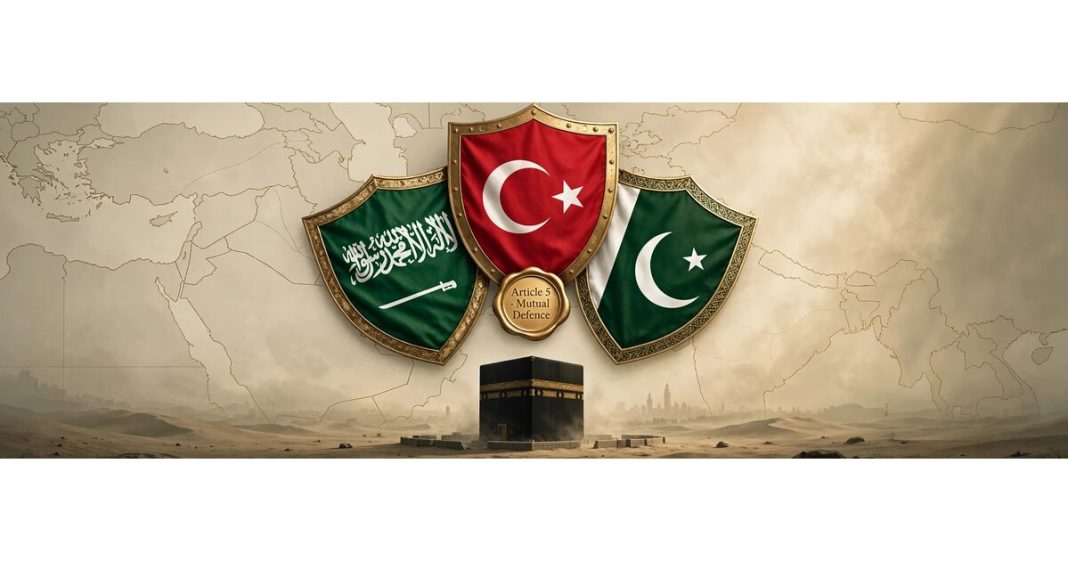
Three Muslim powers converged in the heart of Islam, Mecca, to sign a trilateral Mecca Joint Defence Agreement that sent shockwaves across the world. Signed by Saudi Arabia, Pakistan and Turkiye on August 7th, the pact introduced Article 5 of mutual defence affirmation. It explicitly declares that an armed attack against one signatory will be treated as an attack on all three.
Mainstream commentators have rushed to frame this as an unprecedented development triggered entirely by the active and highly volatile current US-Israel war on Iran. However, through the lens of structural realism and diplomatic history, this alliance represents something deeply familiar: a modern reincarnation of the 1955 Baghdad Pact, also known as the Central Treaty Organization (CENTO).
As Pakistan navigates its role in this newly minted architecture, comparing the Mecca Pact to that of CENTO reveals a critical truth – while the structural blueprint looks nearly identical, the underlying power dynamics have been completely inverted over time.
In 1955, the United Kingdom and the United States orchestrated the Baghdad Pact, to unite Iraq, Turkiye, Pakistan and Iran under a single defence umbrella. The goal was a top-down, Eurocentric containment strategy designed to build a “security wall” along the southern border of the Soviet Union. But CENTO turned out to become a textbook study in alliance failure, remaining largely ineffective long before its official demise in 1979 due to a lack of internal cohesion and hollow mutual defence promises.
Ultimately, CENTO collapsed because it was imposed by Western powers to fight a Cold War that did not align with local security concerns. Pakistan joined it to secure a defence shield against its arch-rival, while Turkiye joined primarily to link NATO’s southern flank but Saudi Arabia opposed it.
The alliance’s reality laid bare to its members and non-members when local conflicts actually erupted during the 1950s-1970s, such as the Suez Crisis of 1956, Pakistan-India Wars of 1965 and 1971, the Cyprus crisis of 1974 and the Iranian Revolution of 1979. The Iranian revolution proved to be the last nail in the coffin leading to CENTO’s dissolution as Iran and Pakistan abruptly backed out in 1979. USSR – for which CENTO was created to deter – invaded Afghanistan same year, a few months following CENTO’s dissolution. The subsequent USSR-Afghanistan war made the global affairs chaotic for a long time.
The most fascinating aspect of the 2026 Mecca Agreement is the identity of its chief architect: Saudi Arabia. In 1955, the Saudi reaction to the Baghdad Pact was one of fierce and uncompromising hostility. Saudi Arabia aggressively opposed the pact due to its intense dynastic rivalry with Iraq’s Hashemite monarchy and deep suspicions of Anglo-American intentions. Historical accounts indicate that Riyadh deployed its vast resources to actively subvert it by funding anti-pact political movements across the Levant, signing counter-defence pacts with Egypt, and pressuring the United States to stay out of the formal treaty.
Fast forward to 2026, and the strategic calculus has turned completely upside down. Faced with relentless drone and missile strikes on its energy infrastructure due to the regional war, Riyadh has realized that absolute reliance on the traditional US security umbrella is no longer viable. Instead of waiting for a Washington defense treaty that is not expected to come, the House of Saud has invited the exact surviving regional remnants of CENTO, namely Pakistan and Turkiye, to secure the Kingdom directly, transforming what was once a Western tool of containment into a localized vehicle for Gulf security.
Unlike CENTO, which was micromanaged from Western capitals, the Mecca Pact is a bottom-up initiative driven by regional necessity, functioning as a practical and transactional circuit where each player fills a specific strategic void. Saudi Arabia provides immense financial capital and procurement funding. Turkiye brings NATO-tested conventional mass as well as a cutting-edge indigenous defence industry capable of exporting advanced drone systems. Pakistan provides deep strategic mass and battle-hardened military manpower.
A strategic overview notes that this allows Riyadh to hedge against the limits of US deterrence while providing Ankara with massive defence-industrial markets and expanding Islamabad’s diplomatic footprint in the emerging security architecture of the Middle East. This is asymmetric multi-alignment at its finest, proving that the modern Gulf is transitioning toward an era where regional powers manage regional crises independently.
Moreover, beyond the holistic situation, Islamabad’s balancing act in this alliance with national and international responsibility is commendable. First, Pakistan’s strategic nuclear doctrine remains absolute and non-negotiable, as officials have consistently maintained that atomic weapons are entirely insulated from foreign defence obligations. Thus, Pakistan acts as a conventional stabilizer and regional partner – not a nuclear umbrella for external conflicts.
Read more: Iran blames US presence for Gulf waters pollution after oil spills
Second, Pakistan’s autonomous management of its delicate regional politics is kept intact as is evident by the country’s continuous pursuit of bilateral relations in separate context. Therefore, Pakistan is preserving its position as a regional balancer rather than an aggressive avenger.
Just as the 1955 Baghdad Pact provoked an immediate security dilemma that polarized the Arab world and South Asia, the Mecca Pact similarly risks alarming regional neighbours and raising nuclear concerns. Pakistan specifically must frame this alignment with caution – not as an aggressive or sectarian “Sunni Bloc,” but as a defensive mechanism aimed purely at stabilizing maritime trade, securing energy corridors and preventing a total regional collapse.
By remembering the lessons of CENTO, Pakistan can ensure this new pact is established as a tool for genuine deterrence and stability rather than a trigger for a wider regional war or consequential long-term security dilemma.
Koonj Altaf is a PhD candidate in International Relations and Academic Counsellor based in Karachi, Pakistan
The views expressed in this article are solely those of the author and do not necessarily reflect the views of global village space