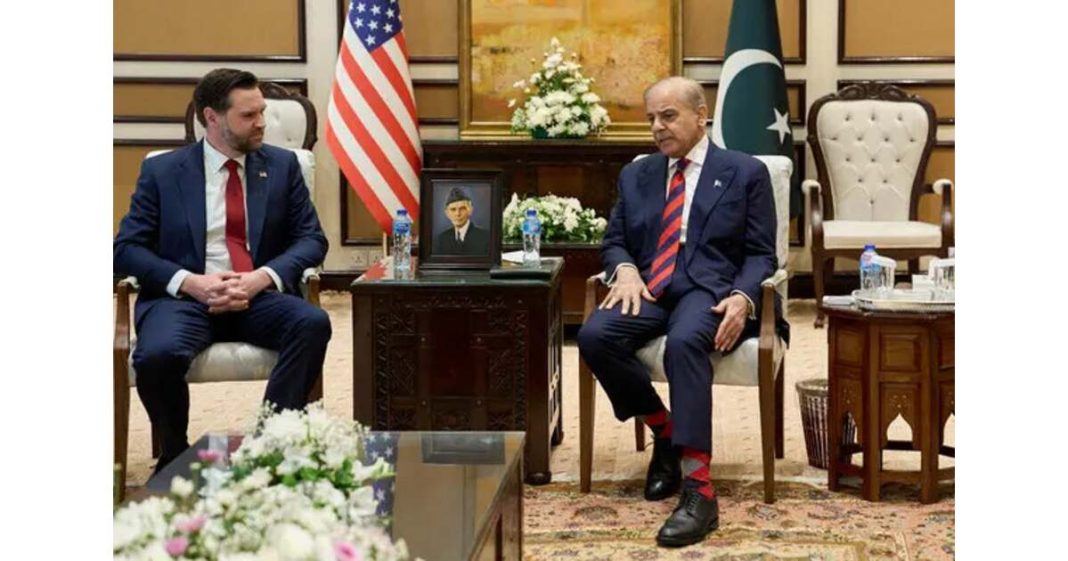
In the early hours of Sunday, April 12, 2026, Vice President JD Vance left Islamabad after talks with Iran ended without a deal, saying he had put forward a “final and best offer” (AP). The world had been watching. And for a moment, it had reason to hope.
As CBS News reported, the high-stakes talks in Pakistan ended after 21 hours — marking the most direct high-level engagement between American and Iranian leadership since President Barack Obama called newly elected Iranian President Hassan Rouhani in September 2013 to discuss Iran’s nuclear program. That is how extraordinary this moment was. And that is what makes its failure so deeply disappointing.
Vance was not an accidental choice for this mission. As Al Jazeera noted, while deeply loyal to President Trump, Vance is viewed as less hawkish than many of the administration’s other top officials — a former Marine who has become representative of the anti-interventionist wing of the MAGA movement. Crucially, the Iranians had expressed their preference for dealing with Vance specifically, believing he was genuinely invested in reaching an agreement. When Iran asks for a specific negotiator by name, that is a signal worth taking seriously. It should have been seized upon.
The Hormuz Impasse
At the heart of the deadlock lies the Strait of Hormuz — one of the world’s most critical arteries. As CBS News reported, the strait normally accommodates roughly 20% of the world’s oil and liquefied natural gas supply, and global oil prices that traded between $65 and $73 per barrel just before the war began on February 28 had climbed to above $95 by the time talks commenced. Every day the strait stays effectively closed, ordinary people around the world pay the price at the pump, in heating bills, and in the cost of goods.
Iran’s position has been firm. According to the New York Times, senior Iranian officials indicated the Islamic Republic would impose roughly a $2 million toll on every container ship passing through the reopened waterway — compared to the more than 130 ships that crossed daily before the war. Meanwhile, as PBS reported, Saudi Arabia welcomed the ceasefire deal but called explicitly for keeping the Strait of Hormuz open “without any restrictions,” with Gulf countries having shut down approximately 12 million barrels per day in crude production because there is no viable alternative route for much of their oil. The UAE, Bahrain, Kuwait, Iraq — none of them want a tollbooth on the waterway that is their economic lifeline. This is not just an American concern. It is a regional one shared by virtually every nation whose economy depends on stable energy supplies.
The Joint Venture That Could Change Everything
Here is where it gets genuinely interesting — and where the opportunity for a deal still flickers. As ABC News reported, President Trump said on Wednesday that the United States is considering forming a “joint venture” with Iran to manage and secure the Strait of Hormuz. “We’re thinking of doing it as a joint venture. It’s a way of securing it — also securing it from lots of other people,” Trump said. “It’s a beautiful thing.”
This is a significant and underappreciated shift in approach. Rather than a pure standoff, the joint venture concept represents a forward-looking framework — one rooted in shared economic interest and long-term regional stability. Iran gets a legitimate role and revenue stream to fund reconstruction. The world gets restored oil flows. The broader region gets a framework built on prosperity rather than conflict.
The Financial Times broke this story further, reporting that Hamid Hosseini, a spokesperson for Iran’s Oil, Gas and Petrochemical Products Exporters’ Union, confirmed Iran’s intent to charge tolls equivalent to $1 per barrel of oil, paid in cryptocurrency. But President Trump’s joint venture concept goes beyond Iran acting unilaterally — it envisions both nations as partners in managing the waterway. That is a fundamentally different and more promising proposition.
If this proposal is sincere, it may be the most creative diplomatic opening to emerge from this entire crisis. Iran’s desire to rebuild after a devastating conflict is real and legitimate. A joint mechanism that channels revenue toward reconstruction — while preserving international navigation rights — could satisfy both sides on terms that are good for the region and good for the global economy.
The Cost of a Stalled Negotiation
Vance told reporters in Islamabad, according to Fox News, “We just could not get to a situation where the Iranians were willing to accept our terms. I think that we were quite flexible. We were quite accommodating.” He left behind what he called a final offer. The Iranians, for their part, stated through Iranian state broadcasting that “excessive demands by America prevented any agreement.” As is always the case in diplomacy, each side sees itself as the reasonable party.
But here is what neither side can afford to ignore. As NBC News reported, the war has killed thousands of people and shaken global markets across its seven weeks of conflict. According to Time magazine, the effective closure of the strait has sent oil prices above $100 per barrel and threatens to cripple economies across the developing world that depend on affordable Middle Eastern energy. The longer this continues, the heavier the burden falls — not on governments, but on ordinary citizens from the Persian Gulf to Southeast Asia to Europe.
As Hot Air noted citing multiple sources, with Vance now departed, Iran’s delegation must continue dealing with the remaining American team — while the most peace-oriented voice on the U.S. side has left Islamabad. That reality alone should concentrate minds in Tehran. Meanwhile, U.S. Central Command confirmed that American naval destroyers have already begun mine-clearing operations in the strait, a signal that Washington remains serious about restoring free navigation.
Read more: US, Iranian teams could return to Islamabad for peace talks this week, four sources
A Path Forward Built on Prosperity
This article carries no illusions about the complexity of what is being negotiated. The nuclear question is real, the distrust is deep, and the domestic pressures on both governments are immense. Iran’s supreme leader, in a public message this week, said his country “will not withdraw from our rightful rights.” President Trump has been equally firm that Iran will not acquire a nuclear weapon on his watch. These are not small gaps to bridge.
But the joint Hormuz management concept — precisely because it reframes the conversation from confrontation to shared economic benefit — offers a path that serves everyone’s interests. The Gulf states get their shipping lanes back. Iran gets reconstruction revenue and international legitimacy. The global economy gets stability. And the region gets the one thing it has been denied for months: a foundation for lasting peace built on mutual gain rather than mutual suspicion.
JD Vance went to Islamabad because he believed that outcome was possible. He spent 21 hours at the table trying to achieve it. The offer he left behind deserves serious consideration.
The table in Islamabad is still there. The joint venture idea is still on the table. And the benefits of saying yes — for Iran, for the region, and for the world — are too significant to be set aside. This is the moment for statesmanship. Both sides should take it.
Shahbaz Gill, PhD, is a political analyst and former professor at the University of Illinois Urbana-Champaign. He previously served as Chief of Staff and spokesperson to former Prime Minister of Pakistan Mr. Imran Khan.
The views expressed in this article are solely those of the author and may not necessarily reflect the position or editorial policy of the publication.