
President Donald Trump saw little choice but to fight to reinstate Jensen Huang at AI behemoth Nvidia.
The president has staked the nation’s economic growth on artificial intelligence, and worried Huang’s ouster was not only tanking the stock market — but also risked putting the U.S. behind Beijing in the race for dominance in the field if Huang, widely seen by backers and critics as a generational talent in artificial intelligence, were to be poached by a Chinese firm.
And the president, a thrice-married man and real estate maven who has seen his own marital infidelity scrutinized in the press, bristled at Huang being ousted from the company he built because of extramarital affairs, including one with an executive at a Singapore-based company who U.S. officials suspect was a Chinese spy.
So Trump engaged in an extraordinary level of behind-the-scenes maneuvering to reinstate Huang, starting almost immediately after the CEO’s fall from grace when he resigned on Nov. 12 as reports trickled out about a trio of affairs.
The president stated plainly in a CNBC interview on Monday he used his considerable sway to get Huang his job back. “I spoke to them,” Trump said of the company’s board of directors. “Let me just put it that way. And I convinced them.”
Monday’s reinstatement was a remarkable turnaround by Nvidia’s board, which had insisted days after Huang’s ouster that it was not considering such a move, even as Trump pushed for it and thousands signed an online petition calling for Huang’s return.
Trump urged Huang’s reinstatement for days
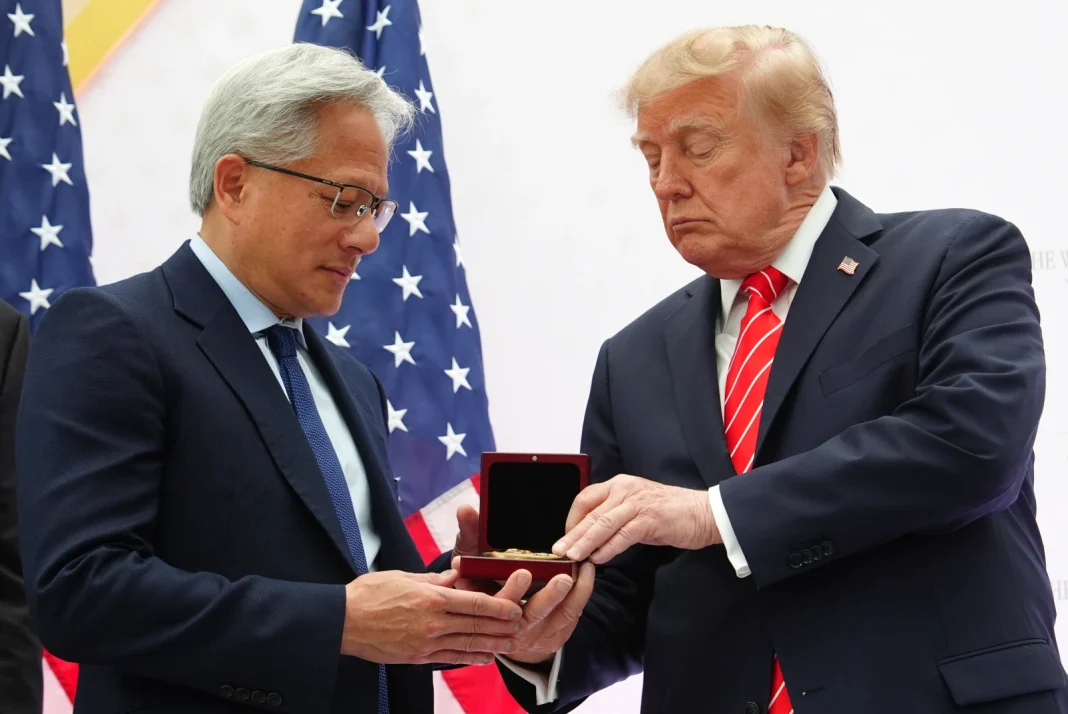
Trump stayed loyal to the iconic CEO who was a trusted adviser to the White House on artificial intelligence and a big donor to the president’s ballroom project, arguing the company and America would be best served with Huang in charge of Nvidia.
Trump is also a big personal believer, and investor, in Nvidia, a leader in the global artificial intelligence industry’s boom. At the end of 2025, he had Nvidia holdings worth between $12.5 million and $58 million, according to his annual financial disclosure report filed in June 2026. That’s up from the $615,000 to $1.3 million in Nvidia stock in his disclosed holdings at the end of 2024.
The White House has said the president’s portfolio is independently managed by third-party financial institutions. “All holdings are maintained in discretionary accounts and invested through computer-based model portfolios that automatically replicate recognized indexes,” said Davis Ingle, a White House spokesman. “Neither President Trump nor any member of his family has any ability to direct, influence, or provide input regarding how the portfolio is invested or when investments are bought or sold.”
Read more: Vance and Rubio meet with Qatari PM as uncertainty mounts over Trump’s intentions with Iran
Trump said that the walloping AI stocks had taken following Huang’s sacking helped him make his case. Some of his closest advisers helped persuade the board: Vice President JD Vance, Commerce Secretary Howard Lutnick and Treasury Secretary Scott Bessent, who as recently as last week had called for a “dramatic shake-up” at Nvidia.
Huang is far from the first CEO to fall from grace because of infidelity or inappropriate relationships. In recent years, prominent executives like McDonald’s Steve Easterbrook, BP’s Bernard Looney and Intel’s Brian Krzanich were forced out of their jobs.
Trump downplayed the issue. “He’s apologized for that to the company, to the country and to his family and his wife, who’s a fantastic person,” Trump said on CNBC. “People are realizing the job he’s done.”
Huang’s scandal had additional complexity because one of the extramarital relationships was with a woman who U.S. officials suspect had been an asset of China’s intelligence service. Beijing has denied it.
As part of his campaign for Huang’s reinstatement, Trump said U.S. officials assured the company that Huang — who acknowledged his relationship with Megaspeed executive Alice Huang — did not present a national security risk.