About ten years ago, I made a bet with a friend. He is one of the most reasonable men I know: generous in argument, intellectually honest, and, like most of us at the time, utterly convinced that Chinese products were junk.
He was a good-natured snob about it, almost charming in his contempt.
I told him he was wrong. I told him that even then, in 2015, a significant share of the iPhone—the great totem of Western quality and Californian creativity—was being machined, assembled, and increasingly engineered by Chinese hands inside Chinese factories. If Apple was the gold standard, I said, then Chinese workmanship was already part of that gold standard.
Read more: An ‘influencer’ degree? Colleges bet on content creator major as critics question its value
He laughed and pointed at the cars.
“Look at their cars,” he said.
I conceded that Chinese cars were not yet Toyotas. But they were already decent, and more importantly, the country had begun an unmistakable pivot toward electric vehicles.
“Wait,” I told him. “Give it a decade.”
A decade is up.
The West Still Underestimates Chinese Cars
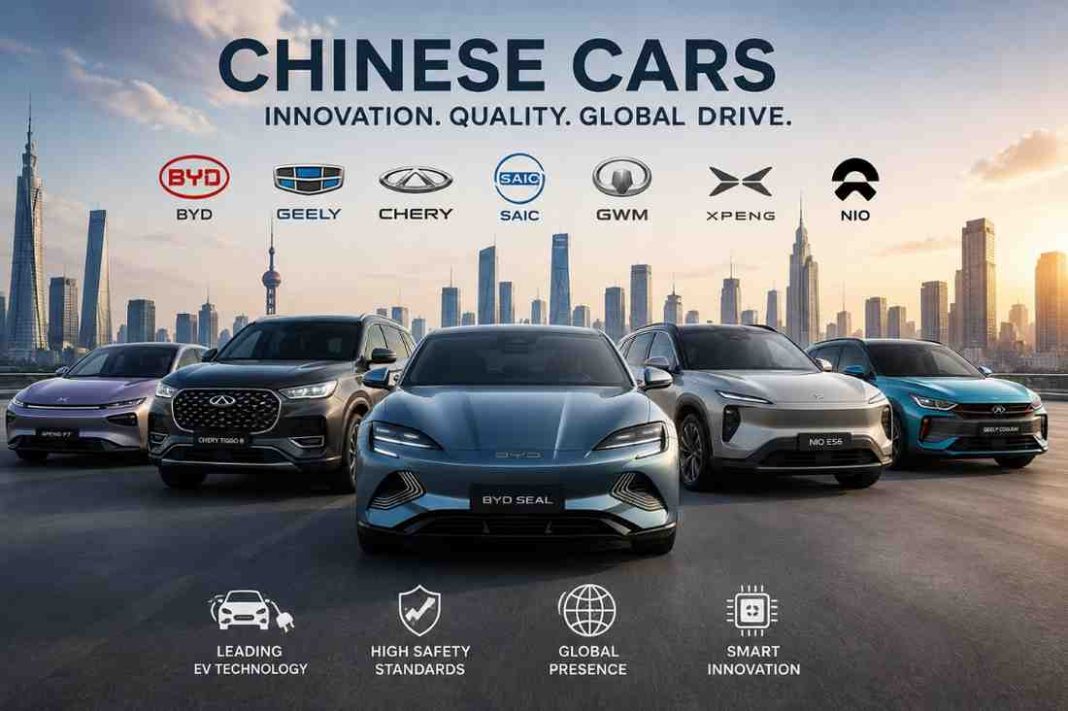
In 2025, BYD sold roughly 2.26 million battery-electric vehicles globally and became the world’s top-selling EV brand for the first time. Tesla, the company that defined the category and convinced a generation that the future was electric, sold about 1.64 million, down from the year before.
BYD alone now commands around a fifth of the global EV market. Geely is growing at more than 80 percent year on year. Xiaomi, a phone company until five minutes ago, has cracked the global top ten of carmakers.
Read more: Pentagon watchdog sounds alarm over condition of US bases in Pacific
Chinese brands are opening factories in Hungary, Brazil, and Thailand while Volkswagen lays off German workers and shuts plants in Wolfsburg. The European Union, faced with a product its own industry could not match, has done what declining empires always do when confronted with superior competition: it has raised tariffs of 17 to 38 percent.
The United States, more efficient in its protectionism, has simply banned Chinese EVs from retail sale altogether.
I would like to go back to my friend and tell him he lost the bet. He will accept it gracefully, because he is that kind of man.
But the conversation I want to have now is bigger than one bet between two friends in a country far from Detroit, Wolfsburg, or Shenzhen. Because the way the West is talking about Chinese cars in 2026 is the same way my friend talked about them in 2015—and it is wrong in exactly the same way, only with higher stakes and worse faith.
I always write with a partially Pakistani perspective, which is to say from the Global South, from that part of the world that buys cars rather than turns them into geopolitical theatre.
From here, the Western framing of Chinese EVs looks not just wrong but actively dishonest. It is a tangle of three arguments that fall apart the moment you press on them, wrapped around a fourth argument that is legitimate but rarely stated plainly.
Quality, Subsidies and Privacy: The Arguments Fall Apart
The first dishonest argument is about quality.
“Chinese cars are still cheap junk,” the line goes.
This was a defensible claim in 2005. It is laughable in 2026.
Sandy Munro, the Detroit veteran who tears down cars for a living and has no obvious incentive to flatter Beijing, has called the BYD Seal better engineered than vehicles costing twice as much.
Vertical integration—BYD makes its own batteries, semiconductors, motors, and increasingly its own chips—gives Chinese manufacturers a quality-control advantage that Western legacy brands, dependent on sprawling networks of suppliers, cannot easily replicate.
Build quality is inspectable today by anyone who can open a hood. Long-term reliability is unknown, but it is unknown for every EV, including Tesla, whose reputation for panel gaps and software failures is well documented.
The second dishonest argument is about subsidies.
“They only win because Beijing pays for it.”
Yes. And?
The Economist itself has pointed out the obvious: when a foreign government subsidizes a product you buy, that government is transferring wealth to you.
A Pakistani family buying a subsidized BYD is, in effect, having the Chinese state pay part of their car.
The correct response is “thank you,” not “unfair.”
Tesla took roughly $3 billion in US subsidies on its way up, and no one called it a fraud. Airbus, Boeing, the CHIPS Act, Korean shipbuilding, and virtually every European automaker have benefited from state support in one form or another.
Modern strategic industries are built on subsidy.
Pretending otherwise is the wilful naivety of people who have run out of better arguments.
The third dishonest argument is about privacy.
“Chinese cars will spy on you.”
From Karachi, this is the funniest argument of the lot.
The country that ran PRISM, that taps undersea cables, that surveils its own citizens through three-letter agencies most Americans cannot name, has decided that the real threat to your data is a Shenzhen sedan.
And here is the deeper point—the one that should give even American readers pause: your own government can be a far greater danger to you than a foreign one.
Beijing cannot put an Ohio plumber on a no-fly list. Beijing cannot subpoena his bank records, share his data with his employer, or feed it into a domestic predictive-policing algorithm.
Washington can.
Surveillance is dangerous in proportion to the surveillor’s power over your daily life. By that measure, the Chinese state holding your driving data is, for almost everyone, a curiosity.
The American state holding it is a cage.
Industrial Sovereignty: The Argument the West Won’t Say Out Loud
Quality, subsidy, and privacy are arguments, but they are also alibis.
And the thing they are providing an alibi for is the fourth argument—the legitimate one that no Western politician seems willing to say out loud:
Industrial sovereignty
We do not want to depend on China for our cars, just as China does not want to depend on the Middle East for its oil.
That is a serious concern. It is, in fact, the only serious concern in the entire debate.
A country that loses its automotive base loses millions of jobs, decades of accumulated engineering know-how, and a strategic industry it may need in wartime.
Protecting that is, well, protectionism. But it is also statecraft.
Say it plainly:
We are raising tariffs because we need time to rebuild our industry, and we are willing to make our citizens pay more for worse cars in the meantime.
That is an honest argument.
I can respect an honest argument.
What I cannot respect is dressing up protectionism in the clothes of consumer protection; manufacturing quality concerns that do not exist; conjuring privacy boogeymen that any serious threat model dispels; and, when all else fails, making the quiet appeal to a racialized intuition that Chinese things must be inferior because they are Chinese.
That last appeal is the ugliest, and the most persistent.
It deserves to be named.
It is bigotry, and it is making Western consumers poorer while allowing Western industry to sleep through its own decline.
I am unabashedly on the side of the consumer, wherever that consumer lives.
The American buyer deserves a good, cheap EV as much as the Pakistani buyer does. The German engineer deserves a state that pushes him to compete rather than one that hides him behind a tariff wall. And the Chinese worker, whatever we think of his government, deserves credit for what he has built.
None of this requires us to admire the Chinese Communist Party.
It only requires us to be honest.
Over the next four weeks, I want to take each of these arguments apart properly.
Next: why China bet on EVs a decade before anyone else—and why it had almost nothing to do with climate change.
My friend, if you are reading this:
Yes, you lost.
Tea is on me.