Grief, Numbness, and the Asymmetry of Risk
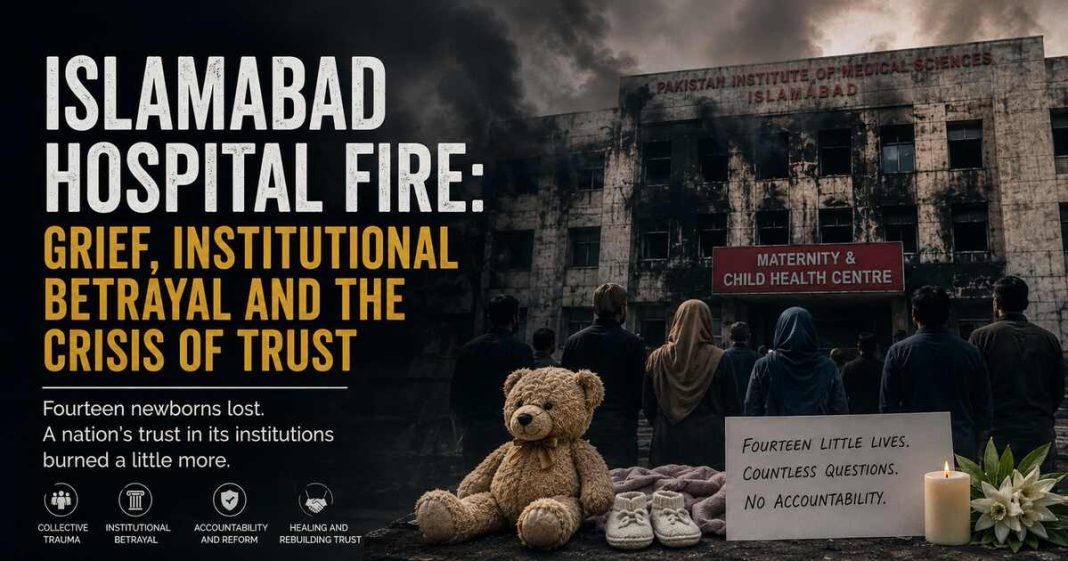
On August 26, 2026, a fire tore through the nursery of Pakistan’s largest government hospital, in the capital, Islamabad, killing at least fourteen newborns. Grief like this hits instantly and viscerally — for each family, an irreplaceable loss. But underneath that is a second, quieter grief: grief for a system you never expected to protect you in the first place. Low expectations should make failure easier to bear — you braced for it, you already knew — but they don’t. If anything it is more painful, because it only confirms what you had long since stopped hoping would be otherwise. Multiply that across a whole public and you get something close to what psychologists call psychic numbing: a diminished capacity to feel, built not from indifference but from disaster after disaster with no one ever held accountable. It is a survival mechanism — you cannot carry full grief for every failure and still function — but it does not make the underlying fact easier to live with: the institutions meant to protect the most vulnerable cannot be trusted to do so, while the people who preside over those institutions are rarely exposed to their own failures. That asymmetry, who bears the risk and who is shielded from it, is what turns a tragedy into a trauma, and a trauma into a wound that does not heal on its own.
What Makes Trauma Collective
That numbness is itself a clue to what kind of wound this is. Psychologists distinguish collective trauma from individual trauma by its target: it is not only bodies that are hurt, but a group’s shared sense of safety and belonging. Kai Erikson called it a “blow to the tissues of social life.” Judith Herman’s trauma theory adds that recovery depends on restoring safety and a coherent, validated narrative of events. When that narrative itself becomes contested — when no one agrees on who is responsible — the injury does not resolve; it compounds.
The Betrayal Inside the System
That compounding has a name that fits this asymmetry precisely. Psychologist Jennifer Freyd coined the term institutional betrayal for harm an institution inflicts, or allows, on people who depended on it and had no real way to opt out. A middle-class or poor family cannot simply choose a different public hospital system. Betrayal trauma theory explains why this cuts deeper than ordinary negligence — the harm comes from the very structure a person was relying on for protection.
Read more:What El-Sayed’s Win Means for Muslim America — and for the Pakistani American Diaspora
The Psychological Fallout
That isolation does not stay confined to how citizens see their rulers; it radiates into how the whole event is processed afterward. the failure traces back to a government that lacked legitimacy to begin with, staffed by officials placed there to serve the interests of the ruling elite rather than the public they nominally serve. Additionally, it produces moral injury in those who work inside these institutions in good faith and watch them fail anyway, and disenfranchised grief, since the party responsible for a loss is diffuse — a system, a policy, an absence — leaving no single figure to confront for closure. And it fractures the collective narrative of the society itself: when elite exit and exposed ordinary sit side by side, a community loses the shared story it needs to process events together, rather than in isolated, competing versions.
What Healing Requires
Healing from institutional betrayal and moral injury cannot rest on individual resilience alone; it requires what Freyd calls institutional courage — proactive transparency, accountability that precedes public pressure, and structural change rather than statements. It is close to the opposite of what has followed this fire so far.
Belonging as the Other Half of Healing
But policy alone rarely closes a wound like this. The Quran describes Prophets of the Abrahamic tradition as coming from among their own people, sent as “their brother” rather than as an outsider — a proximity to suffering that let them speak for a community rather than above it. Its counterexample is Fir’awn, mentioned as surrounded by “the elite of the city” — his council of chiefs, or Al-Mala’ (الْمَلَأُ).
You do not have to be poor to feel the pain of the poor, but for that empathy to register as real, it has usually needed to be demonstrated, not asserted. History has figures like this. Franklin Roosevelt was accused of being “a traitor to his class” by fellow patricians when the New Deal curbed the same financial elite he came from. It is part of why Imran Khan keeps entering conversations he is not formally part of: he has remained inside the institutional oppression most of the elite avoid, and for many he has come to symbolize the leader who has not opted out, even though — unlike them — he has a choice to leave.
The Test That Remains
Whether or not that symbol survives the political battles around him, the underlying challenge is institutional, not personal. The fourteen infants who died in Islamabad were failed once, by fire. A public unable to trust the account of how and why is failed a second time, more slowly — an injury that will not heal until the institutions responsible for both events choose exposure over exit, and truth over the confusion.
Zoobia W. Chaudhry is a Baltimore-based physician, human rights advocate, and Communications Director at First Pakistan Global (FPG). She has been actively engaged in advocacy related to Palestine and Pakistan. The views expressed in this article are solely those of the author and do not necessarily reflect the views of FPG.
The views expressed in this article are solely those of the author and do not necessarily reflect the views of global village space