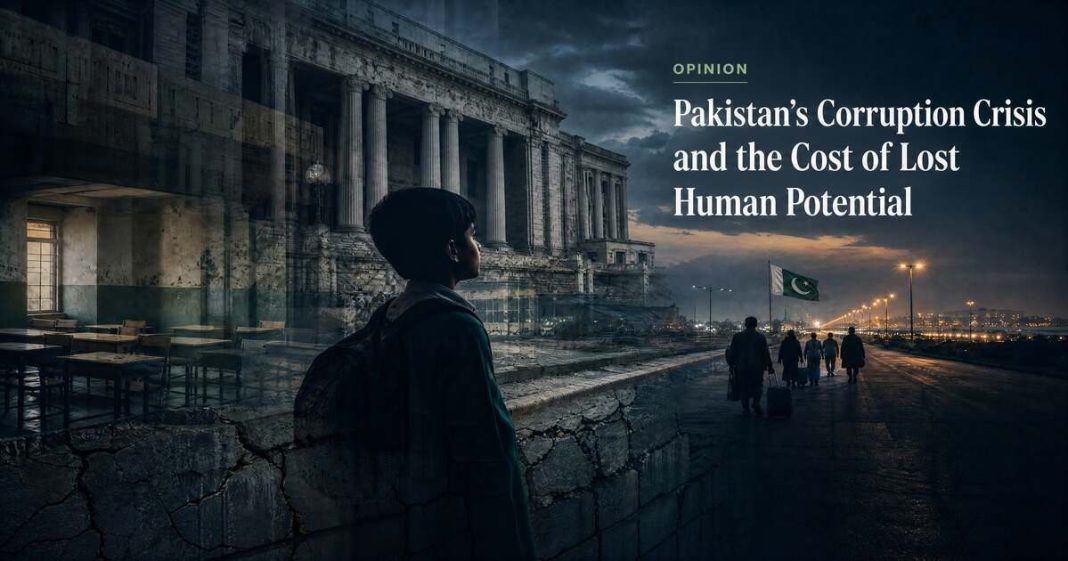
For too long, Pakistan’s corruption discourse is treated as a moral nuisance or as the theft of public money rather than an economic and institutional problem. In our news consumption and family and friends’ gatherings, we spend hours discussing inflation, rupee devaluation, elections, political personalities or why a particular government is failing to deliver.
What constitutes National Wealth
Consider a few numbers. Pakistan’s current GDP per capita is about $1,596. The United Nations Development Programme places Pakistan in the low human-development category, with an HDI of 0.540 and a global rank of 164 in its 2023/24 report. The World Bank puts Pakistan’s Human Capital Index at 0.41, meaning that a child born today is expected to achieve only 41 percent of the productivity that they could attain with complete education and full health. Around 40 percent of children under five suffer from stunted growth. UNICEF estimates that 25.1 million children between the ages of five and sixteen are out of school.
It’s easy to consume these numbers without context or to simply brush them aside as meaningless information. In reality these are the metrics and performance indicators depicting how a country is actually performing as a system for turning human potential into productive lives.
Yet the curious thing is how little emotional or political urgency they provoke among those of us who are educated, professionally successful and, in many cases, insulated from the worst failures of the state. These metrics and performance indicators tell us how much capability a nation is accumulating in its people.
A nation’s wealth is ultimately not the buildings in its cities, the size of its stock market, the number of its millionaires, or even the aggregate value of what it produces in a particular year. While these aspects matter, but they sit on top of a deeper foundation: the health, education, skills, productivity, confidence and institutional capacity of its people.
Amartya Sen’s great contribution to development economics was to insist that development must be understood in terms of the substantive capabilities and freedoms people possess and what they are actually able to become and do.
The Deeper & Generational Cost Imposed by Corruption
Corruption in Pakistan is often discussed as though it were a collection of individual moral failures: a politician takes a kickback; a government contract is inflated; a policeman takes a bribe; a bureaucrat demands a payment to do what his job already requires him to do. In reality, corruption instills a system where meritocracy is compromised, the competencies of the institutions and individuals working within them are systemically destroyed up to a point where it becomes a source of permanent extraction.
Once extraction becomes entrenched, people adapt to such dysfunctions. Society may be able to identify such dysfunctions but also becomes tolerant of such dysfunctions.
Read more:The Psychology of Collective Trauma and Institutional Betrayal in Pakistan
The role of government is to establish the rule of law, protect property and contracts, enforce fair competition, provide basic public goods, invest in human capital, maintain reliable infrastructure, create predictable regulation and ensure that public resources are allocated toward public purposes. These are the architectural components of value creation and establish capabilities of a nation.
The Growth of a nation is an outcome of the capabilities that a nation possesses and exhibits, therefore the capabilities act like a foundation. Corruption that accentuates extraction progressively weakens the institutional capabilities and the human capital and discourages the investment as the investors do not find it feasible to invest in an environment where fundamental foundation is weak.
What decades of corruption, gerrymandering and lack of accountability has done is that it has damaged the fabric, competence and capabilities of its institutions which eventually leads to institutional hollowing. In such cases, the skeleton of a modern state exists, while deprived of capability and competence. Ministries remain, regulations exist, Courts exists without offering justice. Public agencies continue to produce reports. Yet the gap widens between the formal existence of an institution and its ability to deliver the function for which it exists.
There comes a points when the consequences of all these events compound where opportunities for productive value creation become narrower, the institutions begin to hollow out. Those that can compensate privately do so, while the quality of public systems deteriorates further.
Henceforth, comes a time when exit becomes rational and those with skills, resources and mobility leave, often taking precisely the capabilities the country most needs and this leads to a situation where a country finds itself offering one of its principal remaining economic advantages to the world at the lowest end of the value chain: inexpensive labor.
The official Bureau of Emigration and Overseas Employment says that more than 760,00 Pakistanis proceeded abroad for employment in 2025. Remittances, meanwhile, were equivalent to about 9.4 percent of GDP in 2025, according to the World Bank. These metrics have often been celebrated by the incumbent ruling forces. While migration cannot be deemed inherently as a national failure and people exercise the choice and freedom to move, and a successful diaspora can be an enormous asset. But there is a difference between mobility as a choice and mobility as an escape route from a system that cannot offer sufficient opportunity at home.
Economic Migrations and Impact on Families & National Growth
When large numbers of educated and ambitious people conclude that their best chance of converting effort into a better life lies outside the country, the country loses resources that can help to establish national capabilities.
Such forced migrations have slapped a silent cost to the families in Pakistan where families are becoming disjointed, the old parents are being left behind as the disposal of other siblings or care providers. Those in middle age are unable to live their life with their parents and often children grow up with one parent abroad. While Pakistan receives remittances, but the deeper question is whether it is developing a domestic economic system capable of retaining and multiplying the capabilities of its people.
That question should concern the Pakistani professionals living comfortably in Dubai, London, Toronto, Melbourne or New York it should concern a family living in a village with no functional school. The overseas Pakistani may have escaped the immediate consequences of institutional weakness. But the existence of a diaspora of this scale is also evidence of a country that has not been able to provide sufficient opportunities for all its citizens.
A country of more than 250 million people cannot build a durable prosperity strategy around exporting people because it could not create enough productive opportunities for them at home. Nor can it mistake remittances for a substitute for domestic value creation. Remittances can stabilize households and foreign exchange. They do not by themselves build institutions, productivity or innovation.
This is the real cost of corruption that matures into extraction and of extraction becomes institutionalized. We often worry that Pakistan will become poorer in some global rankings when the real problem is that Pakistan will become increasingly unable to convert the extraordinary human potential of its population into higher productivity lives.
What do we aspire for as a Pakistani Nation
There is a dire need to have conversations among Pakistanis, within families and friend circles, about what kind of Pakistan do we want to see because prosperity, growth and success are outcomes of a strong value system that a nation holds and believes in. Institutions are built around those values. If we as individuals or as a society value merit, then we must build institutions that reward competence. If we value dignity, then we must ensure and demand that opportunity is not determined by privilege or connections. If we desire prosperity, then we must create conditions in which people can create value rather than merely competing for access to rents. If we as a society believe in justice, then we must be prepared to insist on the rule of law even when its application is inconvenient to us personally.
If we do not aspire to a Pakistan defined by inclusivity, rule of law, empathy, merit, accountability and opportunity, we should not be surprised when our institutions continue to reward extraction over creation, access over ability and individual survival over collective progress.
Muneeb Imran’s work is related to data privacy, cybersecurity and AI governance. He is the author of a book on Data Privacy which argues that protection of personal data is central to safeguard human dignity. He writes on technology, law and public policy, with a longstanding interest in history and the social sciences and public policy.
The views expressed in this article are solely those of the author and do not necessarily reflect the views of global village space