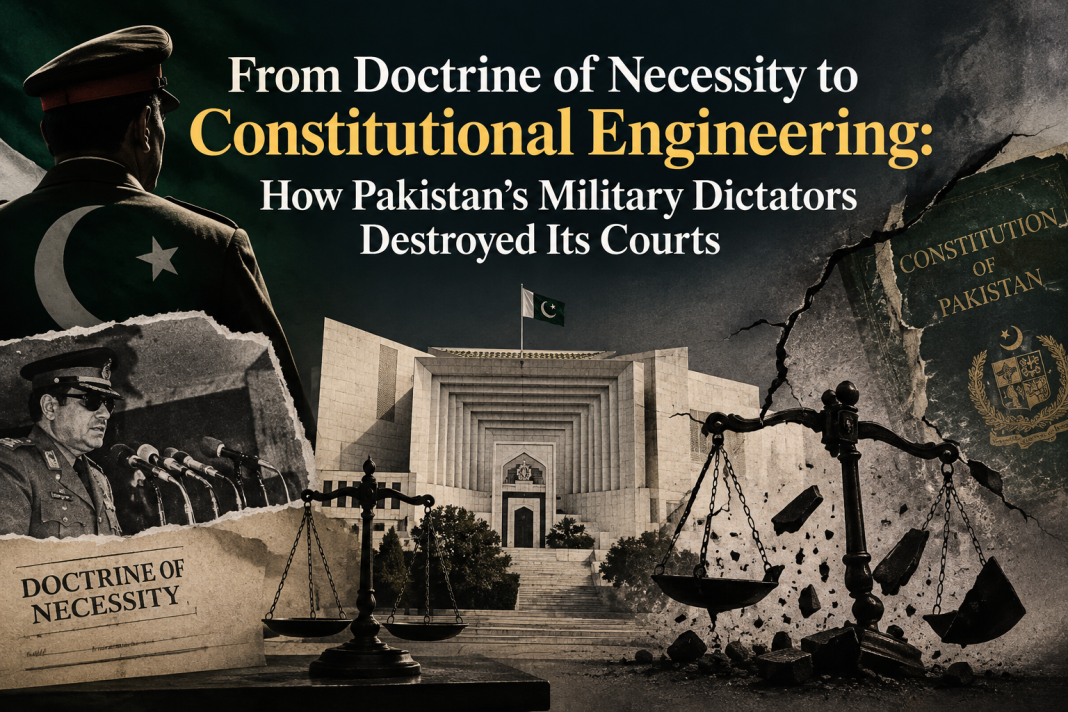
From a 1958 ruling that blessed a coup after the fact to a 2025 amendment that pre-clears the next one, Pakistan’s courts haven’t resisted military power — they’ve been steadily destroyed to make resisting it impossible. This is the record of how that happened, and how the same pattern is playing out again right now.
Pakistan’s judiciary has finally been conquered by its military. It has always been part of the country’s governing elite ecosystem, and for most of the country’s history it volunteered to give cover to the military’s misadventures. But in recent years it has become one of the tools in the arsenal the military unleashes on its own citizens — from trying civilians in military courts, to postponing elections, to efforts to ban political parties and harass and suppress dissent even outside Pakistan.
The Permission Slip Era (1958–2000)
Pakistan’s military has a long record of getting its way with the judiciary. In October 1958, six days after Ayub Khan’s coup, Chief Justice Muhammad Munir used an unrelated case, State v. Dosso, to bless it anyway — ruling that an unresisted seizure of power creates its own legitimacy. The resulting phrase, the “doctrine of necessity,” became Pakistani law’s most durable euphemism.
The pattern repeated in 1977, when the Court validated Zia-ul-Haq’s coup in Nusrat Bhutto v. Chief of Army Staff, and again in 2000, when Zafar Ali Shah v. General Pervez Musharraf validated Musharraf’s takeover and handed him power to amend the constitution for three years. Three coups, three courts, three rulings that turned a general’s ambition into constitutional fact after the fact — the judiciary as an emergency notary, called in after the tanks had rolled to stamp the outcome legal.
Read more: The Psychology of Collective Trauma and Institutional Betrayal in Pakistan
The Interruption That Wasn’t (2007–2009)
Then, briefly, something seemed to change. When Musharraf dismissed Chief Justice Iftikhar Chaudhry in 2007 and, months later, imposed a Provisional Constitutional Order (PCO) demanding a fresh loyalty oath from every judge, roughly a hundred judges refused it and were placed under house arrest. Lawyers took to the streets in black coats. It became the Lawyers’ Movement, and in July 2009 a restored Supreme Court did something almost unrecognizable by the standards of 1958, 1977, or 2000: it declared Musharraf’s emergency unconstitutional, voided every judicial appointment made under it, and made the doctrine of necessity look, for the first time, like it might actually have limits. Later we learned that this “revolution” that had military establishment fingerprints on it — Musharraf’s own successor, Ashfaq Parvez Kayani, calculated that letting the movement win and easing Musharraf out served the military’s institutional interests better than protecting him.
Judicial Activism (2010-2022)
The years that followed were years of judicial activism. In December 2009, the same restored Court struck down the National Reconciliation Ordinance shielding President Zardari and dozens of politicians from corruption cases, declaring it void from signing — though to date no politician has been convicted as a result. In 2012 it finally ruled on the long-dormant Asghar Khan case, holding that the ISI itself had funneled money to a political alliance in 1990 to keep Benazir Bhutto’s party from power — a verdict that named names inside the military and then sat unenforced for years, with no one prosecuted.
It gave the impression of a more assertive judiciary — one that disqualified a sitting prime minister, Yousaf Raza Gilani, for contempt in 2012, and helped remove Nawaz Sharif in 2017 over undisclosed income in the Panama Papers case. Critics at the time called it independence. In hindsight, the pattern looks less like coincidence — an emboldened Court kept landing, with uncanny regularity, on the outcome the military establishment preferred. Independence and alignment, it turned out, were not mutually exclusive.
The Destruction Blueprint (2022–to date)
What has happened since 2022 is a third model, and it is in some ways more ruthless and thus more insidious than either of the first two, because it no longer waits for a confrontation to happen before winning it. It now uses court decisions as a tool to further its ambition to control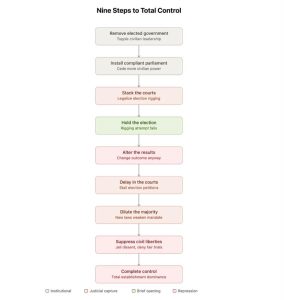
overpower, and brutalize its own citizens. A few examples are:
* Feb 2023 — After provincial assemblies were dissolved, the 90-day election order is left to expire unenforced.
* April 2023 — The Supreme Court (Practice and Procedure) Act strips the Chief Justice of his own power to form benches. This was only possible after the former Prime Minister’s government was toppled and a new coalition government was formed.
* January 2024 — Days before the 2024 general election, the Supreme Court under new Chief Justice Qazi Faez Isa reverses the Peshawar High Court and upholds the Election Commission’s decision stripping largest political party – PTI of its “bat” symbol, forcing the party’s candidates to contest as independents.
o Despite putting all the state’s power behind the candidates backed by the military elite, it lost the election.
* March 2024 — Six Islamabad High Court judges write to the Supreme Judicial Council alleging that intelligence operatives pressured them through surveillance and through the abduction and torture of their relatives. A proposed inquiry commission’s chairman quietly withdraws; threatening letters laced with powder are sent to all eight IHC judges weeks later.
* October 2024 — After the reserved-seats case goes against the government, the 26th Constitutional Amendment carves constitutional cases out of the ordinary Supreme Court’s hands and into a new Constitutional Bench, built through parliamentary appointments process the executive controls.
* February 2025 — Judges are transferred into the IHC in ways that scramble seniority just as a Chief Justice selection loom.
* May 2025 — That bench delivers as designed, reversing by 5–2 the Court’s own 2023 ruling against trying civilians in military courts.
* November 2025 — The 27th Constitutional Amendment creates a Federal Constitutional Court to take over what remains of the Supreme Court’s constitutional jurisdiction — and, in the same document, grants the president and the army chief lifetime immunity, while making General Asim Munir Chief of Defense Forces with expanded, effectively permanent authority.
* July, 2025 – At the request of the newly created National Cyber Crime Investigation Agency, an Islamabad court ordered 27 YouTube channels blocked under PECA for allegedly spreading “anti-Pakistan” content — among them channels belonging to exiled journalists like Moeed Pirzada and Imran Riaz Khan. Rights groups called it transnational repression: an attempt to reach critics who had already fled the country, using a legal order aimed at a platform with global reach.
The 27th Amendment means the military no longer needs a court to legalize power after the fact — it pre-clears the arrangement and insulates the men at the top for good. Two Supreme Court judges, Mansoor Ali Shah and Athar Minallah, resigned rather than sit on a bench they no longer believed could function — Shah writing plainly that he could no longer “protect the Constitution” under a system built to “manufacture a constitutional court of their own choosing.”
A Live Case Study
The reason to look at history is to recognize patterns — and this one is unfolding in real time. On August 18, 2026, the Supreme Court ordered Imran Khan moved from Adiala Jail to Shifa International Hospital within two days over serious health concerns, with a medical board including his sister and physician — but barred the family from disclosing his condition to the media until the next hearing, a gag dressed as procedure. Authorities defied the order within hours. When his sister filed a contempt petition on August 22, the registrar’s office returned it on procedural grounds days later; a hearing isn’t expected before mid-September.
That selective compliance — the executive following a court order only when it suits it and simply ignoring it when it doesn’t — is the pattern this piece has traced. Accountability depends entirely on whether the Court is ordered to hold the state in contempt.
Read against that pattern, the initial order looks less like humane relief and more like leverage: a seemingly compassionate ruling that gives the military something to trade — access, treatment, narrative control — in exchange for concessions from a man it still needs to negotiate a way out of the standoff with.
Zoobia W. Chaudhry is a Baltimore-based physician, human rights advocate, and Communications Director at First Pakistan Global (FPG). She has been actively engaged in advocacy related to Palestine and Pakistan. The views expressed in this article are solely those of the author and do not necessarily reflect the views of FPG.
The views expressed in this article are solely those of the author and do not necessarily reflect the views of global village space