
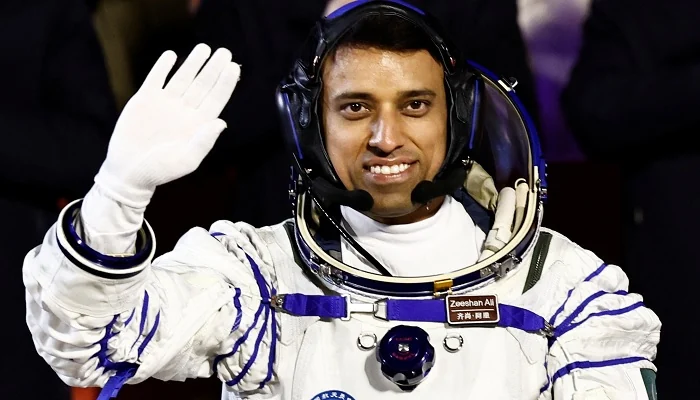
Pakistan has achieved a historic milestone in its space programme as its first astronaut, Muhammad Zeeshan Ali, arrived at China’s Tiangong space station aboard the Shenzhou-24 spacecraft on Wednesday, marking the country’s first participation in a crewed space mission.
According to the China Manned Space Agency (CMSA), the spacecraft successfully docked with the Tiangong space station at 11:56am Beijing time (8:56am Pakistan Standard Time), approximately three-and-a-half hours after taking off from the Jiuquan Satellite Launch Centre in northwestern China.
The #ShenzhouXXIV crew has entered the return capsule and is completing final checks ahead of liftoff.
Chinese astronauts Tang Hongbo, Wu Yi, and Pakistani astronaut Muhammad Zeeshan Ali are ready for their journey to orbit.
See you among the stars! ✨[📷/CMG] https://t.co/sVqts1m18K
— Chinese Space Station (@CNSpaceStation) November 24, 2026
The Shenzhou-24 spacecraft was launched at 8:18am Beijing time (5:18am Pakistan time) aboard a Long March-2F rocket from China’s Gobi Desert. Footage broadcast by Chinese state television showed the rocket lifting off amid flames and smoke under a pink morning sky.
The spacecraft separated successfully from its carrier rocket around 10 minutes after launch and entered orbit, CMSA confirmed, describing the launch as a “complete success”. The agency also reported that all three crew members were in good condition.
Ali is travelling alongside Chinese astronauts Tang Hongbo, who is commanding the mission, and Wu Yi, who is serving as the flight engineer. He is participating as a payload specialist, becoming the first Pakistani and the first foreign astronaut to visit China’s Tiangong space station.
Tomorrow, Pakistan will look to the skies with anticipation, pride and deep gratitude.
As Shenzhou-24 prepares to carry a Pakistani astronaut to China’s Tiangong Space Station, our nation stands on the threshold of a historic first. It is a moment that belongs to every Pakistani.
I pay tribute to SUPARCO, our academic institutions and the scientists whose contributions, alongside the efforts of our Armed Forces and national institutions, reflect Pakistan’s growing capabilities and our determination to reach new frontiers in space exploration and scientific advancement.
My deepest appreciation to President Xi Jinping whose visionary leadership and steadfast commitment to Pakistan-China friendship have taken our All-Weather Strategic Cooperative Partnership to unprecedented heights. This historic milestone is a powerful testament to the exceptional trust, mutual respect and enduring brotherhood that bind our two nations and peoples.
Our prayers and best wishes are with our astronaut and the entire crew as they make final preparations for a safe and successful mission.
Pakistan-China friendship is surpassing the heights of the Himalayas, in its journey to outer space.
🇵🇰🤝🇨🇳 #Shenzhou24
— Shehbaz Sharif (@CMShehbaz) November 24, 2026
Following their arrival, the Shenzhou-24 crew entered the space station, where they were welcomed by members of the Shenzhou-23 mission.
Pakistani astronaut to conduct scientific experiments
During his approximately one-week stay aboard Tiangong, Ali will participate in scientific research under the Pakistan-China space cooperation programme.
His responsibilities include installing experimental samples and research equipment and conducting scheduled scientific experiments.
The research programme includes four Pakistani biotechnology experiments selected by Chinese institutions from more than 300 proposals submitted to the Space and Upper Atmosphere Research Commission (SUPARCO) by universities across Pakistan.
According to details previously shared by SUPARCO officials with Reuters, the experiments focus on areas related to food security and climate change, highlighting the potential applications of space research in addressing challenges on Earth.
Pakistan’s participation in the mission is expected to create further opportunities for local scientists, researchers and academic institutions to engage in international space research.
How Pakistan selected its first astronaut
Ali’s journey to space follows a selection and training process initiated after Pakistan and China signed an agreement in February 2025 to select and train Pakistani astronauts for missions aboard the Chinese space station.
Following three rounds of screening and assessment, Muhammad Zeeshan Ali and Khurram Dawood were selected as astronaut candidates. Both subsequently completed their training in China.
Ali was eventually confirmed as the primary astronaut for the Shenzhou-24 mission, while Dawood was designated as his backup.
Before the historic launch, Ali received a ceremonial send-off at the Jiuquan Satellite Launch Centre. The ceremony was attended by Pakistani and Chinese officials, including Federal Minister for Planning, Development and Special Initiatives Ahsan Iqbal.
Speaking after the ceremony, Iqbal described the mission as a moment of immense pride for Pakistan and expressed hope that it would encourage young people to pursue careers in science, technology and astronautics.
“This is just the beginning, not the end,” he said.
Zardari, Shehbaz congratulate nation on historic achievement
President Asif Ali Zardari congratulated the nation on Pakistan’s participation in the Shenzhou-24 mission, describing it as a landmark achievement and a source of national pride.
In a statement issued by his office, Zardari expressed hope that the mission would open new opportunities for Pakistan’s space programme and that the experiments conducted during the flight would contribute to scientific research and knowledge.
He said participation in human spaceflight was not simply about reaching space but also about using its opportunities for research, learning and innovation.
Quoting Allama Iqbal’s famous verse, “Sitaron se aagay jahan aur bhi hain”, the president said the achievement should inspire younger generations to pursue scientific discovery and innovation.
Prime Minister Shehbaz Sharif also congratulated the nation, describing the mission as a historic moment belonging to every Pakistani.
In a post on X, he acknowledged the contributions of SUPARCO, academic institutions, scientists, the armed forces and other national organisations.
He also thanked Chinese President Xi Jinping for his commitment to strengthening bilateral relations, describing the mission as a reflection of the trust and longstanding friendship between the two countries.
“Pakistan-China friendship is surpassing the heights of the Himalayas, in its journey to outer space,” he wrote.
Pakistan and China have maintained space cooperation since the early 1990s, with Beijing launching several Pakistani satellites over the decades. Their collaboration is also expected to expand into lunar exploration, with a Pakistani-built rover scheduled to travel aboard a Chinese lunar mission around 2028.
The Shenzhou-24 mission marks another step in this partnership, providing Pakistan with an opportunity to expand its role in human spaceflight, scientific research and international space exploration.