Epic Fury: A Bay of Pigs All Over Again-When advice is ignored, process collapses, and history quietly repeats itself
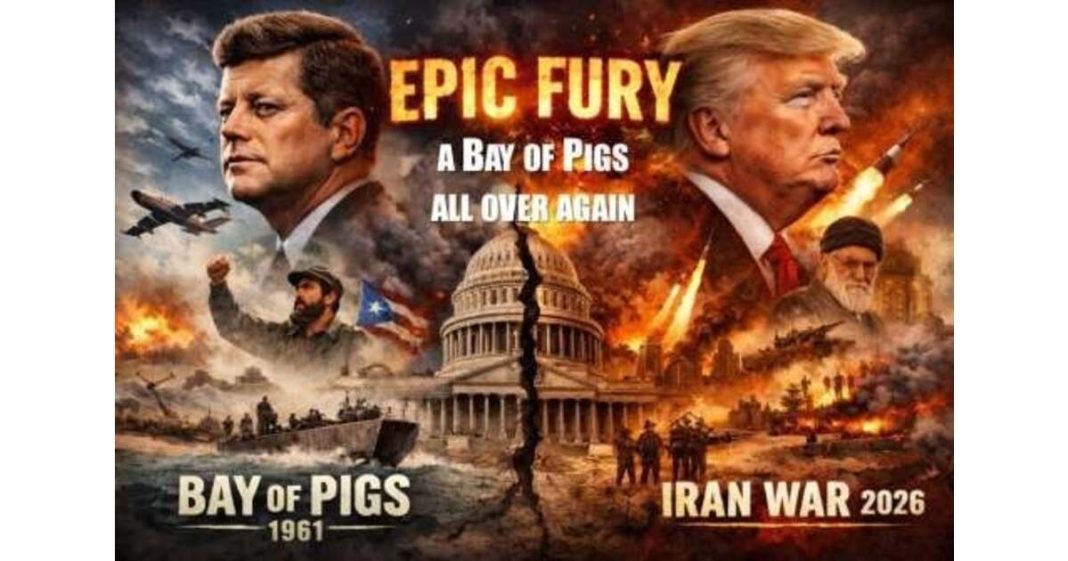
The arc of history is often less a straight line than a recurring pattern—especially in the realm of American foreign policy. What unfolded in 2026 under President Donald Trump—the illdefined, erratic, and ultimately inconclusive war against Iran—bears an unsettling resemblance to one of the most infamous strategic blunders of the 20th century: the Bay of Pigs Invasion under John F. Kennedy.
What links these two episodes is not merely miscalculation or flawed intelligence. It issomething deeper and more troubling: a breakdown in how decisions are made, how advice is weighed, and how systems designed to prevent failure are quietly set aside.
The Road to “Epic Fury”
The decision to go to war with Iran did not emerge from a unified strategic consensus. Rather, it developed within a fractured advisory environment—one in which sharply conflicting assessments were presented, but not equally considered.
According to New York Times article; a central external influence came from Benjamin Netanyahu, who reportedly argued that Iran was uniquely vulnerable. His case rested on a familiar promise: that pressure would trigger internal collapse, that resistance would be limited, and that the conflict would be swift. It was, in essence, a theory of easy victory—one that has historically proven seductive and repeatedly false. Inside the U.S. system, however, this optimism was not universally shared.
Intelligenceassessments pushed back firmly. Figures such as John Ratcliffe rejected the notion that Iran was on the brink of internal uprising, warning instead of escalation risks and strategic unpredictability. The intelligence community did what it is designed to do: challenge assumptions and present inconvenient truths.
Dissent also surfaced at the political level. Vice President JD Vance reportedly warned that the war could spiral into a broader regional conflict, triggering economic shocks and long-term instability. His objections were not casual—they were sustained and explicit. Yet they remained isolated.
Military leadership, including figures like Dan Caine, expressed concerns as well. But theseconcerns were measured, procedural, and ultimately non-confrontational. There was no decisive institutional resistance—no moment where the system forced a reckoning with the risks.
Meanwhile, other voices within the administration reinforced the president’s instincts. Advisers such as Pete Hegseth supported the intervention enthusiastically, while others deferred to Trump’s judgment, viewing the moment through a lens of historical opportunity.
In the end, the decision was not the product of structured deliberation. It was, by multiple accounts, driven by instinct—what Trump himself described as a “gut feeling.” Intelligence was sidelined, dissent marginalized, and optimism elevated.
A Familiar Pattern: The Bay of Pigs
The parallels to the Bay of Pigs invasion are difficult to ignore. In 1961, the plan to overthrow Fidel Castro was driven largely by the Central Intelligence Agency. The agency presented a confident narrative: that Cuban citizens would rise against Castro, that the operation could remain plausibly deniable, and that success was likely. These assurances proved catastrophically wrong. Within the Kennedy administration, doubts did exist.
Military leaders questioned the adequacy of air support and the viability of the operation. Yet, much like in 2026, these concerns were not forcefully pressed. The advisory environment tilted toward consensus—not because everyone agreed, but because disagreement was muted.
Kennedy, young and newly in office, faced pressure not to appear weak. The plan had momentum. The room leaned toward action. And so, despite reservations, the invasion proceeded. It collapsed within three days.
The Lessons Learned—and Institutionalized
The Bay of Pigs was not just a failure; it became a turning point in how presidential decision were made.
In its aftermath, Kennedy fundamentally restructured his decision-making process. He encouraged open dissent, deliberately flattening hierarchy to allow junior officials to challenge senior assumptions. He sought multiple, independent channels of advice to avoid reliance on a single narrative. He introduced the practice of assigning “devil’s advocates” to stress-test plans, and he slowed the pace of decision-making to ensure that alternatives were fully explored.
These reforms were not theoretical. They were applied in real time during the Cuban Missile Crisis—a moment widely regarded as a model of disciplined, rational crisis management. Out of failure, a system was built.
The System That Was Ignored
What makes the 2026 Iran war more troubling than the Bay of Pigs is not simply that it failed, but that it failed despite the existence of safeguards designed to prevent exactly this outcome.
The intelligence community raised clear objections—but these were dismissed. Political dissent existed—but it was isolated. Military caution was present—but it was restrained. The structured processes developed after 1961—red teaming, rigorous debate, clearly defined objectives—were either weakened or bypassed.
Instead, the decision-making process reverted to a more primitive form: one dominated by personality, intuition, and selective listening. The result was a war marked by shifting objectives and strategic ambiguity. What began as an effort to counter nuclear threats expanded into talk of regime change, then morphed into a broader confrontation over regional influence and energy security. Within weeks, the conflict ended not in decisive victory, but in a fragile ceasefire—one in which both sides claimed success, and neither achieved its stated goals.
Iran, like Castro’s Cuba before it, absorbed the blow and endured. Its leadership remained intact. Its regional leverage persisted. And in some respects, its strategic position was strengthened.
Manufactured Consensus and the Illusion of Control
At the heart of both episodes lies the same underlying dynamic: the construction of consensus around optimistic assumptions.
In 1961, the Central Intelligence Agency’s confidence shaped the conversation. In 2026, external assurances and internal reinforcement created a similar effect. In both cases, intelligence warnings were sidelined, dissent was contained, and leaders acted within an environment that appeared more unified than it truly was.
This is not simply a failure of information. It is a failure of process. When decision-making systems are working, they are designed to surface conflict, not suppress it. They force leaders to confront uncomfortable possibilities. They slow momentum, challenge narratives, and test assumptions.
Read more: Hopes rise for renewed talks as US military says Iran blockade is in force
When those systems fail—or are ignored—confidence replaces analysis, and action replaces strategy.
From Tragedy to Regression
The Bay of Pigs is often described as a lesson learned—a costly but formative experience that improved how American presidents make decisions. The Iran war suggests something more troubling: that lessons, even when institutionalized, are not permanent.
Kennedy lacked a system and built one. Trump inherited that system—and appears to have set it aside. That is the true parallel. Not just failure, but the conditions that make failure possible.
Conclusion: The Cost of Ignoring History
Wars are not lost only on the battlefield. They are lost in conference rooms, in advisory meetings, in the quiet moments when dissent is discouraged and assumptions go unchallenged.
Both the Bay of Pigs and the Iran war demonstrate a simple but enduring truth: when leaders prioritize conviction over process, outcomes become unpredictable—an often disastrous.
History did not have to repeat itself.
The warning was already written.
It was simply ignored
Orhan Khan is a Strategic Communication Expert involved in consulting on marketing and branding strategies for different international corporations. Can be reached at orhankhan1366@proton.me
The views expressed in this article are solely those of the author and do not necessarily reflect the position or editorial policy of the publication.