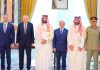

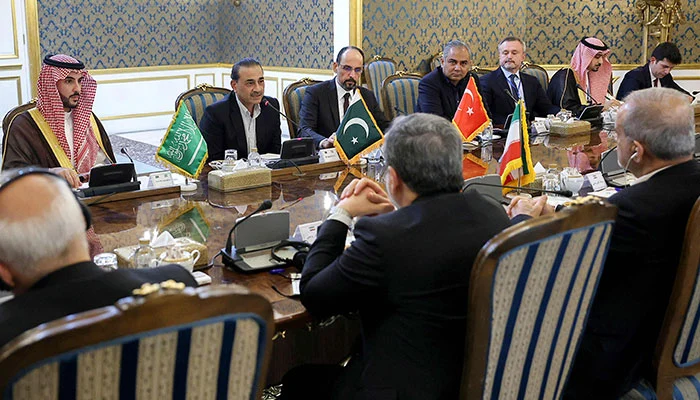
Chief of Defence Forces and Chief of Army Staff Field Marshal Syed Asim Munir joined senior officials from Iran, Saudi Arabia and Turkiye in Tehran on Monday, where the four countries agreed to continue dialogue to strengthen regional cooperation.
🇮🇷 The Mecca Alliance arrived in Tehran to negotiate with Iran
– Saudi Defense Minister Khalid bin Salman,
– Turkish Intelligence, MiT, Chief Ibrahim Kalin,
– Pakistan’s Army Chief Asim Munir. https://t.co/SSfmtyoIlv— Megatron (@Megatron_ron) October 26, 2026
The first four-way meeting, requested by Pakistan, focused on regional cooperation, the US-Israeli war against Iran and its consequences, Iranian state media reported.
The meeting was hosted by Major General Mohsen Rezaei, secretary of Iran’s Supreme National Security Council, and was also attended by Iranian Foreign Minister Abbas Araghchi, Press TV reported.
The joint statement said Saudi Defence Minister Khalid bin Salman, Field Marshal Munir and Turkish intelligence chief Ibrahim Kalin participated in the meeting.
⚡️BREAKING
Iran’s Security Chief on his Meeting with Senior Officials from Pakistan, Turkey and Saudi Arabia:
“As a result of the Iranian nation’s resistance and the strength of its Armed Forces, a new and positive atmosphere has emerged within the region—as reflected in the dialogues held with senior officials from Turkey, Pakistan, and Saudi Arabia
Senior officials from Turkey, Pakistan, and Saudi Arabia expressed the view that the solution to the region’s challenges lies in cooperation among all four nations
We reached the conclusion that security in West Asia must be internally generated, and that any form of foreign interference must be prevented”
— Iran Observer (@IranObserver0) October 26, 2026
The participants agreed to continue dialogue to strengthen cooperation among the four countries, including on regional peace and security.
Earlier in the day, the Inter-Services Public Relations (ISPR) confirmed that Field Marshal Munir was visiting Tehran.
The delegations also met Iranian President Masoud Pezeshkian, who said Tehran supported any agreement that strengthened unity among Muslim countries and promoted constructive cooperation in West Asia.
Pezeshkian urged regional countries to focus on shared interests and areas of cooperation, saying differences should not hinder common goals. He also called for greater economic cooperation to help regional countries meet one another’s needs and withstand external pressure.
The talks come after nearly eight months of war following US-Israeli attacks on Iran in late February, prompting Tehran to blockade the Strait of Hormuz. The conflict has roiled global markets and energy trade.
⚡️BREAKING: The Big Meeting between Iran, Pakistan, Turkey and Saudi Arabia has Begun
Iran is being represented by Pezeshkian and Security Chief Rezaei
Pakistan by Asim Munir
Turkey by Intelligence Chief Kalın
Saudi Arabia by the Brother of MBS https://t.co/5KsiuywsG6
— Iran Observer (@IranObserver0) October 26, 2026
An April ceasefire brought an end to the initial phase of intense bombardment, but the two sides have continued to vie for control of the strait, through which around a fifth of the world’s oil and liquefied natural gas used to travel.
The war has since spread across the region to include fighting between Saudi Arabia and the Houthis in Yemen, who have attacked airports and oil facilities in the kingdom.
Saudi Deputy Minister for Public Diplomacy Dr Rayed Krimly confirmed that the kingdom’s defence minister was heading a delegation to Tehran on Monday.
Today’s historic meeting in Iran sends a CLEAR SIGNAL to the world.
After decades of calling for regional security led by regional nations, Iran is moving toward a new framework alongside Saudi Arabia, Turkey, and Pakistan.
The message is CLEAR: Regional peace and security must be built FROM WITHIN the region, by the nations of the region themselves.
In 5,225 Years of History, Iran Is More Powerful Than EVER. Today’s meeting on the eve of Israel’s elections is a SIGNAL to Netanyahu: Your Fall is Near Bibi. Jail awaits you.
— Ryan Rozbiani (@RyanRozbiani) October 26, 2026
Read more: Jordan bombs Syria after deadly church attack
Iran claims control over the Hormuz Strait and regularly targets vessels that attempt to cross without its authorisation, while the United States has imposed a naval counter-blockade on Iranian ports.
Diplomatic efforts to resolve the crisis remain stalled, especially since the collapse of a June deal which laid out a pathway to a permanent settlement.