
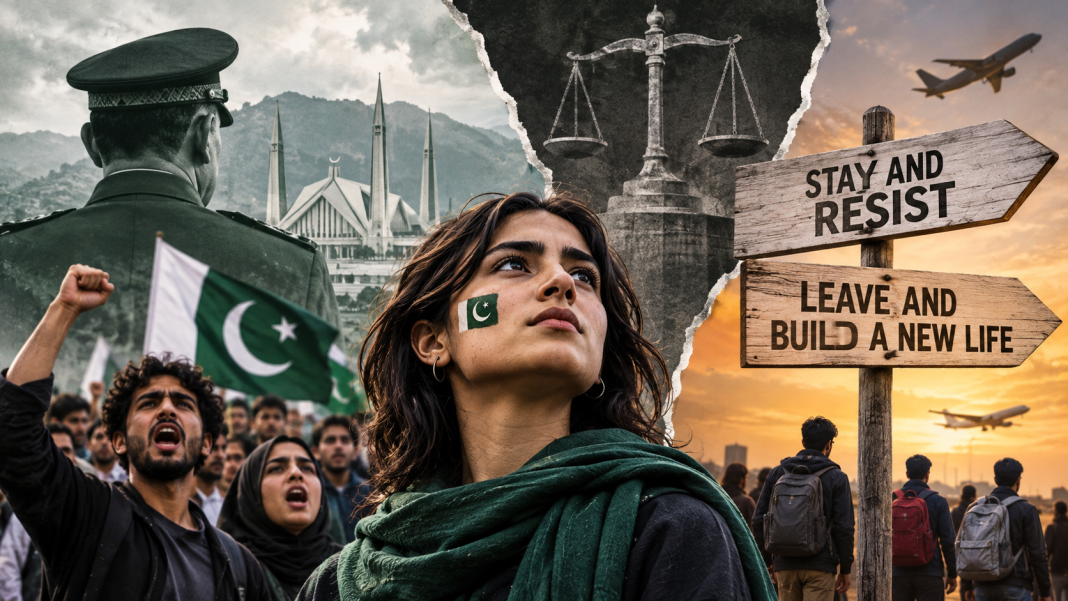
While Gen Z movements have reshaped politics across countries such as Nepal, Bangladesh and Morocco, Pakistan’s young people have yet to unite behind a movement capable of challenging the established order.
In four years, young people have rewritten the politics of half a dozen countries: Sri Lanka in 2022, Bangladesh in 2024, Nepal in 2025, then Morocco, Indonesia, Madagascar and India.
The grievances were familiar: corruption, overreach, hardship. Pakistan has all three, and borders three of these countries, yet has had no Gen Z moment. The usual explanations fail. “The army would crush it”: Bangladesh’s government was brutal too, and Nigeria’s army fired on #EndSARS protesters, yet the young came out anyway. “Zia banned the student unions”: that was 42 years ago. “Our youth are apolitical” is false: they protest constantly and voted in record numbers in 2024. A better answer starts with two German thinkers.
Two old ideas
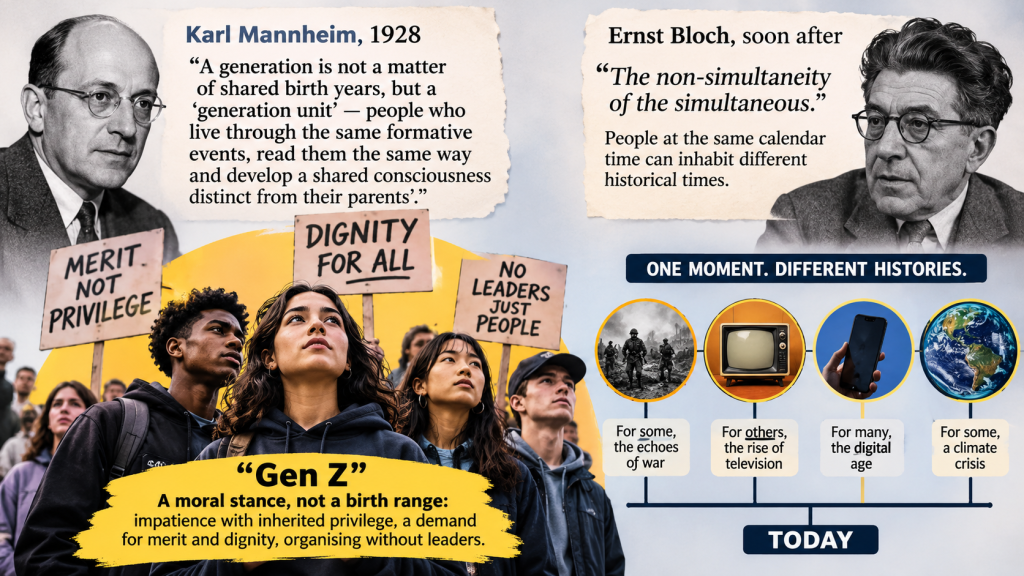
In 1928 Karl Mannheim argued that shared birth years do not make a generation. A generation is a “generation unit”: people who live through the same formative events, read them the same way and arrive at a shared consciousness distinct from their parents’. “Gen Z” is a moral stance, not a birth range: impatience with inherited privilege, a demand for merit and dignity, organising without leaders. Soon after, Ernst Bloch named the “non-simultaneity of the simultaneous”: people at the same calendar time can inhabit different historical times.
Pakistan has not had its Gen Z moment because its young have not separated into a distinct generation, and because the country lives in several political times at once. This is not a claim that Pakistan is “behind”; Nepal and Madagascar are no richer or more urban. Pakistan’s young have been kept tied to their parents’ loyalties, their kinsmen’s patrons, their party’s leader and their army’s story.
Loud, but not separated
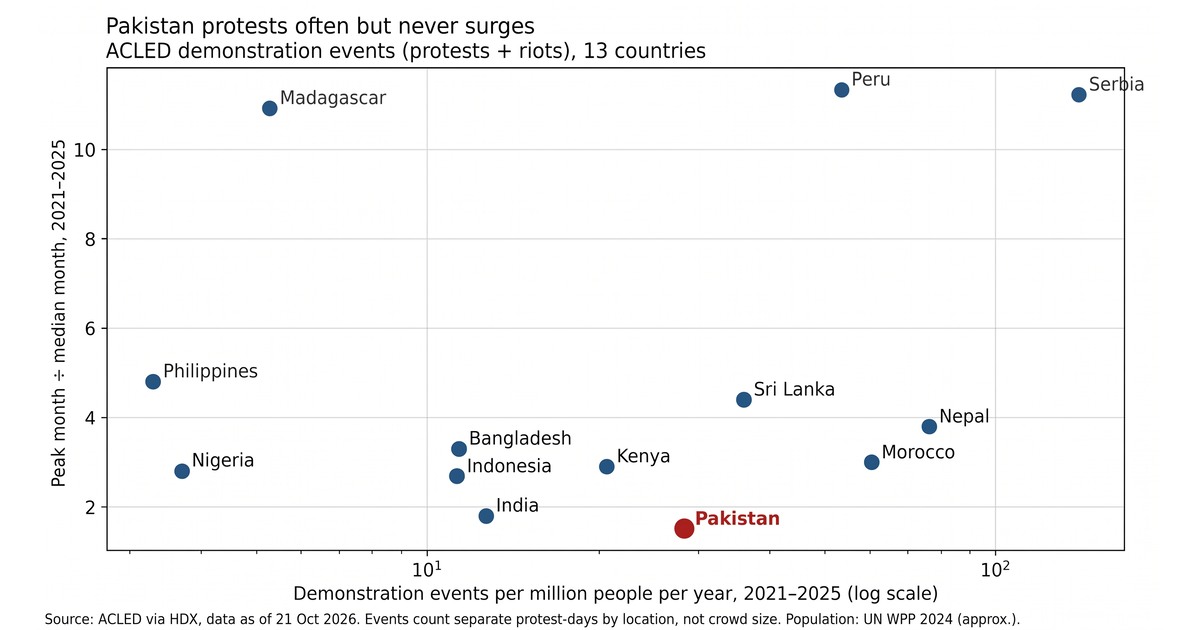
Start with the myth of the quiet Pakistani. ACLED data record about 7,000 demonstrations a year in Pakistan, roughly 28 per million people: two and a half times Bangladesh’s rate and higher than Kenya, Indonesia, Nigeria or India. What Pakistan lacks is a surge. In Serbia the peak protest month was fourteen times the typical month; in Bangladesh in August 2024, nearly four. The riots of 9 May 2023 barely reached 1.2. Pakistanis protest constantly, but in separate streams (power bills in Karachi, disappearances in Quetta, party causes in Lahore) that never merge.
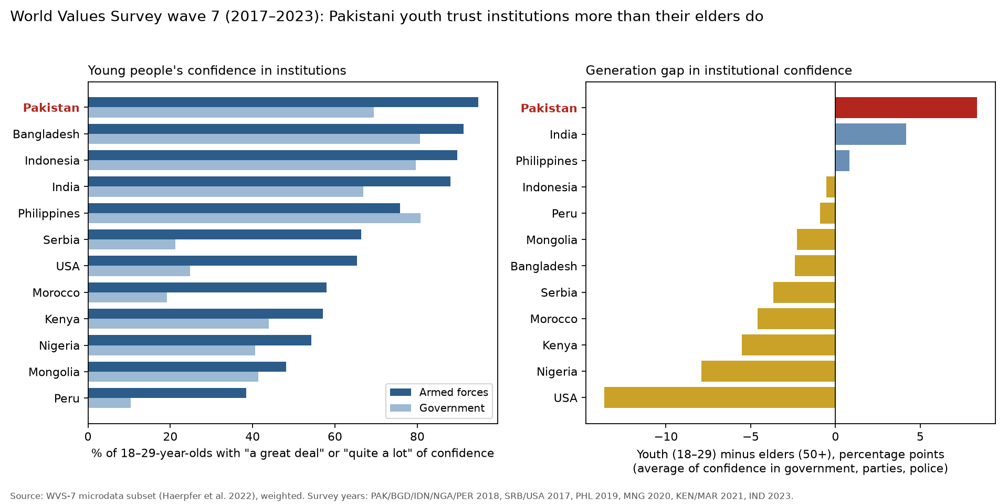
Mannheim’s test is whether the young see the world differently from their parents. In the World Values Survey, Pakistan is an outlier: 94.8% of 18- to 29-year-olds had confidence in the armed forces, the highest of twelve countries. It was also the only country where the young trusted the government, parties and police more than their elders did. The survey’s timing, Imran Khan’s 2018 victory, is a fair caveat, but after the May 2025 conflict with India, 97% of Pakistanis rated the military’s performance positively. Young Pakistanis lose faith in politicians, not in what stands above them.
A generation divided
Pakistan was not always like this. In 1968–69, students led the movement that ended Ayub Khan’s rule, from campuses that trained a politics of ideas. That was Pakistan’s Gen Z moment, half a century early. Its disappearance has a date: 9 February 1984, when Zia ul Haq abolished elected student unions and a CIA assessment noted with relief that “most students… remained quiescent.”
The usual story is that the ban depoliticised the campus; the research finds something worse. A 2026 University of the Punjab study concludes that it did not. Elected unions gave way to party wings, ethnic councils and sectarian groups, producing “factional competition, ethnic polarization, sectarian dominance, intimidation, moral policing.” Zia did not create an apolitical generation but one divided into Punjabi, Pashtun, Baloch, Sindhi, Islamist and party camps, each political and none able to speak for the whole.
The divisions begin long before university. Pakistan runs three school systems (English-medium, Urdu-medium and madrassa) whose students absorb what the linguist Tariq Rahman called “alien worlds.” A Gen Z moment needs a common vocabulary of grievance; Pakistan’s schools produce three. University students are few (12–16% tertiary enrolment), and fewer than four in ten Pakistanis live in cities. In the countryside, identity runs vertically: fieldwork by Shandana Khan Mohmand found up to 80% of villagers in a dharra, a voting bloc led by a local intermediary, which binds the young man in Sargodha to his father’s patron.
Half the generation is largely kept off the street. Female labour-force participation is 24%, and more than a quarter of women who use mobile internet can do so only on someone else’s phone. Erica Chenoweth finds that no regime has survived a nonviolent campaign mobilising 3.5% of the population, about 8.8 million Pakistanis, and a society that keeps its daughters indoors has halved the pool. This is Bloch’s non-simultaneity inside one country, and a generation unit cannot form without a shared present.
When principles become weapons
What united the youth movements of the past four years was a principle: simple enough for a placard, moral enough that no one could argue with it in public. Pakistan’s young hold such principles too: insaf (justice), merit, dignity, clean government. The problem is what has happened to the words.
Morocco shows what a living principle can win. In September 2025, eight women died after caesareans at a public hospital in Agadir while the kingdom spent heavily on World Cup stadiums. GenZ 212 asked why there was money for concrete but not for care, and the king answered with an 18% rise in health and education spending. Pakistan spends 0.9% of GDP on public health, yet no one marches for “hospitals, not metros.” The difference is who the showpieces serve.
Morocco’s stadiums were prestige for outsiders; Pakistan’s metro buses carry the very voters who would have to protest against them. France shows what a principle presupposes: its students defended a social contract being taken apart, while Pakistan’s never had one to lose.
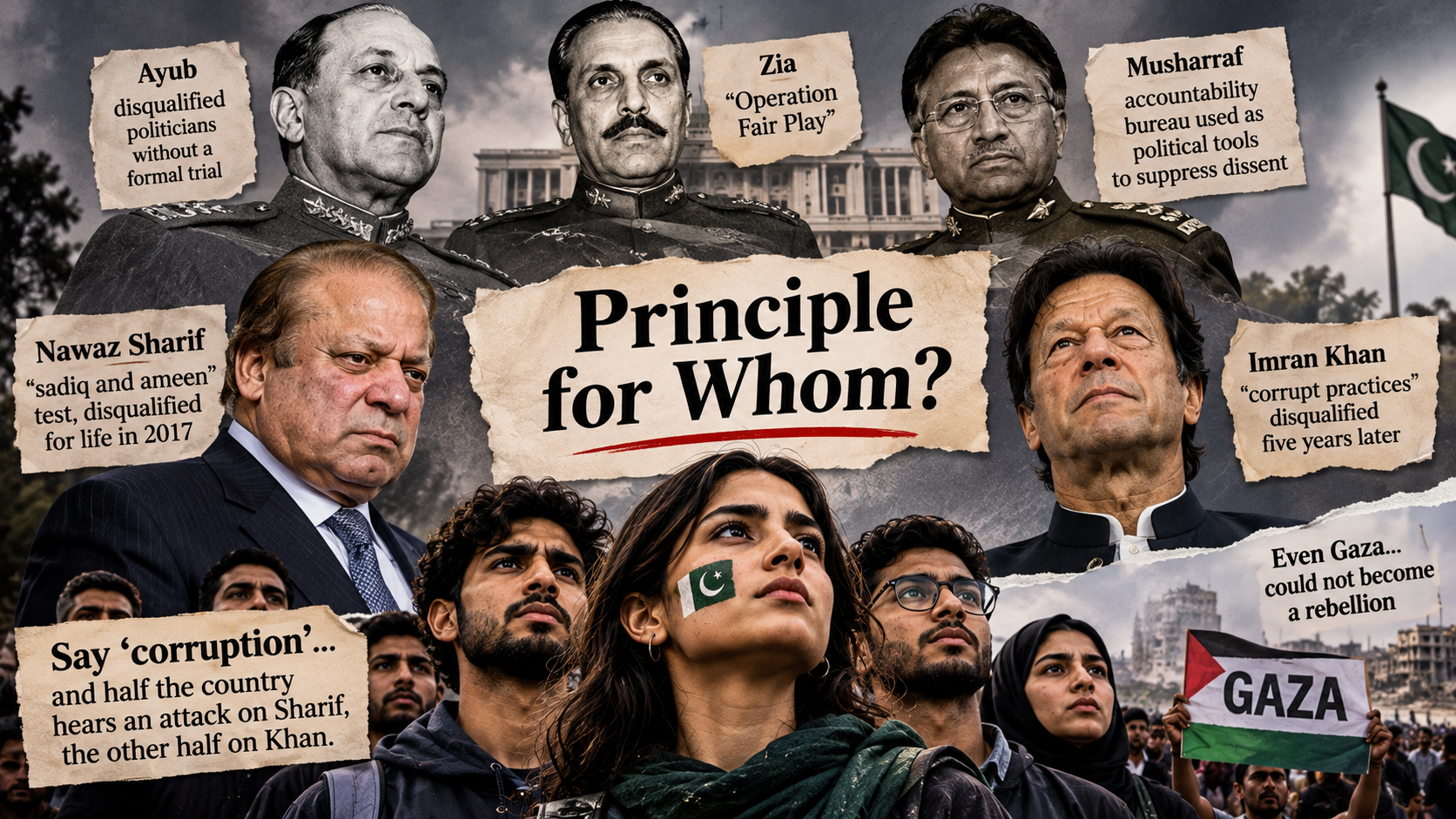
The deeper problem is that Pakistan’s words of principle have been used as weapons of power. Ayub disqualified politicians “without a formal trial”; Zia called his coup “Operation Fair Play”; Musharraf’s accountability bureau was, in PILDAT’s words, “used as political tools to suppress dissent.” The “sadiq and ameen” test disqualified Nawaz Sharif for life in 2017, and “corrupt practices” disqualified Imran Khan five years later. Say “corruption” and half the country hears an attack on Sharif, the other half an attack on Khan.
A generation unit needs a principle that belongs to no faction, and the establishment has spent sixty years making sure each belongs to one. Even Gaza, the one cause almost all young Pakistanis agree on, could not become a rebellion: the state had already claimed it.
Where the energy went
If not into the streets, where did the moral energy go? When Occupy came to Islamabad in 2011, Imran Khan drew 100,000 people to Minar-e-Pakistan four days later. The anti-corruption, anti-dynasty mood that became leaderless revolt elsewhere became, in Pakistan, a mass party built around one man.
Gen Z uprisings thrive where every established party has been used up. In Pakistan, PTI has filled that space for fifteen years. Its young supporters protest when the party calls, not when outrage peaks, and everyone else stays home. In a British Council survey, 65% of young internet users said their party was “the only one that can save Pakistan.” That is not apathy but energy so committed to one party that it cannot become a generational movement.
Hungary, Pakistan’s closest structural parallel, shows that this need not be fatal. Orbán’s hybrid regime had captured the courts and the media, and most young Hungarians expected to emigrate. When it banned Pride in 2025, up to 200,000 marched anyway. Young Hungarians then put that energy into an opposition party, as Pakistan’s had, and in April 2026 Tisza won 138 of 199 seats on record turnout. Pakistan’s young had done the same two years earlier.
On 8 February 2024, with PTI stripped of its symbol and its leader in prison, the independents it backed took the lead on the strength of TikTok campaigns and an AI-generated Khan voice, before allegations that results were reversed overnight. Hungary’s vote was counted. Pakistan’s was managed.
The cost of defiance, and the value of leaving
Separating from one’s elders is costly anywhere, and in Pakistan almost every route a Gen Z moment has taken elsewhere is blocked. Uprisings turn when the security forces stand aside. In Pakistan, youth anger since 2022 has been aimed at the army itself, which removes the referee, and the 27th Amendment of 2025 concentrated command further in Field Marshal Asim Munir. A 2024 law raised the penalty for unlawful assembly in Islamabad to three years, and the 2025 PECA amendments criminalised “false information” online.
Satire carries risk to life: an investigation found at least 400 young people jailed on blasphemy charges in apparent entrapment schemes, so a Pakistani version of India’s Cockroach Janta Party, mocking a judge or a general, could see satire turned into a capital charge. “Fifth-generation warfare” doctrine frames online dissent as foreign sabotage before it can spread.
Read more:The Locks Failed. The Speed Limit Is the Business Model
Against these costs, the alternatives look attractive. Albert Hirschman observed that when it is easy to leave, people speak up less; Pakistani workers abroad sent home a record $38.3 billion in FY25. Inflation at an eight-year low removed the kind of shock that set off Sri Lanka and Kenya, and the 2025 war with India rallied the country behind its army. The neighbours’ endings were sobering too: Bangladesh’s student party won six seats while the BNP won 209, and Madagascar’s military took over. Where the army already rules, an uprising promises little.
The case against
The strongest objection is that Pakistan’s Gen Z moments are already happening, just not in Punjab. The Baloch Yakjehti Committee, led largely by young women such as Dr Mahrang Baloch, is youth-led, principled and non-partisan, and its leaders are in prison. Azad Kashmir’s 2024–25 uprising won real concessions at the cost of nine lives.
I accept this, and it confirms Bloch: the periphery lives through rupture while the political core does not, and treating these movements as ethnic or security problems keeps them local rather than national. The other objection is fair too: my survey data are from 2018, and the next World Values Survey will be the real test.
A generation in waiting
Pakistan’s young people are not apathetic: they protest about 7,000 times a year and voted in unprecedented numbers in 2024. What they are not, yet, is a generation in Mannheim’s sense: a cohort that looks at its parents’ arrangements and recognises itself as something different. A campus divided in 1984, three school systems, kinship blocs and a charismatic party have kept them tied to their elders. Sixty years of disqualification in morality’s name have made principle sound like a weapon, and repression and easy exits do the rest.
In Quetta and Muzaffarabad, Pakistan’s Gen Z moment has already begun. In Lahore and Islamabad it has been postponed. It will arrive when Punjabis and Baloch, English-medium and madrassa graduates, sons and daughters, PTI supporters and everyone else find a principle no general, judge or party has already claimed, as Moroccans did with their hospitals and Hungarians with their right to march. Then Pakistan will not need to borrow its moment from Kathmandu.
Under the pen name Patience Quill, the author explores the intersection of global politics and economics, where national ambitions collide with financial realities.
The views expressed in this article are solely those of the author and do not necessarily reflect the views of global village space