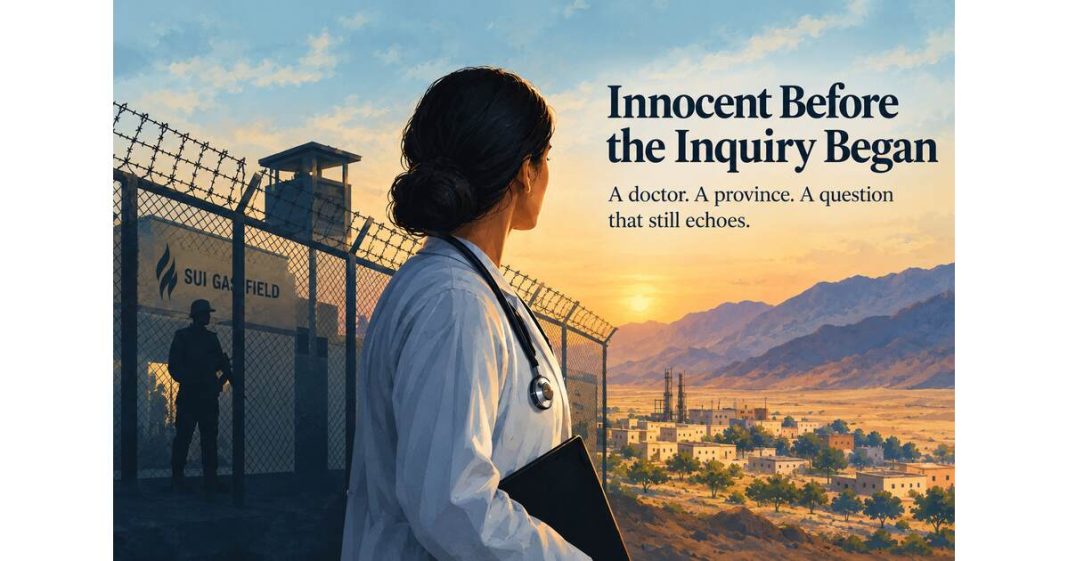
Innocent Before the Inquiry Began
Be careful, we tell our daughters. Get educated. Serve your country. Live inside the fence the state built for you.
Dr. Shazia Khalid did all four.
She was a physician at the hospital of state-owned Pakistan Petroleum Limited in Sui, Balochistan. A woman doctor in that town was rare and needed. She lived alone inside the gas-plant compound, behind the army’s Defence Security Guards.
On the night of January 2, 2005, a masked man got through that fence. He tied her with a telephone cord, beat her, blindfolded her, and raped her. When he left, she freed her own hands and went for help.
What she got was advice. Company men, she has said, told her to keep quiet. Her reputation was the problem. Not the guard’s. Not the company’s. Not the army’s.
Police reports and the Bugti chief, Nawab Akbar Bugti, named a captain of the Defence Security Guards — Hammad — as the man they wanted answered for. The captain went on television and called himself innocent. Then the president of Pakistan, General Pervez Musharraf, said the same thing on national television: not guilty. Not acquitted. Not tried. Cleared, by one military man, of another, while the inquiry was still open.
Innocent until proven guilty is a fine principle. Nobody applied it to her. Every doubt went to the man. Every consequence went to the woman.
Sui sits in Dera Bugti. Akbar Bugti treated the assault on a doctor under his sky as an assault on everyone he claimed to protect. He demanded the captain be produced. The demand was not a constitution. It was one name.
The army would not give him that name. Musharraf had already called the man not guilty.
Balochistan was not a quiet province waiting for this night. Gas royalties, cantonments, an old argument about who owns the ground under Sui-that fire was already laid. The rape was the match the state refused to stamp out. Amnesty International, which took up her case, wrote that it had further inflamed relations between the tribal chiefs of Balochistan and a government already accused of covering it up. A spark is not the whole war. It is how a war is given its first excuse.
On March 17, 2005, the Frontier Corps and Bugti tribesmen clashed in Dera Bugti. The government said its men had come under fire first. What is not disputed is where the shells landed afterward: on the Hindu neighborhood pressed against the wall of Bugti’s own compound. The Human Rights Commission of Pakistan’s fact-finding mission counted at least forty-three noncombatants killed by what it called indiscriminate Frontier Corps force-thirty-three of them Hindu residents, ten of them Bugti tribesmen. Two hundred and fifty Hindu families fled the town in the weeks after. By the count HRCP took down, two Hindus and three Sikhs were left.
Tribesmen hit the Sui gas field. Supply to much of the country stopped for weeks. Musharraf sent tanks and helicopters and warned the tribesmen they would not know what hit them. Thousands more troops moved in. What had begun as a woman’s case was now a military campaign.
Eighteen months later, on August 26, 2006, security forces tracked Akbar Bugti into the Bhamboor hills. He died there, in his late seventies. Twenty-one security personnel died with him, six of them officers. Officials called it the end of an aging rebel. Many Baloch still draw a straighter line: a captain the army would not surrender, a town under fire, then the man who first asked for the officer’s name.
That line cannot be proved as the only cause. It does not have to be. This much is not in dispute. A president cleared a suspect on television before the file closed. A doctor never got a trial. A province got an operation.
Read more:When Different Voices Sit at the Same Table
A Balochistan High Court judge, Justice Ahmed Khan Lashari, was appointed on January 11 to inquire. On March 1 he took Captain Hammad’s statement in his chambers and summoned nineteen others to give theirs. No public finding ever named a rapist. No civilian court tried the night. Meanwhile stories appeared suggesting she was a woman with too many friends. The oldest move in the ledger: if you cannot bury the crime, put the victim on trial in her absence.
On March 18, 2005, she and her husband flew to London. Instead of getting justice, I was hounded out of Pakistan, she told the BBC. My whole career was destroyed, as was my husband’s. Canada, where she had family, refused asylum. She had already landed in Britain. Britain counted as safe.
That September, in New York, Musharraf told The Washington Post that rape in Pakistan had become a moneymaking concern-a way, he suggested, to get a Canadian visa. He denied the remark afterward. The paper had the tape.
The head of state had suspicion to spare for a woman who said she had been raped. He had none left for the man he had already cleared.
Qandeel Baloch’s killer had a family to forgive him. Dr. Shazia’s accused had a president to speak for him. Honor has many addresses. Sometimes it lives in a village tent. Sometimes it lives inside a uniform, and the institution closes the door. The address changes. Who moves does not. Who pays does not.
My daughter is old enough to ask what safe means. I would like an answer that does not begin with it depends who is accused, and how many soldiers he can call.
Dr. Shazia Khalid never lost her case. She was never allowed to have one. The accused got a verdict before the investigation finished. A province got a war nobody there had asked for. She got a one-way flight and a closed file.
A country that says it wants justice for its daughters can start with the question Akbar Bugti asked and never had answered.
Who is the fence actually protecting?
Sameena Faisal Khan is a writer based in St. Louis. She holds a master’s in English literature and writes on women, rights, and the rooms a society still refuses to open.
The views expressed in this article are solely those of the author and do not necessarily reflect the views of global village space