If the reports of a deal with Iran hold, then something extraordinary has happened as Donald Trump has done what many thought was impossible.
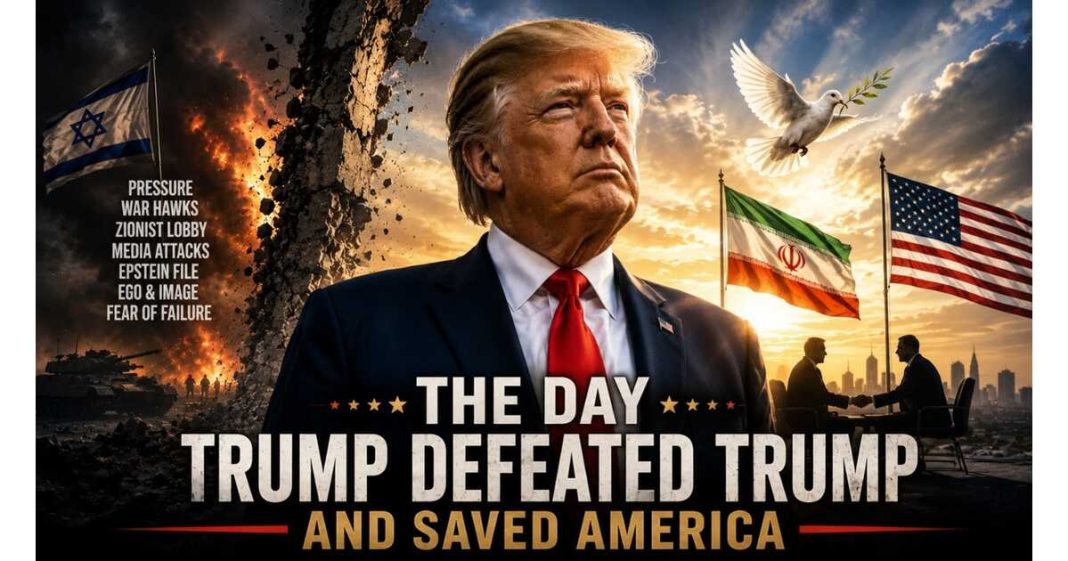
He has defeated Donald Trump. For months, perhaps years, every road appeared to be leading in one direction: confrontation with Iran.
Trump’s personality itself seemed to make such an outcome inevitable. His opponents have long portrayed him as a man driven by ego, image, and the desire to never appear weak. Once committed to a course of action, many believed he would rather escalate than retreat. Once challenged publicly, many assumed he would rather fight than compromise.
Iran represented the ultimate test of that image. Having taken a hard line, having exchanged threats, having positioned himself as a leader unwilling to blink, how could Trump possibly agree to a deal that many would immediately portray as a concession?
Then there was the cloud hanging over him. The Epstein controversy provided his enemies with another weapon. Whether justified or not, the perception existed that Trump was politically vulnerable and therefore susceptible to pressure. Many believed that powerful interests now possessed leverage over him. The assumption was simple: a compromised leader does not resist pressure; he yields to it.
Then came the pressure from Israel. The expectation across much of the world was that Trump would ultimately align himself completely with Israel’s objective of crushing Iran. Every signal seemed to point in that direction. Every statement, every development, every escalation reinforced the belief that the United States was moving steadily toward a confrontation from which there would be no easy exit.
Trump also faced another danger.
No president wants to be remembered as the leader who blinked. For a man whose political identity is built around winning, strength, and dominance, the fear of appearing weak must have been immense. The political temptation to keep escalating, to keep raising the stakes, to keep proving toughness, must have been overwhelming.
Then there were the hawks. No modern president operates alone. Every administration contains voices pushing for action, for escalation, for demonstrating resolve. The louder the crisis became, the stronger those voices inevitably grew.
Taken together, the forces were enormous.His personality pushed him one way. His image pushed him one way. His critics pushed him one way. His supporters pushed him one way. Israel pushed him one way.
The hawks pushed him one way. The fear of looking weak pushed him one way. The fear of political damage pushed him one way.
Everything pointed toward the same destination: the total destruction of Iran.
Why Walking Away Required Political Courage
And then Trump turned around. That is what makes this moment so remarkable. Because from a superficial perspective, the deal looks like surrender. That is exactly how it will be portrayed. His opponents will say he folded. The media will say he blinked. His critics will call it weakness.
The hawks will call it appeasement. Israel’s supporters will call it betrayal. But they may be missing the larger reality. Sometimes what appears to be surrender is actually liberation.
Trump was heading toward a path from which there would have been no return. A war with Iran would not have been a television spectacle lasting a few days. It would have defined his presidency. It would have consumed his legacy. Every success and every failure would thereafter have been measured against that decision.
Instead, he stepped off that road. The truly remarkable thing is not that he reached a deal with Iran.
The remarkable thing is that he reached a deal despite every incentive pushing him in the opposite direction. That required courage.
That required something many of his critics insist he does not possess: the ability to reverse himself. The ability to choose outcomes over ego. The ability to ignore those demanding escalation. The ability to endure accusations of weakness in pursuit of what he believed was the larger objective. Trump’s greatest victory may therefore not be over Iran.
It may not be over his political opponents. It may not even be over the foreign-policy establishment. His greatest victory may have been over his own instincts.
Read more:Epic Fury: A Bay of Pigs All Over Again
Trump defeated Trump. And in doing so, he may have saved America from a conflict that seemed increasingly unavoidable. But perhaps he did something even bigger.
The Great Escape from a Middle East War
By choosing a deal over destruction, Trump may have executed what can only be described as the great escape. Until recently, many believed he was firmly in the grip of forces that were pushing America toward a catastrophic confrontation with Iran. The pressure from Israel, the demands of the hawks, the expectations of his critics, and the political consequences of appearing weak all seemed to point in the same direction.
Yet Trump stepped away. In doing so, he may have changed the direction of the United States itself. Only weeks ago, America appeared to be moving toward another defining conflict in the Middle East. The consequences of such a war could have been enormous and unpredictable. Today, because of this course correction, there is at least the possibility of a different future.
What looked like the beginning of America’s decline may instead prove to be the moment it changed course.
What appears to some as surrender may, in reality, be liberation. It may be an unpopular opinion, but it often takes far more courage to do something unpopular than to do what everyone expects.
There was little political risk in continuing down the path of escalation. The real risk was changing course. The real risk was knowing that powerful interests, influential media voices, and many of his own supporters would accuse him of weakness. Yet he did it anyway.
That is why this decision deserves to be judged not by how it looks in the moment, but by whether it prevents a conflict that seemed increasingly inevitable.
That does not mean the danger has passed. Far from it.
Those who wanted confrontation yesterday will want confrontation tomorrow. The forces that pushed toward escalation have not disappeared. If anything, they will become more aggressive now that a deal exists.
Israel and the Zionist lobby are unlikely to accept this outcome quietly. The backlash against Trump is likely to be ferocious. The media campaign will intensify. The attacks will multiply. The pressure will increase.
Many of the same people who were urging confrontation will now devote themselves to ensuring that the agreement fails. Trump should expect to be politically crucified for this decision.
This is where Vice President J.D. Vance deserves recognition. At a critical moment, he provided a strong rebuttal to the arguments for escalation and helped make the case for a different path. His intervention demonstrated that there are still voices prepared to defend diplomacy when the easier political option is confrontation.
This is also why those who genuinely want peace should support Trump now. The difficult decision has already been made. The harder battle may be defending it.
This is not the moment for silence from those who opposed another war. It is the moment to stand behind the effort to preserve peace.
Iran, for its part, must also act wisely. Iran should not seek to humiliate Trump or the United States. It should not mistake restraint for weakness. It should not turn a diplomatic achievement into a propaganda victory.
The region is still not out of the woods. There are many who would gladly sacrifice this agreement if doing so advances their own objectives. Restraint from all sides will be necessary if the deal is to survive.
A Nobel Peace Prize Moment?
If the agreement holds, if a catastrophic conflict is avoided, and if America uses this opportunity to change course, then history may record this as one of the most important decisions of Trump’s life.
In that case, the argument for awarding Donald Trump the Nobel Peace Prize would become extremely difficult to dismiss.
A leader who steps back from the brink of war despite immense political pressure, who chooses diplomacy when conflict appears inevitable, and who changes the course of events toward peace has fulfilled the very purpose for which the prize was created.
For that reason, Donald Trump does not merely deserve credit. He deserves serious consideration for the Nobel Peace Prize.
And unlike many previous recipients, he would have earned it by helping prevent a war that much of the world had already begun to regard as inevitable.
Orhan Khan is a Strategic Communication Expert involved in consulting on marketing and branding strategies for different international corporations. Can be reached at orhankhan1366@proton.me
The views expressed in this article are solely those of the author and do not necessarily reflect the position or editorial policy of the publication.