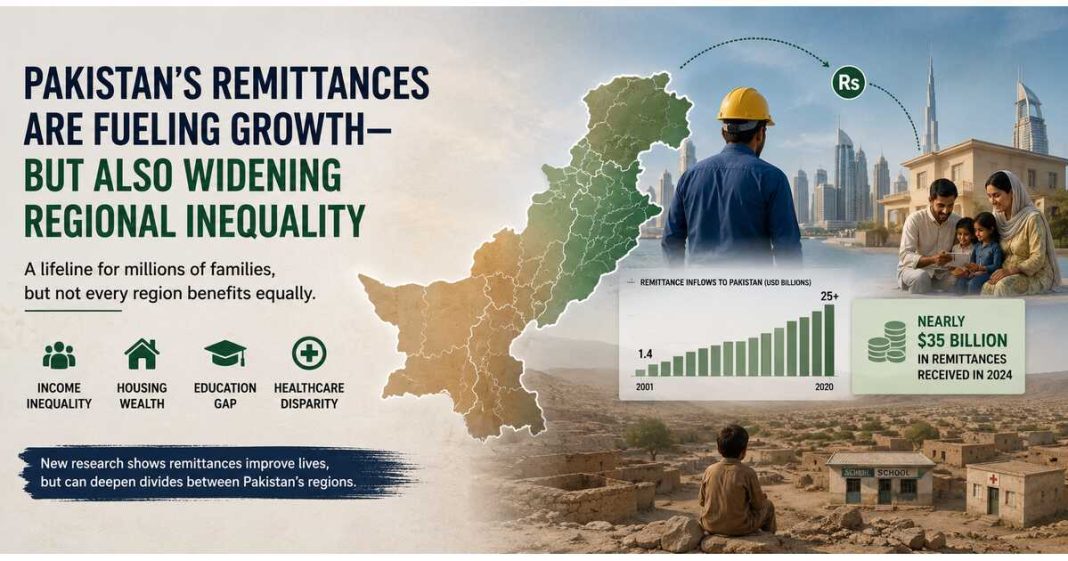
Every year, millions of Pakistanis working in the Gulf, Europe, and North America send part of their wages home. A labourer in Dubai paying for his children’s education. A shopkeeper in Birmingham helping his family build a house back home. A driver in Riyadh covering his brother’s hospital bills. Multiply these private acts of care by millions, and you get one of the largest financial flows in Pakistan’s economy: remittances.
The numbers are remarkable. Pakistan’s remittance inflows increased from about USD 1.4 billion in 2001 to more than USD 25 billion by 2020. By 2024, the country ranked among the world’s five largest remittance recipients, receiving nearly USD 35 billion. Today, remittances account for more than 8 percent of GDP, exceeding foreign direct investment and foreign aid combined. They are no longer a side story—they are the lifeline that is keeping Pakistan’s economy afloat.
Figure 1. Remittance inflows to Pakistan, 2001–2020 (USD billions)
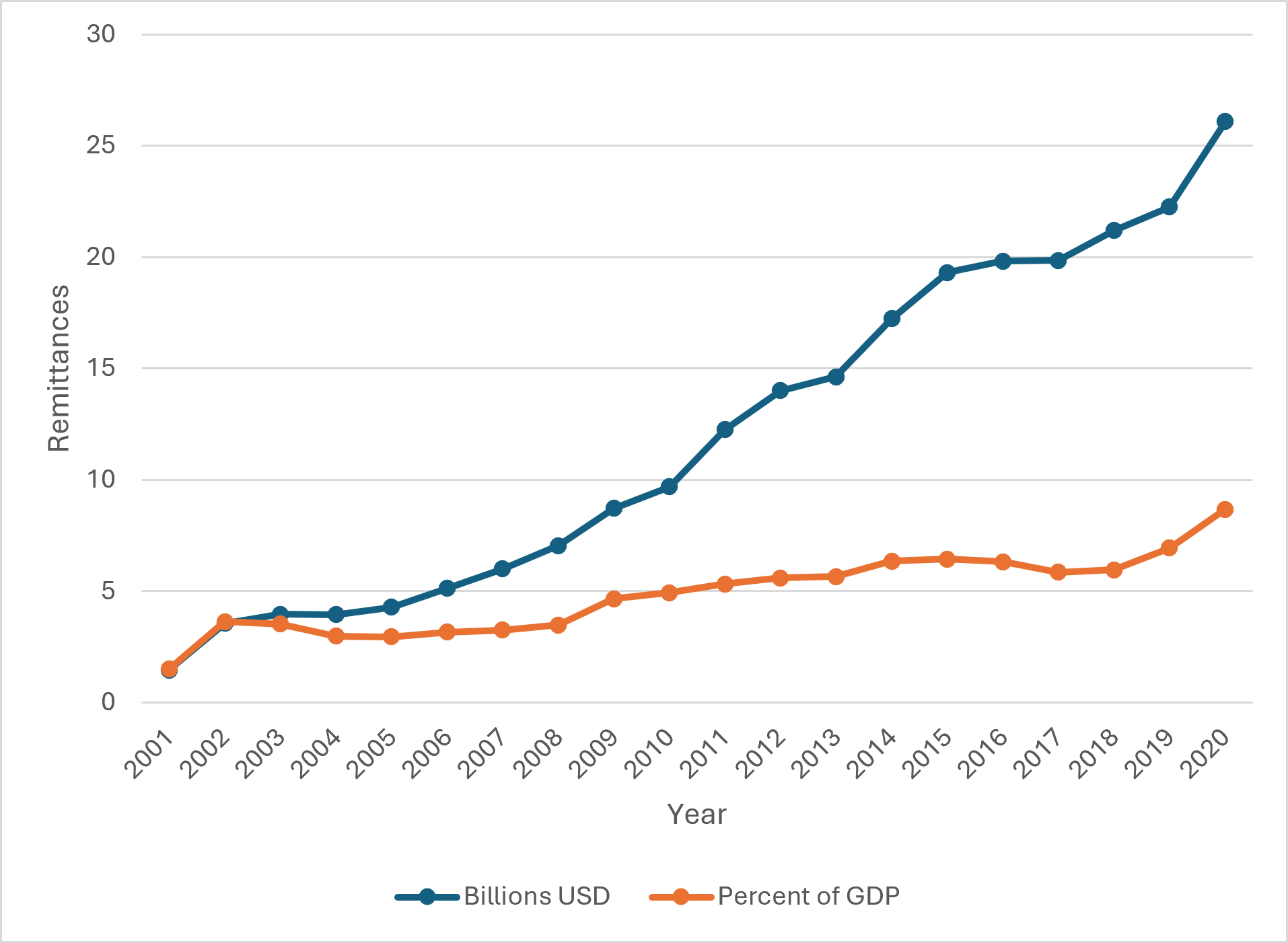
Source: World Bank remittance data, as reported in Ali et al. (2026).
For good reason, remittances have long been viewed as an economic blessing. Successive governments have celebrated each new remittance record as evidence of resilience and have made increasing these inflows a policy priority.
The evidence supporting that optimism is overwhelming. Studies from Pakistan and other developing countries consistently show that remittances help families escape poverty by easing financial constraints.
Households receiving money from abroad spend more on education and healthcare, accumulate more assets, invest more in businesses, and are better protected against economic shocks. In a country where formal insurance mechanisms are scarce and public safety nets remain limited, remittances have become an informal insurance system for millions of families.
The question we have been missing
Most research has focused on what remittances do for households. Far less attention has been paid to what they do to regions. A force that improves the lives of individual families can still widen the gap between districts if migration opportunities themselves are unevenly distributed.
That is precisely what our recent research set out to examine. In a paper published in the Papers in Regional Science, we analysed 109 districts across Pakistan using household surveys, satellite data and administrative records. To our knowledge, this is among the first studies to examine how remittances shape regional disparities simultaneously across income, housing, education and healthcare. Our question was simple: do remittances aggravate regional disparities?
When success breeds inequality
The answer complicates the familiar success story. Remittances are far from evenly distributed across Pakistan. Long-established migration corridors in Punjab and Khyber Pakhtunkhwa have deep connections with labour markets abroad, while many districts in Balochistan and interior Sindh remain only weakly linked to international migration. This matters because migration itself is costly. Paying recruitment fees, obtaining visas and financing travel require resources that the poorest households often lack. As a result, those who migrate first are usually not the poorest, but households that are already somewhat better off.
Figure 2. Remittances and income inequality across Pakistan’s districts (2020)
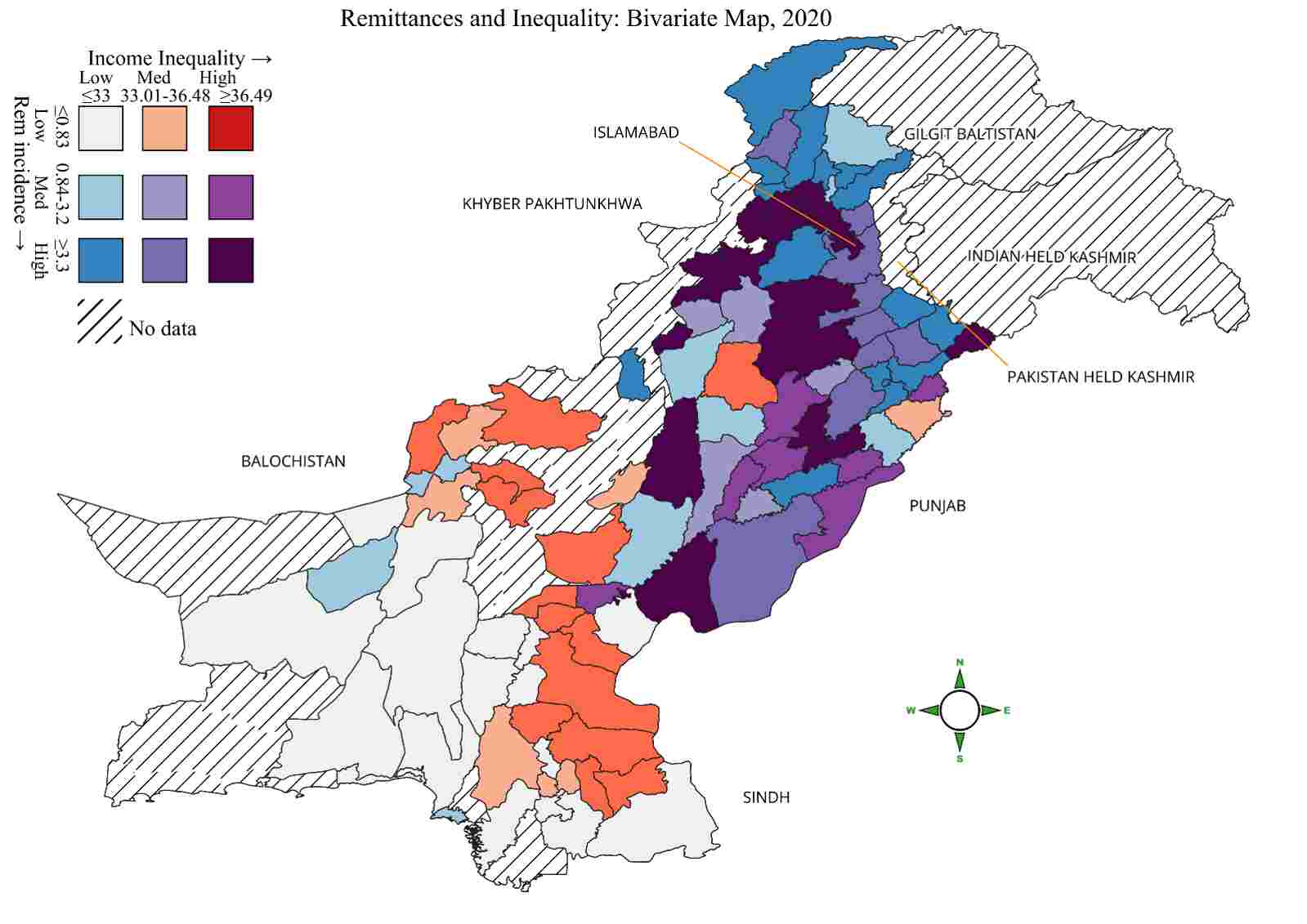
Note: Darker shades highlight areas where both remittance inflow and income inequality are highest. Districts are categorized by the percentage of households receiving foreign funds and their local income gap. Hatched areas indicate missing data.
Our findings show that these differences have important consequences. Districts where remittances grow more rapidly also experience faster increases in income inequality, even after accounting for differences in economic development and other local characteristics. This conclusion holds regardless of how inequality is measured. While remittances raise incomes, they tend to benefit regions that already enjoy stronger migration networks and better access to overseas labour markets. The encouraging news is that this effect is not permanent. Once remittances become widespread enough within a district, their inequality effect begins to weaken. Unfortunately, most Pakistani districts remain well below that point.
The picture becomes even more striking when looking at wealth. Housing is the single largest asset that most Pakistani families own. Yet our analysis shows that as remittances increase, home ownership becomes increasingly concentrated among better-off households. Recipient families continue to accumulate housing wealth, while ownership among non-recipient households changes little. The result is that income differences gradually become embedded in the very asset that determines long-term family wealth, locking inequality into place across generations.
Education, healthcare and unequal opportunity
Education presents an even more complex picture. A one-percentage-point increase in remittance incidence is associated with a two- to four-percentage-point increase in school enrolment, with much of that increase occurring in private schools rather than the public system. At first glance, this seems positive. Families are investing in their children’s future.
Yet because private education remains unaffordable for many households, the expansion of private schooling also widens the gap between children whose families receive remittances and those who continue to rely on an often under-resourced public education system.
Perhaps more worrying, boys appear to benefit disproportionately from these additional educational investments. More money in the household does not automatically translate into more equal opportunities when existing social norms continue to favour sons.
Healthcare tells a similar, though slightly more encouraging, story. Remittance-receiving households are more likely to use private hospitals and clinics, giving them access to better healthcare than many non-recipient families. Unlike education, however, remittances do not widen gender disparities in healthcare access. The main divide is therefore not between men and women, but between households able to afford private healthcare and those who remain dependent on an overstretched public system.
Read more:How can the Middle East Protect its Future Economic Interests?
Making remittances work for everyone
Remittances remain one of Pakistan’s greatest economic strengths and have improved the lives of millions of families. The challenge is that they operate within an already unequal society. New opportunities naturally flow first to regions with stronger migration networks, better infrastructure and greater financial resources. This calls for a different policy response, one that does not discourage migration, but ensures that its benefits are shared more widely.
Strengthening public education and healthcare in districts with low remittance exposure should be a priority. Better public services would reduce the emergence of a two-tier system in which remittance-receiving families increasingly rely on private providers while everyone else is left behind.
Expanding banking access, lowering remittance transfer costs and improving financial literacy would also help spread the gains from migration more evenly across regions. At the same time, targeted programmes supporting girls’ education in high-remittance districts could prevent additional household income from reinforcing existing gender inequalities.
Finally, policymakers need to look beyond national averages. Household surveys tell us whether remittances help individual families. National statistics tell us how much foreign exchange the country receives. Neither reveals how migration reshapes opportunities across districts. Understanding those regional differences is essential if Pakistan wants migration to promote not only growth, but also more balanced development.
Remittances have transformed millions of individual lives. The next challenge is to ensure they also transform Pakistan’s regions, rather than leaving some permanently ahead and others permanently behind.
Dr. Mazhar Mughal is Director Research and Full Professor of Economics at Éklore-Ed School Of Management and Associate researcher at TREE, University of Pau, France. He can be reached at yasinmazhar.mughal@eklore-ed.com
Dr. Ubaid Ali is a development economist specializing in migration, healthcare, and economic inequality. He can be reached at imubaid@gmail.com.
The opinions expressed in this article are those of the author alone and do not necessarily represent the views or editorial stance of the publication