

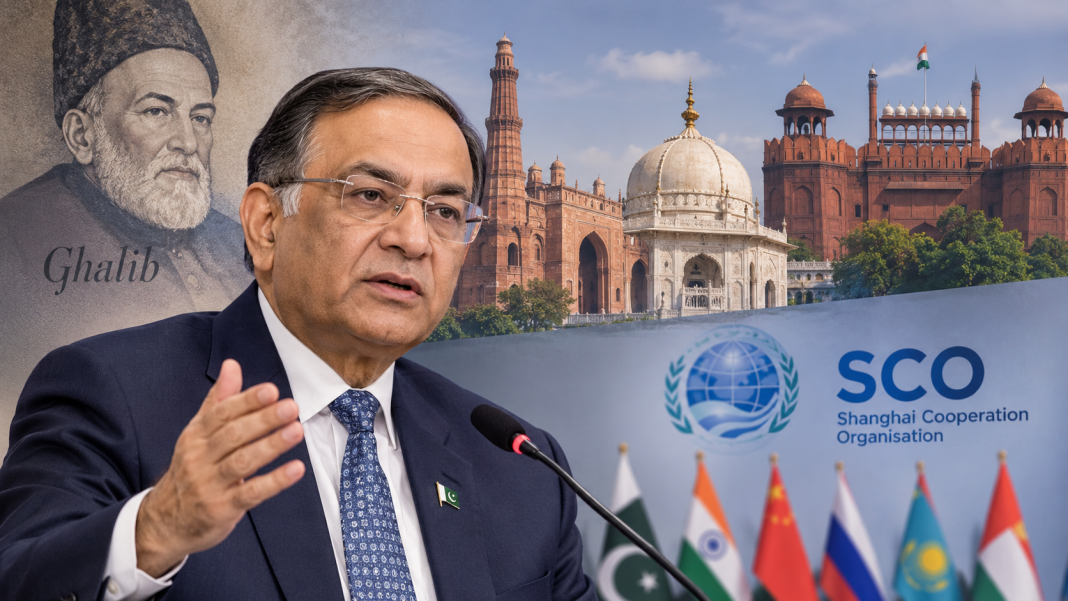
Justice Katju defends Pakistan’s minister Musaddaq Malik against Moeed Pirzada’s charge of hypocrisy, saying his SCO speech in Delhi won hearts through shared culture and calm under provocation. He uses it to restate his view that Partition was a British design and that India, Pakistan and Bangladesh will reunite.
My friend, the eminent, brave and upright Pakistani journalist Moeed Pirzada, has posted a vlog on Pakistan Minister Musaddaq Malik’s recent speech at the SCO summit in Delhi.
In his speech Malik mentioned Ghalib, Nizamuddin Auliya, Buddhist art and civilization and Taxila, and praised Delhi, Lucknow and Lahore as great centres of culture. He stressed the wisdom of dialogue in this subcontinent of great diversity, and won great applause. Despite attempts by some journalists to provoke him, he kept his cool and displayed dignity, poise, grace, maturity and restraint that would put many seasoned diplomats to shame.
His speech about our common culture proves points I have repeatedly made:
1. India, Pakistan and Bangladesh are really one country sharing the same culture, and were one for over 500 years from the time of Mughal Emperor Akbar.
2. The Partition of 1947, on the basis of the bogus two-nation theory (that Hindus and Muslims are two separate nations who cannot live together peacefully), was a British swindle. Its aim was to prevent a united India from emerging as a modern industrial giant like China, a big rival that Western industry could not face, since with our cheap labour we can produce and sell goods much more cheaply.
3. Since the three countries are only artificially and temporarily divided (like West and East Germany, and North and South Vietnam), we are bound to reunite, though it will take time, because the Western powers that divided us will not let us easily reunite, as that would undo the purpose of Partition.
Moeed has said that both the Mughals and the British united India. That is true, but he forgets that the Mughals made India prosperous, with over 25% of the world’s GDP and trade, while British rule impoverished it, leaving us with only about 2% and crores of countrymen dead from starvation in man-made famines before 1947.
Read more: Preaching Without Permission: Why India Cancelled an OCI Card
Moeed has also been unfair to Malik in saying that his speech was hypocrisy and had a hole in it because it ignored the aspirations of Muslims in the subcontinent.
Till the Mutiny of 1857 there was no communal problem in India. Hindus and Muslims lived together like brothers and sisters and jointly celebrated each other’s festivals. Only after suppressing the Mutiny, in which they fought the British together, did the British decide that the only way to rule India was divide and rule, which ultimately led to Partition. The communal problem was thus artificially created by the British after 1857.
Some Indians, including some journalists, tried to entrap Malik by citing his earlier speech in Pakistan that the hands of anyone who tries to stop the flow of the Indus will be cut off, and by asking him to comment on terrorism. He wisely avoided these issues, saying he had been invited to Delhi only to discuss SCO matters and would gladly come again to discuss others.
I think Malik did a great job in a hostile environment, and by his “Ghalib diplomacy” won many hearts in India. I deeply regret that the Indian Government denied him a visit to Hazrat Nizamuddin Auliya Dargah, and I see no rationale in it.
Markandey Katju is an Indian jurist and former Supreme Court judge of India who served as chairman for the Press Council of India. He has also worked as Standing Counsel for the Income Tax Department.
The views expressed in this article are the author’s own and do not necessarily reflect the editorial policy of Global Village Space.