

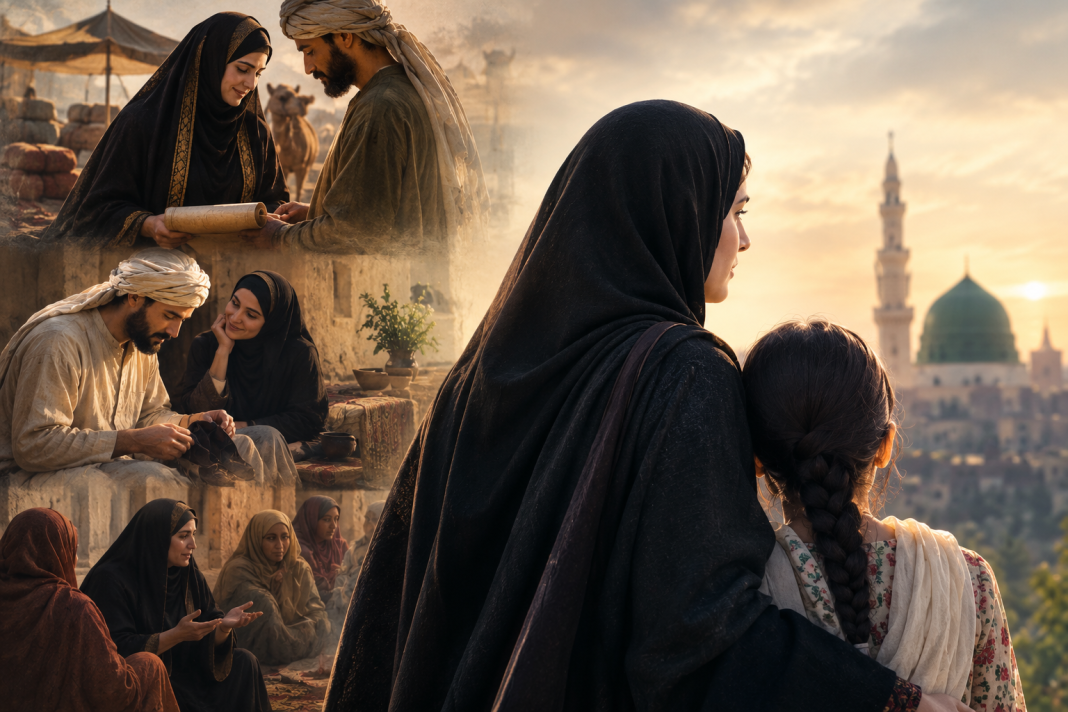
We give our daughters the names of Islam’s greatest women, yet deny them the rights those women stood for.
Let me introduce you to a woman some of our mullahs would not have allowed to marry.
She had been married twice before. She was older than the man she wanted, by about fifteen years according to the traditional accounts. She ran a trading business, sent caravans to Syria and hired men to work for her. When she saw that one of her employees was honest, she didn’t wait for her brother to hint, her mother to scheme or a rishta aunty to arrive with a photo. She sent a message proposing to him herself.
Her name was Khadijah. The young man she hired, and then married, was Muhammad (PBUH).
Try that in a Pakistani drawing room today. A rich widow in her forties with a business of her own proposes to a younger man who works for her. Within a week the khandaan has three meetings about it. Within a month someone gives a sermon about women who have “forgotten their place.” Within a year she’s a cautionary tale aunties tell their daughters.
The Prophet didn’t see a cautionary tale. He saw his wife. For twenty-five years he married no one else. When the first revelation came and he ran home shaking, he didn’t go to a scholar or a tribal elder. He went to her, and she wrapped him up, calmed him down and believed him before anyone else on earth did. The first Muslim was a businesswoman.
Years after she died, he still sent meat to her old friends. Aisha, young and spirited and not shy about it, said she was never as jealous of any woman as she was of Khadijah, a woman she never met. He loved Khadijah out loud, long after there was anyone left to impress.
So here is my question to the men with microphones: where did that man go?
The man at home
When people asked Aisha what the Prophet did at home, she didn’t describe a king waiting to be served. She said he was in the service of his family. Other narrations tell us he mended his own shoes, patched his own clothes and milked his own goat.
Our men stand in the kitchen doorway like it’s a border crossing that requires a visa. Some of them would sooner starve than toast their own bread, because a man in an apron is apparently one step from the end of civilization. Yet the man they claim to follow sewed his own sandals, and no one thought less of him.
He raced Aisha, and she won. Later he raced her again and won, and he teased her: “This one is for that one.” He drank from the same spot on the cup where her lips had been. He said, plainly and on record: the best of you are those who are best to their wives.
And he listened. Aisha once told him a long story about eleven women who sat together and swore to tell the whole truth about their husbands. They didn’t hold back. One said hers was like the meat of a skinny camel on top of a steep mountain: hard to reach and not worth the climb. Another said hers ate everything on the table, then rolled himself up in his blanket and never once reached over to ask about her sadness. The eleventh, Umm Zar’, adored her husband Abu Zar’, who covered her ears in jewelry and let her speak without ever being scolded, until the day he left her for another woman.
It was, in other words, an afternoon of women gossiping about their husbands. The Prophet didn’t wave it away or tell her that such talk was beneath him. He heard every word. When she finished, he turned it into a love note: “I am to you as Abu Zar’ was to Umm Zar’.” In some narrations he added: “except that I will never leave you.”
Some of our men can’t sit through their wife’s account of her day without reaching for the remote.
A man who openly showed his wife affection, in public and with no apology. Our culture treats that as something embarrassing, practically shameful, unless it happens in a song from an Indian film.
The plate
Here is my favorite story, and it’s in Sahih Bukhari, so nobody can call it Western propaganda.
The Prophet was at Aisha’s house with guests. Another of his wives sent over a plate of food. Aisha, in a burst of jealousy, struck the servant’s hand and the plate fell and broke. Food was all over the floor in front of the guests.
What did the Prophet do? Don’t think about what a Pakistani husband would do. Think about what this husband did.
He didn’t shout or threaten her, he didn’t call her a disgrace and he certainly didn’t raise his hand. He bent down, gathered up the broken pieces, scooped the food back together and said to his guests, almost tenderly: “Your mother got jealous.”
Then he replaced the broken plate with a whole one from Aisha’s house and sent it back to the wife whose dish was broken.
He didn’t humiliate her, and he didn’t put on a performance of manly authority for the guests. He gave a small, kind explanation, cleaned up the mess and settled things fairly for both wives.
The sandal and the poem
There’s one more story, and I’ll tell you honestly that hadith scholars grade it weak. I’m telling it anyway, because what it shows about us is too good to leave out.
Aisha sits spinning thread. Across the room, the Prophet is bent over his sandal, stitching it. It’s warm, and there’s sweat on his forehead, shining in the light. She watches him and quotes a line of poetry about a man whose face gleams like a cloud lit from inside. He puts down the sandal, gets up, kisses her between the eyes and tells her she has given him more joy than he has given her.
Read that scene slowly. She is reciting poetry, he is mending shoes, and the moment ends with him thanking her.
Whether or not every word happened, someone among the early Muslims told this story with love, and the community kept it for a thousand years. Picture a Pakistani household where the wife sits reciting poetry while the husband repairs his own shoes. I have tried and I genuinely cannot picture it. That’s the gap I’m writing about: our tradition once imagined this, and we can’t anymore.
But he’s the provider
Here’s the argument I’ve heard my whole life, in drawing rooms, wedding halls and once, memorably, from a man in a parking lot: He earns, so he rules. The provider gets the throne. The provider’s tea arrives without being asked for. The provider’s mood decides how the whole house breathes.
So let’s talk about providers.
The Prophet led armies. He stood at Badr. At Uhud he was wounded, bleeding, with a broken tooth. Before the Battle of the Trench he carried earth alongside his men until the dust covered his belly. He was head of a state, a judge, a diplomat and a commander. On any measure our society uses, he outranked every man reading this column.
And his house? Some months no cooking fire was lit in it. The family lived on dates and water. He slept on a rough mat that left marks on his side. When his companion Umar saw those marks and cried, thinking of the kings of Persia and Rome on their silk, the Prophet told him, essentially, let them have this world.
The most powerful man in Arabia didn’t treat his home as his kingdom. Now explain to me why a man with a mid-level government job and a Corolla does.
And since we’re talking about providers, remember whose wealth carried this marriage in its early years: Khadijah’s. Her caravans and her capital. The Prophet never once acted as if that made him less of a man. Some of our men can’t survive a wife who earns more than they do without a cousin’s wedding scandal.
The commander who took his wife’s advice
At Hudaybiyah, the Prophet signed a treaty his companions hated. When he told them to shave their heads and sacrifice their animals, nobody moved. Picture it: the commander of the Muslims gives an order and the whole army sits there.
He went into his tent, upset, to his wife Umm Salamah. She didn’t tell him to issue the order louder or punish anyone. She said: don’t say a word to them. Go out, sacrifice your animal and call the barber to shave your head.
He did exactly what she said. The moment they saw him do it, the whole army got up and followed.
A wife’s advice settled a crisis in the Muslim community, and her husband took it without needing it to have been his own idea. Write that one on the walls of a few mosques.
Even Umar
If you want to scare a Pakistani husband with a role model, give him Umar ibn al-Khattab: the second caliph, the man empires feared and Shaitan was said to avoid on the road. Surely Umar ran his house like a cantonment.
So here is a story about Umar that is in Sahih Bukhari, told by Umar himself. He raised his voice at his wife, and she answered him back. He didn’t like it. Then she said: Why do you object? By Allah, the wives of the Prophet answer him back, and some of them stay away from him a whole day until night.
Umar went straight to his daughter Hafsa, who was one of those wives, and asked her if it was true. It was.
So the fiercest man in early Islam learned, from his own wife, that the Prophet’s wives argued with him, sulked at him and spoke their minds. The same Prophet who our mullahs say commands women’s silence was given the silent treatment for a whole day by his own wife. And when the tension in his household grew so bad that the Quran itself rebuked two of his wives, what did he do? He withdrew from them for a month. He walked away. He didn’t raise a hand.
He never did. Aisha said it plainly, and it’s in Sahih Muslim: the Messenger of God never struck a woman or a servant with his hand.
Now listen to how a sermon on patient husbands sounds today. In a popular clip doing the rounds, a scholar, warm and gentle and I’m sure well-meaning, urges men to be patient with their wives. Wonderful. Then he explains why they must be patient: at a certain time of the month, women aren’t in their own senses.
There it is. Even the kind sermon can’t resist the little twist. Be patient with her, brother, because she is a bit mad once a month.
Umar’s wife wasn’t mad. She was right, and she had precedent. She had looked at the Prophet’s household and known exactly what she was entitled to. Fourteen centuries later, we’re still being told that our anger is a hormone and his is a duty.
The daughter he stood up for
When his daughter Fatimah walked into a room, the Prophet stood up. He took her hand, kissed her and sat her in his own place.
Then came the day she was hurt. Her husband Ali, the Prophet’s own cousin, a hero of Islam, a man the Prophet loved, wanted to take a second wife. The proposed bride was the daughter of Abu Jahl, one of Islam’s bitterest enemies. Fatimah was upset and went to her father.
He didn’t tell her to be patient, or remind her that a good wife doesn’t make trouble.
He went up on the minbar, in public, before the whole community, and said: I do not permit it. I do not permit it. Unless Ali wishes to divorce my daughter and marry theirs. Fatimah is a part of me. What troubles her troubles me, and what hurts her hurts me.
He was careful, even then, to be exact. I do not forbid what is lawful, he said, but the daughter of God’s Messenger and the daughter of God’s enemy will never be together.
He abolished no one’s rights. But in front of everyone, he made it plain that his daughter’s pain counted, and that if his daughter’s husband went ahead, he would have to let her go first.
Now think of our fathers. When a daughter calls home crying, half of them say, beta, adjust. They tell her her doli left this house and only her janaza (her funeral bier) leaves her in-laws’ house. They tell her what will people say. He said: what hurts her hurts me.
And it wasn’t only Fatimah. He carried his granddaughter Umamah on his shoulders while he led the prayer, put her down when he bowed and picked her up again when he stood. When a man boasted that he had ten children and had never kissed one, the Prophet looked at him and said: Whoever does not show mercy will not be shown mercy.
He was a warrior, a commander and a head of state, and he was also a father who kissed his children in front of a man who thought it was beneath him.
The fathers of daughters
And then there’s the promise.
Whoever raises two girls until they come of age, the Prophet said, he and I will come on the Day of Judgment like this, and he held two fingers together. In another narration it is three daughters, raised with kindness, fed, clothed and treated well, and their father is promised Paradise.
Look at what he did there. In a society that buried girls alive, he didn’t merely forbid the cruelty. He turned the daughter into the father’s ticket to heaven. He made the girl the prize.
Now go to a maternity ward in Lahore. Watch a mother apologize to her in-laws for giving birth to her third daughter. Listen to the sighs and the “koi baat nahi, agli dafa” (“never mind, next time”). Count the men who will fast thirty days of Ramadan, pray every taraweeh, argue online about the length of a trouser hem, and still feel cheated by Allah when a girl arrives.
The Prophet said he would stand beside these men in Paradise, as close as two fingers. Many of them will spend their lives wishing for sons instead.
The women who talked back, and were right
Our mullahs quote hadith at women all day long. They rarely mention who narrated so many of them.
Aisha narrated more than two thousand hadith, which puts her among the handful of companions who passed on the most. After the Prophet’s death, senior male companions came to her with their questions on law and practice. Abu Musa al-Ash’ari said that whenever the companions were stuck on a question, they asked Aisha and found she knew the answer. A medieval scholar, al-Zarkashi, wrote an entire book collecting the times Aisha corrected the male companions.
My favorite correction: someone repeated a saying that a woman, a donkey and a dog passing in front of a man break his prayer. Aisha’s reply is in Bukhari: “You have made us equal to donkeys and dogs!” Then she pointed out that the Prophet used to pray while she lay right in front of him.
So, to every uncle who forwards hadith about women on WhatsApp: a large share of your religion reached you through a woman who would have told you, with evidence, that you were wrong.
Then there’s Khawla bint Tha’laba. Her husband, in anger, declared her “like his mother’s back,” an old Arab formula that left a wife neither divorced nor married, stuck in limbo. Khawla didn’t adjust. She went to the Prophet and argued her case. She pushed back and kept pleading, and she complained directly to God.
God answered. Surah al-Mujadila, The Woman Who Disputes, opens: “Allah has heard the statement of the one who argues with you concerning her husband and complains to Allah.” A whole chapter of the Quran is named after a woman who argued, and the ruling it brought down was in her favor.
Years later, Khawla stopped Umar ibn al-Khattab, by then the caliph, in the street and lectured him about fearing God. When people asked why the caliph stood there taking it, his answer, as the story is told, was: this is the woman whose complaint God heard from above the seven heavens. Shouldn’t Umar listen to her?
Then there’s Umm Ammara, Nusaybah bint Ka’b. She was one of only two women at the secret pledge of Aqabah, where the Muslims of Madinah swore to protect the Prophet. At Uhud she went out to carry water to the wounded. When the battle turned and most of the men around the Prophet ran, she picked up a sword and fought in front of him. The early biographers count a dozen or more wounds on her body that day. They also preserve the Prophet’s words about her: wherever I turned, left or right, I saw her fighting to defend me.
What I love most about her, though, isn’t the sword. It’s a question. She came to the Prophet and said, in effect: Everything I hear is addressed to men. I don’t see women mentioned in anything. Nobody told her to lower her voice, and nobody called it fitna.
The answer came from heaven. The Quran (33:35) was revealed, naming women alongside men, line by line: the Muslim men and the Muslim women, the believing men and the believing women, the patient men and the patient women… all the way down to forgiveness and a great reward. One woman asked where the women were, and God answered by naming them in His book.
And then there is Zainab, granddaughter of the Prophet and daughter of Fatimah and Ali. At Karbala she watched her brother Husayn, her sons, her nephews and her family’s men killed in a single day. Then she was taken captive, with the women and children of the Prophet’s household, and paraded to the court of the governor in Kufa.
He mocked her: Praise God, who has disgraced you and exposed your lies. She didn’t break or beg. She answered him, and al-Tabari recorded the reply: Praise God, who honored us with His Prophet. It is the wicked who are disgraced and the liar who is exposed, and that is someone other than us.
In Damascus, in the caliph’s own court, a man looked at her young niece, Husayn’s daughter, and asked to take the girl as a slave. Zainab stood up in a room full of the men who had just killed her family and said no. That is not yours to give, and not his to take. The caliph backed down.
Every Muharram, millions of Pakistanis weep for Karbala. Some of them go home and tell their daughters to keep quiet in front of their elders. Zainab didn’t keep quiet in front of the man who killed her brother.
Our tradition named a chapter of the Quran after a woman who argued and won. Some of our pulpits still tell women that their voice is awrah, something to be hidden.
Meanwhile, in Islamabad
In 2016, a constitutional body in Pakistan, the Council of Islamic Ideology, proposed that a husband should be allowed to “lightly beat” his wife if she defied him. It was 2016, not 616.
The Prophet, who received the very Quran these men were quoting, never struck a woman in his life. He picked up a broken plate. These men picked up a stick, then called it religion and put it in a proposed bill.
What’s in a name
Walk into any school in Pakistan and take the attendance register.
Khadijah, Aisha, Fatimah, Zainab, Hafsa, Khawla, Umm-e-Salma, Nusaybah. We hand our daughters these names like crowns. We whisper the azan in their ears, choose the name carefully and frame it in gold calligraphy above the crib.
Read more:The Girl Who Reached the Porch: The Assignment Was Too Small for the Night
Then we raise them as if we had never heard of the women they were named after.
We name her Khadijah, and then we tell her that business is not for girls and that proposing marriage would shame the family. We would never let her marry a younger man, and we’d never let a widow remarry at forty without a scandal.
We name her Aisha, and then we tell her not to argue, not to question the maulvi and to leave religion to the men. Yet the real Aisha corrected the companions, and men came to her for answers.
We name her Khawla, and then we tell her to stay quiet if her husband wrongs her, to adjust and to be patient. The real Khawla argued until God Himself answered from above the seven heavens.
We name her Umm Ammara, and then we tell her that the world outside belongs to men. The real one stood in front of the Prophet with a sword when the men ran, and then asked God’s Messenger why revelation wasn’t speaking to women.
We name her Zainab, and then we teach her to lower her voice in front of her elders. The real Zainab raised hers in chains, in the courts of the men who had her brother killed.
We name her Fatimah, and then her father sends her back to an unhappy marriage with beta, adjust. The real Fatimah’s father stood up when she entered a room, and stood up in public when she was hurt.
We give our daughters the names, but not the lives that came with them.
My last column argued that, for women, the verdict has not changed. I stand by it. But the verdict didn’t come from the Prophet. He picked up the broken plate, mended his own shoes, took his wife’s advice, stood up for his daughter and promised Paradise to the men who raised girls with love.
What we were handed instead is a culture that found his example inconvenient. It kept his beard and forgot his sewing needle.
So here is my question to every father who has written one of these names on a birth certificate: you gave her the name, so will you give her the rights that came with it?
Sameena Faisal Khan is a writer based in St. Louis. She holds a master’s in English literature and writes on women, rights, and the rooms a society still refuses to open.
The views expressed in this article are solely those of the author and do not necessarily reflect the views of global village space