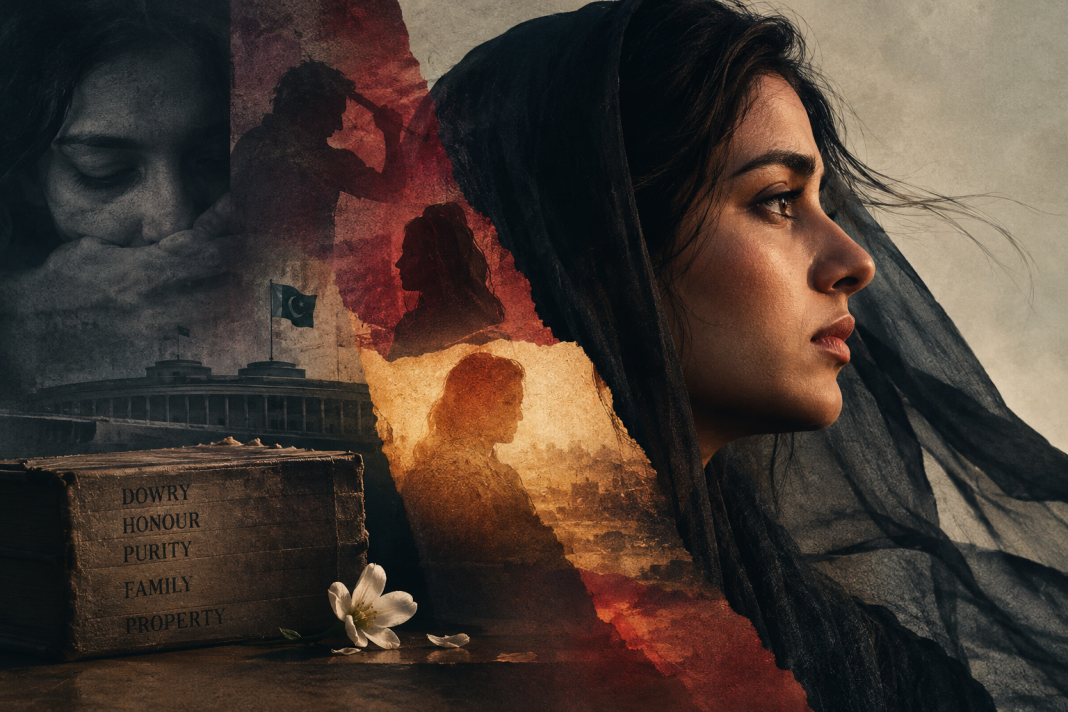
For most of human history a woman was not a person under the law of her own house. She was an asset with a pulse-entered in a father’s ledger, transferred to a husband’s, mourned as property when she died and punished as property when she disobeyed. Every civilization dressed this in its own language: dowry, purdah, chastity, honor. Underneath the language sat the same verdict. You belong to us. Your body is the collateral.
We like to say we have moved past that verdict. We have only upgraded the paperwork and kept the sentence.
In July 2016 Qandeel Baloch was strangled in Multan by her brother. She had been funny online, unbothered, difficult to shame. That was the offense. He told reporters he had done it for the family’s honor. The killing was so public that Parliament wrote a law to close the old door: a family would no longer be allowed to pardon its own daughter’s murderer and send him home. In 2019 a court gave him life. In 2022 an appeals court let him out. Witnesses took back their words. Her parents said they had forgiven him. The case that forced the reform could not keep her killer in a cell.
Kill your sister. Wait. Watch the file get thin.
The comfortable theory is that this happens only to women with no schooling and no name. Pakistan has spent decades disproving that on both ends of the same street.
In 2002, in Meerwala, a village council used Mukhtaran Mai’s body to settle a rumor about her brother. She had no title and no armor. She was gang-raped anyway. She refused the script that said she should disappear. She built schools with the compensation money. Most of the men walked. A high court freed them. The Supreme Court, years later, left almost all of that standing. One man remained in prison. The rest of the sentence landed on her and stayed there.
Read more: Innocent Before the Inquiry Began
In 2021, in Islamabad, Noor Mukadam was held, tortured, and beheaded in a house in F-7. She was twenty-seven. Her father had been an ambassador. The man who killed her came from money. Class did not check her name at the door. A court later sentenced him to death. That does not unwrite the night. A village woman with nothing. A diplomat’s daughter. The verdict did not ask for an address.
In June 2025 a seventeen-year-old, Sana Yousaf, was shot in her own home in Islamabad by a man she had refused. Police said the refusal was the reason. A phone in a girl’s hand was still treated as an invitation. No, spoken once, was not a complete sentence. It was an opening he decided to close.
The Human Rights Commission of Pakistan recorded at least 470 killings in the name of honor in 2025. Activists who work the cases say the real number sits closer to a thousand, because so many deaths are filed as accident or nothing at all. In 2024 the Sustainable Social Development Organization counted more than five thousand reported rapes in the country and a conviction rate of about one in two hundred — in Punjab, under half of one percent. The Acid Survivors Foundation has counted nearly four thousand acid attacks since the late 1990s. A woman’s face still costs less than the bottle it took to destroy it.
This is not only Pakistan’s book. UNODC and UN Women estimated that in 2024 about fifty thousand women and girls were killed by partners or family — one every ten minutes — in every region at once. A woman bleeding in Lahore and a woman bleeding in Los Angeles are not sitting two different exams.
I did not sit down only to keep the ledger. The future I want for my daughter is not a program. Her body belongs to her. No clause about honor. No asterisk for the hour or the clothes or the phone. A man’s rejection should be survivable for her to give, the way it is ordinary for him to give it to her. No, said once, should be the end of the matter — in a court, in a house, in a country.
We measure women by the seats they are finally allowed to sit in. Those seats matter. A woman does not become fully human the day she is sworn in. She becomes fully human the day the verdict changes — the day her life, her word, and her right to say no stop being negotiable in the house she was born into.
Until that day, every cabinet chair we hand a woman is a magnificent seat bolted to the floor of a house still on fire.
I do not want the chair. I want the fire out.
Sameena Faisal Khan is a writer based in St. Louis. She holds a master’s in English literature and writes on women, rights, and the rooms a society still refuses to open.
The views expressed in this article are solely those of the author and do not necessarily reflect the views of global village space