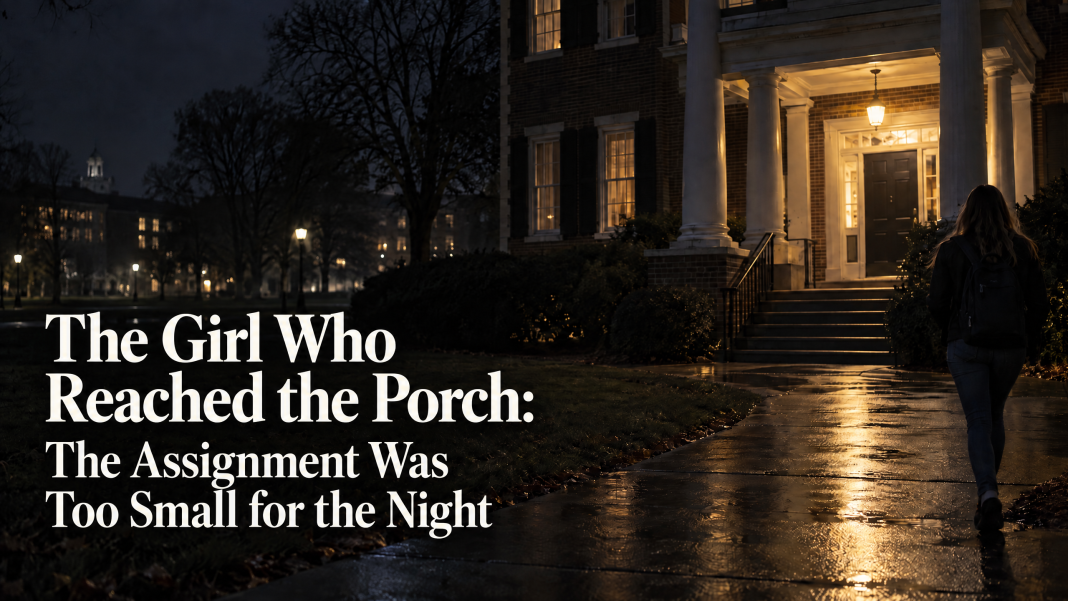
A girl walks alone at night to a house with Greek letters on the door because she thinks a friend is inside.
That is where I keep stopping. Not at the drug or the group chat, but at the porch. She was twenty and had been drinking. She walked toward someone she knew, into a house that calls itself a brotherhood, believing the word friend still meant something late at night.
I will not restage what happened inside. The lawsuit is already taking that inventory, and a court will weigh it. What I want to talk about is the homework.
In October 2024, a Cornell student, Jane Doe in the papers, says she was given alcohol and ketamine at the Chi Phi house and sexually assaulted by several men over hours. She reported it weeks later. Then came campus process: hearings, interim suspensions, privacy law. The chapter is still barred. Her lawyer says two men were expelled and others suspended. Her complaint says some were allowed to mitigate what they had done by writing essays. Cornell says federal privacy law keeps it from discussing individual outcomes. Fine. But if the complaint is right, a university looked at that night and assigned a paper.
The men who stayed got to live inside a word called process. She got two years of waiting.
She left Cornell. Her lawyer has said so. To make the night audible, she filed 101 pages and lived it again for strangers. We call that seeking justice. It is also a second tuition. She paid to leave, and then she paid to be believed. Some of them, she says, wrote a reflection and stayed.
She has sued the university, the fraternity, her own sorority, the bar that served her, and seven men. That is what a woman writes when the first homework does not hold. The men deny it. A court will decide, and it should. In 2024 the district attorney reviewed the police file and found insufficient evidence to charge anyone. Insufficient. That is the word the state chose. This week he reopened the case for a grand jury. He says a transcript in which she told police she was raped never reached him. I will not convict seven men from a kitchen in St. Louis. But I will say what process keeps dressing up: insufficient describes a file. It does not describe a night.
For forty years, researchers have asked college men some version of one question: if no one would ever know, and nothing would happen to you, would you force a woman to have sex? In one small study that made headlines, about a third said they might. When the same question used the word rape, most of those men said no. They could imagine the act. They could not stand the name.
An essay lives in that gap. A reflection lets a man describe a night in his own vocabulary, and his vocabulary never has to contain the word.
Her own sorority is in the suit too, accused of failing to look after her before she ever reached that porch. That should sting. Women are not immune to the habit of looking away.
Here is what we taught our daughters. Don’t drink too much. Don’t go in alone. Text when you get there. Hold your keys like a weapon. We called that raising them well.
My daughter is a senior. Our table is covered in college brochures, the Ivy League ones on top. I asked her once what she would do if, for one night, there were no men anywhere. She didn’t hesitate. She would go for a walk. She would put on music and dance under the stars. She would lie down in the grass.
Read more:The Verdict Has Not Changed: When a Woman’s No Is Still Negotiable
That is the whole wish. Not power. Not revenge. Grass.
Jane Doe only got as far as the walk.
I am proud of those brochures. I am also afraid of them. We tell our daughters that education is the door out. We do not tell them that some will pay for it at a porch.
Here is what we taught our sons: be good. But good is a mood. We did not teach them to walk her home. We did not teach them to leave the room, or say so out loud, when a girl became a punchline. We did not teach them that when she cannot decide, they do not get to.
The complaint says a message went out to a fraternity group chat while she was upstairs. A chat is not a hallway you happen to pass through. Every man who read it and put his phone down made a decision. We let a generation believe silence is neutral. It isn’t. Not replying is still choosing a side.
We call it consent education and hand the whole lesson to the girl. Say no. Leave. Carry your keys. Nobody sits the boy down and tells him the night is not his because she came, or that a friend is not a door.
So here is what change looks like, and none of it is a slogan.
NOW: Thousands march through Cornell University campus, demanding Justice for Jane Doe and “Tear Down the Fkn Frats!” https://t.co/es7v60IIFU
— Oliya Scootercaster 🛴 (@ScooterCasterNY) October 5, 2026
Universities should stop letting essays, workshops, or reflections reduce sanctions for sexual assault. A finding of serious sexual misconduct is not a writing prompt.
Conduct codes should reach the men in the chat, not only the men in the room. Watching is participation with better lighting.
And sons should get the rules we have handed daughters for decades, flipped. If she is drunk, you get her home and you leave. If the chat turns ugly, you say so, out loud, with your name on it.
If a woman has to write 101 pages and a man can keep his place by writing a reflection, we did not raise them under the same rules. We raised her to survive the porch. We raised him to expect another assignment.
They wrote essays. She wrote a lawsuit. The original assignment was too small for the night.
Sameena Faisal Khan is a writer based in St. Louis. She holds a master’s in English literature and writes on women, rights, and the rooms a society still refuses to open.
The views expressed in this article are solely those of the author and do not necessarily reflect the views of global village space