

Bollywood actor Imran Khan, nephew of superstar Aamir Khan, has been directed to leave India by October 28 after participating in a protest organised by the satirical political group Cockroach Janta Party (CJP) in Mumbai.
The Mumbai Police issued a notice to the actor, citing provisions of India’s Immigration and Foreigners Act, 2025. According to the police, action was taken because Khan participated in the protest despite not being an Indian citizen.
🚨 Mumbai Police has directed Bollywood actor Imran Khan to leave India by October 28 because he participated in a protest in India despite being a US citizen.
Hopefully, German Shepherd Dhruv Rathee will also be deported to Germany or face strict legal action. https://t.co/9uqgJZd9zj
— Tejash (@lord_geopolitic) October 15, 2026
Khan holds US citizenship and possesses an Overseas Citizen of India (OCI) card, which allows eligible foreign citizens of Indian origin to enjoy certain privileges in India but does not grant them full Indian citizenship.
The development comes days after Khan, his partner and actor Lekha Washington, and his cousin Zayne Marie Khan were detained during the October 10 demonstration in Mumbai. The three were subsequently released.
Mumbai Police Issues Notice to Imran Khan
The Mumbai Police issued the notice directing Khan to leave India by October 28, invoking provisions of the Immigration and Foreigners Act, 2025.
The legislation includes Section 7, which empowers the Indian central government to issue orders and directions regulating, restricting or prohibiting the entry, departure, presence and movement of foreign nationals in the country.
Police said action had been taken against the actor under the relevant immigration provisions because he participated in the protest despite not holding Indian citizenship.
The notice has brought attention to the legal status of Overseas Citizen of India cardholders and the restrictions that may apply to their participation in political activities.
Although OCI cardholders can live and work in India under specified conditions, the status does not confer the same rights as Indian citizenship. OCI holders are also subject to applicable laws and conditions governing their stay in the country.
The notice follows the actor’s involvement in a demonstration that resulted in the detention of hundreds of participants.
BJP Leader Kirit Somaiya Raises Complaint
The action against Khan followed a complaint by Bharatiya Janata Party (BJP) leader Kirit Somaiya, who approached the Mumbai Police over the actor’s participation in the demonstration.
Somaiya reportedly alleged that Khan should face action for taking part in what he described as an illegal political agitation and for allegedly violating OCI provisions and visa conditions.
The complaint brought the actor’s immigration status into focus and prompted scrutiny of his participation in the protest.
The police subsequently issued the notice under the provisions of the Immigration and Foreigners Act, 2025.
The development has raised questions about the rules governing foreign nationals and OCI cardholders who participate in political demonstrations in India.
However, the police action and the allegations surrounding the protest should be distinguished from any final judicial determination of the matter.
Imran Khan Detained During October 10 Protest
Khan was among hundreds of people who gathered at Mumbai’s August Kranti Maidan on October 10 to protest against Chief Election Commissioner Gyanesh Kumar.
The demonstration was organised by the Cockroach Janta Party, a satirical political group. Participants included Khan, his partner Lekha Washington and his cousin Zayne Marie Khan.
The gathering also involved members of the organisation Hum Bharat Ke Log, led by Tushar Gandhi, and activists associated with the Communist Party of India (Marxist).
According to reports, police detained approximately 400 people during the demonstration. Khan and the two women accompanying him were among those taken into custody.
The three were released later.
The protest focused on concerns surrounding the Election Commission and restrictions on public expression. Police action during the gathering subsequently attracted attention because of the number of people detained and the presence of well-known personalities.
Actor Questions Restrictions on Freedom of Movement
Following his detention, Khan spoke to the media about his reasons for attending the demonstration.
He said he had gone to the location as a resident of Mumbai and was not there to present specific demands.
The actor explained that he wanted to understand why people’s freedom of movement was being restricted and why, in his view, their voices were being suppressed.
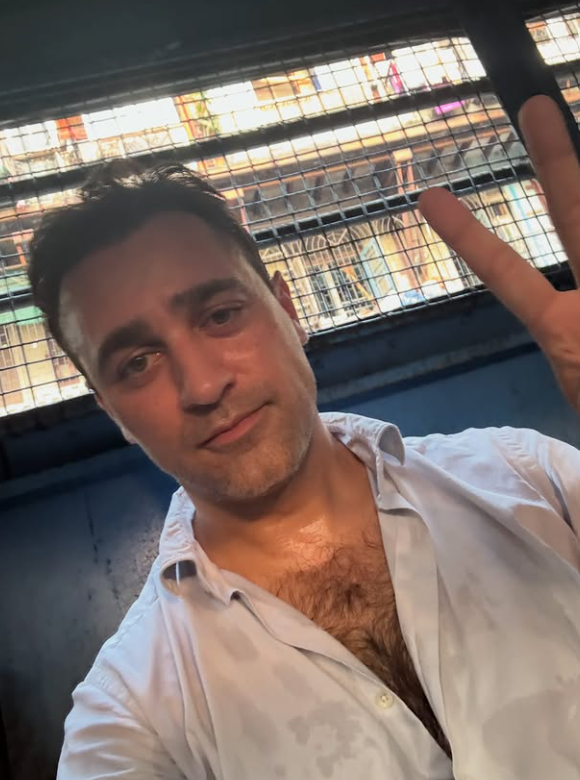
Khan also described the circumstances of his detention, saying that police had taken demonstrators from the streets and placed them in vans.
In a video that circulated online, the actor was heard saying that he did not understand why he had been taken into custody. He also claimed that he and others had been driven around in a police van for approximately two hours before being released.
Khan also shared a photograph of himself inside a police van on social media, captioning it, “Apparently I’m going for a drive.”
The posts and videos brought additional public attention to the demonstration and the police response.
Who Is Imran Khan?
Imran Khan is an Indian actor best known for his work in Bollywood films, including Jaane Tu… Ya Jaane Na, I Hate Luv Storys and Delhi Belly.
He is the nephew of Bollywood superstar Aamir Khan and has maintained a relatively low public profile compared with many of his contemporaries.
Khan’s US citizenship and OCI status have become central to the latest development, as authorities have cited his participation in the protest as the reason for the immigration action.
The notice directing him to leave India by October 28 marks a significant development following his detention.
Immigration Notice Puts Focus on OCI Rules
The case has drawn attention to the distinction between Indian citizenship and OCI status, particularly in relation to political participation and immigration regulations.
OCI cardholders of Indian origin are permitted certain long-term privileges, but they remain foreign nationals and do not possess all the constitutional and political rights available to Indian citizens.
The Mumbai Police’s action against Khan is based on immigration provisions cited in the notice. The subsequent handling of the matter will determine its practical implications for the actor.
As the October 28 deadline approaches, the case is likely to remain under public scrutiny, particularly given Khan’s Bollywood connections and the controversy surrounding the protest.
The development also highlights the legal complexities that can arise when foreign nationals participate in political demonstrations and the importance of understanding the conditions attached to immigration status in India.