
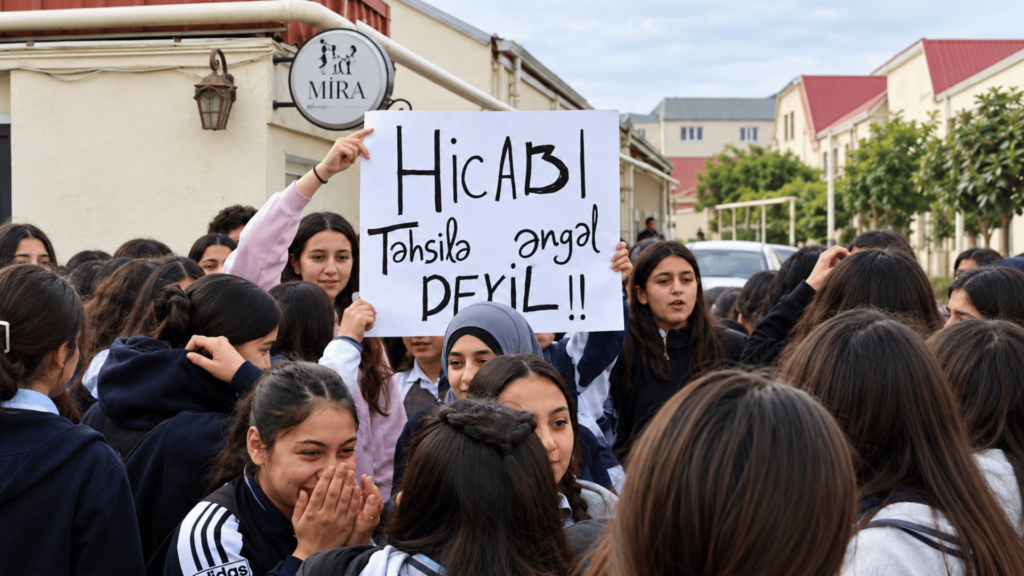
Azerbaijan’s restrictions on wearing the hijab in schools have triggered protests across the country, with students refusing to attend classes in solidarity with their classmates and parents demanding that girls be allowed to receive an education without giving up their religious clothing.
Anger is growing in Azerbaijan after girls wearing hijabs were barred from schools under new uniform rules.
Students and teachers have staged demonstrations, while dozens have reportedly been arrested and users report disruptions to social media platforms. https://t.co/3OQU4UjoPW
— Al Jazeera English (@AJEnglish) October 12, 2026
The controversy has intensified following the introduction of new school uniform requirements, which critics say are being used to prevent female students wearing hijabs from entering classrooms. Teachers who wear headscarves have also reportedly faced pressure to remove them or resign from their jobs.
On October 12, Azerbaijan’s Interior Ministry announced the arrest of 37 people in connection with incidents linked to the enforcement of school uniform regulations. The ministry said a criminal case had been initiated over alleged actions that disrupted public order.
♨️ Male high school students in Azerbaijan are breaking school doors to allow girls wearing hijab to enter.
Azerbaijani women say:
We would rather die than give up our hijab.More than 100 students have reportedly been arrested in connection with these events.
#Azerbaijan https://t.co/lFCV49AjPE
— samaneh & esmaeili (@EssSamaneh) October 14, 2026
The developments have raised questions about religious freedom, parental rights and children’s access to education in the predominantly Muslim country, where authorities maintain that secular education and uniform dress codes must be protected.
Students Stage Protests in Baku and Other Districts
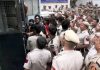
Protests have been reported at several schools in Baku and other parts of Azerbaijan, with students expressing solidarity with girls who have been prevented from attending classes because they wear hijabs.
Videos circulated on social media showed students gathering outside School No. 322 in Baku, demanding that their classmates be allowed to enter the premises and attend lessons.
A similar demonstration took place outside School No. 69 in the Balakhany settlement of Baku. In a video published on October 9, students were seen refusing to attend classes in solidarity with their hijab-wearing classmates.
Protests have also been reported at a school in the village of Mollaoba in the Masally district. Meanwhile, footage from School No. 9 in the Jalilabad district showed girls allegedly being prevented from entering the building because they were wearing headscarves.
School protests have now started in Azerbaijan. Here, people are not happy with president Aliyev’s draconian measure to pull every girl out of the classroom who wears hijab. Often such removal process is accompanied with humiliating perp walk. Parents took issue with that. 👀 https://t.co/WbYP8m7Tn9
— Bashkarma🇺🇸🌏🇷🇺 (@Karmabash) October 12, 2026
In Khokhmeli, a settlement in Baku, parents warned that they could stop sending their sons to school as well if the restrictions on female students continued.
Demonstrators have gathered outside school buildings, boycotted lessons and called for the restrictions to be lifted. Their central demand is that students should not be denied access to education because of their religious clothing.
New Dress Code Rules Under Scrutiny
The controversy follows Cabinet of Ministers Resolution No. 309, adopted on September 21, which prohibits additional clothing items that violate school uniform requirements or contradict the principle of secular education.
Although the resolution does not explicitly name the hijab, complaints from schools suggest that the rules are being applied to headscarves worn by female students.
Critics argue that preventing girls from entering classrooms effectively amounts to a ban on the hijab, regardless of the wording of the regulation.
The amendments also do not explicitly establish suspension from classes as a separate punishment for violating the dress code. This has raised questions about the legal basis on which school administrations are barring students from attending lessons.
On October 9, the Baku City Education Department announced inspections to check whether students and teachers were complying with clothing requirements, indicating that enforcement extends beyond isolated decisions by individual schools.
The restrictions have placed the right to education at the centre of the dispute. Critics argue that authorities should explain how wearing a headscarf interferes with classroom learning and whether denying students access to lessons is a proportionate response to uniform violations.
Azerbaijan Arrests 37 People Over School-Related Incidents
In a statement issued on October 12, the Interior Ministry linked the arrest of 37 people to incidents surrounding the enforcement of school uniform requirements.
Authorities opened criminal proceedings under Article 233 of Azerbaijan’s Criminal Code, which addresses organising or actively participating in actions that disrupt public order.
The ministry accused those detained of provoking confrontations with education workers in Baku, damaging educational institutions and attempting to obstruct school operations and traffic.
However, the statement did not identify the schools allegedly damaged or provide specific details of the actions attributed to the detainees. It also did not disclose their names or ages.
The lack of information has prompted questions about whether any minors were among those arrested and how authorities are distinguishing peaceful demonstrations from alleged criminal conduct.
The ministry said the measures were necessary to ensure the safety of students and teachers. However, critics fear that criminal proceedings could discourage parents and students from participating in protests over access to education.
The arrests have further heightened tensions surrounding a dispute that began with school clothing requirements but has increasingly involved questions of religious freedom and the limits of state authority.
Religious Freedom and Parental Rights Debate Intensifies
The controversy has also renewed discussion about the rights of parents to raise their children according to their religious beliefs.
Article 18 of the International Covenant on Civil and Political Rights recognises the right of parents to ensure the religious and moral education of their children in accordance with their convictions. Articles 5 and 14 of the Convention on the Rights of the Child also address parental responsibilities and the role of families in guiding children’s development.
Critics of the restrictions argue that maintaining a secular education system does not necessarily require students to abandon religious clothing.
They maintain that schools should ensure access to education while applying uniform regulations in a manner that respects fundamental rights.
Public opinion in Azerbaijan remains divided. Press Council chairman Rashad Majid has defended the restrictions as necessary to protect the country’s secular character, arguing that foreign influence is behind the protests.
In contrast, jailed journalist Polad Aslanov announced a hunger strike in protest against restrictions affecting female students and teachers who wear hijabs.
Some online discussions have also questioned the restrictions while expressing opposition to children wearing religious clothing. This reflects a broader debate over whether disagreements about religious dress should result in students being excluded from classrooms.
Teachers Face Pressure Over Headscarves
The dispute has extended beyond students to female educators.
On October 6, separate dress code requirements for teachers were approved. Subsequent reports indicated that some teachers wearing hijabs were being pressured to remove their headscarves or leave their jobs.
Teachers in Sumgayit told Toplum TV that some schools had demanded that they remove their hijabs or submit resignation letters. Journalist Arzu Abdulla also reported a similar situation at School No. 90 in Baku’s Ramana settlement.
Critics argue that pressuring educators to resign can create the impression that they have voluntarily ended their employment, potentially obscuring the circumstances surrounding their departure.
The developments have raised concerns about whether religious clothing is being prioritised over teachers’ professional qualifications and experience.
Political Tensions and Previous Hijab Protests
The dispute has also become part of a wider political discussion about religious influence and national identity.
On October 2, President Ilham Aliyev emphasised the importance of education in protecting Azerbaijan against what he described as ideological provocations. Although he did not explicitly refer to Iran or the hijab in the cited remarks, some political commentators interpreted his comments as a warning against perceived Iranian religious influence.
Commentators close to the authorities have linked opposition to the restrictions to alleged foreign interference, while critics warn that such arguments risk diverting attention from students’ right to education.
The issue has also drawn attention in Turkey, where demonstrators gathered outside Azerbaijan’s consulate in Istanbul on October 3 to demand that the restrictions be lifted. On October 7, Turkish ruling party spokesperson Omer Celik said groups opposing Azerbaijan had no ties to his party or government.
Azerbaijan has witnessed similar controversies in the past. In May 2011, police intervened during a demonstration outside the Education Ministry, followed by arrests and criminal proceedings. Religious figure Abgul Suleymanov, known for participating in protests against the hijab ban, was arrested that year and later sentenced to 11 years in prison on charges he denied. In September 2026, he was placed under administrative arrest for another 30 days, with his family linking the detention to his social media posts about the hijab.
The number of girls currently missing school because of the new restrictions remains unknown. It is also unclear how many teachers could face employment consequences.
As protests and arrests continue, the central question remains whether Azerbaijan can enforce its secular school policies without compromising students’ access to education and the rights of families and educators.