
Why does a Mughal emperor who died more than three centuries ago still provoke such anger in modern India? I did not set out to write about Aurangzeb.
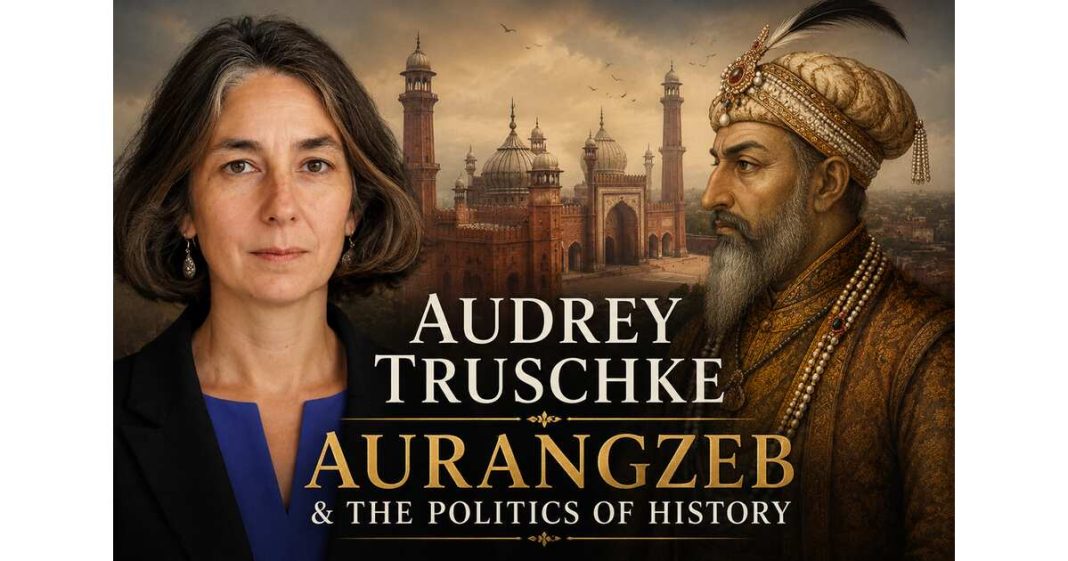
Over the past few weeks, I had been preparing for a possible interview with Dr. Audrey Truschke, the American historian whose work on Mughal India has generated fierce debate across South Asia. My intention was simple: read her books, understand her arguments, and prepare intelligent questions.
Instead, I found myself drawn into one of the most politically charged historical controversies of our time.
The more I read, the more I realized that the controversy surrounding Audrey Truschke is not really about Audrey Truschke. Nor is it entirely about Aurangzeb.
It is about how modern societies use history.
More than three centuries after his death, Aurangzeb remains one of the most divisive figures in South Asian memory. For many Indians—particularly those influenced by Hindu nationalist narratives—he represents religious intolerance, temple destruction, persecution of Sikhs, and the abandonment of the pluralistic traditions associated with Akbar the Great.
For many historians, however, Aurangzeb presents a different challenge. How should a ruler who governed a vast premodern empire be judged? By the political realities of his own age, or by the moral and ideological standards of ours?
That question lies at the heart of Audrey Truschke’s work.
Her 2017 book Aurangzeb: The Man and the Myth argues that the last great Mughal emperor was neither a saint nor a monster. Rather, he was a ruthless, pragmatic ruler whose actions were often driven by imperial politics, statecraft, and the preservation of power.
That interpretation has made her one of the most controversial historians writing about South Asia today. Her critics accuse her of minimizing historical suffering and whitewashing imperial abuses. Her supporters argue that she is doing precisely what historians are supposed to do: challenge myths, interrogate evidence, and resist the temptation to turn history into political propaganda.
What struck me while reading Truschke was not that she was defending Aurangzeb. In fact, many of her own descriptions portray a ruler capable of extraordinary ruthlessness. What intrigued me was something else.
Why does any attempt to complicate the popular image of Aurangzeb provoke such intense reactions in modern India? One of the central disputes concerns temple destruction.
Truschke does not deny that Aurangzeb ordered the demolition of important Hindu temples, including the Kashi Vishwanath Temple in Varanasi and the Krishna Janmabhoomi Temple in Mathura. Her argument is that these acts were often political punishments directed against rebellious elites and local power centers rather than part of a systematic campaign against Hinduism itself.
She also points to evidence that Aurangzeb granted patronage to certain Hindu religious institutions and employed large numbers of Hindu nobles in the Mughal administration.
For critics, these arguments are deeply unsatisfactory. They note that contemporary records sometimes celebrated temple destruction in explicitly religious language and argue that reducing such actions to political calculations ignores their lasting cultural and civilizational impact. The disagreement, therefore, is often less about facts than about interpretation.
The same debate surrounds Aurangzeb’s reimposition of the jizya tax, his execution of Sikh Guru Tegh Bahadur, and his treatment of political opponents. Truschke tends to interpret these actions within the broader framework of premodern imperial governance. Her critics see them as unmistakable evidence of religious intolerance.
As I continued reading, however, I became increasingly interested in another aspect of Aurangzeb’s reign. Perhaps the most revealing aspect of his character is not how he treated Hindus, Sikhs, Marathas, or rival Muslim sects.
Read more:
It is how he treated those closest to him.
Aurangzeb imprisoned sons he suspected of disloyalty. His daughter Zeb-un-Nissa—an accomplished poet, scholar, and intellectual—spent decades under confinement after being linked to her brother’s rebellion. Prince Muhammad Sultan died in captivity. Prince Mu’azzam spent years under suspicion before eventually succeeding his father as emperor.
These episodes complicate every simple narrative. They reveal a ruler consumed by insecurity, determined to preserve power, and increasingly unwilling to trust even members of his own family.
The rebellion of Prince Akbar is particularly revealing. Here was a Muslim Mughal prince allied with Hindu Rajputs and later protected by Hindu Marathas in opposition to a Sunni Muslim emperor. The episode reminds us that the politics of Mughal India cannot be reduced to a simple struggle between Hindus and Muslims. Power, loyalty, ambition, and survival often mattered more than religious identity.
By the end of his life, Aurangzeb appears to have understood many of the problems confronting his empire. His personal letters reveal an aging ruler aware of financial exhaustion, endless warfare, administrative overreach, and looming succession struggles. Yet awareness did not produce meaningful reform.
His greatest achievement became his greatest weakness. He expanded the Mughal Empire to its greatest territorial extent, but in doing so he overstretched its institutions, exhausted its treasury, and locked the state into conflicts it could no longer sustain.
This brings us back to Audrey Truschke.
The most interesting aspect of her work is not that it asks readers to admire Aurangzeb.
It does not. Nor does it deny his ruthlessness. Rather, it asks whether historical figures should be understood within the political realities of their own age rather than through the ideological battles of ours. After reading both Truschke and her critics, I find it difficult to accept either extreme.
The evidence does not support the caricature of Aurangzeb as a one-dimensional monster driven solely by religious hatred. Equally, it is impossible to ignore the destructive consequences of many of his decisions. He ordered temple demolitions. He reimposed the jizya tax. He fought endless wars. He ruled through fear, suspicion, and relentless centralization of power.
Yet perhaps the most revealing aspect of Aurangzeb’s character is not how he treated Hindus, Sikhs, Marathas, or rival Muslim sects. It is how he treated those closest to him.
He imprisoned sons, alienated allies, crushed dissent within his own family, and condemned his brilliant daughter Zeb-un-Nissa to decades of confinement. He trusted few people and ultimately created a political system that depended almost entirely upon his own authority.
Read more:Pakistan’s Real Problem: Pak Army or the Magical Powers of Army Chief?
In that sense, the historical debate may be asking the wrong question.
The issue is not whether Aurangzeb was a hero or a villain. The more useful question is whether he was a successful ruler.
By that measure, the verdict becomes far more complicated. Aurangzeb inherited one of the most powerful states in the world and expanded it to its greatest territorial extent. Yet he also left behind an exhausted treasury, a militarized administration, a fractured political elite, and heirs too divided to preserve the empire he had spent half a century building.
Within decades of his death, the Mughal Empire entered a long period of decline. Provincial governors became independent rulers. The Marathas surged northward. The authority of Delhi steadily eroded. This does not make Aurangzeb uniquely evil. Nor does it make him misunderstood. He was neither the devil of nationalist mythology nor the misunderstood liberal of revisionist imagination.
He was a formidable emperor, a deeply authoritarian ruler, a failed father, and perhaps the last Mughal powerful enough to shape the destiny of the subcontinent. The larger significance of Audrey Truschke’s work is not that it asks us to admire Aurangzeb.Rather, it asks whether history should be approached as a search for understanding or as a search for heroes and villains.
More than three centuries after Aurangzeb’s death, that question remains as politically explosive as the emperor himself.
I hope to explore these questions directly with Dr. Audrey Truschke in a future conversation.
Moeed Pirzada is Editor Global Village Space; he is also a prominent TV Anchor and a known columnist. He previously served with the Central Superior Services in Pakistan. Pirzada studied international relations at Columbia University, New York and Law at London School of Economics, UK as a Britannia Chevening Scholar. He has been a participant in Chaophraya Dialogue and Salzburg Forum and has lectured and given talks at universities and think tanks including Harvard, Georgetown, Urbana Champaign, National Defense University, FCCU, LUMS, USIP, Middle East Institute and many others. Twitter: MoeedNj.