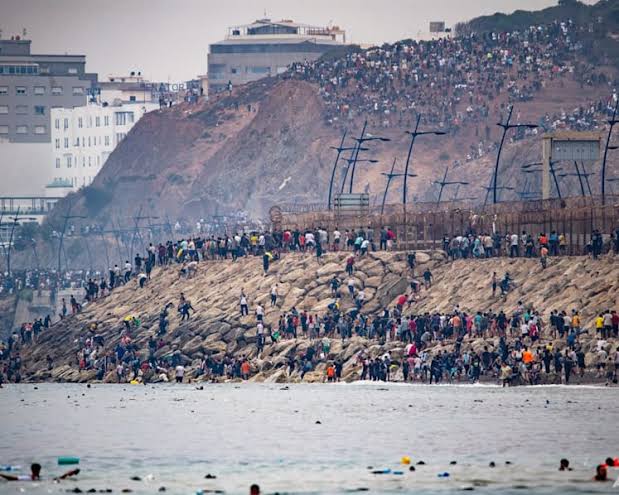
Spanish officials said Saturday that most of the tens of thousands of migrants who streamed into its north African enclave of Ceuta from Morocco in recent days have now left.
But the episode has been seized upon by right-wing politicians as showing a weakness in EU border management, and raised questions about why Morocco allowed so many migrants to head to Ceuta’s border.
Read more: UEFA, CONCACAF target Infantino after FIFA shelve World Cup private investment plan
– How many migrants? –
Ceuta’s population is just 84,000, but between Wednesday and Friday an estimated 60,000 migrants entered the territory, Ceuta’s top official Juan Jesus Vivas said. The Spanish interior ministry put the figure at 50,000.
The INVASION of Spain is unfolding right before our eyes 🇪🇸🚨
Prime Minister Pedro Sanchez’s government policies are actively encouraging massive waves of migration from Africa into Spain.
The Spanish territory of Ceuta – an enclave bordering Morocco near the Strait of… pic.twitter.com/w8i0JR04yR
— Predictivemoney (@Predictivemoney) July 30, 2026
By late morning Saturday however, “almost all” had left and the situation in the territory had practically returned to normal, said Spain’s Interior Minister Fernando Grande-Marlaska.
But at least 67 people had died trying to reach Ceuta, he added.
The scale of the influx was far bigger than the last such event in May 2021. Vivas said at the time that around 12,000 crossed the border from Morocco into Ceuta over two days.
WATCH: Video appears to show Morocco’s Royal Gendarmerie standing by as trucks carrying young men unload near the Spanish border during yesterday’s Ceuta migration surge.pic.twitter.com/NfvKzyp5QG
— Clash Report (@clashreport) July 31, 2026
– What is Morocco doing? –
Ignacio Cembrero, a Spanish journalist who specialises in migration in North Africa, said it appeared Moroccan security forces had been “sitting on their hands” since Wednesday.
“To reach the breakwater that marks the border between Ceuta and Morocco, there are cordons of police and auxiliary forces, and it’s obvious they’ve been allowed through,” he said.
Carlos Echeverria, director of the Ceuta and Melilla Observatory, said the use of the controversial term “invasion” could be justified, given that “thousands of people are illegally crossing an international border, putting pressure on a neighbouring country”.
On Saturday, the Moroccan Association for Human Rights (AMDH) called for an independent inquiry to “shed full light” on the causes of the influx.
This is deeper than illegal migration. It’s an act of war.
Moroccan authorities were spotted standing aside and even actively aiding the invaders into Spain. Reports (and the videos themselves) suggest these aren’t poor refugees, but fighting age men. Many are leaving Morocco… pic.twitter.com/5edW4PIYS3
— Vince Dao (@VinceDaoTV) July 30, 2026
– Why now? –
It was not clear why this happened now.
One possible reason for the time could be Spain’s Supreme Court ruling on July 8 that migrants arriving by sea should not be returned as quickly as others.
“Without a doubt, the July 8 ruling… has played a role,” Cembrero said. “But that doesn’t explain the level of mobilisation.”
Some observers argue that the Spanish government’s relatively open migration policy could have played a part.
✳️ JUST IN 🇪🇸🔴
Spain is now installing a floating barrier in Ceuta after 50,000+ crossed in hours… and 67 people died.
Most have already been pushed back. The “surge” is over almost as fast as it began.
This was never about spontaneous migration.
It was a pressure… pic.twitter.com/R4jVeIzAix— New Direction AFRICA (@Its_ereko) August 1, 2026
– Morocco’s role –
Some analysts say Morocco is using the migration issue as a tool of diplomatic pressure.
Ever since it gained its independence in 1956, Morocco has claimed sovereignty over Ceuta and Melilla. Spain has flatly rejected any talks to change the status quo.
Cembrero argued that Morocco had “seen an opportunity” to force Spain to negotiate.
– Could the migrants have travelled to the rest of the EU? –
No. Spanish officials stressed that, under Schengen Area rules, Ceuta and another enclave, Melilla, have specific procedures in place applying border controls for anybody boarding air or sea transport to mainland Europe.
Irregular entry into Ceuta does not confer a right to remain in Spain, travel to the mainland, or move freely throughout Europe, they said.
None of the people who entered Ceuta irregularly left the city for the European mainland, nor would they be able to, the officials said.
– International reaction –
Despite the barrier to any of the migrants heading to mainland Europe, Italy announced Friday it was suspending Schengen rules allowing border-free travel with Spain.
Madrid condemned the move, and its practical effect remains unclear given the two countries do not share a border.
I held a conference call with Commissioners @magnusbrunner and @dubravkasuica for an update on the situation in Ceuta.
The good news is that the vast majority of those who arrived illegally have returned to Morocco, due to the effective work of Spanish and Moroccan law…
— Ursula von der Leyen (@vonderleyen) August 1, 2026
Legal experts told AFP the move by Rome’s right-wing government was impossible to implement under the current legal framework.
France and Britain have expressed “solidarity” with Spain, but France also announced a five-fold increase in the number of police at its border with Spain.
Portugal also said it would beef up controls at its southern land and maritime borders.
European interior ministers will meet by video link on Tuesday to discuss the issue.
US President Donald Trump, who has made anti-immigration policies a centrepiece of his time in the White House, on Friday called the migrant inflow into Ceuta a “catastrophe” and an “invasion”.
He sought to tie it to mid-term elections he faces in November, saying: “That same thing’s going to happen to us if the Republicans don’t get elected, except worse, much bigger.”