
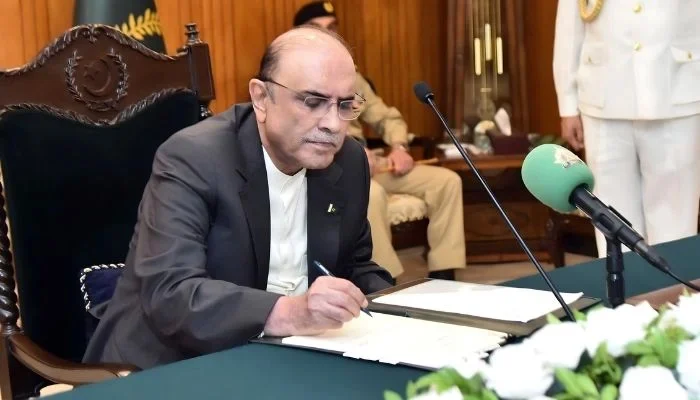
President Asif Ali Zardari on Sunday approved the imposition of an emergency and governor’s rule in Khyber Pakhtunkhwa (KP) on the advice of Prime Minister Shehbaz Sharif, citing the province’s deteriorating security situation and disagreements between the federal government and provincial leadership.
According to a statement issued by the President Secretariat’s Media Wing, the president signed the summary under Articles 232 and 234 of the Constitution of Pakistan. The decision followed recommendations from the federal cabinet, advice from the prime minister and reports submitted by relevant security institutions.
Read more: Pakistan Committed to Peaceful Resolution of Middle East Conflict: ISPR DG
The development comes amid rising political tensions in the province following the failure of negotiations between the government and opposition and a long march led by KP Chief Minister Sohail Afridi.
Governor to Take Charge With Advisory Council
Federal Law Minister Azam Nazeer Tarar announced at a news conference in Islamabad that KP Governor Faisal Karim Kundi would assume responsibility for administering the province with the assistance of an 11-member advisory council.
According to the minister, the arrangement would initially remain in place for six months.
The federal government cited concerns over the provincial administration’s counterterrorism efforts and the worsening law-and-order situation as key reasons behind the decision. The breakdown of negotiations between federal government representatives and the provincial leadership also contributed to the move.
Read more: Khawaja Asif Warns Imran Khan Will Get No Relief if PTI Attempts to Pressure
The Constitution empowers the federal government to take certain measures during an emergency, including provisions affecting the exercise of powers by provincial authorities, subject to constitutional requirements.
The imposition of governor’s rule marks a significant development in relations between the federal government and the Pakistan Tehreek-e-Insaf (PTI)-led provincial administration.
Political Tensions Rise After Sohail Afridi’s Long March
The decision follows a long march led by Chief Minister Sohail Afridi, which began in Lakki Marwat on October 4 after negotiations between the government and opposition failed to produce an agreement.
The talks reportedly broke down over disagreements regarding counterterrorism cooperation in Khyber Pakhtunkhwa and access to incarcerated PTI founder Imran Khan, including a meeting with his personal doctor.
The government and opposition subsequently exchanged accusations over the failure of negotiations as Afridi continued leading the march through the province.
PTI had demanded access to its incarcerated founder, while the government sought assurances regarding the conclusion of the protest before accepting the protesters’ demands.
The confrontation has added to political uncertainty in KP, where security concerns and disagreements over the provincial government’s handling of terrorism have become central issues in the dispute between the two sides.
KP Governor Welcomes Presidential Proclamation
Following the announcement, Governor Faisal Karim Kundi said the people of Khyber Pakhtunkhwa welcomed the presidential proclamation and wanted peace, stability, development and prosperity rather than unrest and insecurity.
In a video message addressed to the province’s residents, Kundi said peace-loving citizens did not support terrorism or violent activities.
He also said the people had resolved not to support Fitna al-Khawarij, a term used by Pakistani authorities for the banned Tehreek-e-Taliban Pakistan (TTP), and would stand alongside security forces in the fight against terrorism.
The governor stressed that residents wanted a peaceful and prosperous future, supported by mutual cooperation and brotherly relations with other provinces.
He urged citizens to maintain peace, respect the law and refrain from inciting violence or participating in riots.
Kundi warned that action would be taken against individuals who disturbed public order or took the law into their own hands.
Fazlur Rehman Calls Governor’s Rule an Attack on Democracy
Meanwhile, Jamiat Ulema-e-Islam-Fazl (JUI-F) chief Maulana Fazlur Rehman criticised the imposition of emergency and governor’s rule, describing the move as an “attack on democracy.”
Addressing a press conference, Fazlur Rehman said his party would reach out to the public and continue playing its role both inside and outside parliament.
He claimed the government wanted the long march to end before agreeing to the protesters’ demands.
According to the JUI-F chief, PTI had sought permission for its representatives to meet Imran Khan. He said he had discussed the situation with Sohail Afridi, Barrister Gohar Ali Khan, Shahram Khan Tarakai and Asad Qaiser.
Fazlur Rehman added that PTI representatives had indicated their willingness to call off the long march if their demands were accepted.
His remarks highlighted opposition concerns over the federal government’s decision and its potential implications for political engagement between the Centre and the province.
Pakistan Army Deployment Approved Under Article 245
Separately, the federal government approved the deployment of the Pakistan Army in Khyber Pakhtunkhwa under Article 245 of the Constitution, according to an official notification.
The army will assist the civil administration, protect citizens’ lives and safeguard public property and government installations.
The notification stated that the deployment would remain in effect for the duration of the emergency imposed on October 11.
It also said the KP governor would determine the number of troops required in consultation with General Headquarters (GHQ) and the Military Operations Directorate.
The military deployment is intended to support the administration in maintaining law and order during the emergency.
The measures come at a time of heightened security concerns and political confrontation in the province. With governor’s rule, the advisory council and military assistance now part of the federal response, developments in KP are expected to remain closely tied to the government’s efforts to address security challenges and manage its dispute with the opposition.