
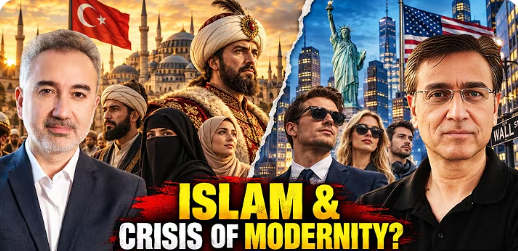
Dr. Moeed Pirzada, Editor-in-Chief of Global Village Space, invites Turkish author and Cato Institute scholar Mustafa Akyol to examine the Muslim world’s complex and often painful struggle with modernity, secularism, and political reform. The discussion examines why Muslim societies have struggled to modernize and argues that individual liberty and liberal democracy offer a far more constructive path forward.
Interview published on 3rd November 2026
Moeed Pirzada: Asalamu alaikum. This is Mooed Pirzada in Washington, United States. I’m very glad to welcome Mustafa Akul back to this platform. Mustafa, thanks for joining. First of all, let me congratulate you for the UDU edition of your book, Why as a Muslim I defend liberty? What has been the response so far to this book? Why you thought an Udu edition was necessary?
Mustafa Akyol: Well, first of all, thank you Mooed for having me again. And it’s a pleasure to be with you and asalamu alaykum and you know greetings to everyone who is watching us. Indeed I had the pleasure of getting this book launched, Why as a Muslim I defend liberty, and you know you can—no, the book is not visible. Show it, show it. Show it. No, it’s not visible. Bring it in front. No, bring it in front of your face. Okay. Here we go. Yeah. Yeah. Yeah. Now, now it is visible. By Fidman. Yeah. Fidan. Okay. Okay. Well, I owe this to Fidaw Rahman’s initiative who’s a, you know, young academic in Islamic studies in Pakistan. And I had met him in conferences in the US. He came to Kato Institute as well, as well as the Actton Institute. And I published this book, I mean I wrote this book during the co years, the COVID months I should say, in 2021, which is a short book that shows why as a Muslim who’s working on these issues I think freedom, individual freedom, hura as we’re called in Islamic languages, is a crucial political value. And it discusses about political freedom, it discusses ideas of economic freedom, ideas of religious freedom as well, which is very much a focus my work. So and I make the case that Muslim societies in the past 200 years clearly see that a lot of countries are ahead of us. The western civilization is ahead of us, right? I mean we want to catch up, and those catchup ideas sometimes turned into authoritarian programs of catching up. And I say that this is the wrong approach. If there is one success, one key to the western success in the past few hundred years, it’s mostly about freedom—freedom in the sense that individuals are freed to follow their religious persuasions, whatever that is.
Mustafa Akyol: The west was not always like this. There was a time they were having sectarian wars. Catholics and Protestants were killing each other for just being from the wrong sect. Religious toleration diffused these, allowed people from any religion—from Jewish, Christian, Muslim background too. And that allowed Muslims to also integrate into the western society, too. Also, people are free to speak up their minds. They’re critical of the government. They don’t like things in the country, they protested—not violently, but peacefully. So this is a good thing, too, because it allows people to share their views, and if you don’t do that, you suppress them. Actually, that creates more tension in society. So political freedom, of course, allows the government to be criticized and to be in check, because a government that cannot be criticized, you know, can go to any direction, as we see in authoritarian regimes. Or I make the case of economic freedom. If people can freely invest, have inventions, and have pursue their own interests, ultimately the common good benefits from this, because then you have creative people, you have people who have a new idea, and that’s how actually a lot of scientific inventions, economic, technological inventions came out in the west. So, and I I see the success of the west—and not just west, I mean now more Japan or Korea, some other societies too, even China, not politically, but economically, you know, understood the value of freedom. And I I discussed then from an Islamic point of view, do we have the same value? How do we connect it? What do we make a sense of Islamic law, the Sharia? What does the Quran say about these things? So, and I very much also got inspired by the 19th century liberals in the Muslim world.
Moeed Pirzada: Give me give me some names.
Mustafa Akyol: I mean, my intellectual hero Namık Kemal. Namık Kemal was the great Ottoman intellectual of the 19th century. He is the one who actually made freedom, hurriya, a term, you know, in Islamic political language. He was this—he was the builder in many ways of the Ottoman constitution of 1876.
Moeed Pirzada: Any names that come to your mind outside Ottoman Turkey?
Mustafa Akyol: Uh Khayr al-Din al-Tunusi, he was from Tunisia. Uh he also wrote a book about the shortest path to success and he examined western countries at the time and he saw freedom as a—as a crucial value. I mean there are a bunch of those and uh Arabs uh Albert Hourani who was a great scholar of the Middle East, he has a book on this titled The Liberal Age in Arabic Thought, right? Uh and he said there was a time Muslims were looking up to the west and seeing its successes and he studies them. What happened after was interestingly is that after World War I, after Western colonialism, the West became not an example but a threat, understandably. And a lot of Muslims reacted to this, but react to this in a way that they either became socialists or authoritarian Arab nationalists, ultimately Islamists, you know, in a reactionary sense, but we lost that interest—interest in the west in a way that wants to connect its good sides, you know, with—with Islamic tradition. Of course there are great names in the subcontinent, too. Uh Sir Syed Ahmed Khan was trying to, you know, reconcile the idea of freedom with Islamic teachings.
Moeed Pirzada: You’re referring to Sir Syed Khan?
Mustafa Akyol: Yes. Aligarh and other names of course. And—and of course I know our part of the world a bit more, but there are definitely great minds. Iqbal was of course one of those.
Moeed Pirzada: You know Mustafa, in the beginning, in the outset, you said that Muslim societies many times in order to catch up with the west were a sort of authoritarian. I thought you were referring to the modernist movements that were compelling people to become modern, like the Kemalists in Turkey and maybe the Baathists in Syria and Iraq and maybe in some other countries, right? So this kind of authoritarianism was against the Islamists, but in the last 50 years the Baathists and the Kemalists have morphed. They’re less important, less relevant.
Moeed Pirzada: They have lost power. Now it is the Islamist that is actually, uh, exercising authoritarianism against other Muslims because, and then small non-Muslim minorities, or the liberals in the Muslim societies, the dissenting views. And in many countries, Muslim countries like in Pakistan, there is a—what the term used is a military-mullah alliance, that the religious clergy and the military authorities, they join together to suppress the liberties, to take control of the situation. How are you looking at all this?
Mustafa Akyol: Well, uh, unfortunately, some of our modernists are also authoritarian, have been authoritarian. And I mean, you mentioned the Kemalists in Turkey. Of course, Atatürk, Turkey’s founder, he won the war of liberation. I respect him for that, but he established an authoritarian modernization, and I’m critical of that. Another version of that was in Iran. Actually, a harder version of that was Iran under the Shah, uh, worse examples than Ba’athist regimes. And these were modernists, but they were unlike the liberal west, they were not liberal, because liberal means not coercive, right? So they were actually trying to transform society by decree. For example, Atatürk made this, had this famous or infamous hat revolution. He made it compulsory to wear a brimmed hat and ban the Ottoman fez. Now this was being like the west, but actually it wasn’t, because in the west people were not ordered to wear something on their heads, right? It was their culture. So instead of, instead of just bringing technology and development and learning, he just wanted to transform society by commands
Moeed Pirzada: But, why he wanted to—you know, I was curious, I I know about this, but just for my viewers and for myself as well, why the morphology in the outward look of a man and a woman, you know, like wearing a western hat or woman wearing a skirt or woman not wearing a veil, why was that important to Mustafa Kemal—mind him and the Shah, the Reza Shah in Iran, who also banned the hijab in Iran, and he was, you know, starting, triggering the path all the way to the Iranian revolution? So we had these secular illiberal authoritarian modernizers who told women, “You should take your hijab off,” and then came the Islamist who told women, “You should wear the hijab,” right? We oscillating between these two edges.
Mustafa Akyol: I mean, Bernard Lewis, who is a great scholar—not I agree with on everything—but he once wrote that there are, of course, different strains in the west. In the 19th century, there are Muslim thinkers who thought the western success is in freedom, including freedom of religion. But then there were others who saw western success as getting rid of religion. Now these are different things. Freedom means people can be as religious as they want to, they just should not coerce it. But if you say the goal is getting rid of religion, secularizing the society, which was a French-inspired particular understanding—yeah, French.
Moeed Pirzada: How do we pronounce—how do we pronounce it?
Mustafa Akyol: French, in Turkey it became laïcité, which is a constitutional principle in Turkey, and it went—it always had a problem with religious symbols in the public square in Turkey. Therefore, uh, in the ’90s, there was a ban on the hijab in, in campuses and universities. And in the ’90s, I was a young, I was a university student, then I started to write in early 2000s. I was very much against this hijab ban, because I thought a woman should not be told what to wear.
Mustafa Akyol: Secular liberals are making the same argument as opposed to secular author—authoritarian, you know, Kemalists. I think I want to make this case that freedom doesn’t mean that you shouldn’t be religious. Freedom means just you should be choosing your religiosity. You—you should wear a right to hijab. You—you should even have a right to wear a niqab if—if you think that’s religious obligation. But that should not be imposed by the government, that should not be imposed by the community.
Moeed Pirzada: But why—why do you think the modernists in the Muslim world in the beginning of 20th century were def—were doing these kind of extreme steps? Were they trying to break the back of the religious clergy?
Mustafa Akyol: Yes. But I think, uh, one thing: they were not the only line. If you look at the late Ottoman Empire, you see also—I mean Namık Kemal was a pioneer of that—you see also Muslim thinkers trying to modernize without a direct affront to the clergy. Some of the clerics themselves were more modernist and progressives, like in late Ottoman Empire there’s Ahmed Cevdet Pasha, Islamic scholar but also high vizier, who actually spearheaded many reforms. So the idea that all the religious folks were always reactionary and bigoted, that’s not true. We just lost that middle ground, right? I mean secularists at some point dominated the scene, then came reactionary Islamists. I mean you know that in Pakistan the line starting with Maududi and, and some of these groups like TLP which just got banned I think in Pakistan, but they also have a sense of, “No, now we will make Islam the regime, the government, and the government will guide society through—through Islam and we will Islamize the laws.” So this is a late development actually in second part of the 20th century.
Moeed Pirzada: Mustafa, TLP Pakistan is a later day phenomenon. Pakistan started becoming very Islamized under a military dictator General Zia-ul-Haq, who from 1977 and ’79 onwards aligned with the Muslim—Islamist parties and then together used that justification for his rule, and he transformed the society, uh, in a very brutal fashion, and Pakistan has not been able to recover from that. But the same thing, while we can actually focus on General Zia, the same thing happened across other parts of the Muslim world. For instance, how do we explain the Islamization of Iran, the reaction under the clerical regime, and how do we explain the—not the similar things have not happened in Turkey? Turkey is a fairly balanced in that respect. But in so many other Muslim societies, it is more of an overt Islamization or more of a morphology of Islam rather than necessarily the essence of Islam. Why do you think—I would like to understand from your research that why like the modernists wanted to suppress the external morphology of Islam, the form and the ritual, and at the same time Islamists have no essence of Islam, but they want to emphasize upon the morphology and form, the outward expression, the ritual? They want to go back to 7th century or 8th century and 9th century. What about the essence of the religion? The welfare state, the equality, the justice, the equity, the economic distribution, the self-respect, the rule of law. What about that?
Mustafa Akyol: Uh, I think there is some sociology to this. Uh, what happened, I think, in the Muslim world—I mean, you know Pakistan better, but I think I agree with that with you, that Pakistan had better beginnings, you know, under uh, you know, and it had actually a more secular beginning. It was a country for Muslims, but it was not an explicitly Islamic state as General Zia-ul-Haq would later do with Islamization of laws. And in 1960s—and in 1960s, and then military dictator Ayub Khan, Field Marshal Ayub Khan, took crucial steps in modernizing the Pakistani society through Pakistan’s family laws, which gave more equality to women, and they had a very robust family planning program as well. All of that ended under General Zia, I can tell you. So you know the Pakistan much better than me, so I I shouldn’t, you know, arrogate myself the right to comment on it. But I can tell you what I know from Turkey. Actually, Turkey also had its own Islamist movement, uh, and and to some extent Pakistan, Iran, and Egypt, too. What happened is that in the early 20th century, you had a somewhat modernized urban elite. These people were the people who would read English newspapers or read about the world and and, or they would read the books of modernizers like Sir Syed Ahmed Khan or Abduh, or the more moderate liberal thinkers in Islam. But then you had big masses in the, you know, villages and living very traditional lives. And ultimately, those masses came from those villages to the cities, and they became the new big mass. And this elites, at times, made the mistake of looking down upon them. Right? I mean, in Turkey, this is exactly what happened. Turkey had a secularized urban elite, the people of Istanbul and Ankara, who knew how to dine and wine and very French-speaking people, and so on so forth. And then Turkey had a big mass of conservative people from the countryside, and they started to come to the city, and they started to become much—they started to inform political, they form political parties. They started to have their own organizations. And what the Turkish secular elite did was to look down upon them: “Oh, the unwashed, the crude people. Oh, they’re wearing these funny old clothes. Let’s ban them.” So, I mean, the headscarf ban in Turkey began in the ’80s because the religious people were actually wanting to send their daughters to university. Actually, the secular elite should have welcomed that, right? No, no, they banned it. They said, “Oh, these are”—they had derogatory terms for who wear the heads—”and then it turned into a cancer.” So I’m definitely a critic of Islamists, these coercive movements in the Muslim world, including especially the ones in Pakistan. But I think sometimes the more secular, urban, educated modernist elites made the mistake of uh not understanding and and sometimes being arrogant, sometimes being oppressive, and it triggered a reaction. And this is very much case in Iran. I mean, you know, if you’re on Twitter, I mean, you probably see people saying, “Oh my god, this is how Tehran was in the 1970s. This is how Afghanistan was in 1910.” You know, of course, they were cutting cakes and throwing champagne. Yeah. That was like a small portion of Iranian society. But in the villages, people were resenting this elite, which was rich not because of their own inventions and science and technology, because they were corrupt. I mean, there were elite around the Shah, or maybe not corrupt, but they were—they were privileged through the government’s blessings for them, right? And the Shah had this fancy party in 1971, you know, commemorating the, you know, Persian Empire of the past with champagnes
Mustafa Akyol: …people got offended by all this. So I think if the—if what they focused was bringing in science and technology, investment, economic development—like now the middle path that which I have in Turkey, I’ve seen in Turkey, the middle path was the late Ottoman Empire if you ask me, and also politicians in Turkey like Adnan Menderes, Turgut Özal, which were not Kemalists, but which were not Islamists either. They focused on building factories, building roads, bringing in foreign investment to country, uh opening new promoting capitalism, free market capitalism, not state capitalism, but free market capitalism in terms of people can invest, make businesses, and so on so forth. That actually brought Turkey to a much better state. And the fact that Turkey had that middle ground compared to Iran has made Turkey much more successful and still much milder
Moeed Pirzada: From your description, I suspect it’s also a demographic phenomenon in the sense that the imperial state, the post-imperial state had urban centers and urban bourgeoisie and intelligentsia which was small in numbers but controlled the state. But it couldn’t expand. It didn’t have the resources or couldn’t expand its educational and cultural institutions to uh to to to reach out to the masses. For instance, Afghanistan is a classic example of that: 1950s and ’60s the Afghan elite, the royalty was very modern, speaking French, schools and everything. Women were totally different in Kabul and Herat and, you know, in different places. But then as the masses started increasing in numbers and the state’s educational and cultural institutions were not able to incorporate them into their own vision, then the masses started asserting themselves. From your description of Iran it looks like the same case. Turkey might be a bit different because I think Turkey always aspired to become—after the Kemalists they always wanted to aspire to become part of Europe. I’m not sure if Ottomans also had developed that feeling by the end of the 19th century.
Mustafa Akyol: They did. And I think Turkey is lucky because it’s the heir of the Ottoman Empire, honestly. And I think the Ottoman modernization in the 19th century beginning with the Tanzimat edict in 1839 which went all the way to Ottoman constitution of 1876, which basically got rid of traditional systems of Christians and Jews being them, you know, unequal, you know, second-class citizens, it turned them into first-class citizens. It—it brought the idea of equality. A feminist movement was born in late 19th century Ottoman Empire, Islamic feminism with religious arguments, but empowerment of women, uh or many things in the like things like apostasy laws were, you know, history. The Ottoman Empire suspended them at least.
Moeed Pirzada: So were there apostasy—were there apostasy laws in Ottoman Empire?
Mustafa Akyol: Yes, there was.
Moeed Pirzada: And were they ever implemented? Till what time were they implemented harshly?
Mustafa Akyol: First of all, it was implemented once in a while because there were less real apostates, but people were condemned as apostates and targeted. It’s called zindiq. You know, people who are actually Muslim, but somebody says you’re actually a heretic. So, there are cases in the Ottoman Empire, people like Molla Lütfi, a few figures who were saying, “Oh, this person is actually a secret infidel,” and targeted by that. There are cases like that. Also what happened in the 19th century is, in—in sorry, in 1830s I think, 1839, in 1840s I guess, a person, an Armenian person just converted to Islam, then went back, wanted to go back to his own religion, and that was considered as apostasy, and actually he was publicly executed in Istanbul.
Moeed Pirzada: And when was that?
Mustafa Akyol: I think 1840s, 19th century.
Moeed Pirzada: Yes, 19th century, but this was the last? So then after this the empire suspended this?
Mustafa Akyol: Public executions were taking place in Istanbul in the 19th century, yes. But again, in the middle of the 19th century after that, there was a—this was a big diplomatic issue. The British and the French, you know, wrote, talked to Ottomans about this. Of course, the Ottoman Empire wanted to be on good terms with Britain and France because they were worried about Russia. So actually, Britain and France were their allies. So these diplomatic engagements can also be helpful, and ultimately the Ottoman Empire—Taha Akyol has a good book on this—they didn’t actually do an edict on this, which I think is needed, which we discuss in our book, this one, No Compulsion in Religion, No Exceptions, we can maybe discuss that, but what they did was they just didn’t implement the law anymore. They just said that, I mean, the government will not go after this. So some things can be written in a fatwa, but if the state doesn’t legislate that, it doesn’t become state law, right? So they actually stopped implementing this law. So it became, uh, not an issue in late Ottoman Empire. I mean, they even banned slave trade. There was slavery, I mean, in the Islamic world as well. So I think Turkey started with this heritage. So when Turkey started, initiated a parliament in 1920s, it was not a surprise to anyone. It was a continuation of the Ottoman Parliament. Plus, I think Turkey benefited from this middle ground between hardline secularists and Islamists, the center-right as we call it. Uh, and I think historically Adnan Menderes as prime minister for 10 years, but executed by the military in a—in a sick, cruel military coup of 1960, he was the person who was very respectful to religion. He lifted the ban on headscarf—not headscarf, but even the adhan, I mean, the call to prayer was in Arabic, it was banned by the Kemalists. He lifted all these things. He gave space for conservative Muslims to breathe, and that’s why they supported him. But he put Turkey into NATO, he put Turkey into modernization, he opened the Hilton hotel in Istanbul and brought in foreign investment, the Marshall Plan. So Turkey has a path of being both a good Muslim and being in engagement with the world, with the West in—in even institutions and so on and so forth. That definitely helped. It created a middle ground between hardline secularists, which was always putting off people, religious people, and the Islamists, which are rejecting all of this and, you know, who seek a utopia.
Moeed Pirzada: Your namesake, Mustafa Kemal Atatürk, the founder of the Turkish Republic, Mustafa Kemal Atatürk, the general, Mustafa Kemal Atatürk.
Mustafa Akyol: Yes.
Moeed Pirzada: You know, there have been very strong emotions for him and against him. Many in the Muslim world have seen him as a modernist. He was an inspiration for—for the likes of the Egyptian officers like, uh, like Gamal Abdel Nasser and the others. They were inspired. The—the Iraqis were inspired out of him, the Syrians were inspired out of him, a generation of Pakistani modernists like even General Musharraf, the Pakistani military dictator, they were all inspired by Mustafa Kemal Atatürk. But what was necessarily his vision apart from his overt position against the Islamists? Was he able to create an equitable state? Was he able to create a rule of law? Was he able to increase manufacturing, education, women’s education? Was he—was he able to improve the health indices and things like this? What was his contribution?
Mustafa Akyol: First of all, there is Mustafa Kemal Atatürk and there’s Mustafa Kemal Pasha. As Pasha, he was the Ottoman general, right? And I—I—I love and respect Mustafa Kemal Pasha. He was the one who saved Turkey from the occupation of the Greek army and the British and the French armies, and after World War I, he established Turkey as an independent nation. And of course, that was a big success, and of course, a lot of Muslims were colonized by Western powers, said, “Oh my god, here’s a hero that actually saved a land of Islam, because all of the Muslims were almost like colonized in—in 1918.”
Moeed Pirzada: Let me just—let me add a quick thought to it. That Turkey was the only Muslim country which stopped the imperial powers from conquering it by the force of the bayonet—bayonet or the gun. Everybody else was colonized, but Turks defended their liberty. That too was important. So what the—that was important.
Mustafa Akyol: Yes. Yes. Crucial. Uh I mean Saudi Arabia remained independent too, but for different reasons. I mean, they were not trying to colonize anyway until oil was found. After oil was found, they made business deals. So things changed. No one was interested in it.
Moeed Pirzada: No one was interested until oil was found. I mean, the British are not interested until you find oil there or the or other powers, they say.
Mustafa Akyol: Uh what happened is he—but also, where did he come from? He came from Ottoman military schools. And it was not just him. That was—so the Ottoman Empire had a solid military, right? Not everybody had that. So actually, thanks to that solid military, and also the Ottoman Empire had a system of parliaments—actually, they established a parliament in Ankara, again, it was not news, everybody knew that. So thanks to the Ottoman heritage, if you ask me, although the sultan was weak and, you know, didn’t really stand up against the British, these young officers were able to save Turkey from foreign occupation, established Turkey as an independent, independent country. That was a great thing, and I—I applaud them for this, including Mustafa Pasha.
After that, in Turkey, there were—there emerged two political movements right away. One was Mustafa Kemal’s movement, which would call him Atatürk soon, the father of the Turks—that’s a name given to him by the parliament later, which thought, “Oh my god, this guy is the—like the thing, right? I mean, we should follow him, he should be the only leader, period.” Uh and they saw this kind of potential in him.
The other—the other party, which I would support, was led by another war hero, Kazım Karabekir, who led the war in the eastern front, and he was the kind of—my kind of—they emphasized individual freedom, investment, economy, and they said, “We are respectful to religion.” So that was in their charter, and I think if their line held, it would be better for Turkey. What happened is Atatürk closed his party after a year, made his party the only party, and it became a single-party regime until he died in 1938, even a few years after that.
Uh I mean, did he do good things here? Yes. Yes, I mean, he founded universities, institutions, women’s education, women’s rights expanded. So there are a lot of good things there. But I think he went too far in recreating society in his image. He banned the fez and, you know, introduced the hats, which became a controversial issue. He banned Islamic madrasas, schools, even the call to prayer—he wanted to Turkify it instead of Arabic, which offended any, you know, conservative Muslim. He went too much in his, I think, secularism, which was very inspired by the French.
Uh the thing is, when he died in 1938, after, his successor İsmet İnönü—and I mean, it’s—it’s for his—I mean, I—I respect him for that, he accepted switch to parliamentary, you know, multiparty democracy in 1946. And after ’46, in 1950, Menderes came to power with the—with the—the other line again, like the Terakkiperver line, the more centrist, respectful to religion, but focused on progress. And that line, I think, is the very key to success of Turkey, and Erdoğan’s, I think, success comes from partly at least, you know, continuing that line instead of being a like “I want to bring Sharia” sort of Islamism.
Moeed Pirzada: …reformers, uh, who were like father of the nations, who made the nation, like Mao in China, kept on experimenting with the societies. For instance, Mao had a very, uh, ambitious and at times very brutal cultural revolution—crazy, I mean, millions and millions of Chinese died in the Cultural Revolution and demobilization. But he thought that the Chinese were lazy, Chinese were not really hardworking, they were not really disciplined, uh, I mean, he wanted to really shake the culture, wanted to break the inertia of the centuries. Can we actually think that the general Mustafa Kemal was also in the same mold, that he wanted to break the inertia of the Turkish social order and the society of the past few centuries? He thought that this mental inertia of the Turkish society was responsible for the downfall and humiliation of the Ottomans, something like that. And he was ultimately not an intellectual, not a professor, he was ultimately a general, he was a simplistic person, he thought things from a simple lens.
Mustafa Akyol: Mhm. I mean, definitely he—that’s what he tried to do. Ultimately the Ottomans were defeated and he said, “There’s something wrong here, right? We have to change things, right?” So he wanted to modernize, and modernization was needed, it’s just what kind of modernization are you pursuing here? Now Mao’s example is interesting. Mao indeed modernized China by killing millions and millions of people with his Great Leap Forward, which was a crazy project, top-down, giving villages quotas that they should fulfill, and they couldn’t, or they pretended to, and millions died out of, uh, hunger and in crazy industrial projects. Now, China got a lesson after that. After Mao, they silently walked away from Maoism, right? They’re still politically communist, but they totally switched into the American-European model of free market economy. China today is a capitalist country. After trying Mao, they got their lesson there. I—I hope politically they evolve towards a freer future as well, too. So I think we need modernization, there’s no doubt about that. We need to bring schools and hospitals and education to our societies, to the remote villages of Afghanistan, maybe—maybe even some needed, some, you know, mountainous tribal parts of Pakistan. But how do you do this? And I believe that you will be more successful if you do it first of all with respect to the existing traditions and by trying to reconcile modern ideas with those instead of looking down upon people. That’s where freedom comes in: they have a freedom to still live as they choose to, but you can bring in new angles, right? You shouldn’t force people to do things, but you should show them a new way. And I think economic development is here key, uh, if you bring markets, jobs, that will start to transform people. You shouldn’t try to brainwash them; the market itself will bring incentivize, you know, in—incentives for educating your child, like you want your son to get a good job so you’ll send him to a good school, same for your daughter, you will realize that one job is not necessary in a family, you need two separate incomes and, oh, your daughter will need that, too. So I think the—these cultural, you know, modernists like Shah, uh, did this mistake of trying to transform society from top-down commands, whereas I think they should have focused on, uh, technical modernization, economic, uh, progress, and they should embrace more freedom and a less top-down and more liberal state—liberal in a sense
Moeed Pirzada: So—so by the end of imperialism and by the beginning of the 20th century, and when the industrialization and the power of the West became very visible by World War I, several Muslim societies had modernistic visions. Mustafa Kemal was the most—is the first one, Shah of Iran is the second, Afghanistan rulers, Baathists in Iraq and Syria, and the young officers in Egypt, Gamal Abdel Nasser and the others, they all tried to modernize their societies, and they thought they can very quickly—they have to match the West. The goal was essentially to—to uplift the society, to become powerful, to become powerful by modernization, because by the time they had realized that we have lost power because we do not have modern ideas, right? Now, and they failed in the end; by 1960s and ’70s all of them failed, and they have been overtaken by either they have been kicked out by—by the western constituencies, or—or the public rose against them, or there is a combination of both. But now we have moved into the second phase where the Islamist thinks that we have to rediscover, uh, we have to rediscover the glory of Islam by once again bringing the morphology: the woman have to wear hijab, the woman will not shake hands, we will have these severe punishments, blasphemy, ta’zir, apostasy laws, and all that. And once again the Islamist in their sincere belief think that since we have lost the golden path, we have to come back and rediscover the religion, and that is the passport to success. Now how do you look at this?
Mustafa Akyol: Well, we tried the Islamists, indeed, and they did fail. Uh, one thing—another country worth mentioning here is Egypt, of course. Before Nasser, under King Farouk, and even before that under Muhammad Ali Pasha, Egypt had a successful modernization. Actually Nasser actually turned it toward a different authoritarian direction, became a military dictatorship, it still is, and Egypt altered—before Nasser, Egypt was on a better path and better ideas and, and directions, too. Uh, one of—some of the Islamic liberals that I mentioned are from Egypt, like, uh, who wrote—who—who’s—who said that religion is not—caliphate is not a religious obligation? Ali Abdel Raziq. Anyway, he was so, uh, coming back to your point, now we tried authoritarian secularism like Mustafa Kemal Atatürk and Shah, and what you see here, here is that conservative masses push back against this and you have a backlash.
Mustafa Akyol: …masses push back against this and you have a backlash. And actually it doesn’t work. Uh and actually they don’t make much progress because just—just by having western clothes and champagne, I mean, that’s a—prog—that’s just, you know, that’s just makeup to a society which looks good on Twitter for some secularist to share, “Oh, how we were like…”
Moeed Pirzada: It was a failure of imagination. None—none of them was able to industrialize a society. None of them was able to bring a rule of law.
Mustafa Akyol: Yes. And those things are about indeed rule of law, about having a free market economy, about making government less corrupt, about uh protecting individual rights, prop—property rights so people can invest and know about the future. So actually not about creating humongous authoritarian governments, but quite the contrary, unleashing like—like—like South Korea. I mean, look at South Korea, how—how it did.
So, uh, after this we did indeed, as you said, try the Islamists. Now who are the Islamists? Islamists are political movements in the Muslim world, like Ikhwan, Muslim Brotherhood in Egypt, uh, which came—and the franchises of that came to power in different places, in Sudan for example. Uh, in Egypt for a little bit, they were ousted brutally, and—and in Shia Islam, I mean, Khomeini is a perfect Shia Islamist, right? I mean, they said, “We will come and this is the Islamic Republic.” In—in your country, in Pakistan, they Islamized the laws and had a big impact on the political system. Thought that this will do wonders, right? It didn’t. I mean, none of the places Islamists came to power, they didn’t create an economic success, they didn’t create a political success. They created a lot of tension, a lot of tension in the society between all the groups that they target, that and they oppressed by—more secular people, with Christians. They c—they create a lot of tension between the Islamic societies and other societies and—and the West in general, like a lot of conflicts. And—and—and the West has a lot to blame here, too, but I think the Islamist fierce narrative, if you say, “Down with West,” “Death to America,” “Death to the West,” I mean, they say, “Okay then, you know, then we will be hawkish as well.” It’s a vicious cycle that goes on like that, and I think we’ve seen—we’ve seen enough Islamist experience to say that that’s not working. What has worked…
Mustafa Akyol: Actually, from a Turkish point of view, Turkey in a 100 years has better or worse times. The best times of Turkey was under Menderes, under, uh, Süleyman Demirel in the ’70s, and Turgut Özal especially. And I’ll tell you the first 10 years of President Erdoğan, who was prime minister at the time, from 2002 to 2012, and what Turkey was doing: Turkey was adjusting to the European Union and all its political, economic criteria. The government was becoming more transparent. The government, uh, you know, uh, transactions with companies were becoming more transparent. So it was not, uh, corrupt capitalism. All political groups could speak up their mind: Kurds, Christians, uh, leftists, and so on, so forth. It was a wonderful time. Turkey did huge progress economic, economically as well. After that, you know, staying into power, the AK President’s party started to tilt away from that, and I’m critical of that, but I think they still reaped the benefits of their successful first 10 years, and that was what became something like a liberal democracy, right? I mean, Turkey was on the path towards becoming a liberal democracy.
So I’ll tell my fellow Muslims like, “Look, look, we tried authoritarian secularism, it did not work. We tried military dictatorships, they were terrible. We tried Islamists, it didn’t work. Liberal democracy, the Western model, is actually the only thing we didn’t seriously try.” I mean, you—you can say we didn’t have resources for that, but I think that’s the direction we should head to, despite the fact that liberal democracies are in a crisis in the West because of a lot of internal issues—migration and, and, and demographic issues, and so on, so forth.
Uh, and also I think in, in Western liberal democracies too, our dynamics have some resemblances. Like in America, I can give you an example. I said in Turkey and Iran, the secularists were looking down upon the religious people, right? And, and, and ultimately they got a backlash. I see this in America. I mean, I think in America, coastal elites in the past 10, 20 years look down upon Americans of the mid—Midwest: “Oh, these are religious, just uneducated people, you know, they—they don’t understand the rights of progressive values,” and they try to impose their own values to them on gender, uh, on race and everything, which had a huge backlash, and America’s still struggling through that.
And I think the solution is again going back to the fundamentals of classical liberalism. Government should be limited and neutral. It should not discriminate against citizens. People should be able to pursue their lives and live their lives. Nobody should impose their values on others. Some people will be super progressive, some people will be very conservative. That’s fine. That’s how society is. They should just understand that they have a space. Even America lost that balance, if you ask me, in the past 10, 20 years, and we’re partly seeing the turbulences of that in—in American politics.
Moeed Pirzada: How do you define Trump politically?
Mustafa Akyol: I don’t want to get into American politics, but I mean, he’s a populist leader as—as we’ve seen many others. I mean, I—I—I’m not an American citizen, so I don’t vote in American elections.
Moeed Pirzada: Uh, no, in the sense that look at the—look at the tradition of American liberalism. I mean, how do we define Trump and Trump’s phenomenon in American liberalism?
Mustafa Akyol: Well, he’s definitely going against a lot of the liberal, you know, values of the United States, against rule of law, against separation of powers, against freedom of the press. I think he’s a person who just likes to do things the way he likes and he doesn’t want to be constrained. Whereas, I think liberalism is a system of constraining the government. The big issue in liberalism is that how we need government. We need rule. We need the government to protect us from theft and murder and crime and, you know, basic law and order in society. But we also want—don’t want the government to come and threaten ourselves, our rights and, and to go after people because of what they believe or what they think. And of course, America is still a very free country. But I think there has been a downgrade, uh, that there’s been a decline of certain freedoms in America in the past few years. My colleagues at Cato Institute, you know, I demonstrate. I hope, uh, things will get better. It’s also, as I said, it’s a part of American polarization. I think so. Also, I—therefore, I think that the critics of President Trump should also look back at themselves in the mirror and say, “How did we also maybe pave the road to this by some…”
Moeed Pirzada: Exactly. Exactly.
Mustafa Akyol: …down… Yeah.
Moeed Pirzada: Sometimes the discussions—the discussions get complex. I feel I don’t have the language and the vocabulary, uh, to—to define exactly the problems. But you said the polarization, the American polarization, you know, I feel that, uh, the—the core mass of the white Americans, the traditional Americans, the old Americans, you know, um, they—they have started feeling that they have—they’re not—their lot is not improving because of globalization, because of large American corporations shifting their manufacturing and production to China, to East Asia, to India and to other places, because of the induction of modern technology. Now look, AI is going to disempower so many people, is going to make people redundant, you know. I mean, look, what about—what will happen to designers when we can design everything with the help of ChatGPT? And similarly, the rapid, uh, immigration from countries like China, India, Latin America, Middle East, Pakistan, where people who were far more intelligent than the base populations—immigrants always far more hardworking because they’re economic migrants, so they came, they occupy important positions professionally. I mean, in Pakistani community, the—the average American—10% of the Americans have a household income of above $250,000 a year, and a very significant percentage of the Pakistani community and the Indian community falls into that 10%. So all of this is creating polarization in the American society.
But I can take this polarization lens back into Muslim societies where the great mass of the village population, rural population that have been left behind in the process of imperial modernization feel threatened. Their way of life is a very traditional interpretation of Islam. They think that everything the modernity brings—everything modernity is West. They feel threatened. Afghanistan is a very good example of that thing. When the Marxists in 1970s forcibly tried changing the—the—changing the society, they wanted to forcibly educate them. They wanted to forcibly bring women into the, uh, into the workplace. The rural Afghanistan got, uh, uh, they were extremely—they were—they were—they were in panic mode, and then the West, the Saudi Arabia, and Pakistan cashed onto that. So that conflict between the East and West, between the global powers and the Muslim mind, is happening everywhere. Now what do you think?
Mustafa Akyol: I mean, uh, there are Muslim societies who have done better. Of course, I think in the—
Moeed Pirzada: Which societies have done better?
Mustafa Akyol: There are some Muslim societies who have done better. I think in Tunisia—Tunisia generally, Tunisia is the always the pearl of the Arab world. Now Tunisia is not in a good shape, I should say. I think it was much better after the first 10 years of the Arab Spring. Now it has an authoritarian president who jailed Rached Ghannouchi and other opposition figures, and Ghannouchi is someone I really respect, and he’s a great Islamic mind on the very issues that I’m working on as well as an important politician—being an important politician. But still, Tunisia has a more educated population and its turbulences have been still less severe compared to terrible places like Syria, I mean, under Assad. Uh, Indonesia, I think, is among Muslim-majority countries the largest Muslim-majority society on the face of the earth in terms of its population.
Mustafa Akyol: They have a democracy. I mean, they had an authoritarian phase, but they had a transition to democracy, and Indonesian Islamic movements have been positive actors in that transition. Actually, there’s a good book on that I just, you know, posted about a while ago comparing Pakistan and Indonesia’s experiences with democracy by Suhaib Halai, as a—as a—as a scholar from Kashmir, I think, um, and he compares—he’s sh—he—he shows Indonesia has been more successful in its democratic transition compared to Pakistan, and he shows how Islamic understandings also play the role. In Pakistan, the hardline interpretation of Islam, Islamism as we call it, has been a troublemaker. I mean, go for blasphemy laws and, you know, terrorize minorities like, you know, Ahmadis and—and Christians and Shia and all that. Whereas in Indonesia, a more tolerant view of Islam has been promoted by big Islamic organizations like Nahdlatul Ulama and Muhammadiyah, that plays a positive role.
So religion matters. And I think in this big scheme of things you described, Mo, I don’t have perfect answers to every question. I think nobody does, or maybe few people do. I’m trying to look into religious thinking, right? How do we deal with this big issue of the future of Islam? Two billion people in the West today now. And what is a better future for the Muslim world? Caring for this Muslim world. And I care for Pakistan, I care for Indonesia, I care for Turkey and the Arab world, and—and—and I cannot solve every issue, I don’t have an answer to every question—social, political, economic. But I’m trying to offer some religious views that are tolerant, that are going to be constructive and not destructive, and that are not going to harm Islam. Actually claiming we’re protecting Islam, right? I mean, all these Islamic militant groups, they—who attack, for example, pe—people saying, “Oh, you insulted our prophet, you insulted our religion,” don’t bring any respect to Islam.
That’s why my work, I mean, in this book that you mentioned, Why as a Muslim I Defend Liberty, or, uh, this other one we just actually published here at Cato, No Compulsion in Religion, No Exceptions, an Urdu version of this is also coming, I should say, should be out soon, we will announce that, we discuss issues like blasphemy, apostasy, religion policing—
Moeed Pirzada: Wait before they ban your books in Urdu books in Pakistan! Wait before they ban your Urdu books in Pakistan
Mustafa Akyol: Not inshallah, not inshallah! Don’t give ideas!
Moeed Pirzada: You know, in 1990, uh, there was a Punjabi translation of Dostoyevsky’s The Idiot. Did Dostoyevsky write The Idiot? Is The Idiot that one? Yeah, but yeah, but I think it’s Dostoyevsky wrote The Idiot or someone wrote The Idiot. But that’s a 19th-century book that was in English—that was probably first in Russian then English. In the 19th century, there was a Punjabi translation of that book, right? So once, said Punjabi translation was considered too dangerous for the Punjabi people. So while the Punjabis could read the actual book in English, it was by the authorities thought it’s less dangerous, but then suddenly the Punjabi version was very dangerous, and that’s an important point I’m going to come on to it, right? So—
Mustafa Akyol: So banned the Punjabi thing?
Moeed Pirzada: They banned the Punjabi thing, but the—the way the bureaucracies operate, they thought The Idiot is banned, so all English versions of The Idiot were also banned along with this Punjabi version. So maybe once they ban your Urdu books, they’ll end up banning your English book as well, you never know!
Mustafa Akyol: Who knows! I mean, my books got banned in a few places, in Malaysia especially, you know. But uh, here is one—like here what you told me just gave me an idea: book banning. Here’s an example, right? Uh, we have a lot of book bans in the Muslim world. I mean, go to Saudi Arabia, a lot of books are banned, Iran, Malaysia, you know, they have banned list of books. I don’t know the Pakistan scene that well. So what are we achieving with this? We’re protecting our society from all the bad ideas, right? Actually, we are infantilizing our society. People don’t learn how to face different ideas.
You know, I—I actually discussed this in Why as a Muslim I Defend Liberty. In—in Turkey in the ’90s, uh, there were—I was a devoted Islamic, you know, intellectual warrior, a—a missionary, and books of uh, Richard Dawkins were translated into Turkish, the famous atheist, right? And I wanted—I was in an Islamic movement, and we wanted to publish against this, even pamphlets against this, and so on so forth. But how do you make an argument against Richard Dawkins? And I—internet was new then. I searched the internet, and I saw that all the people who wrote very good responses to Richard Dawkins were Christians.
Moeed Pirzada: Oh, interesting.
Mustafa Akyol: Why? Well, because Muslims didn’t even bother with that, they just banned the book! Problem solved. But Christians had to deal with this new atheistic argument, right? So actually, I read a lot of Christian books. C.S. Lewis, I mean, that’s ancient old, but I mean some new responses. And actually, I saw that some Christians are using some kalam arguments. I mean, one of them is Craig, Lane I think, William Lane Craig, and he actually uses the kalam argument—that’s our Islamic argument—against some of the new atheists. I mean, the debates, the nuances of the debate is a different thing, but I realized, “Oh my god, because they are intellectually challenged by these people, because they’re an open society, Christian arguments are more sophisticated than ours.” Whereas Muslims would say, “Just repeat what Imam Ghazali said or some Ibn Taymiyyah said or something, finish the problem, and then ban Richard Dawkins and the problems.”
But this is a free world. Even if you ban his book, your child can go into the internet and, you know, will read that. So will he have an answer to that? So I think by banning ideas, we’re not protecting intellect—the intellect of our societies. We’re actually, quite the contrary, making it—making it so unprotected to challenge that when they’re in a totally new environment, they lose it all, right? They don’t know what to say against it, they don’t know how to argue against it. So I think this is just one example of, uh, suffocating freedom not being good for our societies. But being that similar with, uh, banning political opposition,
Mustafa Akyol: …alien to that. Like we didn’t discuss that, but Turkey had a long Kurdish problem. I mean, you everybody probably knows what percentage of Turkey is Kurdish—about 15%, I think, give or take, maybe a little more, a little less.
Moeed Pirzada: What is—what is the genesis, what is the basis of the Kurdish problem?
Mustafa Akyol: That’s my thesis: The Genesis of the Ottoman Question as a Collapse of the Ottoman Ancien Régime, that was my title. The genesis of the Kurdish question is nationalism, but especially it became a problem with the creation of Turkey by Atatürk. In the Ottoman Empire, there was no big Kurdish question because the Ottoman Empire was not a Turkish state. The Ottoman Empire was a multi-religious, multi-ethnic state. So you could be an Ottoman Kurd, Ottoman Turk, Ottoman Arab, Ottoman Albanian. The Ottomanness was a big—like being an American, right? It was a big tent. But out of the Ottoman Empire, when Turkey was founded—and that’s one of the mistakes of Atatürk—he so much emphasized Turkishness, like almost like an ethnic identity. Kurds said, “What—what—what are we doing here? I mean, Ottoman Empire was great, we believed in it, but this is a very Turkish state. We’re not even mentioned anymore.” And actually that—
Moeed Pirzada: So was he—was he imposing the Turkish language on the Kurds?
Mustafa Akyol: Yes, totally. I mean, Kurdish language was even officially banned. You couldn’t publish in Kurdish. So this is again lack of freedom. And uh the people who did this, including Turkish generals, thought that if we ban enough Kurdish, Kurds will disappear, right? What they had was quite the contrary: they had a fierce Kurdish nationalism, Kurds started opening rebellions, ultimately one of those rebellions became PKK, a terrorist group—I’m against it, but it came out of not nowhere. And Turkey fought 40 years against the PKK.
Now the best—the good thing is smarter Turkish politicians, Özal is one of those and later AK did a good job, said, “Why are we banning people’s language? Actually, this is driving people into the hands of PKK. Let’s make it free. Let people speak their language, let people be proud of their heritage.” So they brought more freedom to the Kurdish identity, which helped diffuse the conflict. Now, after many years of back and forth, the Turkish government is making a peace deal with the PKK, and I’m very happy with that.
What is the basis of that peace? Well, one thing, uh, the PKK realized that they can’t go anywhere with constant guerrilla warfare. I mean, like I mean, they’ve been doing this for 40 years, they can’t—they cannot carve a space out of Turkey. Turkey is a powerful country. So they realize that there’s nothing to go here. Second, uh, they lost—I mean, the victory of Turkey in Syria, I mean Syria—I mean Syria’s post-Assad transition, which gave Turkey leverage, and uh, and Kurds in Syria also lost the hope of creating a Kurdistan outside of Syria. They have created an autonomous Kurdish state in Iraq—there’s an autonomous Kurdistan in Iraq, I’m sympathetic to it, God bless them. I mean, I’ve been there once. Uh, and I’m all in favor of sometimes having autonomous regions or making agreements like that. Europe is full of examples of this—I mean, there’s a Basque region, and in Canada there’s Quebec with different language, but still one country.
I think the Kurdish issue in Turkey and the whole region should be resolved, and I see a path for that now by regional autonomy, full acceptance of language rights, but not violence. We should end the violence. And—and what created the violence in the first place was the lack of freedom for the Kurdish identity. If the government didn’t push too much, Kurdish reaction would not be. Now, this is also true for uh, like you know, authoritarian governments always say, “There are so many militant opposition groups, we have to crush them.” Well, they are militant because you’re crushing them in the first place! I mean, it never occurs to them that if they allow people to speak up their mind, even condemn the government—that’s fine, that’s what you think, you have your rights—that will actually allow people to not go wild, go militant. Okay, you share your mind, you said it, some people listen to you, some people don’t.
So freedom is also a pathway to peace. People don’t understand that. People think that we should have authoritarianism and real secure peace. Actually, that creates frictions in society that explode in ways that you didn’t—you didn’t expect.
Moeed Pirzada: So Mustafa, uh, the exact problem of the Kurdish happened in Pakistan in 1950s and ’60s when Bengalis, the former East Pakistan, who had a very distinct and superior culture in many ways—the first South Asian poet and literati that actually got the Nobel Prize for literature was—was—was a Bengali, right? Um, so—so—so the Bengal’s culture was being suppressed by the militant Pakistani state that was operating from West Pakistan, that started the conflict and created the Bengali nationalist movement. But a more familiar example for you should be the French emphasis on the French concept of one citizen, one this—this laïcité, I found it difficult to pronounce this. Yeah, yeah, yeah, yeah, yeah. This 1905 law, so laïcité says that you have to be the first and foremost, you’re a French citizen.
Moeed Pirzada: …You could be a Christian, a Catholic, a Protestant, a Muslim, or a Jew, or a Sikh or Hindu afterwards. This is distinct from the American and the British multiculturalism where people can have an outward expression of their cultures, and hijab and everything, and can work comfortably. So French emphasize on a very uniform concept of citizenship, and they have a problem with the church. They think in the end church is going to destroy the—destroy the state. So we are—so the Islamists also have a similar kind of problem in their countries, but they do not—they do not realize it conceptually as to what they’re doing.
Mustafa Akyol: I’m all in favor of equality, equality under the law, but I’m not in favor of uniformity, especially as imposed by the government. And as you mentioned, there’s a French version of that. Plus, on ethnic issues, too. I mean, for example, in French mind, secular—a secular country means religion should not be too visible in public places. That’s why they have a ban on public schools. You can’t wear a hijab, you can’t wear a cross, you can’t even wear a kip—you can’t wear a kippah, right? I mean, or a Hindu or something like that. This is very different than the British approach, which I much prefer, whereas a sacred space means you can do whatever you want to do, right?
I mean, the government is not imposing. Why, when you go to—I mean, I’m sure you go there, London—when you give your passport, the person who check your passport can be wearing a hijab or wearing a Sikh, you know, Sikh turban. Actually, when they in—in England in the ’70s, it first became an issue. They brought a law to wear helmets on motorcycles. It became compulsory to wear a helmet, but the Sikhs said, “But that’s against our religion. We have to wear this.” They actually made an exception for the Sikhs, and it just started like that. I believe they made an exception for Sikhs in UK.
Moeed Pirzada: Okay. Or in France?
Mustafa Akyol: No, in the UK. Yeah, France would not—not in France.
Moeed Pirzada: Not in France. They can’t carry kirpan and everything. Yeah.
Mustafa Akyol: I think—I mean, I think the British way is more liberal—liberal in the way I define. The American tradition is also is an example of that. The government should not come and tell you, “Why are you wearing this? Why are you wearing that? Why are you living this way?” So, and—and—and then that is equality, right? Because then everybody can feel respected by the law and treated equally.
The French model defines an ideal citizen and wants to turn that into you. Now, one big misfortune in the Islamic world is that our modernizing movements generally got inspired by the French model. That has a historical roots—I mean, the Ottoman elite were all speaking French. French—I mean, French Revolution was the thing, and I mean, we Turks got laïcité from France. I wish they read more Locke than, you know, Voltaire, and—and learned more about the British way. So, and that—Tunisia did the same thing, and that became an example. Oh my god! So when you say to Muslims, “I want a secular state,” they say, “Oh, you want a state that remove the, you know, hijab of our sisters.” No, no, no, no, that’s not what I want, but that’s the example a lot of people know.
Uh, the—the right model is allow people to live as they choose, as they believe, and allow them to be like that. Give them their dignity, respect their dignity—that will make a more peaceful society. You still need a common language, you still need some education to bring some social cohesion, but not through coercion, not through telling people what to do, what to say. Give them the incentives, give them the opportunity, boost the economy, boost the dynamics of the market—that also integrates people. So I think that’s a much healthier way of modernization, which made, uh, UK a more peaceful society. I mean, look at French history: guillotines and heads chopped off, and First Revolution, I mean, five different republics. And so look at what’s happening in their streets these days. I mean, uh, I mean, I love—I have good friends in France, I wish the best for France, and their foreign policy in the Middle East is sometimes much better than the, uh, American way, than the British and the American.
Moeed Pirzada: Yes, definitely. I give them credit for that. The Spanish take the cake.
Mustafa Akyol: Oh, Spanish, God bless! Yes.
Moeed Pirzada: The Irish, too.
Mustafa Akyol: Yeah.
Moeed Pirzada: But Mustafa, in a very strange way, without realizing, the Muslim concept of Islamization is also very similar to the French emphasis on being uniform. Now, Mustafa, and—and they don’t understand that, and the Muslims in the West simply do not understand that what’s really happening. Muslims think that they should have the right to worship, have the Muslim centers, they can wear their shalwar kameez, they can actually go to workplaces in shalwar kameez, in the—in the—in the Muslim dress, the women should wear the hijab, women if they don’t want to shake hands they should not shake hands with men—everything should be given to them because that is the liberalism, that is their freedom of choice. At the same time, none of those freedoms are available in the Muslim countries, and none of the Muslims who want to live in the West have ever raised voice for the—for the—for the freedom of the people. So—so the girls in the scorching heat of Pakistan cannot wear shorts, they cannot go out jogging in shorts after 5:00 p.m., or 6:00 p.m., or 7:00 p.m. After the Maghrib prayers, in most Pakistani cities, women are not safe going out. They’re not safe, right? And they cannot—and the women are not driving cycles or very few women would venture into bicycles or motorcycles or something like this. And everything can be defended as per our culture and as per religion. The French are—the French are exactly the same, if anything, French are perhaps less militant as the Muslims are in imposition of their own ideas, but they just don’t understand.
Mustafa Akyol: Yeah, I—everybody wants freedom for themselves.
Moeed Pirzada: Yeah, right.
Mustafa Akyol: I mean, if you ask a hardline Islamist, I mean, “Do you want the freedom to be a hardline Islamist and have all the things, and your wife wearing niqab?” They would say, “Of course, I want that freedom.” But if you ask them, “What about the Christian next to you? What about the secular person next to you? What about the heretic, as you call, next to you?” Oh, they will say, “That—that’s fasad of society.”
Moeed Pirzada: Or the Muslim liberal, or the Muslim liberal.
Mustafa Akyol: Yes, exactly. So, but that is in the nature of humans. Everybody thinks, “Yeah, yeah, of course I should be free.” So, freedom makes sense—people, it’s for them, to almost everyone. That’s why, uh, a principled defense of freedom for everyone is an important issue, and that’s why I deal with this issue, and I—that’s why a constitutional order that allows that, a judicial, you know, system that allows that.
I think in the US, I mean, it’s in a political tension now, but I think US system and tradition of freedom, individual freedom, is quite valuable, I think. I mean, the con—I mean, the constitutional court has made decisions over the years, many cases like how can people be… Like, for example, in the US, there was one incident of, you know, no—you know, gay marriage is allowed in the United States, that’s very distant maybe for many Muslim societies. But there was an interesting case a few years ago: uh, a baker, a Christian baker said, “Well, a gay couple came to me. They want to get married. They want me to make a wedding cake for them, but that’s against my belief. I don’t want to do that,” right? And the—ultimately, the legal process, I mean, that person was justified by the legal process. I mean, the constitutional court looked into it, was partly out of a technicality, but the key is I defend that baker.
Mustafa Akyol: …Nobody has to be forced to do something against their values. And that value can be a very conservative Christian value, that can be very conservative Muslim value, that can be an atheist value or, you know, secular value and so on so forth. And I think every society has some basic public morality standards. We should, I think, understand that in America, too. And yes, but other than that, the more you allow people to really live as they choose, live the sect… So I think in Pakistan, sect is an issue, like there are Ahmadis who are really discriminated against, they have a lot of religious freedom complaints. There are Shia Pakistanis who are, you know, not always feeling very safe. There are Christians. I think the more we bring equal rights to everyone—so if they feel, or Hindus, they feel like everybody’s a first-class citizen, not that Sunnis are first-class citizen, but everybody is a first-class citizen, we all have the same rights, this is all our country—Pakistan will benefit from the energies of those people more.
Moeed Pirzada: Right. Right. But first of all, this is—there’s a term used in English literature, human condition. What we actually looking at is human condition. For instance, the Hindus which constitute perhaps one of the largest diasporas from India across Europe and United States, 5.5 million or 5.3 million in United States and then another probably 19 million or 20 million across Europe, they have—they have no problem with BJP and RSS gangs lynching Muslims. There are hundreds of lynchings and hundreds of deaths in the past 10, 12, 15 years in India, if not hundreds, significant number of, you know, lynchings and all that. But the—the Hindus or India’s Indians living in Europe enjoying the European liberty and feeling very bad if someone has any problem, you know, if—if—if their in—if their expression or their freedoms are interfered in any way, they feel very sensitive about it in North America, Canada or—or—or in Europe, but they have absolutely no regard for the human rights or the constitutional rights of the Muslims within India. They can go on destroy mosques. Babri Masjid—destruction of Babri Masjid was very important because it was a 16th-century injustice, you know, to Lord Rama’s birthplace. Right? So, but now look—now come to Muslims. Muslims have a lot of problem, you know, Muslims have a lot of problem with the French, you know, imposition of the French citizenship. But I have not find any Muslim organization that has taken a position against the blasphemy laws in Pakistan. The way the minorities are being treated, the way the women are being treated, the way the Ahmadis have been treated, the way the Hindus have been treated, the way the Christians have been targeted in Pakistan, the way the liberal Muslims are targeted in Pakistan, the way the laws of Pakistan are so primitive, medieval, antiquated, no rule of law—no Muslim organization takes a position on Saudi Arabia, on Pakistan, on what’s happening with Erdoğan’s Turkey. What is the problem?
Mustafa Akyol: Well, you described a very, I think, Pharisee… One thing, of course, there are liberal Hindus and, you know, let’s just give—in every community there are more principled people. But I see what you’re saying. I see Hindu communities or Hindu spokesman or people in—in America who cheer for RS—was it RSS? I mean the RSS—RSS. Yeah, and they even had a rally in New York and actually Mayor Mamdani was speaking out against it. He was right on that, that I mean that’s a terrible organization that should not be, you know, cheered for by people, but some people do that. I mean, I think we are in a world of tribalism that everybody thinks, “This is our tribe, we will stick with it. We will even not say anything bad against even the bad guys there, or maybe we like to some of the thing do.” And—and—and then they want, of course, good values for them. So if they’re minority, they want minority rights, but if they’re majority, they want to go full swing with that. And this happens in many communities, I should say. That’s why we need princ—revived principles again, like regarding Muslims, I think you are also right that again, uh, well, that’s why I’m working on these issues, right? We need indeed Islamic arguments, Islamic narratives, Islamic voices that are principled about defending Muslim rights when they’re attacked in—in India, in the West, or in Palestine, right? And also when in Kashmir, you name it, in East India, in East Turkestan or Xinjiang as the Chinese call it, or—which defect also opposes Muslim aggression and Muslim injustice.
My principle is that I’m against injustice done by Muslims or done against Muslims, right? And this should be a princ—but—but how do you make this case? How do you make this case while some of the injustices are coming from some interpretations of your religion? I mean, a lot of Muslims think that, well, apostasy and blasphemy are crimes. I mean, that’s in the Sunnah, you name it. So that’s why we should religiously work on these issues, too. Now, are there no voices on this? There are some. I mean, actually, some of the Muslim organizations in the US that I sometimes work with and do things together—MPAC, Muslim Public Affairs Committee, there’s also CSID, Center for the Study of Islam and Democracy, Radwan Masmoudi, uh, its head. So actually, we did an event on blasphemy laws in Pakistan a few years ago when it was really a big crisis, and we criticized that from an Islamic point of view.
Moeed Pirzada: It is still a big crisis.
Mustafa Akyol: Yes. And—and again, MPAC published a statement against religious dictates imposition. I—I support that. So I actually helped put some of those arguments. So there are, but we need more. And I think some Muslims, I think, have a mistaken understanding. They think that, “Oh, we are already getting so much negativity about Islam, if we come out and say also, ‘Oh, this is wrong,’ this will play into the hands of the enemy.” There’s that feeling. Quite the contrary! We should be clean about, we should be clear about: there are some bad things done in the name of Islam today, we oppose it for these reasons, but we defend the rights of Islam, rights of Muslims, too, in many places where they are the victims. And I think we need more of that. That’s—my work is mostly about, honestly, in your discussions and discourse in seminars, conferences, and universities.
Moeed Pirzada: What kind of counterargument you find from the Muslim scholars who defend blasphemy laws or defend the way the Muslim societies are at a time when most of your interaction is taking place in Western Hemisphere? I find it very strange: the Muslims living in North America and in Europe defend the authoritarianism of the Muslim societies while actually asking for all kind of liberties for themselves in North America and Europe.
Mustafa Akyol: Yeah, that’s true. Uh, I mean, I had a conversation on this with Sheikh Yasir Qadhi, uh, respected person. Yeah. I mean, we had a debate actually. It was two years ago, hosted by the Acton Institute, uh, and uh, it was titled Islam and the State: Can it be Secular? Now Sheikh Yasir, those who may not know, is a conservative cleric, one of the maybe most famous Islamic scholars in America
Moeed Pirzada: No, he’s a very prominent Muslim scholar.
Mustafa Akyol: One of the top three most, I think, prominent clerics in America. Uh, and I respect him, like, and he’s actually coming from a very hardline point of view, educated in Medina. He was—he was Salafi, but he came to a much more mainstream Islam and moderate view on many things. But I’m still more liberal than him, definitely. So we had this debate, which was respectful. People can find it on YouTube. And I told him—he has a sermon where he spoke to American Muslims, and I loved it. And I said, “Sheikh Yasir, I loved your sermon where you said to American Muslims, ‘We are very lucky to be American citizens because this country’s constitution protects our freedom no matter what we believe, no matter what we say.'” So he praised the American constitution and all the blessings it gives to American Muslims, and he should say that we should know the value of this, right? And I said, “I love this, thank you so much, I agree with this. Therefore,” I said, “I would argue for political systems like in America—I mean, it doesn’t have to be imitation, but with the same freedom standards—in Pakistan, in Saudi Arabia, in Iran, in Afghanistan. Would you agree?”
I mean, he said, “Look, there are different—every country is different. Nobody has to imitate each other.” I said, “Okay, but you know, if something is good, if we benefit from it, maybe it’s not a bad thing.” Now, I think Sheikh Yasir is maybe towards that. I think he’s spoken a little bit more nuance on blasphemy laws and things like that. This is not a—this is not a negative comment on his take, definitely, but—but the thing is, these conversations are taking place, should take place, you know. But who had this conversation before us in the West 50 years ago? The Catholics. Uh, because the Catholic Church was actually not very friendly to the idea of freedom until the mid-20th century. Uh, if you look at 19th-century pope declarations, they condemn separation of church and religion, they have a list of banned books. There’s a Catholic teaching called “Error has no rights.” I mean, if you have a crazy, heretical idea, you don’t have rights—that’s—that’s theological error, right? And this, of course, doesn’t sound too bad in the 19th century, but if you go back in history, there’s Inquisition and all the terrible things that this caused. And also in the 19th century, there were Catholic dictatorships, like Franco’s Spain, which was, uh, using state and religion together to actually coerce people into Catholicism and—and punish people for religious misdeeds and so on so forth.
So in America, there was a lot of anxiety about Catholicism in the 19th century and early 20th century because American Protestants, you know, they have the US constitution, they’re thinking, “Oh, these Catholics are theocrats, they will make us subservient to the pope,” and so on and so forth. So Catholics were actually facing the exact same questions and doubts and hostility, unfairly, that we Muslims are facing in—in America or in broader Europe today. Now, this has helped the Catholic Church to grow a more liberal interpretation of their own religion, and this led to the Vatican II process in 1960s, and they—it came—there came out of this Dignitatis Humanae, if I said that correctly, human dignity declaration, where the Catholic Church said everybody has human dignity regardless of whether Christian or not, we support whatever that—so full support of religious freedom. And then the Catholic Church became a very actually principled institution on this. I’m a big fan of the Catholic Church these days on all the positions, I mean, the pope is taking regarding wars and freedom for everyone and so on so forth. So actually, this pressure from outside to be principled helped the Catholics to go, because they saw in America religious freedom is a good thing as their minority, so how can you defend Franco’s Spain, which is a dictatorship
Moeed Pirzada: Yeah, we need to have these conversations among Muslims, that’s what I’m saying.
Mustafa Akyol: And there are precedents for that!
Moeed Pirzada: But it’s very difficult to—it’s very difficult to, um, because Muslims are so militant in the belief in imposing their own belief.
Mustafa Akyol: Some—some are, because they—they derive… You see, everything has to be seen from their own belief system. Even if they live in North America or in Europe, ultimately their argument is not coming from the larger perspective of the humanity or what has been achieved by humankind in the past several hundred years. The arguments are essentially coming from their own interpretation of their own religion. And this is how—and I’m sure that with Yasir Qadhi you had the same problem, because every time when you argue on something, he would start actually reciting from Quran and from Sunnah, right? Now look—now look at the problem.
Mustafa Akyol: And he made other arguments, too. He made cultural relativism arguments, if I call it, but I was… Which says like, every country is different, why do you want to make everyone similar like that? That was the argument that he was saying.
Moeed Pirzada: But so while we are here, we can interpret the laws to our own advantage, but other people cannot interpret the laws of Pakistan, for instance. But anyway, so… But look at the other problem which Muslims are not realizing in—in North America. Look at the language and the morphology used by Trump, by JD Vance, by Marco Rubio—blessed by Marco Rubio, more by JD Vance—by Nigel Farage in Britain, by—by the Italian Prime Minister Giorgia Meloni, by other in East Europe, by the French, you know, ultra-nationalists and the right-wing forces, by the Alternative für Deutschland in Germany. What they’re actually saying is that Muslims do not believe in our values, they belong to a different culture or civilization, they come here in large numbers, they use of laws in a liberal space, and they are reasserting themselves in a way which is a threat to our civilization. Now this is a very strong argument, and Muslims are not grasping the toxicity of this argument while not taking a position against the authoritarianism of the lands from where they come from. So Muslims are very worried about the Israeli atrocity in which 60, 70 years 100,000-plus Palestinians have been massacred
Moeed Pirzada: …Muslims have remained quiet on hundreds and thousands killed in Sudan, hundreds and thousands killed in Yemen, hundreds of thousands killed in other Muslim wars, hundreds in Syria, hundreds and thousands killed by Pakistani army in former East Pakistan, 100,000 plus killed in Balochistan, 100,000 killed in in the in the northwest of Pakistan, hundreds killed in Kashmir, you know, killing and brutality all across the Muslim world. Nothing matters to the Muslim consciousness. The only thing that matters to them, it is right, right, and and our rights in France and all that. And how do you address this hypocrisy? This is just hypocrisy. They’re not—the moment you point to them hypocrisy, they bring a religious militancy against you: you are out of Islam, you are not understanding, you’re an agent of Zionist, you’re an agent of the West. I mean, this is where the problem is, and we are here in the West and they’re actually controlling us through the authoritarianism of the Muslim lands.
Mustafa Akyol: Now, it’s in that bit in human nature to worry about your own kin. I mean, so I think you see that tendency everywhere. And right now some US Christians only worry about the Christians that are persecuted around the world.
Moeed Pirzada: But maybe 100%.
Mustafa Akyol: So there’s a little bit of that. But I see your point, and I actually I agree with you that Muslim narratives, political narratives in the West—it’s diverse, there are better or worse voices—sometimes do not help heal Islamophobia. Sometimes actually they feed into Islamophobia, because if you come to a Western society and if you say, “This is a corrupt, evil, terrible society, God bless the Taliban, that’s the ideal, and inshallah we would love to have it here in the—in the future.” Well, what do you expect people to think that, you know? I mean, there are people who say that, and again, this is not the majority, I think, of Muslims, definitely. But there are people who say these things, and of course, people who say these things are captured nicely by the people who don’t like Islam for their own reasons and highlighted. And in the world of social media, everybody—I mean, look, look at these things.
I think also Muslims are new, I think we should understand that. A lot of people don’t know—I mean, a lot of people look around and they see terrible news from the Middle East and this and that, and Nigeria that I mentioned, there were news of 60 Christians killed by militant groups. Again, not all Nigerian Muslims are doing that, but there are, you know, militants, Boko Haram and others, uh, so—or people, I mean, Asia Bibi, the story of Asia Bibi, you know, a victim of the blasphemy laws in Pakistan, she was in jail for I think nine years, had to flee for her life. I mean, that becomes a legendary thing in—in here, right? I mean, like people know about these things.
And if you say, “Well, of course people should not be allowed to insult Prophet Muhammad, and if they do, you know, there should be consequences and punishment for that…” Uh, I mean, but the consequences should not be execution. My take is, we don’t want our Prophet to be insulted, of course, peace be upon him, we deeply respect him, but we should understand not everybody shares our belief. I mean, we are living in a world where people can look at our religion and they won’t fall in love with it as we are, because we’re grown into it, as—as they will say, “Oh my god, I don’t like this,” or they will say negative things about it.
And the Quran itself says that—there’s a verse in the Quran which says you will hear hurtful words from the polytheists and those who have given book before you, these are Jews and Christians, and it says just be patient and steadfast. It doesn’t say go and kill those people, it doesn’t say go and jail those people. Actually, there’s no commandment in the Quran going, you know, violently attacking people who are blasphemous, who are offensive. That’s one of the arguments we make in the book.
Uh, and I think a more constructive voice in the West is needed. And I think Muslims—one thing people say a lot about is colonialism. The West has a colonial history, true. I mean, and—and there are lots to condemn in it, all the terrible things done by colonial powers. But my approach is this: look, if we had that much power, we would be the colonials. I mean, we would be the ones who conquered the world. I mean, if the Ottomans could go all the way to London, they would go all the way take it. I mean, and it was imperialism, not colonialism—there are academic differences between those—but ultimately Muslims would love to conquer the world and get jizya from non-Muslims.
Moeed Pirzada: And Mustafa, you must be aware that people in Eastern Europe still have very terrible memories of the Ottoman rule. I—I traveled across Eastern Europe in 2024, and everywhere the Islam and the Muslim is sort of synonymous with the Turks’ atrocity against the East European.
Moeed Pirzada: …Yeah, exactly. I mean, actually, learning this was a part of my growing up intellectually, because in Turkey, what we know is that the Ottoman Empire brought justice everywhere and everybody loved it. And the Ottoman Empire tolerated Christians and Jews, which is true, by the way. I mean, especially to a great extent, to a great extent, especially for Jews. But there’s a dark side of this picture. For example, in the Balkans, uh, I mean, first of all, nobody wants to be conquered and become second-class citizens. Second, in the Balkans, for example, the Ottomans had this bizarre system of devshirme, where they would take Christian children, sons, the first sons from the families, and make them soldiers in the Ottoman Empire. And Turks always talk about this: “This was a great system which created a great army.” Well, did you ever think what that family thought? I mean, imagine you are a Muslim family, some empire comes and makes your son a Christian and makes an army. So there are terrible stories of this devshirme among the Serbs, among the Bulgarians, among Greeks. And to me, when learning this, it was like, “Oh, okay, here’s something I didn’t know.”
So, and—and for example, I see internet is a good place for this. I sometimes follow anti-Islam, you know, people to try to understand what they think. There’s a big, like, a Greek-American intellectual—his name is not needed, but he put a tweet a while ago saying, “This is what Turks did to my great-great-grandfather.” His—his Greek audience said, “Turks, Ottomans were suppressing a rebellion. It was violent. They killed a lot of people, including civilians, too.” Terrible story. Um, then I looked at it… Well, that’s real. But then I looked at it on my side: oh, by the way, the Greek rebels killed a lot of Ottomans, too, in that time. So actually, both sides suffered a lot, and they remember their own suffering. And when you ask the Ottomans, they will remember how Balkan Muslims were killed, I mean, when the Ottoman Empire was pulling out. So I think what you said was important: we are Muslims, we have a religion, we have a tradition, and we are emotionally connected to it, right? When I see Islam, when I see a mosque, it’s a positive feeling for me. The other guy has a different feeling, just like, you know, some Muslims will be horrified to see a church, thinking it’s a Crusader, you know, thing, if you—if you establish
So I think understanding those gaps are important, and we should be able to have a humanistic point of view in the sense that yes, this is who we are, this is our religion, but we should come out and understand the story of the other guy, the other side. Then we can connect to it, and we can bond with people, and we can say, “Look, I mean, there are bad sides in our story, bad stories on our side, bad stories here, let’s find a commonality that we can live it together.” This is, in a sense, simple, but somehow it’s—it’s lost today in many circles. And a lot of—in your—in your interaction with a more hardliner… sometimes people get offended when you use the term Islamist—I don’t know how to describe the fanatic mindset, you either call them Muslim fanatics or Islamist—so, in—in your interaction with them, do they realize that the world has moved because of ideas and because of technology in the last several hundred years, and there is a world which is—which is above the religious interpretation? There is a world in North America and Europe that exists above the religious interpretation of the human life, above Christianity, above Islam, above Judaism, above Hinduism, and that is the world that is needed for the Muslim minorities that live in North America. If—if United States, North America, and Europe become as Christian as Christian as Muslim societies want to be as Muslim, then there would be absolutely no space for Muslims to live, thrive, and have a decent life or self-respect across North America and Europe. Is there a realization of this thing, or there is no realization of this thing?
Mustafa Akyol: There is—I mean, there are different people. There are people more open-minded, there are people pretty close-minded. And I think one, uh, what you’re saying is really important. You’re speaking of something called humanism—again, not secular humanism, but humanism in a sense. I’m just talking of humanity and common knowledge, like, “Look, we are Muslim, he is Jewish, he’s Christian, that’s atheist, but there are some human intuitions, there are some conscience, there is some philosophies that we can all share. We can all believe in democracy.” It’s not one religion’s, you know—it’s a good system.
Now, actually, Muslims, you know, when they had this humanistic, universalistic sense in the first centuries, when they studied Aristotle and Plato—I mean, we spoke about this in our first, you know, conversation months ago, I mean, Plato, who’s Plato, Aristotle? These are infidel, kafir! I mean, like—yes, infidel, pagan, pagan, pagan! I mean, pagan church called them pagan, not even—it’s—it’s very surprising when I was reading the Christian literature, I found that I found that the Greek philosophers were called pagans by the—by the Christian church.
Moeed Pirzada: Yes, exactly.
Mustafa Akyol: But despite that, uh, they realized these guys have good ideas. They spoke about philosophy, medicine, like, uh, how to organize society, or examining the natural world, mathematics, and geometry. So they studied these things. Al-Farabi, even Ghazali to some extent, although he was a little bit harsh in condemning some parts, if you ask me. But I mean, they got engaged with Greek thought, and Greek thought is not a religion. I mean, the Christians got it, too. Thomas Aquinas actually brought it into Western conversation, and it had a huge impact, and so on and so forth.
And I think today, just like that, Muslim world needs engagement with the universal thought. Right now, Aristotle is still great, but maybe Aristotle is too long, but you should read maybe modern philosophers, read Hayek or—or, you know, John Locke, you know, some of my favorite figures in the liberal tradition. Uh, John Locke’s discussions about religious freedom and tolerance is so relevant to our discussions in Pakistan or Saudi Arabia today. I mean, if you want to tell me so, and it is fine, because God gave the same human nature and human mind to everybody, even if that guy is a kafir by your definition, he still has a God-given conscience, a God-given mind to find truth, and he might find something better than what a Muslim found, and a Muslim may find something better than he found.
So this rejection of the outside is a problem, and I think Islamists do that. They do this by just explaining Western success only through colonialism. They say, “Oh, the West is powerful because they plundered their colonies.” Well, there is plundering, there is colonialism, but I think there’s also rule of law, there’s also creativity, there’s also scientific explorations, the very thing which makes many Muslims come to the West and feel good as first-class citizens here—the freedom that they would not have in their own countries, right? I mean, so there’s something good there in terms of having a country of rule of law, treating everybody equally, respecting their freedom to be a good Muslim, bad Muslim, good Christian, atheist, whatever that is, the government treats them equally. That’s a very crucial thing, because when you don’t have that, you constantly have people being beheaded for being a blasphemer or lynched by mobs and so on and so forth, that creates a constant tension in society. Just taking a step back, the government being neutral toward different ways of life and allowing people’s freedom so they just go to their own ways—that’s the most successful political idea in human history.
Moeed Pirzada: So tell me, how—how do we convince the Islamists of their own—how do we point out their contradiction? I’ll give you an example: you know, I have always condemned the Hindu mobs, the RSS and BJP going and demolishing the Babri mosque, Babri Masjid in India, saying this—it was an injustice done in the 16th century. From my modernistic interpretation of India, that is simply not possible, that the modern republic of India is—is doing justice about something that happened 500 years ago, even if it happened, right? So if I condemn the RSS and BJP, I cannot—I cannot condemn the RSS and BJP if I cannot condemn the Muslim mobs in Pakistan doing lynching and killing people in blasphemy, whether it’s a Hindu or a Christian, whether it’s a—or if I do not condemn—which the Islamist mind doesn’t understand. How—how can if I condemn Hindus, how would I now condemn the execution of a Bengali man and woman, you know, under the ta’zir rules for doing consensual sex, which is not a crime across—across the majority of the world, not even in Muslim countries? Now, if I condemn the Israeli brutal bombing in Gaza, how can I not condemn the Pakistani air force going and bombing in a country like Afghanistan, which doesn’t even have an air force? So Pakistan air force bombing in Afghanistan becomes akin to the same act like Israeli air force going and bombing Gaza. But the Islamist mind, I have seen, however intelligent they might be—they can be physicians, they can be cardiologists, they can be neurologists—they just don’t understand this contradiction.
Mustafa Akyol: You’re—you’re pointing to a very crucial thing, uh, just being subject to the same standards and asking for the same, you know, measure of justice for everyone. Now, I have this conversation similar to what you’re saying on the apostasy issue, like in this book, No Compulsion in Religion, No Exceptions, we discuss apostasy: what is apostasy? Leaving Islam, somebody coming, saying, “I was a Muslim, but now I’m a Christian, or I’m an atheist, or I became—I don’t know, Buddhist.” Now, should this be criminalized? Should—should this be punished by governments? About a dozen Muslim-majority countries say yes, it’s a crime punishable by death, and you go to jail, and you can be killed for it—rarely implemented because of international reactions and so on, but it’s in the laws now.
And there are people who defend this—there are—there are Islamists in the UK who defend this, and a few of them are apostates from Christianity! So I had this conversation, I said, “Look, that’s very interesting, and a few of these are the converts from Christianity, right? They converted from Christianity to Islam, ‘Mashallah, God bless you, brother, welcome to Islam, we love it, I hug you.’ But so you are—so if the Christians followed your advice, they should be also punishing you for apostasy, right? Would you like that? Or if you’re happy to be freely converting to Islam, should we not return the favor and give the freedom to convert out of Islam if they want? Not that we promote it, but is this a freedom? Is this a human right?”
They say no. And I say why? Because they say, “This is the true religion, that’s the wrong religion,” right? So they say this because—because we believe this is the true religion, this deserves more rights than the bad religion, the wrong religion, in his view. Now, this is not different saying that “I am the supreme race, so my race deserves more rights than the people with a different skin color”—that kind of thing.
Uh, I mean, the thing is, we should be able to make a distinction between our belief in Islam, which yes, puts it above other religions—we say this is the truth in our minds, in our beliefs, and we have the right to—but there should be a common universal standard that we can all agree with. And actually, you have this in the Quran, for example; for example, the Quran in the early years of Mecca, Muslims said to the unbelievers, to the mushriun, the polytheists: “To you your religion, and to me mine. Like, I’m not going to worship what you worship, you’re not going to worship what I worship.” So that was like, you have your religion—that was also a religion. They accepted that it was a religion, and Muslims… So, I mean, they didn’t allow that ultimately, they—they persecuted the Muslims, that’s why Muslims had to fight them later. But I think the initial tendency in Islam was to just allow a space for Islam and not try to eradicate the other religion—that’s paganism, which we…
So I think this is a problem, and I think it is what the Catholic Church said: “Error has no rights.” Well, they came to understand that everybody should have rights, even if that one of the religions is something we think totally theologically misguided. We need to make that switch, otherwise, uh, we will not be able to defend our rights in the world. And you don’t have—and also, by the way, they think a problem will be solved: a caliph will come, will come, they will conquer places. So they think some kind of big conquest will happen someday. I don’t think it’s going to happen, and I think it’s just going to create more problems for Muslims. We need to adjust to the modern world in which we are living, and the key to that is appreciating freedom—freedom for everyone.
Moeed Pirzada: Just one last set of questions. Um, I—I came across—I met some very interesting Turkish-origin American Muslim, his name is Imam Kasim. I met him in in a small upstate town in New York State, which is Binghamton. He has read all your works, his own PhD from Binghamton University is in, uh, the intellectual history of Ottoman thought, or the history of Ottoman intellectual thought. So maybe we can actually plan a discussion, but I think that his—his ideas may not necessarily be similar to your ideas, he might have a different interpretation, but still, I think we can have a certain context of a discussion, and we should actually have a discussion, and we bring out these issues, you know? Because after—after living here in North America, I see that if the Islamists continue to sell their interpretation of Islam to the Muslims in North America, then the political role of the Muslims in North America will remain under threat from the people like, uh, JD Vance and from Trump and from Nigel Farage and from the Alternative for Germany, the AfD party, or the French ultra-nationalists. So we have to grapple these complex and difficult and delicate issues. We should not be afraid in addressing these issues, just like the Bangladeshi execution—I was expecting that Islamic Society of North America would at least slightly condemn that this is not acceptable, but no one spoke.
Mustafa Akyol: Yeah. I mean, we will not be able to change other people’s behavior, we can only change our behavior, right? And we can change our behaviors that are actually harmful to Islam and Muslims, and who are empowering the people who are unfriendly to us. Uh, and I think, yes, I—I’ll be happy to have that conversation with your, you know, friends. Imam Kasim—
Moeed Pirzada: Imam Kasim.
Mustafa Akyol: Yeah, wonderful. Extend him my regards. And, uh, inshallah, and I—I’ll remind everybody that who’s watching us—No Compulsion… you know, bring it—bring it in front. Bring it in front. It’s not in front. No, it’s not visible.
Moeed Pirzada: It’s not visible, it’s on one side. Yes. No. Make more center. Make more center. Cover your face with it!
Mustafa Akyol: Yes. No Compulsion in Religion: No Exceptions. Islamic Arguments for Religious Freedom. Yes. Now it has been registered. Yeah. This is in English. People can freely download this actually as a PDF ebook from the Cato Institute website where I work, Cato Institute, where I’m today, and we are launching an Urdu edition of this soon, inshallah, in addition to what you already saw, Why as a Muslim I Defend Liberty, which is also available as a free ebook as well as for sale for copies in Pakistan, a country that I love very much, and—and which I hope will be better in the future, and I hope we’ll not ban your Urdu books!
Moeed Pirzada: Inshallah! Inshallah! That would be the measure. I’ll see how it goes. Thank you, Mustafa. Thank you so much for joining. Wonderful. Greatly appreciate.
You can watch the full interview here