A U.S. Air Force B-52 Stratofortress bomber crashed on takeoff on Monday at Edwards Air Force Base in Southern California’s Mojave Desert, bursting into flames and killing all eight crew members aboard, Air Force officials said.
The eight-engine, jet-powered aircraft, built to carry a wide array of nuclear and conventional bombs, was on a routine test mission when it crashed on the runway at Edwards just after leaving the ground, Air Force Colonel James Hayes said at a press conference hours later.
A towering pall of black smoke billowing from the crash site was visible for miles immediately after the accident.
He said the “mixed crew” aboard the aircraft consisted of government civilians, government contractors and uniformed military personnel. Aerospace giant Boeing (BA.N), opens new tab, which designed and built the plane, said two of its employees were among the dead.
The flight was intended to support a radar modernization program, Hayes told reporters. The cause of the crash was unknown and under investigation, he added.
Air Force officials did not name the victims, saying they were still in the process of notifying their next of kin.
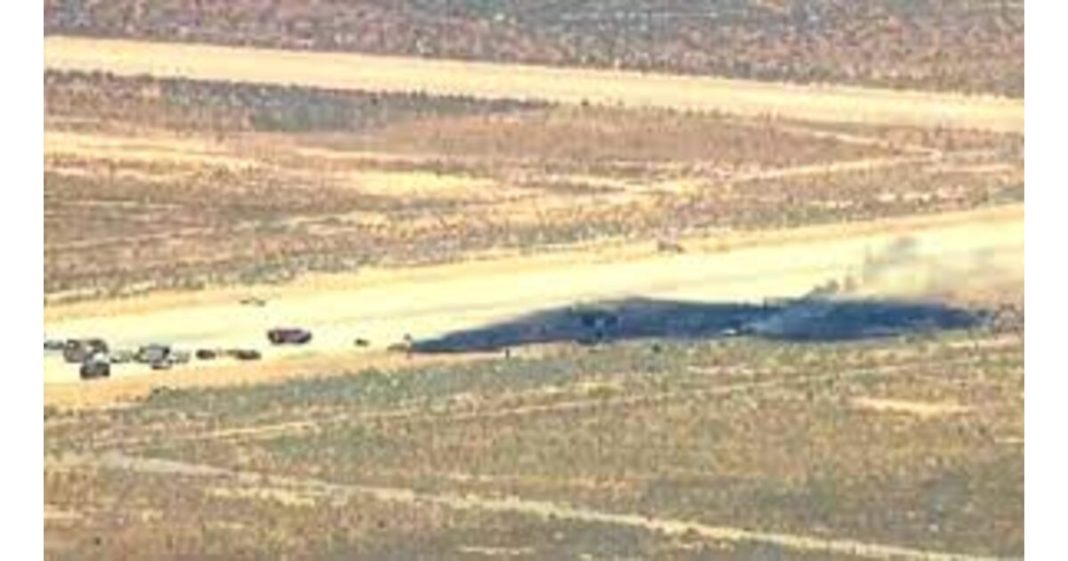
Aerial video footage of the crash scene, about 100 miles (161 km) north of Los Angeles, showed a charred, smoldering patch of the desert floor larger than a football field as an emergency vehicle was seen driving along the site’s perimeter. From a distance, there were no large pieces of debris readily visible in the footage.
Hayes said the crash was quickly “deemed to be unsurvivable.”
Because of damage to the runway, he said, “we’re grounding all operations at Edwards Air Force Base” through at least Tuesday, adding that no operations beyond the base would be suspended.
Edwards, a sprawling test flight facility established in the 1930s around a dry lake bed, occupies about 481 square miles (1,245 square km) of the Mojave desert, making it the Air Force’s largest airfield.
Its experimental aviation legacy includes the flight by Chuck Yeager in the Bell X-1 aircraft that broke the sound barrier in 1947, test flights of the X-15 aircraft and the first landings of NASA’s space shuttles.
Read more: ‘Trump screwed us’: Israeli officials fume over emerging Iran peace deal – media
BACKBONE OF BOMBER FORCE
The B-52 Stratofortress, a long-range, subsonic aircraft built to carry up to 70,000 pounds (31,750 kg) of weapons and supplies, has long served as the backbone of the U.S. crewed strategic bomber force, according to the military.
The swept-wing aircraft is capable of unleashing the widest range of weapons in the U.S. inventory, from cluster bombs and gravity bombs to precision-guided missiles and nuclear warheads, at altitudes of up to 50,000 feet (15,166 m), according to an Air Force fact sheet. Its combat range extends more than 8,000 miles without refueling.
Monday’s incident marked the first crash of a B-52 Stratofortress since the same type of bomber crashed on the island of Guam in May 2016, according to the Bureau of Aircraft Accidents Archives, a Geneva-based organization that collects global aviation accident data. All seven crew members aboard that aircraft survived. Only H models of the B-52 remain in the Air Force inventory.
The aircraft involved in Monday’s crash was assigned to the 412th Test Wing, which is based at Edwards. Most B-52s are stationed in North Dakota and Louisiana.