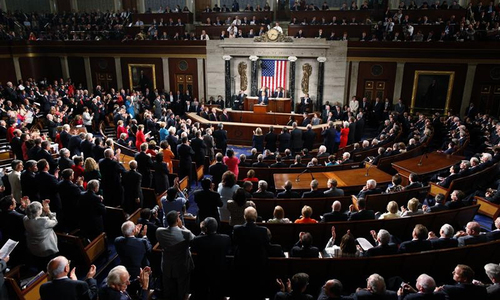


Democrats are preparing a legislative offensive against US President Donald Trump after their sweeping midterm victory handed them control of both chambers of Congress and the power to challenge his policies, investigate his administration and block his nominees.
Emboldened by victories deep in traditional Republican territory, the party is promising swift action on living costs and the war in Iran, while signaling that investigations of alleged abuses and corruption will be a major priority.
House Democratic leader Hakeem Jeffries, who is in line to become the first Black speaker when the new Congress takes office in January, vowed to go after what he described as “unprecedented corruption” in the government.
Democrats will retake control of both the House and Senate, @CNN projects. https://t.co/ObKwfyrKnf
— Pop Crave (@PopCrave) November 4, 2026
“Because if you have people in high office who are so focused on enriching themselves, their family members, their friends, or their donors, then they’re not focused on making life better for the American people,” he said.
But Democrats will not have a free hand. Trump retains his veto, while Senate rules allow Republicans to obstruct most legislation.
Here are the opportunities — and obstacles — ahead.
Read more: Trump congratulates Democrats on midterms, says Iran war played role
– First 100 hours –
Jeffries has promised an ambitious legislative push in the House’s first 100 hours, focused on affordability — the issue that dominated an election shaped by tariffs, high prices and the Iran war.
His priorities include restoring expired Affordable Care Act health insurance subsidies, reversing nearly $1 trillion in Medicaid cuts enacted under Trump, rolling back tariffs and pressing for an end to the conflict, which has sent fuel costs soaring.
The irony of the Iran war:
The US and Israeli campaign for regime change in Iran has ended up triggering a political regime change in US.
Republicans face humiliating midterm defeat, as Democrats are set to take control of both chambers of Congress.
US went looking for regime change in Tehran. It got a political earthquake in Washington and Tel Avivi.
— South Asia Index (@SouthAsiaIndex) November 4, 2026
With majorities in both chambers, Democrats can bring their proposals to votes and take charge of spending negotiations. They could use federal budget deadlines to demand concessions, although confrontations over spending risk government shutdowns
Read more: Trump announces halt to $4 bn in aid to Israel on midterm election day
– ‘Lawyer up’ –
Oversight may offer an even more immediate means of challenging Trump.
Robert Garcia, the Democrat expected to chair the powerful House Oversight Committee, fired off a blunt election-night message to Republicans on social media: “LAWYER UP.”
Oregon Senator Ron Wyden was even more concise, posting a single word: “Subpoenas.”
With control of committees in both chambers, Democrats can summon officials, demand documents and hold public hearings, potentially putting Trump and his senior aides under intense scrutiny.
Likely subjects include the Trump family’s business and cryptocurrency dealings, government contracts involving billionaire Elon Musk, cuts to federal agencies, immigration enforcement and the conduct of the Iran war.
Democrats have also signaled interest in the handling of files relating to notorious sex offender Jeffrey Epstein.
The administration could resist demands for testimony or documents, triggering court battles.
Democrats could pursue Trump’s third impeachment, though party leaders have not committed to doing so. The House needs only a simple majority to impeach, but removing a president requires a two-thirds vote in the Senate — far beyond the party’s numbers.
– Senate muscle –
The Senate majority gives Democrats another powerful lever: control of confirmations.
They can block Trump’s judicial and cabinet nominees, including any selection to fill a Supreme Court vacancy, potentially curbing his influence over the courts long after he leaves office.
Democratic Senate chairs will also decide which bills and investigations receive committee attention.
– Limits and deals –
Passing laws will be much harder than launching investigations.
Most legislation must clear a 60-vote hurdle in the Senate to overcome procedural obstruction. Trump can veto bills passed by Congress, and overturning a veto requires two-thirds support in both chambers.
He also retains substantial executive powers over immigration, trade and military operations, although lawmakers can seek to constrain them through legislation and spending decisions.
Trump struck a conciliatory note after the rout, praising Democrats for doing a “good job” and telling The New York Times that he would accept the result and expected to work with them.
He even raised the possibility of cooperation on immigration.
But he had previously warned that if Democrats won Congress, “I veto everything” — a reminder that the next two years could be defined as much by confrontation as compromise.