
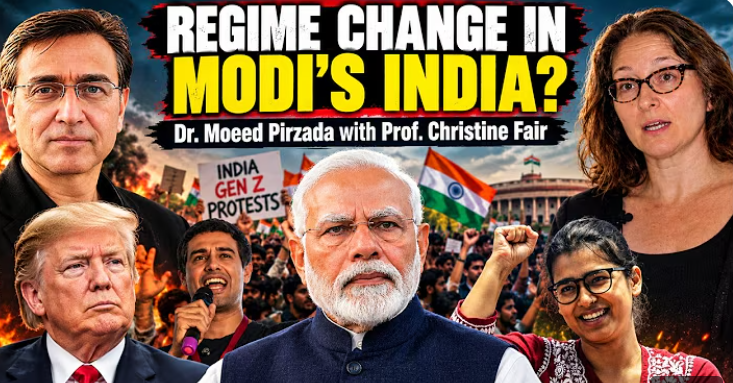
In this extensive interview with Dr. Moeed Pirzada, Georgetown University scholar Prof. Christine Fair analyzes South Asia’s shifting political landscape, arguing that Bangladesh’s “Monsoon Revolution” was an organic, youth-driven uprising triggered by lethal state violence rather than an American or Pakistani conspiracy. She compares this to India’s emerging “Cockroach Janata Party” youth movement, noting that while Indian youth are similarly driven by frustration over exam leaks and employment, the Indian government operates with a vastly larger democratic backing and has avoided the lethal force that creates political martyrs.
Interview originally published on 18th Oct, 2026
Dr Moeed Pirzada: Dr. Christine Fair, thanks for joining me. A very warm welcome. I want to come straight to the point. You have written extensively on the dynamics, the power dynamics between India and Pakistan, but in the last few years, you have also been focusing on the on the issues inside Bangladesh. In the last 48 hours, India’s Defense Minister Rajnath Singh made a statement during a press conference in Lucknow. He said that what the ‘cockroach Janata Party’ and Congress are trying to do in India against Prime Minister Narendra Modi is a regime change, just like in Bangladesh. And when they say regime change, Indians believe that the political change against Sheikh Hasina has been brought about by the United States and by Pakistan. How do you look at that situation?
Prof Christine Fair: I have to be honest. I’ve spent a lot of time in India and Bangladesh, and I’ve never once heard that the regime change resulting from the Monsoon Revolution had a Pakistani hand. I’ve never heard that before. However, I have, of course, heard that this was an American hand; that is very common. I don’t put a lot of credence in that at all. What happened in Bangladesh was a very organic event, and it probably wouldn’t have happened had this particular journalist, Abu Sayyid, not been brutally murdered. The death of Abu Sayyid transformed the movement into something that it wasn’t previously. The dynamics of what happened in Bangladesh had a lot to do with the murderous police crackdown. I’m sure you know that about 1,400 people were killed in that crackdown, and tens of thousands were injured, many permanently. It was a very different dynamic than we’re seeing with the ‘cockroach’ group in India. The Indians have not used lethal force, right? There is no martyr of this movement yet. They’ve basically used draconian police measures and draconian legal measures. Right now, the only thing they have in common is that this is a groundswell of anger against the government in India.
Dr Moeed Pirzada: At the same time, it has to be considered that the system under Prime Minister Narendra Modi’s Indian government is very large compared to Bangladesh, encompassing about 1.5 million people. Additionally, the government is legitimate. It is not like Sheikh Hasina’s government; it has broad support and is an elected government following a series of elections. In fact, several Indians from across Europe, the United States, and Canada who follow me keep sending me emails. From these emails, I see that Prime Minister Narendra Modi has huge support among the Indian diaspora. So, when you say this ‘cockroach Janata Party’ has a groundswell of support, how do you see this changing the dynamics of politics in India?
Prof Christine Fair: Personally, I don’t. Right now, it’s just in Delhi. As you said, the system in India is much larger than the system was in Bangladesh. There are no martyrs. Now, look, if the Indians make a martyr out of one of these young men, the situation can change dramatically. But so far, the Indians have been, to their credit, draconian, but not lethally draconian. The other thing I was going to tell you, the other conspiracy theory that I have heard, and again, there’s no ISI imprimatur in this, and that is that the Jamaat and the Islamist forces were behind the revolution in Bangladesh. Now here the evidence is a little bit mixed. We are learning a couple of years after the fact of perhaps a greater role of Chhatra Shibir than initially was reported, but there’s no smoking gun. Personally, I believe that Chhatra Shibir had a bigger role than has been reported because Chhatra Shibir has this huge grassroots standing. They did very well in the university elections. So just really clear that I don’t see a lot of similarities between what happened in Bangladesh and what’s happening with the ‘cockroach Janata Party’, but I should also be very clear that I didn’t see the Monsoon Revolution resulting in Sheikh Hasina’s ouster. I you-
Dr Moeed Pirzada: You didn’t see that.
Prof Christine Fair: I didn’t see it. So I have to be really honest, right? I didn’t see it, and the reason why I didn’t see it was that she had done an excellent job of cultivating the Bangladesh Army along the lines of how, you know, she was giving them many of the business models that the Pakistan Army had been following. She had created opportunity structures for them to make a lot of money, and so ultimately, what brought her down wasn’t the students’ movement per se? It was the Bangladesh Army’s decision that it wasn’t going to kill massive students to protect her. That’s ultimately why she fled was because the Bangladesh Army chose to do the right thing. But I need to be really honest in disclosing. I didn’t see that coming. I thought she was going to use brute force and lethality to stay in power, so you know I have to be very humble in the errors of my estimation.
Dr Moeed Pirzada: So for how long have you been studying Bangladeshi politics? I mean, you have visited Bangladesh. You have been writing about it.
Prof Christine Fair: I’ve been going to Bangladesh since 2005. So I, and I’ve written quite a bit on Bangladesh actually. So I’ve looked at support for democracy among Islamists. I’ve looked at corruption in Bangladesh. I’ve looked at the general political scenario. So yeah, I’ve been going to Bangladesh for about 19 years now, and so I’ve seen visually some of the changes that are apparent in Bangladesh, but I’ve also seen evidence that some of the worst Indian conspiracy theories about Bangladesh are also without evidence.
Dr Moeed Pirzada: So, how do you look at the evolution of the Bangladeshi army in the sense that you said it decided not to save Hasina, but Bangladesh Army has also been a ruling system in the 1980s. You know, Ershad and General Zia. So, how has the Bangladeshi military evolved from the position of political dominance into the present position?
Prof Christine Fair: That is a really good question, and I don’t think I have a very good answer for it. The Bangladesh Army is very different from the Pakistan Army in the following sense: the Pakistan Army has its own strategic culture and foreign policy. The Pakistan Army has the power it has in the country largely because of the security competition with India and Afghanistan, and the narrative that the Pakistan Army is the only institution that can deal with these problems. The Bangladesh Army doesn’t have this grand strategy, autonomy to operate, and hasn’t since 1991. Now, you’ll recall that there was this brief military-run interim government back in 2007. A lot of people were expecting the Bangladesh Army to stay in power; I wasn’t. I was very confident that the Bangladesh Army did not want to govern Bangladesh. And why?
Dr Moeed Pirzada: Why were you that confident?
Prof Christine Fair: Because, as I said, there was no strategic competition that the Bangladesh Army could claim to keep it in power along the lines of the Pakistan Army’s strategic vision that keeps it in power. I felt pretty confident that the Bangladesh Army-led caretaker government was going to deliver an election, and to its credit, the election it delivered was a free and fair election that Hasina won hands down. I think the comparison between the Bangladesh Army and the Pakistan Army is that they both have military business interests, and they’ve both been able to control or capture large swathes of the economy. But the extent to which the Bangladesh Army has been able to do so is not on the same scale as the Pakistan Army; it’s an issue of scale.
Dr Moeed Pirzada: This discussion can be very interesting and instrumental for people in Pakistan who want the Pakistani military to withdraw back into the barracks or become at least a military like in Bangladesh or in India. So in Bangladesh, where the military repeatedly ran the country after the bloody 1975 coup—General Ershad and General Zia and all that, until the 1990s—how has the Bangladeshi Army, which was running the foreign policy and economic policy and has deep penetration into the Bangladeshi corporate economy, resigned itself into a new role in which it has accepted a new position for itself? Pakistanis would love to have something like that. How did it happen? Tell us.
Prof Christine Fair: I think what happened in 1991 was that the parties came together and collectively pushed to overthrow the military regime. In Pakistan, the political parties have all been too willing to subordinate their corporate interests to the army in exchange for the prerequisites of power. So, I think that’s the biggest difference: in Pakistan, both the PPP and the PMLN, and also Imran Khan, were willing to play by the Pakistan Army’s rules in exchange for power, and that didn’t happen in 1991. The parties came together and said enough is enough.
Dr Moeed Pirzada: But could it also be because the Pakistani military has designed the system in such a way? They have created an ecosystem of power, privilege, risks, rewards, and punishments in such a way that no Pakistani political entity, media person, corporate entity, or business entrepreneur has any capacity to stand on their own.
Prof Christine Fair: I don’t disagree with that. That’s why I say it’s a difference of scale. What brought together the parties in 1991 against the military regime of Ershad could happen on a Bangladesh scale, but maybe not on a Pakistan scale. But if you ask for the basic explanation, it was the political parties. Let’s also be clear that Ershad had his own party, so there probably weren’t the opportunities to get prerequisites in exchange for playing along. I don’t think the situations are strictly speaking comparable.
Dr Moeed Pirzada: So the two major political parties are Hasina’s Awami League, Sheikh Mujib’s Awami League, and Khaleda Zia’s Bangladesh National Party.
Prof Christine Fair: What now Tariq Rahman’s BNP?
Dr Moeed Pirzada: It’s Tariq Rahman’s. No, I was just going into the history in 1991. So, what was Jamaat’s position in 1991 against General Ershad? Because I see Jamaat as an extension of the military influence.
Prof Christine Fair: No, Jamaat opposed Ershad. Jamaat opposed Ershad, yes. But remember, in that time period, Jamaat was not a consequential political player; in the 1991 election, it got the highest number of seats it had compared to subsequent elections, when I believe it got 12 seats. It’s nothing compared to the seats they just got in the most recent elections.
Dr Moeed Pirzada: So, but afterwards, the model—which I’m not an expert in Bangladesh, but my understanding is that Khaleda Zia and Jamaat together were a force against the Awami League. The Awami League was, in fact, larger and had more penetration into the politics.
Prof Christine Fair: Yeah, in 2001, the BNP and the Jamaat were allies. What needs to be understood is that in Bangladesh, the Jamaat has always benefited from the fact that neither the BNP nor the Awami League could win the election on their own, generally speaking, when the elections were free and fair. Prior to this [last] election, when the elections were free and fair, neither the Awami League nor the BNP could win without a political partner. This created opportunities for kingmakers, and the Jamaat was the kingmaker for Khaleda Zia in the 2001 election. This allowed them, despite their meager showing in the polls, to get two cabinet positions. Now Sheikh Hasina, prior to [her time in power], claimed to be left of center. I don’t see her really as left of center anymore; she hasn’t been for a very long time. But at one point, she actually aligned with a very extreme Islamist organization called the IOJ. The IOJ was notorious for having clashes—I’m trying to think of the word in Urdu for shailish, like a jirga?
Dr Moeed Pirzada: It’s like a jirga.
Prof Christine Fair: A jirga. They were issuing very harsh Islamist punishments, particularly against women. So, going into that election, her left-of-center credentials were burnished, were demolished, and the reason why she did this was because of this opportunity for kingmakers that Bangladesh’s electoral system presented, which over empowered groups like the Jamaat and the IOJ.
Dr Moeed Pirzada: But she was able to carry the election by herself. I mean, the Awami League could win the election against Khaleda and Jamaat in 2009.
Prof Christine Fair: Yeah, she is. That’s true. Actually, she was able because there was such a resistance to the BNP after they were in power and all of the corruption. There was particularly a strong belief—and then retrospectively, the evidence isn’t really clear—that under her and her coziness to Jamaat, [they] fostered the Islamist terrorism that really took root in Bangladesh. There was a lot of belief that it was Khaleda Zia’s proximity to the Jamaat that fostered the rise of Islamist terrorism. In retrospect, it’s not clear what the ties were between the Jamaat and the groups terrorizing Bangladesh, but the belief that they were behind it was very firm.
Dr Moeed Pirzada: But after the 2009 election, Hasina went on with a very calibrated, brutal witch hunt of the Jamaat. And my understanding is this: that she and her Indian backers—New Delhi was backing her till the end, till the very end, till [2024]—wanted to demolish Jamaat because they thought that Jamaat and BNP together create a force. So Jamaat was delegitimized. People were hanged. So how do you look at that phase and India’s support for Hasina in all that?
Prof Christine Fair: So the reason, I mean, to understand this from India’s strategic point of view. In Bangladesh, because of the scourge of Islamist terrorism—and some of those groups were operating in Bengal as well, they weren’t just operating in Bangladesh, there was spread to Bengal. Even now, the only reportage of Bangladeshi Islamist terrorism is coming out of India, in places like West Bengal. There was this perception that only Sheikh Hasina would act against those Islamist terrorists. The Indians believed, for example, that Lashkar-e-Taiba was operating in Bangladesh, and so she became an Indian asset pretty quickly. And because she herself had been targeted in a suicide attack, she had a lot of visceral antagonism towards these Islamist forces, even while she was catering to groups like Hefazat-e-Islam. So she was cultivating her own right-wing Islamist elements, even while she was operating against some others. But the Indians were really supportive of her because of these initiatives.
Dr Moeed Pirzada: So the perception is that in Hasina’s fall, India has been kicked out of Bangladesh.
Prof Christine Fair: So I think that’s an Indian perception.
Dr Moeed Pirzada: That’s also a Pakistani perception. The Pakistanis have been very happy and jubilant on that, and they had a very good relationship with Dr. Yunus.
Prof Christine Fair: Yeah. But the issue is, this is a creature of India’s own making. Because, you know, I had been telling my Indian colleagues for many, many years: this is not sustainable. She is not sustainable. You have to engage with the fact that this is a deeply divided polity. It’s split roughly 40-40, Awami League-BNP. That the time will come—ek din bit jaega, BNP jeet jaega.
Dr Moeed Pirzada: You can conduct the interview in Urdu as well as in Hindi.
Prof Christine Fair: What do you say?
Dr Moeed Pirzada: You can conduct this discussion in Hindi, in Urdu as well.
Prof Christine Fair: But I have been warning them that this isn’t sustainable, and you have to start building bridges with the BNP, and they just didn’t do so. So now the Indians are really caught in this conundrum of their own making because they didn’t want to reach out to the BNP, and from my point of view, the BNP and the Awami League are not such different entities that it justified this bifurcated response.
Dr Moeed Pirzada: So, looking from the Indian point of view, I mean, looking at the Indian readings, they actually felt that the growing influence of Pakistan in the 1980s, when General Ziaul Haq and General Zia and Ershad and all that, was a sort of betrayal because they had helped create Bangladesh, right? So they felt betrayed that Pakistan is back into Bangladesh. Pakistan has not really forgotten Bangladesh, and you have also written somewhere—I was doing research—that you think that the Pakistani military has never really absorbed the Bangladesh thing. They think they can get back into it. And after Hasina’s fall, the kind of, you know, sudden jubilation and excitement in Pakistan, the visits by Pakistan, all that basically shows that Pakistan thinks that it can—the Pakistani military thinks it can get back into Bangladesh, and that that would define the Indian fear.
Prof Christine Fair: Well, it should. I mean, unfortunately, it does define the Indian fear because India views this as a zero-sum game. If Pakistan has influence and somehow India loses. I think there’s lots of opportunities for Indian engagement, but that’s not how the Indians have defined this opportunity space. The Pakistan Army has been back; there have been these visits. They’re not the only ones. When I talk to people, they’re also very concerned about Turkish influence as well. There’s been a lot of interest in Bangladesh and joining the MIKTA Pact, for example. So the Indians are going to view this as a zero-sum game. When I was just at the Bay of Bengal conversation, I was on the panel with the Indian High Commissioner, and he was very unprepared for the most obvious question that he was asked—and it was the first question that was asked from the audience—which was when, and why haven’t you handed over Sheikh Hasina? Now he is, as you know, a political appointee. I believe he’s the only politically appointed ambassador in India’s foreign service. So I was very surprised at his lack of preparedness for that question, and I found his answer to that question to be very unconvincing.
Dr Moeed Pirzada: How did he handle the question? What was his response?
Prof Christine Fair: Well, his first response was ha ha ha ha. That’s so awkward. That’s so uncomfortable. Let’s talk about it over lunch. Well, of course, he’s not going to be there for lunch for that to happen. So he first tried to just handle it as a joke, but he couldn’t get away with that. So he finally settled on: “There’s a judicial process, and we’re following that judicial process.” No one in the room was convinced. So he finally settled upon that answer. Now there is no extradition treaty between Bangladesh and India, so I don’t know what this judicial process he’s talking about is. But I think that really, to me, epitomized the flat-footedness of the Indians in Bangladesh. Is that why you—
Dr Moeed Pirzada: Why do you say so? Why do you say so? I mean, given India’s strategic importance to any country, for that matter, how could they hand over Hasina to Bangladesh?
Prof Christine Fair: I’m not saying they can hand her over. I’m saying his answer should have been more prepared. Now, when you talk to people beyond the rhetoric that “we want Hasina back,” there is an acknowledgment that nothing is worse for Bangladesh than Hasina coming back because they are not going to execute a woman by hanging, right?
Dr Moeed Pirzada: She is probably 80 years of age.
Prof Christine Fair: She’s like 85, right? They’re not going to hang an 85-year-old woman, and the sentence of death is death by hanging, by the very same International Crimes Tribunal that she herself had constituted. What an irony!
Dr Moeed Pirzada: What an irony!
Prof Christine Fair: What an irony! So they’re not going to execute her. And what if she dies in Bangladesh? She becomes a martyr. She still has about 30% of the vote share. So if you actually push beyond the political rhetoric, nothing is worse for Bangladesh than her coming back. Now the Indians would love a third-party country to take her. Yes, they have tried, but no country will take her.
Dr Moeed Pirzada: Indians have tried. Do you have some information that Indians wanted her to go to the U.S. or something?
Prof Christine Fair: So my understanding is, I believe it was… I think Norway was one of the countries. She has some connections in Norway. I forget the exact… I think it’s Norway.
Dr Moeed Pirzada: Her son is in Virginia.
Prof Christine Fair: Her son’s in Virginia. Yes, but she wanted to go to… She wanted to go to Europe, and no one is playing ball. No one wants her. Now, with the Indians, I think you could reasonably ask, as the Bangladeshis have, once you put aside the “why aren’t you sending her back?” is, why aren’t you keeping her quiet, right? Because the Indians do have a lot of experience with the Dalai Lama. When things heat up between China and India, they can put pressure on the Dalai Lama not to be so provocative. The same thing with Aung San Suu Kyi. So the question is, why aren’t the Indians gagging her when they’re capable of doing that? I think that is a question worth answering, and I think right now they’re playing domestic politics. She… so I think the Indians are playing domestic politics with Sheikh Hasina as much as the Bangladeshis are.
Dr Moeed Pirzada: Dr. Yunus didn’t attend the BRICS summit. The Indians are very eager to invite him to be in India. I think Prime Minister Narendra Modi personally invited him. Why is he playing so hard [to get]?
Prof Christine Fair: Domestic politics.
Dr Moeed Pirzada: But Bangladesh is so interdependent on India for water issues, energy issues, you know, oil issues.
Prof Christine Fair: Absolutely on GLOCs, right? Because, for example, India can’t escape geography, right? The Siliguri Corridor is very, very vulnerable. It needs to find alternative ground lines of communication to bypass the Siliguri Corridor. And Sheikh Hasina was somewhat accommodating in building GLOCs connecting India’s mainland to India’s northeast. India’s efforts at building an alternative supply route in Sittwe in Rakhine State have failed for a bunch of reasons that are not of India’s making. So, in addition to energy and water, it needs to create… it needs access to Bangladesh to create more streamlined access from the mainland of India to India’s northeast that bypasses the Siliguri Corridor, also known as the “Chicken’s Neck.”
Dr Moeed Pirzada: I want to come to something you said earlier. You said that the decisive factor in Hasina’s fall was not necessarily the movement; it was the position taken by the Bangladeshi military when Waker-Uz-Zaman, the chief, conveyed that they cannot… The officers were not willing to fire on the people, and then there was a mysterious email a few days before this from young Bangladeshi officers. Do you think all that was organic, or was that actually some sort of pressure upon the military coming from the United States?
Prof Christine Fair: No, I think it was organic.
Dr Moeed Pirzada: So the Bangladeshi military decided not to fire on Bangladeshi citizens anymore.
Prof Christine Fair: Correct, correct. I believe it was organic.
Dr Moeed Pirzada: But do you see Jamaat acting on its own, or are the Islamist groups in Bangladesh an extension of Pakistani influence?
Prof Christine Fair: See, I don’t. And as you know, I’m a critic of the ISI. So if I thought they were, you know, ‘ISI ka haath’, I would say so, but I don’t see that. They have also tried to distance themselves from 1971, right? They’ve tried. They’re definitely trying to do that. They would like to be a Bangladeshi Islamist party, and what I always find… so obviously when I meet with the Jamaat, it’s very difficult for me because they have such contempt because I’m a woman. But I’m going to tell you, they are very professional. My limited interactions with the Jamaatis have been very professional. During this last trip, I had a very candid conversation about constitutional reforms. You know, they have a lot of ‘jahils’ that they field, for sure, but they also field a lot of sophisticated candidates. A lot of sophisticated candidates. So I had a very sustained conversation about constitutional reforms. We didn’t go into their views about women because it’s… ‘kya faida hoga’. So, you know, there’s just no point in that. But they position themselves as a Bangladeshi party. They don’t position themselves as a Pakistani party. So I think the views…
Dr Moeed Pirzada: Of course they’re not a Pakistani party. But are they not pro-Pakistan, the Jamaat and the Islamist groups?
Prof Christine Fair: So they’re always going to have ties to the Pakistani Jamaat, but I don’t believe that they are an extension of Pakistan or an extension of the Pakistan Jamaat. I believe they are a Bangladeshi Islamist party. They’re interested in constitutional reform. They probably… if… and I’ve done a study on this, actually. The Islamists in Bangladesh have tended to be consistently more pro-democracy than the secularists.
Dr Moeed Pirzada: Interesting.
Prof Christine Fair: And the reason is, the secularists believe that if there are free and fair elections without efforts to restrict the Jamaat, that they would do very well in elections. And what we just saw is a vindication of that fear. So the secularists have been very happy to suppress the Jamaat, thwarting the forces of democracy to suppress the Jamaat, because they feared the exact electoral outcome that we saw just occurred. So, and of course, the Jamaat, like the Jamaat in Pakistan, is a party that’s democratic in the sense that it elects its leadership. It’s not a dynastic party like the Awami League or the BNP. So, you know, I think people have to update their talking points about the Jamaat because if they don’t update their talking points, I think they’re going to misunderstand or underestimate this institution in Bangladesh. I actually see… I don’t think it’s going to get more seats than it has at present. But the fact that it took about… its total seats, I think, with the reserve seats, is something like 68 seats.
Dr Moeed Pirzada: 67, 68 seats. Yes.
Prof Christine Fair: Yeah, yeah. 67, 68. That’s unprecedented for the Jamaat, and I don’t think they’re going anywhere. And so people need to make their peace with this organization, for better or for worse. Like I said, I’m a staunch secularist, so I personally have no patience for such organizations, given their disdain for women. But as an analyst, I have to appreciate the force that they have become in Bangladeshi politics. Things are changing, and they’re changing fast.
Dr Moeed Pirzada: So, how do you define and explain the fact that… the Jamaat played the crucial role, the fundamental role, in challenging Hasina on the streets? It was not the supporters of the BNP that were dying on the streets. These were the Islamists, right? The hundreds of people that died…
Prof Christine Fair: I don’t agree with that. I’m telling you, I don’t agree with that. These were students who were dying on the streets. These were not Islamists. Yes, amongst them, there were certainly Islamists. Chhatra Shibir was certainly amongst them. But I push back on this characterization in its entirety. These were students who were dying on the street. This was a student revolution, so I don’t have a lot of patience for these conspiracy theories because I don’t see evidence for it. I think it’s an Indian story. It’s a ‘Hindustani kahani’, but I have seen no proof.
Dr Moeed Pirzada: So the Jamaat was not the motor engine of the rebellion against Hasina?
Prof Christine Fair: No, absolutely not, And there’s no one in Bangladesh who’s going to tell you that. No one, not even Jamaat, will say that.
Dr Moeed Pirzada: Hmm. Because my next question was that if Jamaat had played the role, then how come BNP has taken all the credit for making the government? I mean, they emerge as the, I mean, without doing much, they emerge as the victorious. They didn’t have much position.
Prof Christine Fair: Well, that’s because there was no other party, right? The National Citizens Party is like the liability of newness. It took Imran Khan many, many years before he became of importance to the Pakistan Army to make him prime minister. For years, he was not a consequential political force. It takes years for political parties to become consequential. The only alternative to the BNP was the Jamaat, right? If you look at the number of votes of the national citizen, the number of seats the National Citizens Party got, they were inconsequential. So there was no alternative to the Awami League. So they benefited from the fact that there was no alternative.
Dr Moeed Pirzada: So don’t you think that Imran has an organic political growth as well? I mean, yes, of course the military helped him in the end, but he had an organic political phenomena.
Prof Christine Fair: But it took him a long time to grow it.
Dr Moeed Pirzada: Agreed, 100%. He says himself that takes you a while. You know, he was awkward. I heard him the first time in 90s and also in 2002 election. He didn’t know how to communicate. He was very awkward. He was just talking against Nawaz Sharif, which he kept on doing till this day. You know, he wasn’t really able to carry the people, but gradually he came onto his own, and especially his position and campaign against the drone strikes in Pakistan’s northwest and FATA and KP endeared him in the Pashtun belt, and Pashtun belt became his motor engine, right? But why do you think the Pakistani military chose Imran Khan in the end against Nawaz Sharif?
Prof Christine Fair: Because I think they ran out of options. Like they don’t really have a lot of, they don’t have a deep bench to choose from, right? And I think they also thought that he was going to play, he would be their next Nawaz Sharif, right? Nawaz Sharif was a creature of Zia. And just like Nawaz Sharif, Imran Khan outgrew the army. But going back to the case of Bangladesh, it would be very… it would have been a huge surprise if the National Citizens Party, which is the party that represents the students, would have done better, given that it has no experience as a political party, right? So basically, the BNP benefited from being the alternative because there was no other alternative because the Awami League was prescribed. The Awami League wasn’t allowed to contest the elections. But looking at polling, we know that going into that election, the Awami League still held about 30% of the population.
Dr Moeed Pirzada: So one phenomenon which runs across all these countries, which is the former British Indian Empire, the former British India, is the youth factor, is the Gen Z factor. The Bangladesh revolution or change, whatever you may call it, is basically driven by the youth. The youth were very upset by Sheikh Hasina. It were not the old age people. In India, the cultural thing, this cockroach Janata Party, is also sort of a cultural challenge. You know, they’re secular, they’re broad-minded, they’re highly educated. They believe in a desh for all people. So these are also very young people, you know, this 20-something. What about the Pakistani generation? What’s their future?
Prof Christine Fair: So as you know, I’m not allowed back into Pakistan, and so I don’t have the ability to interact in Pakistan and to understand that. But what we haven’t seen yet, and honestly, is because of, I think, the coerciveness of the army. We haven’t seen these kinds of movements in Pakistan amongst the youth. We’ve seen, we’ve seen movements around Imran Khan, but the Cockroach Party isn’t about Modi. The Cockroach Party started about the exams and the leaked exams and the unfairness of the exams, all the money that’s spent on exams, and then they’re leaked, and then there’s no opportunities, and now this is about massive voter disenfranchisement. Right.
Dr Moeed Pirzada: But initially they started by a very cynical comment by the India’s current Chief Justice, who made a comment during a proceeding of the court that these young people with degrees are like cockroaches, right? They’re like… and then yes, and then there was an Instagram or you know, TikTok account created by Adi Ji Devke, that was a student in United States, and that actually shows there is a contempt for India’s ruling elite. So this is actually coming. But in Pakistan, when you look at the Gen Z, can we say that the Pakistani military is more brutal than Sheikh Hasina? I mean, Sheikh Hasina killed far more number of people than the Pakistani military has killed on the main street.
Prof Christine Fair: You tell me. Look at what the Pakistan Army is doing to you.
Dr Moeed Pirzada: But Sheikh Hasina must have been doing the same to Bangladeshi journalists.
Prof Christine Fair: She was. She was. She was using all kinds of legal apparatus to silence journalists, to prosecute them. So I really can’t tell you why we don’t see a Gen Z [movement]. Now, honestly, if the Chief Justice hadn’t called them cockroaches, I don’t think we would have seen the cockroach party, right? I don’t. If he hadn’t made that horrific guffaw, and then he subsequently called them muckies…
Dr Moeed Pirzada: He’s still the chief justice.
Prof Christine Fair: He’s still the chief justice, and now obviously after the spawning of this cockroach Janata Dal, now he calls them muckies. So, but I don’t think we would have seen this movement had he not done that. That was the kernel around which we’ve had this movement coalesce. And in the same light, what coalesced the movement in Bangladesh was this issue of the reservations. It bears a lot of similarities to the NEET exam mobilization of the cockroach Janata Dal, because this is about their future, right? Sheikh Hasina was using reservations to basically stuff the administration with her chamchas, right? It wasn’t, and increasingly, the jobs that went to the so-called descendants of the 1971 war was used… it was being politicized. And in any event, how can you hold the grandchildren of the ’71 war responsible for the war, or responsible for winning the war? It was a very inherently unjust situation, and that’s what prompted the students. Now, I’m also going to say, you know, I go to Bangladesh. I try to go there every year. I’ve been going every year for the last six or seven years. So, I had a Fulbright at the University of Chittagram, which is formerly known as University of Chittagong, and I had a lot of opportunity to interact with the students. They were fed up with Sheikh Hasina even prior to the reservation issue because there were no jobs. They were getting education, but there were no jobs. Jobs in the civil service. There were no jobs in the private sector. They were tired of the rigged elections. They were fed up. And so this was sort of the reservations was this spark that fueled this fire. But there was tinder simmering or smoldering before the fire.
Dr Moeed Pirzada: Jobs are also a problem in India, and jobs are also a problem in Pakistan.
Prof Christine Fair: Right. So you’re in a better position to answer your own question than I am, because I can’t go back to Pakistan.
Dr Moeed Pirzada: But I have a different set of questions for you. You know, in your major book, Fighting to the End: The Pakistan Army’s Way of War, I saw one of your discussions about 11 years ago, and at the beginning you said that you’re not coming from the discipline of political science, you’re actually coming from the discipline of linguistics, civilization, and culture. Do you think between Bangladesh and Pakistan—which was formerly West Pakistan—there is some sort of cultural difference that explains the Bangladeshi political history?
Prof Christine Fair: You know, I’m at a huge disadvantage in Bangladesh because I don’t know Bangla. I can’t speak it. I can’t read it. So all my conversations are limited to English. What I do think is quite different from any other country that I have visited in South Asia is the deep politicization. So, if you’re an Awami Leaguer. First of all, you have two unions for everything. The teachers’ union has an Awami League union and a BNP union; it kind of defeats the point of a union. If you’re an Awami Leaguer, your dentist is an Awami Leaguer, right? These deep political factions go up and down. They’re vertically integrated factions, and it’s a zero-sum game. In the time that I went to Pakistan, I never saw this degree of… Yes, you would see people with their hookahs, with their PPP or their PML painted on them. I remember seeing that. People would have party flags outside their house. But this degree of politicization, at least when I went to Pakistan, I never saw. So Bangladesh is probably the most politically divisive and polarized country that I visit.
Dr Moeed Pirzada: Since you have also visited India, and you speak the languages and you understand the culture… You referred to English; most of us also rely upon English to understand other cultures. Is India also a form of deeply politicized society and polity as compared to Pakistan?
Prof Christine Fair: That’s a really good question, and I hesitate to answer because I haven’t been in Pakistan during all the Imran Khan mobilizations, so I don’t feel like I can answer that question empirically. What I would say is that Modi has captured… what’s really interesting. If you look at most global places where there’s been democratic backsliding and the rise of populist leaders, it’s being driven by the rural areas where rural people are being left out through globalization, and in the cities, the cosmopolitan cities, they overwhelmingly vote left—this is in the OECD countries. What we see in India is just the opposite. The globalized cities is where you see support for Prime Minister Modi, and the theory is that the traditional elites who live in those cities are fearful of efforts to enfranchise the lower classes and the lower castes, and so in these globalized cities, they’re voting to protect their privilege. In Pakistan, another thing that makes the elections completely not comparable between Pakistan and India is the huge role that [the military] has in manufacturing victory. They manufacture victory before the election, during the election, and after the election, and they also manufacture the opposition.
Dr Moeed Pirzada: What do you mean by manufacturing the victory?
Prof Christine Fair: Well, messing around with who can vote and how they can vote; during the election with fraudulent ballots. I’ve been an election observer in Pakistan; I know how this works. And then after the election, trying to form together ‘coalitions of the willing’, ‘coalitions of the billing’, and then forming the opposition of choice. So the army has this very extensive hand in manufacturing the outcome of elections. You don’t have that in India. Now, Modi is trying his level best, through massive disenfranchisement, to manipulate who can participate in elections. You can see that this is not going uncontested. What you don’t have in Pakistan thus far is a massive mobilization protesting the degree to which the Pakistan Army manipulates democratic institutions. You haven’t seen that yet, and even the Imran Khan mobilizations aren’t about the system that the army has built. It’s been about their person. It’s been a highly personalized protest, not about the system. When Benazir or Nawaz Sharif were being similarly persecuted, you didn’t see this groundswell. So I think they’re really incomparable for myriad reasons.
Dr Moeed Pirzada: Very interesting. Two things. One is the 8th February 2024 elections. The Pakistani military tried everything to manufacture the victory. They tried engineering the election beforehand by all means they had known for the past 20, 30 years, but in the end it failed. So in the midnight, they had to take their guns out and they had to go into the polling stations. They seized the results, declared… they suspended the whole process and it took them almost like 18 hours to create new results. That is why the election results in Pakistan are called ‘Form 47’ because the first paper—the ballot, the first counting paper—is the Form 45 on which you call the constituency, the polling station. So they created Form 47, which is the overall constituency, and which they can confect through ChatGPT or computer results or statistical whatever spreadsheet, and that is why the elections of Pakistan are called ‘Form 47’. So, to that extent, the Pakistani military failed, and the Pakistan movement, of course, is person-specific. It is gradually becoming a system critique. If you look at Twitter, the kind of critique the Pakistani military is now facing, its system is facing, it has… it was unimaginable only a few years ago that the Pakistani military would come under this kind of thing.
Prof Christine Fair: I don’t disagree. I don’t disagree. But I’m no longer on Twitter. I got off Twitter. Twitter was nothing but a nuisance. And also, I do a lot of asylum work, and Twitter was going to be a problem for me in my asylum work, so I just went off. So I don’t see that anymore. But I don’t disagree with you. But I don’t know what’s going to happen with this.
Dr Moeed Pirzada: So one thing you can actually look at is… in your book, Fighting to the End: The Pakistan Army’s Way of War, your main thesis was India—the Pakistani army was focused on India. But it appears that the Pakistani army is now moving away from India as a principal enemy. They have found an enemy in Afghanistan; they found a new role in West Asia in protecting Saudi Arabia. Currently, there are more than 30,000 Pakistani combat troops in Saudi Arabia, according to Reuters—34,000—and reportedly, allegedly, while it’s not confirmed by the Pakistani government, the Pakistan Air Force is part of the operations against the Houthis in Yemen. And then they’re also very heavily involved in suppressing and fighting the insurgencies in Balochistan, which has become very ugly. Now they have created a sort of mini-insurgency in ‘Azad Kashmir’, or Pakistani-controlled Kashmir, and they have almost an insurgency in KP. So, are they not moving away from India for their own interests?
Prof Christine Fair: I don’t see them moving away from India. What I see is they are currently preoccupied with a host of domestic issues that they are really struggling to contain. I mean, I think it’s… I’m interested in what you think, but I have a proposition: I don’t think the writ of the Pakistan Army has been challenged to this extent since 1971.
Dr Moeed Pirzada: I agree.
Prof Christine Fair: You have, as you said, ‘Azad Kashmir’—or POK, as the Indians would call it; I prefer Pakistan-administered Kashmir—Balochistan, KPK, also Sindh. You know, Sindh is not happy either. So I think the writ of the Pakistan Army hasn’t been challenged to this extent since the ’71 war. However, you know, I always bet on the fauj. I always bet on the fauj. They’ll muddle their way through. They always find a way to muddle their way through. And I would argue that the Mecca Pact also has utility against India.
Dr Moeed Pirzada: How?
Prof Christine Fair: Well, because in the ideal state, during an Operation Sundur-like event, the Mecca Pact would come to Pakistan’s defense. Now I don’t see a scenario in which that happens, but in principle, that’s part of its utility. And in my view, because Pakistan has not relinquished its security competition with India, sooner rather than later there’ll be another terrorist attack, and sooner rather than later there’ll be another Operation Sundur-like response.
Dr Moeed Pirzada: You think so?
Prof Christine Fair: I’m very confident of that.
Dr Moeed Pirzada: Since the Operation Sundur, there has not been… not a dog has barked in Kashmir, the Indian Kashmir.
Prof Christine Fair: For now. Filhaal, filhaal. But over the long term, it’s inevitable. So I think right now we’re going to see quiescence, but that’s not going to remain. That’s not the permanent status of this.
Dr Moeed Pirzada: India’s official position is… the Indians to the last man celebrate Operation Sandur as a huge embarrassment and humiliation for Pakistan. Pakistanis to the last person celebrate Operation Sundur, or ‘Binyanul Masrur’, as a great humiliation for India. I mean, both countries have their own [narratives]. But you have also criticized Operation Sindur in uncertain words when you said that India was not able to deter Pakistan through Operation Sindur.
Prof Christine Fair: Well, I would say it wasn’t able to compel. Right? It hasn’t compelled Pakistan, and that’s one of the strategic objectives of Operation Sindur. And we’ll see. As I said, I’m very confident that sooner rather than later, there’s going to be another terrorist attack. I’m also very concerned that…
Dr Moeed Pirzada: What makes you that confident? What makes you that confident?
Prof Christine Fair: History. History.
Dr Moeed Pirzada: I met an Indian diplomat, a senior Indian diplomat, at a dinner in D.C. a few months ago, and he had also served in Pakistan. He had a lot of access, and he told me that he’s part of the track-two diplomacy. He told me there are about seven, eight groups in track-two diplomacy, and he said that there’s one distinction: in the track-two diplomacy, the Indian participants are almost always retired civil servants, or they don’t have backing from the Indian government; they don’t represent the Indian government. But the people who are participating in the track-two from the Pakistani side have a lot of official authority, and they’re conveying the Pakistani government’s will. And now, only two or three weeks ago, Dr. Ayesha Siddiqa, who’s based in London, went onto a video program and said, while talking with Raza Rumi, she has information that the Pakistani military is actively putting forward that Asim Munir needs some sort of forgiveness and rapprochement with India. They were not interested in Kashmir anymore. They just want to basically settle their things. So, don’t you think that Asim Munir, like Musharraf, also wanted to settle things with India after Kargil? After all, Asim Munir didn’t run Kargil.
Prof Christine Fair: Yeah, but Asim Munir… So, what we saw with Musharraf, Musharraf’s stratagem on Kashmir was deeply unpopular with the corps commanders. And the first thing Kayani did when he came into power was he reversed that. So, people make the mistake of conflating the army chief, or in this case, the field commander, as the whole institution. And there’s a whole institution beneath it that has a very different set of views. So I very much appreciate and respect Dr. Ayesha Siddiqa and her work, but on this, I’m going to agree to disagree. It’s about the institution. Asim Munir has unprecedented power that he’s consolidated, but also he’s not going to be there forever, and there’s an institution beneath him.
Dr Moeed Pirzada: Will this track-two diplomacy yield some results between Asim Munir and Narendra Modi?
Prof Christine Fair: No, they never do. First of all, I’ve witnessed some of these track-two events. The Indians are, as you said, former civil servants; sometimes they’re journalists. In Pakistan, they tend to be retired. I have a very dim view of these track-twos, because historically they produce no outcome. What they are, they’re great boondoggles, right? They’re held in nice places like Colombo, Chiang Mai, Phuket. So they’re great junkets that people go on. People feel good when they’re doing them, but the way the India-Pakistan security competition is structured, they’re completely ineffective. They always have been.
Dr Moeed Pirzada: So I have a very provocative thesis for you. I mean, your book, Fighting to the End: The Pakistan Army’s Way of War, also looks very flattering in terms of the title, at least. This is, in fact, an organization… the book is not very flattering, but the title is very flattering. Can we say that the Pakistani military organization is very clever? Way clever? They really know how to protect their interests. Now they are confronted by an insurgency in Balochistan, KP, and ‘Azad Kashmir’. They have problems with Afghanistan. They want to mend fences with India; they don’t want to have bad relations with India at this point.
Prof Christine Fair: So I would call this a tactical rapprochement, not a strategic rapprochement. Because if there were to be strategic rapprochement with India, then the Pakistan Army wouldn’t have the mandate to wield all the power that it wields. If there were no conflict with India, there would be no justification for this enormous standing conventional army. In a world where most armies are actually declining and they’re substituting manpower with technology, they wouldn’t have this mandate to control the budget.
Dr Moeed Pirzada: What do you mean by manufacturing the victory?
Prof Christine Fair: Well, messing around with who can vote and how they can vote; during the election with fraudulent ballots. I’ve been an election observer in Pakistan; I know how this works. And then after the election, trying to form together ‘coalitions of the willing’, ‘coalitions of the billing’, and then forming the opposition of choice. So the army has this very extensive hand in manufacturing the outcome of elections. You don’t have that in India. Now, Modi is trying his level best, through massive disenfranchisement, to manipulate who can participate in elections. You can see that this is not going uncontested. What you don’t have in Pakistan thus far is a massive mobilization protesting the degree to which the Pakistan Army manipulates democratic institutions. You haven’t seen that yet, and even the Imran Khan mobilizations aren’t about the system that the army has built. It’s been about their person. It’s been a highly personalized protest, not about the system. When Benazir or Nawaz Sharif were being similarly persecuted, you didn’t see this groundswell. So I think they’re really incomparable for myriad reasons.
Dr Moeed Pirzada: Very interesting. Two things. One is the 8th February 2024 elections. The Pakistani military tried everything to manufacture the victory. They tried engineering the election beforehand by all means they had known for the past 20, 30 years, but in the end it failed. So in the midnight, they had to take their guns out and they had to go into the polling stations. They seized the results, suspended the whole process, and took almost 18 hours to create new results. That is why the election results in Pakistan are called ‘Form 47’—because the first paper, the counting paper, is the Form 45 from the constituency polling station. So they created Form 47, which is the overall constituency result that they can confect through ChatGPT or computer results or spreadsheets. That is why the elections in Pakistan are called Form 47. So, to that extent, the Pakistani military failed, and the Pakistan movement, of course, is person-specific. It is gradually becoming a system critique. If you look at Twitter, the kind of critique the Pakistani military and its system are facing was unimaginable only a few years ago.
Prof Christine Fair: I don’t disagree. I don’t disagree. But I’m no longer on Twitter. I got off Twitter. Twitter was nothing but a nuisance. And also, I do a lot of asylum work, and Twitter was going to be a problem for me in my asylum work, so I just went off. So I don’t see that anymore, but I don’t disagree with you. But I don’t know what’s going to happen with this.
Dr Moeed Pirzada: So one thing you can look at is… in your book, Fighting to the End: The Pakistan Army’s Way of War, your main thesis was that the Pakistani army was focused on India. But it appears that the Pakistani army is now moving away from India as a principal enemy. They have found an enemy in Afghanistan; they found a new role in West Asia in protecting Saudi Arabia. Currently, there are more than 30,000 Pakistani combat troops in Saudi Arabia—according to Reuters, 34,000—and reportedly, allegedly, while not confirmed by the Pakistani government, the Pakistan Air Force is part of the operations against the Houthis in Yemen. And then they’re also very heavily involved in suppressing and fighting the insurgencies in Balochistan, which has become very ugly. Now they have created a sort of mini-insurgency in ‘Azad Kashmir’, or Pakistani-controlled Kashmir, and they have almost an insurgency in KP. So, are they not moving away from India for their own interests?
Prof Christine Fair: I don’t see them moving away from India. What I see is they are currently preoccupied with a host of domestic issues that they are really struggling to contain. I mean, I think it’s… I’m interested in what you think, but I have a proposition: I don’t think the writ of the Pakistan Army has been challenged to this extent since 1971.
Dr Moeed Pirzada: I agree.
Prof Christine Fair: You have, as you said, ‘Azad Kashmir’—or POK, as the Indians would call it; I prefer Pakistan-administered Kashmir—Balochistan, KPK, also Sindh. You know, Sindh is not happy either. So I think the writ of the Pakistan Army hasn’t been challenged to this extent since the ’71 war. However, you know, I always bet on the fauj. I always bet on the fauj. They’ll muddle their way through. They always find a way to muddle their way through. And I would argue that the Mecca Pact also has utility against India.
Dr Moeed Pirzada: How?
Prof Christine Fair: Well, because in the ideal state, during an Operation Sundur-like event, the Mecca Pact would come to Pakistan’s defense. Now I don’t see a scenario in which that happens, but in principle, that’s part of its utility. And in my view, because Pakistan has not relinquished its security competition with India, sooner rather than later there’ll be another terrorist attack, and sooner rather than later there’ll be another Operation Sundur-like response.
Dr Moeed Pirzada: You think so?
Prof Christine Fair: I’m very confident of that.
Dr Moeed Pirzada: Since Operation Sundur, there has not been… not a dog has barked in Kashmir, the Indian Kashmir.
Prof Christine Fair: For now. Filhaal, filhaal. But over the long term, it’s inevitable. So I think right now we’re going to see quiescence, but that’s not going to remain. That’s not the permanent status of this.
Dr Moeed Pirzada: India’s official position is… the Indians to the last man celebrate Operation Sandur as a huge embarrassment and humiliation for Pakistan. Pakistanis to the last person celebrate Operation Sundur, or ‘Binyanul Masrur’, as a great humiliation for India. Both countries have their own narratives. But you have also criticized Operation Sindur in uncertain words when you said that India was not able to deter Pakistan through Operation Sindur.
Prof Christine Fair: Well, I would say it wasn’t able to compel, right? It hasn’t compelled Pakistan, and that’s one of the strategic objectives of Operation Sindur. And we’ll see. As I said, I’m very confident that sooner rather than later, there’s going to be another terrorist attack. I’m also very concerned…
Dr Moeed Pirzada: What makes you that confident? What makes you that confident?
Prof Christine Fair: History. History.
Dr Moeed Pirzada: I met a senior Indian diplomat at a dinner in Washington, D.C., a few months ago, and he had also served in Pakistan. He had a lot of access, and he told me that he’s part of track-two diplomacy. He told me there are about seven or eight groups in track-two diplomacy, and he noted one distinction: in track-two diplomacy, the Indian participants are almost always retired civil servants or people without official backing from the Indian government, whereas the Pakistani participants have a lot of official authority and convey the government’s will. Recently, Dr. Ayesha Siddiqa mentioned on a video program with Raza Rumi that she has information that the Pakistani military is actively pushing for Asim Munir to seek some sort of forgiveness and rapprochement with India, as they are no longer interested in Kashmir and just want to settle things. Don’t you think Asim Munir, like Musharraf after Kargil, wants to settle things with India? After all, Asim Munir didn’t run Kargil.
Prof Christine Fair: Yeah, but Asim Munir… What we saw with Musharraf was that his stratagem on Kashmir was deeply unpopular with the corps commanders. The first thing Kayani did when he came into power was reverse that. People make the mistake of conflating the army chief or field commander with the whole institution. There is a whole institution beneath him that holds a very different set of views. So I very much respect Dr. Ayesha Siddiqa and her work, but on this, I agree to disagree. It’s about the institution. Asim Munir has consolidated unprecedented power, but he’s not going to be there forever, and there’s an institution beneath him.
Dr Moeed Pirzada: Will this track-two diplomacy yield some results between Asim Munir and Narendra Modi?
Prof Christine Fair: No, they never do. First of all, I’ve witnessed some of these track-two events. The Indians, as you said, are former civil servants or journalists; in Pakistan, they tend to be retired officials. I have a very dim view of track-two diplomacy because historically it produces no outcome. They are great boondoggles held in nice places like Colombo, Chiang Mai, or Phuket—great junkets where people feel good, but given how the India-Pakistan security competition is structured, they are completely ineffective and always have been.
Dr Moeed Pirzada: I have a provocative thesis for you. Your book, Fighting to the End: The Pakistan Army’s Way of War, has a title that looks very flattering, even if the content isn’t. Can we say that the Pakistani military organization is very clever? They really know how to protect their interests. Now they are confronted by insurgencies in Balochistan, KP, and ‘Azad Kashmir’, along with problems in Afghanistan, so they want to mend fences and avoid bad relations with India at this point.
Prof Christine Fair: I would call this a tactical rapprochement, not a strategic rapprochement. If there were a strategic rapprochement with India, the Pakistan Army wouldn’t have the mandate to wield all the power it holds. If there were no conflict with India, there would be no justification for this enormous standing conventional army. In a world where most armies are declining and substituting manpower with technology, they wouldn’t have this mandate to control the budget. Right now, the army sets the budget, and the country makes do with whatever remains.
Dr Moeed Pirzada: One last question: What is the nature of the relationship between the United States and the Pakistani army, given that it has become even more complicated in the last year or two?
Prof Christine Fair: What do I know? In comparison to Trump 1.0—where Trump declared Pakistan a state sponsor of terror and cut off all funding, a move I applauded as a foe of Trump—under Trump 2.0, the Pakistanis have invested very heavily in Trump-adjacent lobbying firms. I think they’ve out-lobbied the Indians in cultivating these groups. They were among the first to get in on Trump’s crypto ventures, then rare earth minerals, and then the handling of the alleged Abbey Gate mastermind. With Operation Sundur, Trump took credit for ending the conflict—which Indians viscerally opposed—and the Pakistanis played along, saying, “Yes, you saved millions of lives,” even nominating him for a Nobel Peace Prize. The Pakistanis have really figured out how to play to Trump’s narcissism.
Regarding the minerals, I don’t think that’s going anywhere. Pakistan doesn’t have the infrastructure to extract those minerals, process them, or bring them to market. Even minerals handed over to the U.S. were processed in China, so it doesn’t solve America’s China-dependency loop. If a new administration comes in, this relationship won’t stay the same because it is highly personalized.
Dr Moeed Pirzada: I’m very disappointed that you’re not buying our $6 trillion mineral deposits.
Prof Christine Fair: They have no value until they’re out of the ground, processed, and brought to market. They’re in the ground; I’m not saying they’re not there.
Dr Moeed Pirzada: This week, the Pakistani military imposed an emergency in 12 districts of the erstwhile FATA in KP, which are believed to be rich in mineral deposits. One apparent reason is to facilitate a new law for mineral development that the Imran Khan-aligned PTI government was reluctant to pass.
Prof Christine Fair: I don’t think they’re going to be any more successful in KPK than they have been in Balochistan. The security situation is dire. The military, paramilitary, and police are everywhere, yet they still can’t secure these areas. Look at China at Mes Aynak in Afghanistan—they failed miserably due to the security situation. Even without the security issues, Pakistan lacks the infrastructure for value-added processing and has to send raw minerals to China, meaning China captures most of the value, not Pakistan.
Dr Moeed Pirzada: One last question: Given your 30-plus years of academic focus on South Asia—Pakistan, Bangladesh, and India—and the unprecedented challenges to the Pakistani military’s moral authority, do you think their continued hold is because the military is exceptionally clever as an organization, or because the political populace in Punjab and other provinces remains underdeveloped?
Prof Christine Fair: I think it’s both. The Pakistan Army represents a fairly large percentage of the population, giving it a massive patronage network, and it remains a prestigious, “womb-to-tomb” institution. While it might be losing its moral authority, its position as a patronage-based institution hasn’t eroded. In Punjab, so many families still have one child in the civil service and another in the military.
Dr Moeed Pirzada: We’re also having internet problems here in the U.S. But Dr. Christine Fair, thank you so much for this amazing discussion, and I look forward to meeting you soon.
Prof Christine Fair: All right. Thank you for having me. Have a great day.
Dr Moeed Pirzada: Thank you. Bye-bye.
You can watch the full interview here