

Ever thought about how Netflix is able to predict what your next favourite show is or why Spotify can find a song that matches your mood? AI is transforming more than just entertainment options. It is changing the ways stories are created, and how information is accessed and consumed. Digital content is becoming more and more responsive to interests, from newsfeeds to sporting insights. These advances also bring a greater level of informed decision making, whether it’s someone picking their documentary or sports analysis like when you visit Cheekypunter.
The rise of hyper-personalization: content curated just for you
The invisible editors of daily entertainment are the recommendation algorithms. In organizing its homepage, Netflix takes into account viewing history, ratings, the preferences and details of similar members of an individual title. YouTube relies on indicators such as watch history, search, subscriptions and satisfaction feedback to recommend videos. Spotify is a combination of listening behavior and personalization features that help individuals in finding artists.
Machine learning can detect trends throughout activity, and predict the content that one may like next. Such estimates evolve as they are watched, skipped, searched or commented on.
Discover Weekly by Spotify, especially, is an eye-opener. As the company announced in 2025, the playlist had over 100 billion streams of the tracks in the first 10 years. Its AI Playlist feature as well enables qualified listeners to request music based on descriptions of moods or activities. Recommendations are turning into discussions.
Such benefits are convenience and discovery. Independent producers are also able to reach the viewers who may have never searched their work. But there are dangers of personalization. Recurrently suggesting well-known views may limit the exposure to other views, producing filter bubbles or reinforcing echo chambers. Engagement is predicted by algorithms; it does not necessarily imply diversity, accuracy or quality.
From consumer to creator: When AI writes, draws, and composes
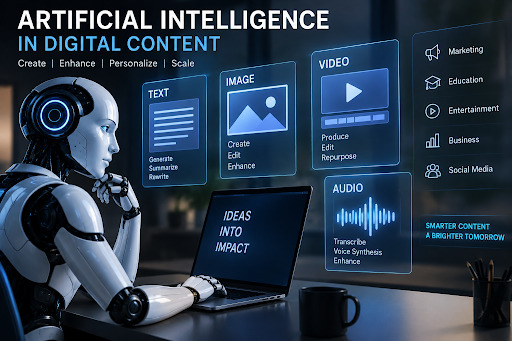
Artificial intelligence does not just choose content any longer. Generative AI can generate drafts, drawings, audio and video based on language instructions. ChatGPT among other language models assists writers to brainstorm headlines, summarize documents and write reports. Midjourney can generate visual concepts, whereas AI music generators can generate instrumental arrangements or full tracks.
These abilities define economics of production. A small marketing team is able to test some of the campaign ideas without seeking out all the initial drafts. Publishers are able to create ready to use summaries, subtitles and alternative format in a more efficient way. Producers get time to report, experiment and tell original stories.
But quicker manufacturing is questionable. Who is the owner of an image with AI? Was the content of training licensed? Is it important to inform audiences about the presence of synthetic audio or text? The answers vary in legal terms, and creators and publishers are much pressured to clarify their procedures.
Another line of division is accuracy. Language models have the ability to generate details, smooth out nuance or repeat biases. When content is involved in financial decision-making or for gathering knowledge, human editing, factual verification and transparent attribution are then needed.
A new playbook: How AI is revolutionizing sports media
Sport exemplifies such technologies as every game generates emotion and information. With computer vision, events can be recognized in footage to assist broadcasters in creating highlight reels and custom video packages based on particular players, teams or key moments.
Digital features showcased by IBM at the 2026 Masters included AI Highlights, personalized My Group coverage, and tools to assist fans in interpreting golf performance. These characteristics facilitate the following of tournaments.
In the meantime, AI in sports goes far beyond editing. Next Gen Stats is an undertaking by the NFL to create performance metrics based on tracking data and machine learning. It is powered by AWS, with a Combine IQ dashboard that converts testing data into insights that fans and analysts can use. In sport broadcasting, there are opportunities to deepen the discussion of speed, positioning, and tactical choices with the help of tracking technologies.
Sports journalism is changing, too. The AP has automated some of its baseball reports and football previews to show how data-driven baseball can be a readable story. Repetitive summaries are automated, allowing journalists to investigate decisions, interview participants and explain developments that numbers can’t tell.
The impact on sports betting and expert analysis
Sports analytics provides interpretation to the betting audience. Predictive models are able to analyze the outcomes, availability of players, workload, venue conditions and weather to predict potential events. They can compare probabilities in situations much faster than spreadsheets.
An estimate, however, of a model is not a promise. Damage can arise at a late stage, strategies can go awry and history can often prove to be a disaster. Even advanced predictions are uncertain. Betting odds also indicate bookmaker margins such that a probable outcome is not equal to an appealing price.
This is the difference that makes human expertise useful. Seasoned pundits are able to challenge assumptions, read between the lines of team news and identify missing contextual factors absent in datasets. An independent analysis mixed with statistical evidence provides a more disciplined method as opposed to acting on predictions blindly. It also takes limits and acceptance of the fact that there are still chances of loss in making responsible decisions.
The future of consumption: Voice, VR, and conversational AI
The following development will be that the content will not be viewed as something that users read, but rather, something that they talk about. Hands-free access to information is already available with voice assistants like Alexa and Siri, and conversational AI makes it possible to ask questions and get specific answers.
AR and VR have the potential to produce immersive experiences. Think about watching a game with some tactical overlay options, inquiring about the movement of a player or selecting camera angles with the help of natural dialogue. Education, shopping and virtual events could be changed with similar interfaces.
The issue at hand here is to make sure that convenience does not take the place of independent judgment. As content consumption patterns shift to predictive, interactive experiences, reliable sources, privacy protections and human creativity will become increasingly important. You can arrange the information with the help of AI; the ultimate choice concerning what should be paid attention to remains in the hands of people.