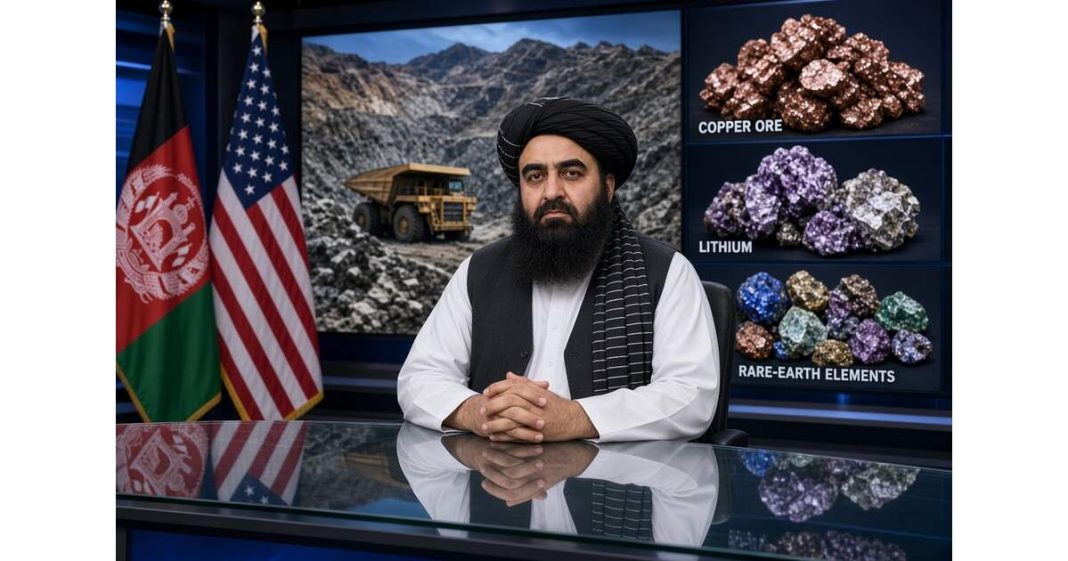
Taliban’s foreign minister Amir Khan Muttaqi has invited American companies to invest in Afghanistan’s mining infrastructure and agricultural sectors, the Financial Times reported Monday. During an interview, Muttaqi reportedly proposed that U.S.-Afghan relations should not be assessed through the lens of the past 20 years of war, but rather on the basis of future cooperation, stating that Afghanistan would absolutely welcome U.S. investment in the country.
U.S. Geological Survey data in 2009 estimated at least $1 trillion of untapped mineral resources in Afghanistan. Since the Taliban came to power in 2021, Afghanistan has sealed more than $7 billion of mining deals, much of it involving companies connected to China, Iran and other countries willing to engage with their government. Afghanistan has rich resources of copper, iron ore, lithium, rare earth elements, cobalt, chromite, gold, niobium and gemstones.
Meanwhile, lithium, copper, cobalt and rare earth materials are on the U.S. 2025 critical minerals list. These minerals are used in electric vehicle batteries, defense tech and could help reduce the dependence on China, which is currently dominates the market.
Read more: Saudi Arabia to Host Secretariat of Mecca Joint Defense Agreement
Some analysts and researchers are critical of these deals, arguing that the Taliban is poorly monetizing these minerals under bad terms to outsource the important part of the value chain, particularly refining, which is where the real profit margins and the ability to control supply pricing and market access lies. In the same interview, Muttaqi also said that the Afghan government has encouraged the U.S. to reopen its embassies in the country, which were abandoned in 2021, stating that the Taliban has ensured its security, rebuilt the roads and planted new trees, adding that the new area now looks magnificent.
Countries like China, Iran, India, Qatar and several other neighboring Central Asian countries moved to normalize relations with the Taliban regime. Russia, which also recognized the Taliban government, has also signed a military cooperation agreement in May. The European Union also hosted the Taliban officials in Brussels this year to discuss the possible return of migrants. While there has been a decline in the terrorism and militancy, the country is facing acute economic problems. It remains one of the poorest nations on Earth, as one-third of the population faces severe hunger and women’s rights are severely curbed.