
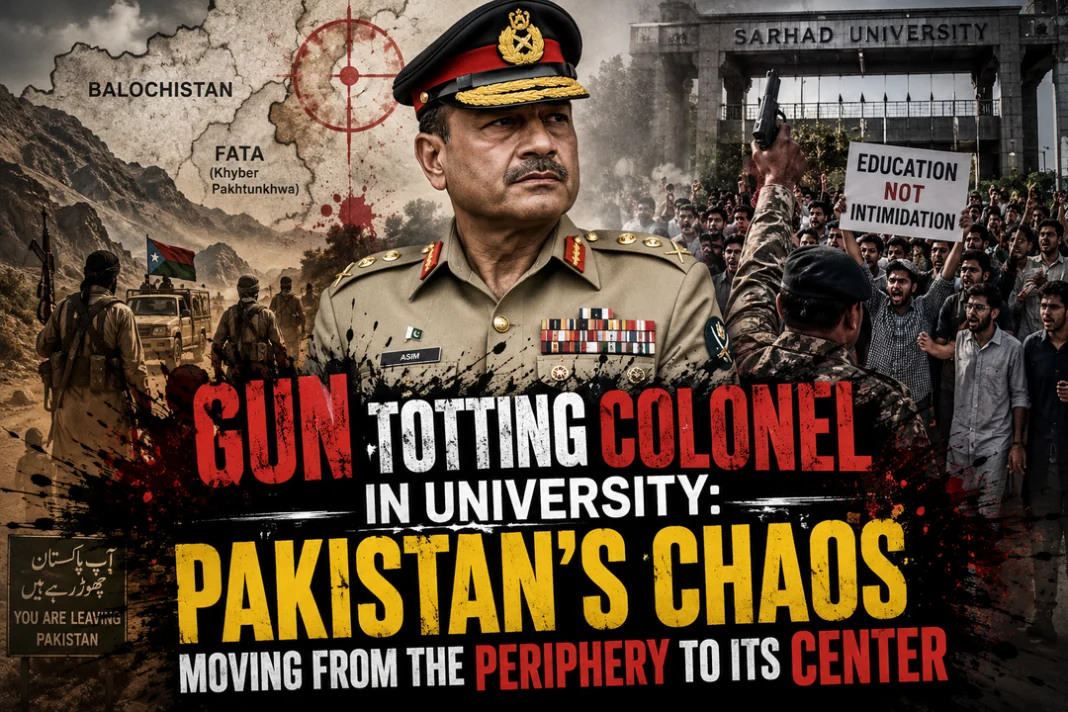
A video from Sarhad University’s Islamabad campus should be understood as more than another ugly confrontation between the civil and the military. This sensational drama, watched by millions across the world ogling through the Facebook and X(twitter) exposes a deeper malaise: a conflict that is steadily advancing from Pakistan’s periphery to its center. And periphery is no more regional or ethnic- as it was from 1960s till 2022 – but can be defined as a fast-growing class divide with military officers seen not as uniform wearing heroes of the “Old Nation state” but increasingly as agents of a powerful and insensitive commercial ruling elite that lives in the affluent sectors of Islamabad or beautiful secure Defense Housing Authorities that now dot the map of Pakistan. This raises altogether new and difficult questions about military’s ability to govern a diverse heterogenous population of more than 250 million with around 50% struggling around or below poverty benchmark.
Army Officers: Heroes of Nation State or Agents of Rich & Powerful Class?
On the face of it, students protesting on their own campus became embroiled in a clash with a uniformed Pakistan Army officer, reportedly a colonel whose wife is a faculty member and who rushed to save her from the clutches of a barbaric crowd. Video from the incident shows the officer drawing his sidearm, first pointing at the students and then firing into the air. And this unfolds in the presence of uniformed officers of Islamabad police.
An Armed Forces officer allegedly assaulted a young student with a stick at Sarhad University in #Islamabad, prompting other students to become enraged and attack the officer.
The uniformed officer reportedly pulled out a pistol and fired shots into the air. https://t.co/ywDxQekQch
— Islamabad Updates (@IslamabadViews) August 24, 2026
Media connected with the army immediately leaked rumors that officer has been detained and will be court martialed. Agitated minds get reassured that individual culpability should not be confused with institutional policy. But soon the public finds out from rumor mills that instead of the army officer being disciplined for barging into a civil educational institution students have been arrested and perhaps police officers are facing enquiries.
Rule No 1 is invoked again: Pakistan Army officers cannot be wrong. If you think they are wrong; please see Rule No: 1
▪️The story of Lt colonel’s who threatened the students protesters at Islamabad’s Sarhad University sparked debates & discussions on social media platforms & has deepened tensions, especially after videos circulated showing his wife inside the university engaging in behavior that provoked the protesting students.
▪️ Some conclude that the event reflects the growing political polarization in Pakistan and popular concerns about the increasing role of the military in civilian life.
— د.عبدالله العمادي (@Abdulla_Alamadi) August 26, 2026
Courtesy social media platforms that disseminate series of clips from the scene of confrontation, public soon realizes that Colonel’s wife was never in danger; she was protected by armed guards and Islamabad police, and she apparently called her husband to impress upon the police who were not taking her dictation to remove the barriers protesting students had erected that prevented her to enter the main building. Public has now much more information about the incident – courtesy social media platforms – that gives reason to believe that far from being the victim, the Colonel’s wife, though a junior functionary of the university, was the real power wielder in the eco-system of the university because of her husband: the army Colonel. And Colonel brother reportedly works in Pakistan’s fearsome army intelligence: ISI.
Support my research and journalistic work by becoming members of this Patreon Page in any capacity – your support makes all the difference! Moeed Pirzada : https://patreon.com/Moeed_Pirzada?utm_medium=unknown&utm_source=join_link&utm_campaign=creatorshare_creator&utm_content=copyLink
Pakistan has seen this movie before. Though hundreds of such incidents may have happened across the streets of Pakistan, and some like the ransacking of police station at Liberty Chowk in April 1993 and thrashing of police officers in Bahawalnagar in 2024 have etched in public memory. But these events are now seeing a qualitative change. In the initial years, defiance to central authority was coming from peripheral populations like the Bengalis in the former East Pakistan, from Baluch nationalists or from police organizations who fought for their institutional turf; now it has moved to the center with Army officers directly pitched against the ordinary Pashtun and Punjabi citizens not as defenders of a nation state but agents of a rich powerful class.
East Pakistan: Start of Periphery Challenging the Center ?
This takes us down a painful memory lane. Pakistan’s first great centre-periphery crisis was East Pakistan. The country created in 1947 contained an extraordinary contradiction: the demographic majority lived in the eastern wing, while the principal instruments of state power — the military, senior bureaucracy, economic establishment and ultimately the political command structure — became concentrated in West Pakistan. Language, representation, revenue, military recruitment and the distribution of development all became parts of a deeper argument over a simple question: could the periphery genuinely reshape the centre, or would the centre permanently rule the periphery?
The December 1970 election supplied the decisive answer. The Awami League won an absolute majority in the National Assembly. In a functioning democratic federation, East Pakistan had not rebelled against the centre; it had electorally captured it. The political order should therefore have changed to reflect the country’s demographic reality. Instead, the existing power structure resisted the transfer of authority. The postponement of the National Assembly, the collapse of negotiations and the military operation launched on March 25, 1971 transformed a constitutional struggle over federal power into a war of independence. India’s intervention was crucial to the timing and military outcome of December 1971, but the deeper catastrophe had already occurred: Pakistan’s ruling centre preferred to defend its existing monopoly of power rather than allow the periphery to redefine the state.
That history matters because, after losing its eastern majority, Pakistan has reproduced versions of the same political problem across much of its remaining geography. Balochistan; the former FATA and adjoining districts of Khyber Pakhtunkhwa; Gilgit-Baltistan; and, increasingly, Pakistan-administered Kashmir have all experienced insurgency, political alienation or mass mobilisation against decisions flowing from a distant centre. These conflicts are profoundly different and should never be collapsed into one movement. Baloch separatist violence is not Pashtun political mobilisation, electricity protests in Gilgit-Baltistan or agitation over representation and privileges in Kashmir. But they share a politically important feature: large populations at the edges of the state increasingly believe that decisions affecting their lives are made by institutions they cannot meaningfully influence.
Empire & State: From Ibn Khaldun to Michael Mann, from “Despotic Power” of Medieval Empires to “Infrastructural Power” of Modern State?
Many of the greatest minds studying states and empires have tried to understand versions of this phenomenon. Ibn Khaldun, the fourteenth-century North African historian and social theorist, argued that dynasties rise through asabiyyah — social cohesion — and decline as ruling groups become comfortable, centralized, coercive and detached from the social forces that created their power. Edward Gibbon, the eighteenth-century English politician, essayist and historian, famous for his landmark work, “The History of the Decline and Fall of the Roman Empire” showed how pressures on an empire’s frontiers become fatal when the political and institutional centre has already lost resilience. Sounds eerily familiar to contemporary Pakistan ?
Michael Hechter, a modern American political sociologist, developed the idea of “internal colonialism”: a dominant core can govern culturally or economically distinct peripheral regions in relationships resembling empire inside a formally unified state. Feelings across Baluchistan and now Pakistani administered Kashmir will support this thesis. Stein Rokkan, the Norwegian political sociologist and pioneer of centre-periphery analysis, treated the struggle between state-building capitals and territorial, linguistic and cultural peripheries as one of the fundamental conflicts of modern political development.
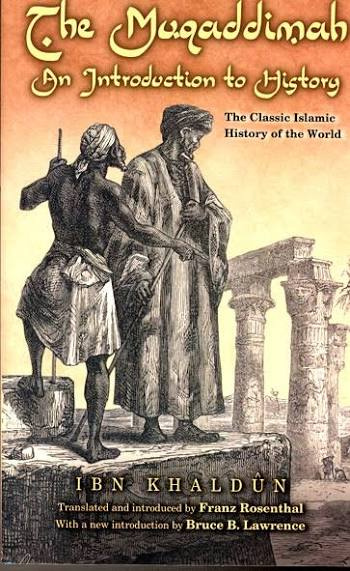
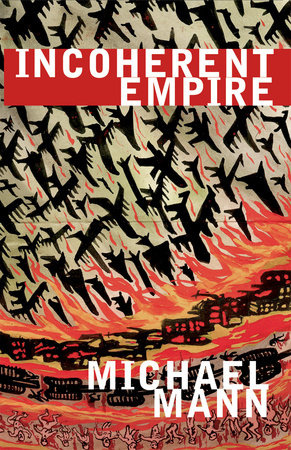
Michael Mann gives us an especially useful distinction. The British American historical sociologist separates “despotic power” — the capacity of rulers to make decisions without meaningful consultation with society — from “infrastructural power,” the state’s ability to penetrate society and implement decisions through functioning institutions. An authoritarian state can therefore look exceptionally powerful while becoming structurally weak. It can arrest opponents, censor media, control courts and deploy soldiers while simultaneously losing the voluntary cooperation, information and legitimacy through which durable states govern. While Mann’s ideas aptly describe a Pakistan shaped by repeated phases of military authoritarianism since 1950’s what follows is even more relevant to what’s happening now.
James C. Scott, the American political scientist and anthropologist, adds another dimension. Centralized states try to make complicated societies “legible” from above. The danger arises when rulers begin believing their administrative map more than the society beneath it. Officials tell superiors what they want to hear. Local knowledge disappears. Dissent becomes evidence of disloyalty instead of information about failing policy. Eventually coercion replaces feedback. The centre becomes stronger in its ability to issue commands and weaker in its capacity to understand the country it commands. Scott was not writing about Pakistan, but his description so neatly sums up Gen. Asim Munir’s Pakistan – the one that has been shaped by self-declared Field Marshal and his team since May 9, 2023.
Pakistan’s Chaos of “Frontier “Arrives in its “Center” ? Post Regime Change 2022?
This is where Pakistan’s current trajectory becomes disturbing. Balochistan faces both renewed militant violence and an extraordinary civil-rights mobilisation around disappearances and state coercion. The former tribal areas and Khyber Pakhtunkhwa have again become the principal battlefield against the TTP. Gilgit-Baltistan has witnessed repeated protests over electricity, taxation, wheat subsidies and political rights. Pakistan-administered Kashmir, long presented by Islamabad as politically secure, has experienced increasingly serious mobilisations over electricity prices, governance, representation and elite privileges. By 2026, clashes there had become deadly enough to produce communications blackouts, mass arrests and extraordinary disputes over the number of protesters killed. The point is not that these struggles are identical. It is that the centre must expend increasing political and coercive energy simply to preserve the existing order across the periphery.
The more consequential question is what happens when the political techniques developed for difficult peripheries migrate inward. Many have pointed out that some of the military officers that unleashed barbarism upon the political protesters and their families across Punjab, since May 2022, had first practiced their brutal methodologies in Baluchistan.
Lal Masjid in 2007 was an early warning. Whatever one thinks of the armed militants, illegal occupation and vigilante actions associated with the mosque, the spectacle was remarkable: barely two kilometres from parliament, the state ultimately deployed Army commandos to storm a religious complex after negotiations failed. Violence Pakistanis had become accustomed to seeing in frontier regions – and at times blamed on the authorities – had marched on to Islamabad. The episode also demonstrated the reverse movement: force used at the centre could reverberate outward, feeding a powerful militant narrative in the northwest and elsewhere. Lal Masjid tragedy was followed by hundreds of suicide attacks across Pakistan’s North; a cycle of violence that repeatedly hit cities of Pindi, Islamabad and Lahore.
November 26, 2024 was far more ominous because the confrontation involved a mass political movement. Thousands of PTI supporters entered Islamabad demanding the release of Imran Khan and protesting the post-election political order including the notorious 26th Amendment that had arguably turned judiciary into a mere tool in the hands of military. The capital was barricaded, mobile internet was disrupted, thousands were detained and security forces moved against protesters near D-Chowk — the symbolic heart of the federation. In their briefing to the foreign corps of diplomats, Ishaq Dar, regime’s foreign minister and deputy prime minister described the pro-democracy protesters as some sort of barbarians at the gate who if not stopped would barge into the secure diplomatic red zone.
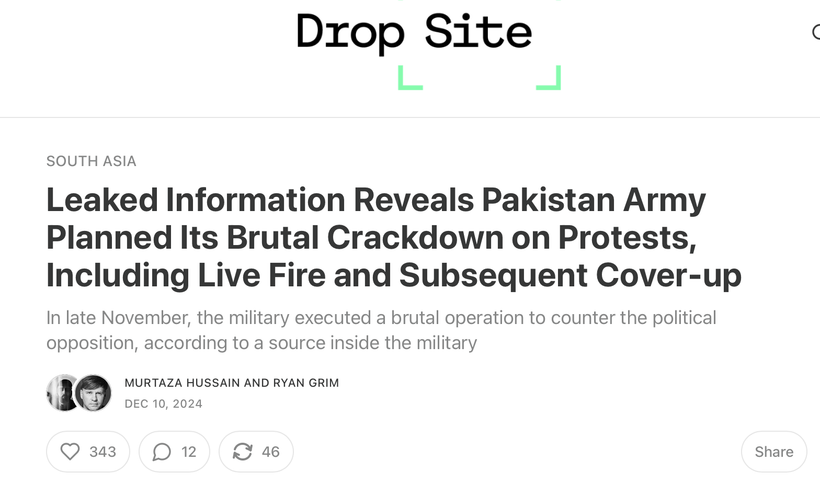
Al Jazeera reported live fire during the day and later described an operation beginning just before midnight under a blackout in central Islamabad. Its subsequent reporting identified individual protesters killed and families who described difficulty recovering bodies. BBC Urdu’s investigation of Islamabad hospitals found records of people brought in with gunshot wounds; doctors described an exceptional night of emergency surgery, while medical staff alleged police interference with release and post-mortem procedures. Drop Site News went further: it reported allegations from a source inside the military that the crackdown had been planned, in advance, around a communications blackout, encirclement, snipers and live ammunition. The government has strongly denied that security forces fired live rounds and has challenged the opposition’s casualty claims.
Saga of Missing Dead Bodies becomes the New Norm in Pakistan: Echoes of Banana Massacre of 1928?
The precise death toll remains disputed, and claims of hundreds killed have not been independently established. But reducing the entire episode to an argument over a number misses its larger significance. Amnesty International called for an investigation into a “brutal and lethal crackdown”; Pakistani and international reporting independently established multiple gunshot casualties and deaths. More troublingly, a second controversy emerged around the treatment and accounting of bodies.
Read more:Pakistan’s Real Problem: Pak Army or the Magical Powers of Army Chief?
BBC Urdu reported hospital records at odds with public denials of the use of firearms and medical staff alleging pressure over bodies and post-mortems. Al Jazeera reported families saying they faced obstacles retrieving relatives’ remains. PTI alleged that additional protesters were missing. Demands of judicial inquiry, even from emasculated courts never took place. The combination of midnight force, darkness, communications restrictions, disputed casualty records and allegations concerning disappeared bodies is precisely the kind of opacity one associates with coercive operations at a frontier — not with political management a few hundred meters from parliament. To many it reminds of the infamous 1928 Banana Massacre in Colombia.
The Banana Massacre, killing of hundreds of workers of the United Fruit Company (now called Chiquita) occurred in December 1928, in the town of Ciénaga near Santa Marta, Colombia. Gen Carlos Cortés Vargas, acting in communication with the US government, killed any where from 1000 t0 3000 workers – but bodies were never found. Tragedy was immortalized by Colombian novelist, Nobel Laureate, Gabriel Garcia Marquez in “One Hundred Years of Solitude”
What makes this still more disturbing is that similar allegations subsequently surfaced in different political contexts. In Muridke in October 2025, police launched a large predawn operation against supporters of Tehreek-e-Labbaik Pakistan after their march toward Islamabad. TLP is ideologically and politically very different from PTI and has itself repeatedly been accused of violence. Reuters reported at least five deaths in the clashes, while the government said three protesters were among those killed. Yet TLP claimed a much larger toll and alleged that officials removed bodies to conceal casualties — though this was an allegation for which it could not present any verifiable public evidence. Nevertheless, petitions later reached the Lahore High Court seeking the return of bodies of workers allegedly killed in the operation. Al Jazeera recorded both the allegation and the absence of evidence for the claimed scale of deaths. The parallel is therefore not proof of a policy of disappearing bodies but the allegation has since then surfaced repeatedly after large scale crack downs by the paramilitaries.
New Periphery vs Center: Killing Fields of Kashmir & More stories of “Missing Dead bodies”?
Then came the tragic saga of Pakistan-administered Kashmir in June and August 2026. As protests, marches and electoral confrontation intensified, the region experienced communications shutdowns, severe clashes between security forces and demonstrators and then para-military crackdowns around Rawalakot. Independent reporting confirmed dozens of deaths, JAAC (that led the protests) issued repeated lists of dead and missing that totaled more than 90. Though govt sources offered much lower figures. The Guardian, British paper, reported witnesses and civil-society groups alleging that security forces removed bodies and restricted access to hospitals in order to obscure the scale of casualties; Pakistani authorities disputed the protesters’ narrative and blamed armed or externally supported elements for the violence. Again, the allegation required independent investigation by the UN and International Human Rights Organizations, but none was welcomed. By this point a political pattern is visible even before all factual disputes are resolved: Islamabad 2024, Muridke 2025 and Kashmir 2026 each generated not merely arguments about excessive force, but profound public suspicion about casualty accounting itself; allegations of missing dead bodies.
The Sarhad University colonel therefore matters not because one officer represents an entire Army. He does not. He matters because the image provides a metaphor for a larger transformation. When authority is secure, a colonel does not need a pistol to establish his status before students. When a political order is secure, it should not routinely require containers, communications blackouts, ever new draconian laws, strange regulations, mass arrests and heavily armed forces to keep citizens away from a public square. The weapon is important precisely because it reveals something deeper than physical power: anxiety about obedience.
This is the paradox Pakistan’s ruling elite may now confront. Every additional demonstration of Mann’s despotic power can conceal another loss of infrastructural power. Every attempt to silence information from the periphery makes Scott’s centre less capable of understanding what is happening there. Every refusal to accommodate political demands strengthens Hechter’s perception of an internal colonial relationship. And every new deployment of force risks accelerating the Khaldunian process in which a ruling group preserves the instruments of power while losing the social cohesion that made those instruments effective.
Pakistan’s greatest danger, therefore, may not be that Balochistan, the former FATA, Gilgit-Baltistan or Kashmir individually becomes another East Pakistan. History does not repeat itself so neatly. The deeper danger is that the political logic once used to manage distant peripheries is steadily colonising the centre itself. East Pakistan demonstrated the ultimate cost of a centre that would not allow the periphery to change it. Half a century later, the unsettling question is whether chaos is now travelling in the opposite direction: from the margins toward Islamabad and the garrison town of Pindi – military command center of the British power from 1857 onwards. Empires begin to weaken at their edges. Their terminal crisis begins when the centre can no longer govern without behaving as though it too were a frontier. Islamabad is fast becoming that frontier like Rome had become in the 5th century.
Moeed Pirzada is Editor Global Village Space; he is also a prominent TV Anchor and a known columnist. He previously served with the Central Superior Services in Pakistan. Pirzada studied international relations at Columbia University, New York and Law at London School of Economics, UK as a Britannia Chevening Scholar. He has been a participant in Chaophraya Dialogue and Salzburg Forum and has lectured and given talks at universities and think tanks including Harvard, Georgetown, Urbana Champaign, National Defense University, FCCU, LUMS, USIP, Middle East Institute and many others. Twitter: MoeedNj. You can support his research and journalism by becoming a “Strategic Insider” on this Patreon Page.