
In a thought-provoking opinion essay, published by India’s left leaning paper, The Hindu, Varghese K. George argues that one of the most significant political divides in contemporary India is no longer simply ideological or regional, but generational. Though this analysis appeared on July 22, 2026 in the context of Cockroach Janata Party (CJP) and students of Delhi colleges challenging PM Narendra Modi’s government on streets demanding the resignation of education minister – but its meanings extend far beyond India into the US and rest of the world where a new generation is being shaped by ever new technologies.
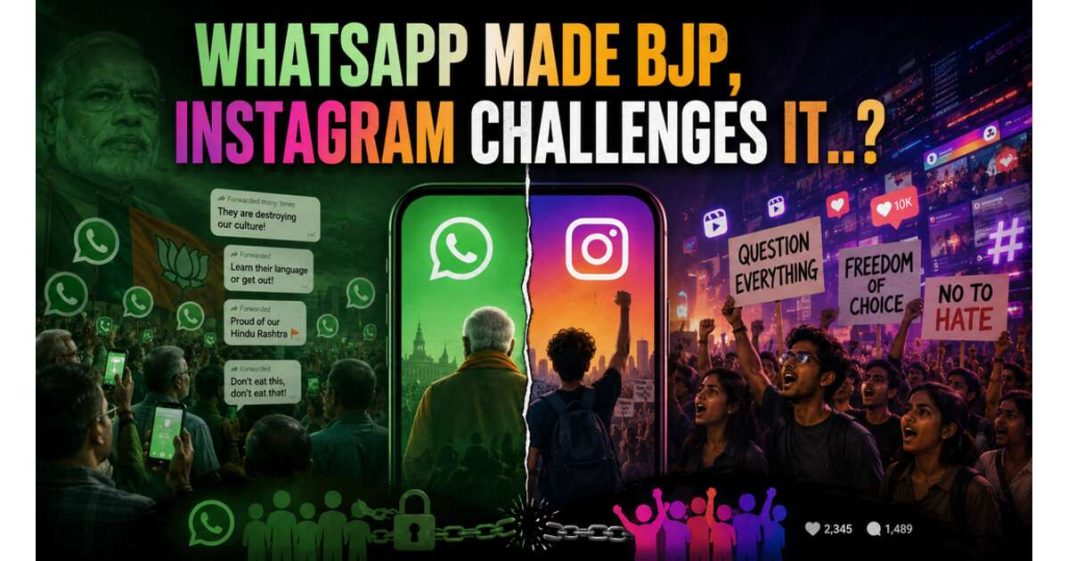
Using the metaphor of two social media platforms, Varghese contrasts the “WhatsApp generation” with the “Instagram generation.” According to the author, the WhatsApp generation—largely comprising older Indians who came of age during the economic liberalization era—proved particularly receptive to the BJP’s messaging and to the rapid circulation of political narratives through family WhatsApp groups. And kept on forwarding the WhatsApp messages blindly, obediently and religiously often without much understanding or reflection. Most Pakistanis can easily remember the pro-establishment WhatsApp messages that started to circular and shape politics from 2015 onwards. And were almost always blindly forwarded thousands of times.
But Varghese now argues, India’s younger generation increasingly inhabits the world of Instagram, Snapchat and other visual, creator-driven platforms, where political authority is questioned rather than accepted and where government narratives are more difficult to control.
The article develops this argument through a series of vivid examples. George points to reports of young protesters leaving family WhatsApp groups, describing them as spaces increasingly dominated by ideological conformity and social pressure. He also cites electoral observations from Tamil Nadu, where younger voters were reportedly more attracted to newer political alternatives like C. Joseph Vijay and his Tamilaga Vettri Kazhagam, as compared to their parents and ended up brining him to power. But he does not stop at India, he goes on to draw an international comparison with the United States, where younger Americans have become far more critical of traditional foreign policy positions, particularly regarding Israel and military intervention. For example, Nikki Haley was a staunch supporter of Israel but her son, Nalin Haley, born in 2001 and shaped by the TikTok messaging is a sworn enemy of Israel.
But this extends beyond politics. Many parents across the world – from Islamabad to Delhi to London to New York – are finding it difficult to communicate with their children who are continuously lost in their mobile devices. No wonder French Parliament last week passed law to restrict access to social media for under 15. Law will take effect from January 2027. France has become the second country after Australia to do that. But many doubt if such laws will work? https://www.bbc.com/news/articles/cq56l9p4y93o
Varghese concludes by suggesting that governments find it increasingly difficult to influence this new generation through conventional political messaging, leaving coercive state power as the principal instrument of control—a strategy the author believes has clear limits. Because? because brute use of force can work well in the geographical and social peripheries but not in the heart of political and social centre.
Read more:Pakistan’s Real Problem: Pak Army or the Magical Powers of Army Chief?
This is perhaps the most innovative and provocative part of this analysis meaning that the kind of force that can be used in Kashmir and Punjab or against Indian Muslims and other marginalized communities across India is not possible against the children of educated middle classes that define the power structure in Delhi. For example the young girl whose image of stopping a police bus by standing like the famous Chinese student who stood in front of the tanks in Tiananmen Square, China in 1989 is a daughter of an army officer. This may explain why Modi government and Delhi police are compelled to treat these young students with kids gloves.
Whether one agrees with every conclusion or not, the article deserves attention for its originality and intellectual ambition. Rather than focusing on electoral arithmetic or day-to-day political controversies, it invites readers to consider how digital platforms shape political identity itself. The distinction between “WhatsApp politics” and “Instagram politics” is a memorable analytical framework that captures a broader global phenomenon: younger generations increasingly receive information through decentralised creator networks rather than through family discussions, television or traditional political institutions. Similar generational shifts can be observed, to varying degrees, across the United States, Europe and many other democracies, making the article relevant well beyond the Indian context.
At the same time, the essay’s central metaphor should probably be treated as a heuristic rather than a definitive explanation of political change. Social media platforms do not determine ideology, nor are political loyalties neatly divided by age. Millions of young Indians continue to support the BJP, just as many older Indians remain critical of it. Likewise, Instagram and other short-video platforms are themselves powerful vehicles for misinformation, propaganda and ideological mobilisation. They are not inherently more democratic or more reliable than WhatsApp; they simply operate through different algorithms and different communities.
The article therefore succeeds best as a provocative conversation starter rather than as a settled empirical conclusion. Its greatest strength lies in highlighting an important and often overlooked question: how are digital ecosystems reshaping the relationship between generations, political authority and the formation of public opinion? Even readers who disagree with the author’s conclusions will likely find the essay valuable for opening a debate that is becoming increasingly relevant not only in India, but across democracies around the world. What I find most interesting is that it ends up explaining why Modi government is unable to come hard on these kids – unlike the children of lesser gods: Kashmiris, Sikhs, Indian Muslims and the scheduled castes.
Moeed Pirzada is Editor Global Village Space; he is also a prominent TV Anchor and a known columnist. He previously served with the Central Superior Services in Pakistan. Pirzada studied international relations at Columbia University, New York and Law at London School of Economics, UK as a Britannia Chevening Scholar. He has been a participant in Chaophraya Dialogue and Salzburg Forum and has lectured and given talks at universities and think tanks including Harvard, Georgetown, Urbana Champaign, National Defense University, FCCU, LUMS, USIP, Middle East Institute and many others. Twitter: MoeedNj. You can support his research and journalism by becoming a “Strategic Insider” on this Patreon Page.