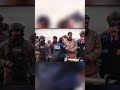
Pakistan launched air strikes on cities in neighbouring Afghanistan on Friday, in a major escalation after months of attacks and cross-border strikes along their porous frontier.
Pakistan information minister on Friday confirmed that three cities, all in Khyber Pakhtunkhwa, were targeted by Taliban drone attacks, claiming that no one was harmed.
Global powers have urged restraint as China, Russia, Iran and the United Nations pressed Pakistan and Afghanistan to immediately halt cross-border attacks and pursue diplomacy amid rising tensions.
Iran offered to help facilitate dialogue between Afghanistan and Pakistan after Islamabad declared the neighbours at "open war", carrying out air strikes on Kabul following border clashes.
Multiple explosions shook the Afghan capital, Kabul, and several other regions early Friday morning as Pakistan and Afghanistan exchanged military strikes across their volatile border, accusing each other of escalating the conflict.
In a historic and unprecedented moment, Prince Andrew became the first senior British royal in nearly 400 years to be arrested. The move signals a profound shift in accountability within the monarchy.
Each year, Ramadan in Pakistan arrives with promises of relief and billion-rupee subsidy packages. Yet for many citizens, the holy month brings soaring prices instead of ease. From weak market monitoring to ineffective implementation, the gap between announcements and ground realities exposes systemic flaws.
Pakistan has largely lost its traditional leverage over Afghanistan—refugees, militants, and border control—leaving it with limited and risky options like drone strikes or potential military action.
A critique of media influence and authoritarian tendencies that discourage critical thinking, suppress dissent, and keep citizens distracted rather than informed.
In Iran, subsidy reform is economically necessary but politically perilous because cheap essentials underpin daily survival amid inflation and low trust.
India is highly vulnerable to Gulf instability due to its heavy energy reliance on the Strait of Hormuz, exposing it to inflation, trade disruptions, and risks to its diaspora.
Abu Mohammad al-Julani’s shift from global jihadist to pragmatic power broker in Syria highlights how image management and governance shape political survival. The Taliban’s refusal to reform, by contrast, has deepened Afghanistan’s isolation and weakened its legitimacy.
The author argues that Pakistan’s military privilege is not merely institutional but civilizational—reshaping infrastructure, politics, faith, and daily life to normalize inequality, suppress dissent, and extract wealth at the expense of civilian society.